PNC-27 is a 32-residue synthetic peptide that fuses a fragment of the p53 tumor-suppressor protein (residues 12–26) to a cell-penetrating leader sequence. In published cell-culture studies it is reported to rupture cancer cells while leaving untransformed cells intact. That result has been reported across breast, pancreatic, lung, colon, ovarian and leukemia cell lines in the published literature, and it has a specific proposed mechanism behind it rather than a vague one.
It also has no human evidence whatsoever. Not weak human evidence, not mixed human evidence — none. That gap between a consistent laboratory record and an empty clinical one is the entire subject of this article, because it is the part most likely to be misrepresented to someone searching for this compound.
Research-context information only. PNC-27 is an unapproved research compound not evaluated by the FDA for any indication. Human evidence is absent. This article reports what has been documented, not what should be done, and nothing here describes a treatment for cancer or any other disease. Cancer care decisions belong with a treating oncologist; no compound on this page is a substitute for oncology treatment. Consult a licensed physician for personal medical decisions.
What PNC-27 actually is
The peptide has two halves doing two jobs.
The first is the HDM-2 binding domain of p53 — residues 12–26 of the tumor suppressor. HDM-2 (the human analogue of MDM2) is the protein that normally binds p53 and marks it for degradation. In many cancers HDM-2 is overexpressed, which is one way a tumor suppresses p53 signaling without mutating p53 itself.
The second is a penetratin-derived leader that carries the peptide across membranes. On its own the p53 fragment would not get where it needs to go.
The combination is what makes PNC-27 unusual: it was designed to engage HDM-2, but the mechanism its researchers describe is not the one you would expect from that design.
The mechanism the lab work supports
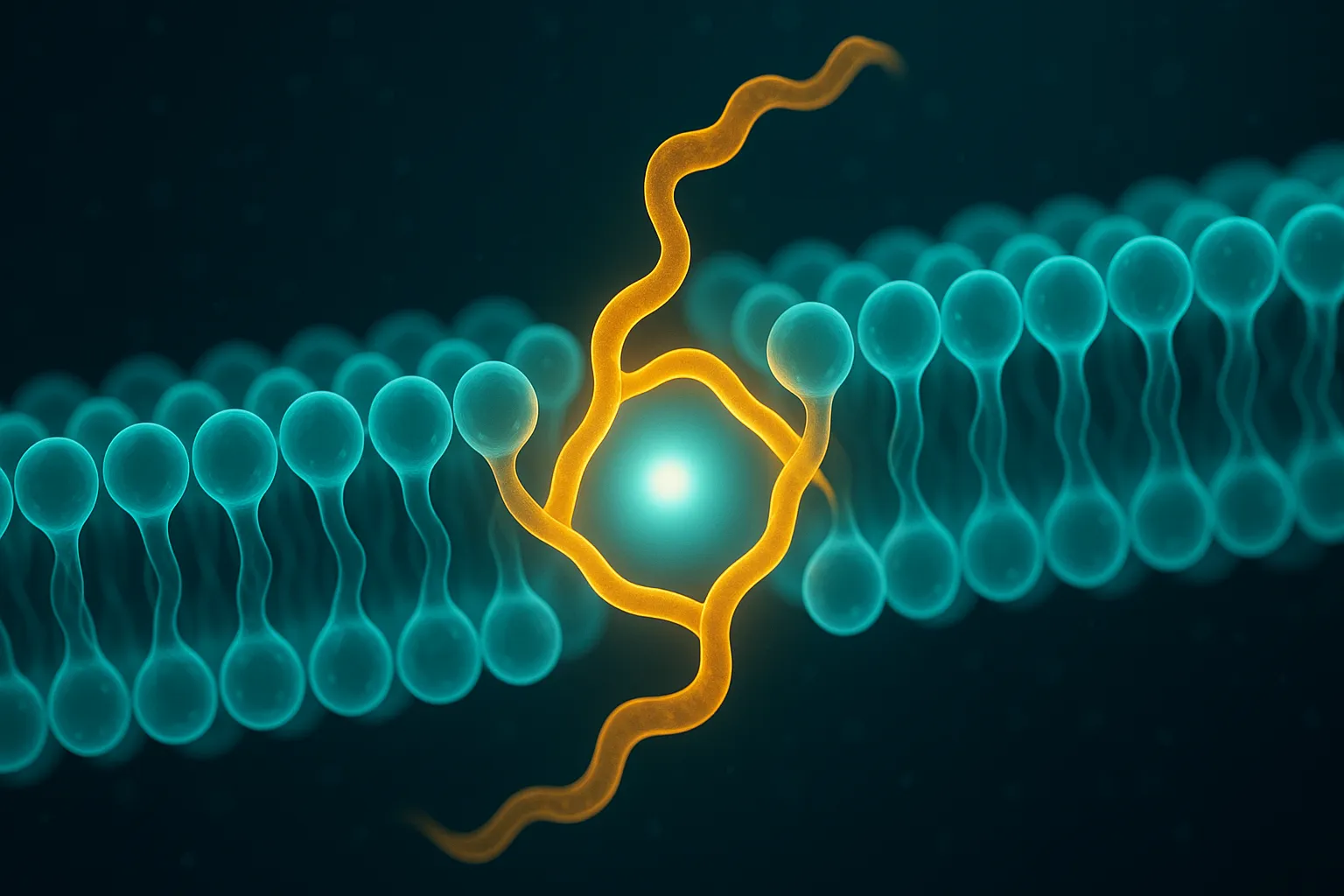
The proposed mechanism is not restoration of p53 signaling. It is physical.
The published account is that PNC-27 binds HDM-2 expressed in the plasma membrane of cancer cells, and that the resulting peptide–HDM-2 complexes line transmembrane pores, causing rapid necrosis rather than apoptosis (Sarafraz-Yazdi and colleagues, PMID 20080680). The selectivity claim follows directly: untransformed cells that do not display HDM-2 in their membranes are reported to be unaffected.
Subsequent work extended this. A 2020 paper reported necrosis in leukemia cells but not in normal hematopoietic cells, again tied to membrane HDM-2 expression (PMID 32878773). Another 2020 paper reported the same dependence in epithelial ovarian cancer lines (PMID 33067207). A 2024 paper reported that a monoclonal antibody against the p53 binding site of HDM-2 blocks the effect — a mechanistic control that strengthens the causal claim within the model system (PMID 38802154). Work on patient-derived ovarian tumor tissue has also been published in an ex vivo format (PMID 26663795).
Two observations about this body of work, neither of which is a criticism of the science itself.
It is coherent. The blocking-antibody experiment is the kind of control that distinguishes a mechanism from a correlation, and the membrane-HDM-2 dependence has been probed rather than assumed.
It is also narrow. The publications cluster around a small number of collaborating investigators over roughly two decades, and every result above is in vitro, ex vivo, or in animals. Independent replication at scale, and any test in a living human, are the steps that have not happened.
The clinical trial question

This is where a reader is most likely to be misled, so it deserves to be stated plainly.
A search of ClinicalTrials.gov on 2026-08-04 returned zero registered studies for PNC-27.
That matters because summaries circulating on peptide aggregator and wiki-style sites describe completed human trials in some detail — a "phase I/II trial in advanced solid tumors," a "phase I trial in metastatic breast cancer," patients who "experienced stable disease and a reduction in tumor size." Those accounts do not trace to a registry entry, and we could not locate a peer-reviewed publication reporting either trial. Written with that degree of specificity, they read as authoritative to anyone who is not checking the registry.
Any claim that PNC-27 has been through human trials should be able to produce an NCT number or a trial publication. As of this writing, neither exists.
What community sources report
The paragraph below reports self-reported community discussion, not clinical evidence. It is included because it is what a reader will encounter elsewhere, and it should be read as anecdote.
In peptide community forums and vendor-adjacent discussion, PNC-27 is described by some users as worth trying on the strength of the cell-culture literature, with reports typically covering injection-site reactions and general tolerability rather than outcomes. There is no mechanism by which these reports could establish tumor response: individuals are not imaging tumors on a schedule, are frequently receiving conventional oncology treatment at the same time, and have no control condition. Reports of "it works" in this setting are not measurements. Some community discussion also involves people considering this compound in place of, or in addition to, oncology care — a decision that belongs with a treating physician and carries consequences that no forum thread can characterize.
What is not known
The list is longer than the list of what is known:
- No human pharmacokinetics. No published data on absorption, distribution, half-life or clearance in people.
- No established human dose. Cell-culture concentrations do not convert to a human dose, and no dose-finding work exists to convert them.
- No human safety data. Selectivity in a dish is not a safety profile. The mechanism is membrane disruption, and any tissue displaying the target would be subject to it.
- No product-quality guarantee. Research-grade peptides are not manufactured to pharmaceutical standards; purity, identity and sterility vary by supplier and lot.
Where it is sold
Vendors selling PNC-27, including Ion Peptide, label it for in-vitro laboratory research only — not for human or animal use. Ion's listing (10mg vial) publishes a third-party COA and states the compound is "not for human or animal use & not FDA-approved." This listing is for the research compound described above, not a cancer treatment — see "What is not known" for the absence of human safety and efficacy data.