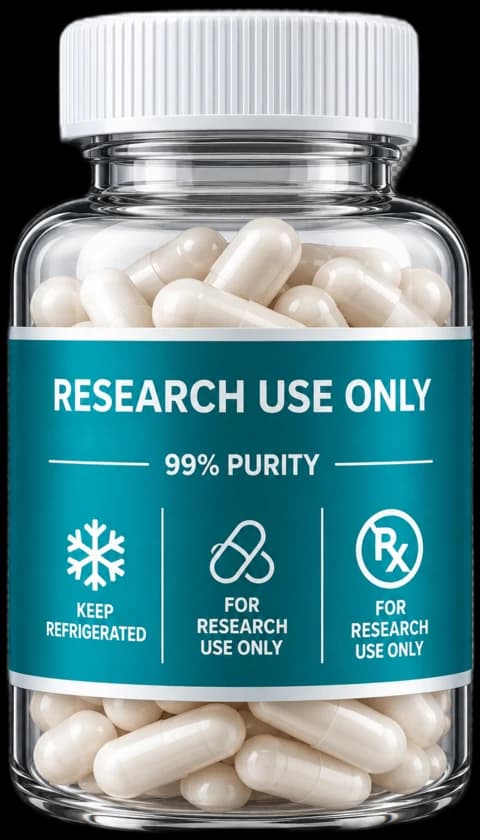
AHK-Cu is a copper peptide studied for hair growth and skin repair — what the research supports, what's borrowed from GHK-Cu, and the real evidence grade.
AHK-Cu is a copper-binding tripeptide — alanine-histidine-lysine complexed with copper(II) — and its headline claim is hair growth. That claim rests largely on a single, genuinely interesting laboratory study: Pyo et al. 2007 (PMID 17703734) reported that AHK-Cu stimulated the cells at the base of human hair follicles and prolonged follicle growth in culture. It's a real finding worth understanding precisely.
It's also where the honesty has to come in. AHK-Cu is the lesser-studied sibling of GHK-Cu, and most of what gets said about it — especially on the skin side — is borrowed from GHK-Cu's much larger literature by analogy, or comes from cosmetic-formulation studies run by the companies selling it. This article leads each benefit with the evidence behind it and flags where that evidence is AHK-Cu-specific versus extrapolated.
Research-context information only. AHK-Cu is a research peptide. Protocols, doses, and reactions reported below come from published research and self-reported community sources. This article reports what has been documented, not what should be done. Consult a licensed physician for personal medical decisions.
How AHK-Cu Works
AHK-Cu is built around copper. The tripeptide acts as a carrier for copper(II) ions, and copper-peptide complexes generally are understood to deliver copper to cells where it participates in enzymatic and signaling processes relevant to skin and connective tissue. This is the shared mechanistic theme across the copper-peptide family, with GHK-Cu the most-characterized example (Pickart & Margolina 2018, PMID 29986520).
For hair specifically, the Pyo 2007 study (PMID 17703734) described a more defined mechanism: in cultured human dermal papilla cells, AHK-Cu increased proliferation, raised vascular endothelial growth factor (VEGF), lowered transforming growth factor-beta1 (TGF-beta1), and shifted apoptosis markers toward cell survival. The researchers proposed that this combination — more papilla-cell survival, more VEGF (which supports the follicle's blood supply), less TGF-beta1 (associated with the regression phase) — promotes follicle growth. That mechanism is plausible and specific, but it was demonstrated on isolated follicles and cells, not on a scalp.
Hair Follicle Stimulation — The Strongest Evidence
The best-supported AHK-Cu benefit is the hair-follicle finding, and it's worth stating exactly what the study showed. In the Pyo 2007 work (PMID 17703734), AHK-Cu at picomolar-to-nanomolar concentrations stimulated elongation of human hair follicles maintained in culture and increased dermal papilla cell proliferation. The same study reported upregulated VEGF and suppressed TGF-beta1, and a shift in the Bcl-2/Bax ratio toward survival — the molecular signature the authors used to argue AHK-Cu prolongs the anagen (growth) phase.
What this evidence is: a mechanistically detailed in-vitro and ex-vivo demonstration that AHK-Cu acts on the cells that drive hair growth. What it is not: a clinical trial. No published randomized human study has shown that a topical AHK-Cu serum regrows hair on people. The cell-culture result is the reason AHK-Cu is on the hair-peptide map at all, and it's a legitimate signal — but the leap from "stimulates dermal papilla cells in a dish" to "regrows hair on a head" has not been made in the published literature. Community sources who use AHK-Cu topically are extrapolating from that gap.
100mg · sold research-use-only · we may earn a commission
VEGF and Follicle Blood Supply
A secondary thread within the same hair finding is worth separating out because it gets cited on its own. The Pyo 2007 study (PMID 17703734) reported that AHK-Cu raised VEGF production in the treated cells. VEGF promotes blood-vessel growth, and follicle vascularization is one of the factors associated with the growth phase of the hair cycle — better perfusion of the dermal papilla is part of how a follicle sustains active growth.
This is a single-study, in-vitro observation, not a demonstrated clinical effect on scalp circulation. It's reported here because it's part of the mechanistic case for AHK-Cu and hair, and because it's frequently quoted as a standalone benefit when it's really one component of the 2007 result. The honest read is that AHK-Cu increased a pro-angiogenic signal in cell culture; whether that translates to meaningful follicle perfusion in a topical preparation on people is undocumented.
Skin and Collagen — Mostly Borrowed From GHK-Cu
AHK-Cu is widely marketed for skin — collagen support, antioxidant effects, general "anti-aging" copper-peptide benefits. Here the evidence honesty has to be sharpest: most of these claims are extrapolated from GHK-Cu, not demonstrated for AHK-Cu. The GHK-Cu skin literature is genuinely substantial — three decades of work reviewed in Pickart & Margolina 2018 (PMID 29986520) describes collagen and glycosaminoglycan stimulation, antioxidant gene modulation, and wound-healing effects.
AHK-Cu's own skin data is much thinner and leans on cosmetic-formulation studies, often conducted or funded by ingredient developers. The two peptides share the copper-tripeptide structure, so a degree of read-across is biologically reasonable — but "GHK-Cu does X, therefore AHK-Cu does X" is an inference, not a finding. Where this article describes skin benefits, treat them as copper-peptide-class plausibility carried over from GHK-Cu rather than AHK-Cu-specific evidence. The distinction is the whole point: AHK-Cu's defensible, peptide-specific signal is the hair-follicle study; its skin profile is largely inherited.
Who AHK-Cu Has Been Studied In
This is the shortest section by necessity. AHK-Cu's primary human-relevant data — the Pyo 2007 study (PMID 17703734) — used human hair follicles and dermal papilla cells obtained for laboratory culture, not living research participants in a treatment trial. There is no published population of people who took topical AHK-Cu under controlled conditions and were measured for hair or skin outcomes.
That means the realistic audience profile is descriptive rather than evidence-derived. Common audience: people interested in copper-peptide approaches to hair who understand they're acting on cell-culture-level evidence and community formulation practice rather than clinical proof. The microneedling-delivery context that community sources borrow comes from studies of other compounds (Dhurat et al. 2013, PMID 23960389), not AHK-Cu. Anyone weighing AHK-Cu is weighing a peptide with a plausible mechanism and a thin human record — which is the accurate frame, neither dismissive nor hyped.
Bac Water Made for Peptides
Don't risk a $300 peptide on generic bac water.
Most cloudy reconstitutions trace back to one thing — and it isn't the peptide. Sterile, non-pyrogenic, 0.9% benzyl alcohol — formulated for peptide reconstitution, not repackaged from generic stock.
✓ 0.9% benzyl alcohol✓ Made for peptides✓ 30 mL multi-dose
In a 2007 in-vitro study (PMID 17703734), AHK-Cu stimulated the proliferation of human dermal papilla cells — the cells at the base of the follicle that regulate the hair cycle — increased VEGF production, decreased TGF-beta1, and promoted elongation of cultured hair follicles. Researchers proposed that AHK-Cu supports hair growth by promoting dermal papilla cell survival and prolonging the growth (anagen) phase. This was a laboratory study on isolated follicles and cells, not a clinical trial in people.
Is AHK-Cu's evidence as strong as GHK-Cu's?
No. GHK-Cu has three decades of laboratory, animal, and human-trial research across wound healing and skin (reviewed in PMID 29986520). AHK-Cu's own evidence is much thinner — primarily the single 2007 hair-follicle cell-culture study plus cosmetic-formulation work, much of it tied to product developers. Many AHK-Cu skin claims are extrapolated from the larger GHK-Cu literature by analogy rather than demonstrated for AHK-Cu directly. The two are related copper tripeptides, but their evidence bases are not equivalent.