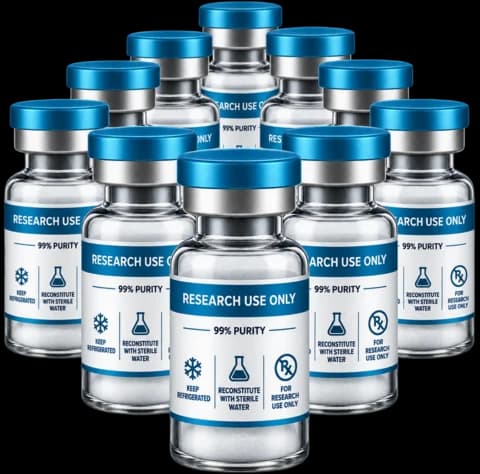
AICAR's often-cited endurance finding comes from mice, not a validated human fitness regimen. AICAR (AICA riboside, tested as the drug acadesine) has also been studied in heart surgery, leukemia, and short metabolic experiments in healthy volunteers and people with type 2 diabetes. Those settings answer different questions; they should not be collapsed into either "it works in humans" or "there is no human research."
This page separates the mouse findings, human metabolic measurements, clinical outcomes and reported adverse events. The studies described below do not establish the efficacy or safety of community fitness protocols or unregulated research-chemical products.
Research-context information only. AICAR is an investigational drug not approved by the FDA. Protocols, doses, and reactions reported below come from published clinical trials and self-reported community sources. This article reports what has been documented, not what should be done. Possession or use of investigational drugs outside an authorized clinical trial may be illegal in your jurisdiction. Consult a licensed physician for personal medical decisions.
AICAR at a Glance
Question
Short answer
Evidence behind it
What does it do?
Converted to ZMP inside cells, which can activate AMPK; not all effects depend on AMPK
Mechanism review (Višnjić et al., 2021, PMID 34064363)
Does it improve endurance?
Sedentary mice ran 44% farther after 4 weeks; this is not a human performance result
See the dosing guide for the distinction between research doses and community claims
Allowed in sport?
No, prohibited at all times
USADA / WADA Prohibited List
What AICAR Does: The Evidence by Study Type
Short answer: preclinical work identifies AMPK-related and AMPK-independent effects, while short human experiments have measured metabolic responses. Neither a mechanism nor an acute biomarker change establishes a durable fitness benefit (PMID 34064363, 17513706, 18709353).
Mouse and rat studies
Endurance. Sedentary mice given AICAR for four weeks increased muscle metabolic gene expression and ran 44% farther on a treadmill (Narkar et al., Cell 2008, PMID 18674809). This is the often-cited mouse endurance finding, not a human result.
Fat and sugar burning in muscle. In strips of resting rat muscle, AICAR raised fat oxidation by about a third and glucose oxidation by 105-170% within an hour (Smith et al., J Physiol 2005, PMID 15774530). This is isolated tissue, not body-fat change.
Mitochondria. AMPK directly phosphorylates PGC-1α, the main switch for building mitochondria in muscle (Jäger et al., PNAS 2007, PMID 17609368). A mechanism step, not a measured AICAR outcome in people.
Brain. In young mice, a week of AICAR raised new hippocampal cell numbers and BDNF much like running did, but by 14 days those effects reversed, with apoptotic genes and the inflammatory cytokine IL-1β up (Guerrieri & van Praag, Oncotarget 2015, PMID 26286955). The authors' point: a drug that mimics exercise in muscle does not necessarily mimic it in the brain.
Human experimental studies
Cuthbertson and colleagues studied 29 healthy men and reported increased skeletal-muscle 2-deoxyglucose uptake during acute AICAR administration, with only a minor effect on whole-body glucose disposal (Diabetes 2007, PMID 17513706). Muscle AMPK activity or phosphorylation did not increase detectably in the AICAR experiments. This was a metabolic experiment, not a trial of endurance gains, muscle growth or a community cycle.
In ten men with type 2 diabetes, intravenous AICAR lowered the liver's glucose output and blood glucose, and reduced circulating fatty acids (Boon et al., Diabetologia 2008, PMID 18709353). These short experiments demonstrate measured human responses, not a lasting clinical benefit or a validated fitness regimen.
What the evidence does not show
The studies reviewed here do not establish improvements in human endurance, fat loss, muscle growth or body composition from a community AICAR protocol. A 2021 systematic review also cautions that many effects attributed to AMPK in AICAR studies are in fact AMPK-independent (Višnjić et al., Cells 2021, PMID 34064363). These are limits of the cited evidence, not a claim that no other human research exists.
The large confirmatory trial did not demonstrate benefit on its primary outcome. These cardiac-surgery outcomes do not answer questions about endurance or body composition; neither their positive nor negative findings should be presented as proof about every proposed AICAR use.
What Side Effects Have Been Reported?
Short answer: in the cited heart-surgery trials, adverse events were similar to placebo apart from a temporary uric-acid rise. The leukemia trial also reported kidney, blood-count and blood-pressure effects. These reports do not exhaust the human literature or establish safety outside their study settings.
Heart-surgery trials (randomized, placebo-controlled). The first multicenter trial found mild uric-acid increases, a mean 1.6 mg/dL, only at the high dose and without clinical consequences (Leung et al., 1994, PMID 7818622). The McSPI trial and the five-trial meta-analysis both reported adverse events similar to placebo apart from a transient serum uric-acid rise (PMID 7574044, 9002496). AICAR is broken down to uric acid, so this is a predictable effect of the molecule.
Leukemia trial (open-label phase I/II, 24 patients). Van Den Neste and colleagues gave acadesine intravenously to patients with relapsed chronic lymphocytic leukemia at doses far above the cardiac regimen (Cancer Chemother Pharmacol 2013, PMID 23228986). They reported:
High uric acid (grade 2 or higher) as common, not clinically significant, and resolved with preventive allopurinol
Transient anemia and/or low platelets, described as not clinically significant
Kidney impairment
Transient infusion-related low blood pressure, described as clinically significant
Research-chemical products. Findings from clinical acadesine studies do not verify the identity, purity or sterility of products sold as research chemicals. Product quality and administration conditions introduce uncertainties beyond the trial findings; they cannot be assessed from the compound name alone.
What USADA says. The anti-doping agency's athlete guidance states that too much AMPK activation, or activation in the wrong tissue, can cause serious effects including neurodegeneration or blocking cell division, and that AICAR "has not been extensively studied in people."
How AICAR Relates to MOTS-c
MOTS-c is a mitochondria-encoded peptide reported to act through the folate cycle and purine synthesis, the pathway in which cells make their own AICAR, leading to AMPK activation (Lee et al., Cell Metab 2015, PMID 25738459). AICAR can activate AMPK through ZMP, but its effects are not exclusively AMPK-mediated (PMID 34064363). A shared pathway does not establish equivalent effects or validate human performance protocols for either compound. The AICAR vs MOTS-c comparison covers the differences.
Evidence Gaps Relevant to Community Use
Fitness outcomes. The studies reviewed here do not establish a human regimen that improves endurance, fat loss, muscle growth or body composition.
Long-term use in healthy people. Acute healthy-volunteer studies exist, including PMID 17513706. Their short follow-up does not establish long-term safety or validate repeated fitness-use cycles.
Different routes and products. The cited human infusion protocols do not validate community subcutaneous administration or the contents of research-chemical vials.
Gout and kidney disease. The reported uric-acid and renal effects do not define a safe regimen for people with these conditions (PMID 7818622, 23228986).
A validated fitness-use dose. Human dose-finding in a disease-specific trial, or a mouse dose expressed by body weight, is not validation of a community fitness protocol.
Cancer outcomes in healthy users. The small leukemia study does not establish cancer prevention or the effect of community use on an undiagnosed tumor (PMID 23228986).
Sport Status
USADA states that AICAR is prohibited because it is an AMPK activator, and that AMPK activators are prohibited at all times under the Hormone and Metabolic Modulators category of the WADA Prohibited List. For a tested athlete this applies out of competition as well as on competition day.
Bac Water Made for Peptides
Don't risk a $300 peptide on generic bac water.
Most cloudy reconstitutions trace back to one thing — and it isn't the peptide. Sterile, non-pyrogenic, 0.9% benzyl alcohol — formulated for peptide reconstitution, not repackaged from generic stock.
✓ 0.9% benzyl alcohol✓ Made for peptides✓ 30 mL multi-dose
Sources are the PubMed-indexed papers listed below plus USADA's athlete guidance. The October 6 citation check was followed by a claim-level review on October 7, 2026, including the healthy-volunteer and diabetes studies. This is a focused evidence review, not an exhaustive systematic search: absence from the cited studies is not proof that no study exists. Untraceable community accounts are not used to establish outcomes or timelines here. Kidney impairment and infusion-related hypotension are attributed to the leukemia trial rather than the cardiac trials. The page leaves doses to the dosing guide. Last reviewed: October 7, 2026.
Frequently Asked Questions
What did research report about AICAR and endurance?
In a 2008 Cell study by Narkar and colleagues, sedentary mice given AICAR for four weeks ran 44% farther than untreated mice (PMID 18674809). Human metabolic experiments also exist, including a study in 29 healthy men (PMID 17513706), but these studies do not establish an endurance, fat-loss or body-composition regimen.
What side effects did human trials of AICAR report?
In heart-surgery trials of intravenous acadesine (the same molecule), adverse events were similar to placebo apart from a transient rise in uric acid, about 1.6 mg/dL at the high dose (Leung 1994, PMID 7818622; Mangano 1997, PMID 9002496). A leukemia trial using much larger intravenous doses (Van Den Neste 2013, PMID 23228986) reported common high uric acid managed with allopurinol, transient anemia or low platelets, kidney impairment and infusion-related low blood pressure. These are findings in specific trial settings, not a complete safety profile for other uses or products.
Did AICAR work in human trials?
Findings depend on the outcome studied: short experiments reported metabolic responses in healthy volunteers and people with type 2 diabetes (PMID 17513706, 18709353), while the definitive RED-CABG trial found no benefit on its primary cardiac-surgery outcome (PMID 22782417). Those different results do not establish a human fitness regimen or long-term safety.
Is AICAR banned in sport?
Yes. USADA states that AICAR is prohibited at all times, in and out of competition, as an AMPK activator under the Hormone and Metabolic Modulators class of the WADA Prohibited List.
How does AICAR relate to MOTS-c?
Both are associated with AMPK pathways, but that does not make them equivalent. AICAR is converted inside cells to ZMP, an AMP mimic; MOTS-c was reported to act through the folate cycle and purine synthesis, leading to AMPK activation (Lee et al., 2015, PMID 25738459), while many AICAR effects can be AMPK-independent (PMID 34064363).
Related Reading
AICAR dosing guide — research doses versus unvalidated fitness-use protocols
Narkar VA, Downes M, Yu RT, et al. AMPK and PPARdelta agonists are exercise mimetics. Cell. 2008;134(3):405-415. PMID: 18674809
Smith AC, Bruce CR, Dyck DJ. AMP kinase activation with AICAR simultaneously increases fatty acid and glucose oxidation in resting rat soleus muscle. J Physiol. 2005;565(Pt 2):537-546. PMID: 15774530
Jäger S, Handschin C, St-Pierre J, Spiegelman BM. AMP-activated protein kinase (AMPK) action in skeletal muscle via direct phosphorylation of PGC-1alpha. Proc Natl Acad Sci U S A. 2007;104(29):12017-12022. PMID: 17609368
Guerrieri D, van Praag H. Exercise-mimetic AICAR transiently benefits brain function. Oncotarget. 2015;6(21):18293-18313. PMID: 26286955
Boon H, Bosselaar M, Praet SF, et al. Intravenous AICAR administration reduces hepatic glucose output and inhibits whole body lipolysis in type 2 diabetic patients. Diabetologia. 2008;51(10):1893-1900. PMID: 18709353
Višnjić D, Lalić H, Dembitz V, et al. AICAr, a widely used AMPK activator with important AMPK-independent effects: a systematic review. Cells. 2021;10(5):1095. PMID: 34064363
Leung JM, Stanley T 3rd, Mathew J, et al. An initial multicenter, randomized controlled trial on the safety and efficacy of acadesine in patients undergoing coronary artery bypass graft surgery. Anesth Analg. 1994;78(3):420-434. PMID: 7818622
Multicenter Study of Perioperative Ischemia (McSPI) Research Group. Effects of acadesine on the incidence of myocardial infarction and adverse cardiac outcomes after coronary artery bypass graft surgery. Anesthesiology. 1995;83(4):658-673. PMID: 7574044
Mangano DT. Effects of acadesine on myocardial infarction, stroke, and death following surgery: a meta-analysis of the 5 international randomized trials. JAMA. 1997;277(4):325-332. PMID: 9002496
Newman MF, Ferguson TB, White JA, et al. Effect of adenosine-regulating agent acadesine on morbidity and mortality associated with coronary artery bypass grafting: the RED-CABG randomized controlled trial. JAMA. 2012;308(2):157-164. PMID: 22782417
Van Den Neste E, Cazin B, Janssens A, et al. Acadesine for patients with relapsed/refractory chronic lymphocytic leukemia (CLL): a multicenter phase I/II study. Cancer Chemother Pharmacol. 2013;71(3):581-591. PMID: 23228986
Lee C, Zeng J, Drew BG, et al. The mitochondrial-derived peptide MOTS-c promotes metabolic homeostasis and reduces obesity and insulin resistance. Cell Metab. 2015;21(3):443-454. PMID: 25738459
U.S. Anti-Doping Agency. What athletes should know about AICAR and other prohibited AMP-activated protein kinase activators. usada.org