Longevity & Anti-Aging
Slow biological aging and extend your healthspan. Research peptides target telomere lengthening, mitochondrial repair, zombie cell clearance, and NAD+ restoration to keep your cells functioning like they did decades ago.
How It WorksLongevity
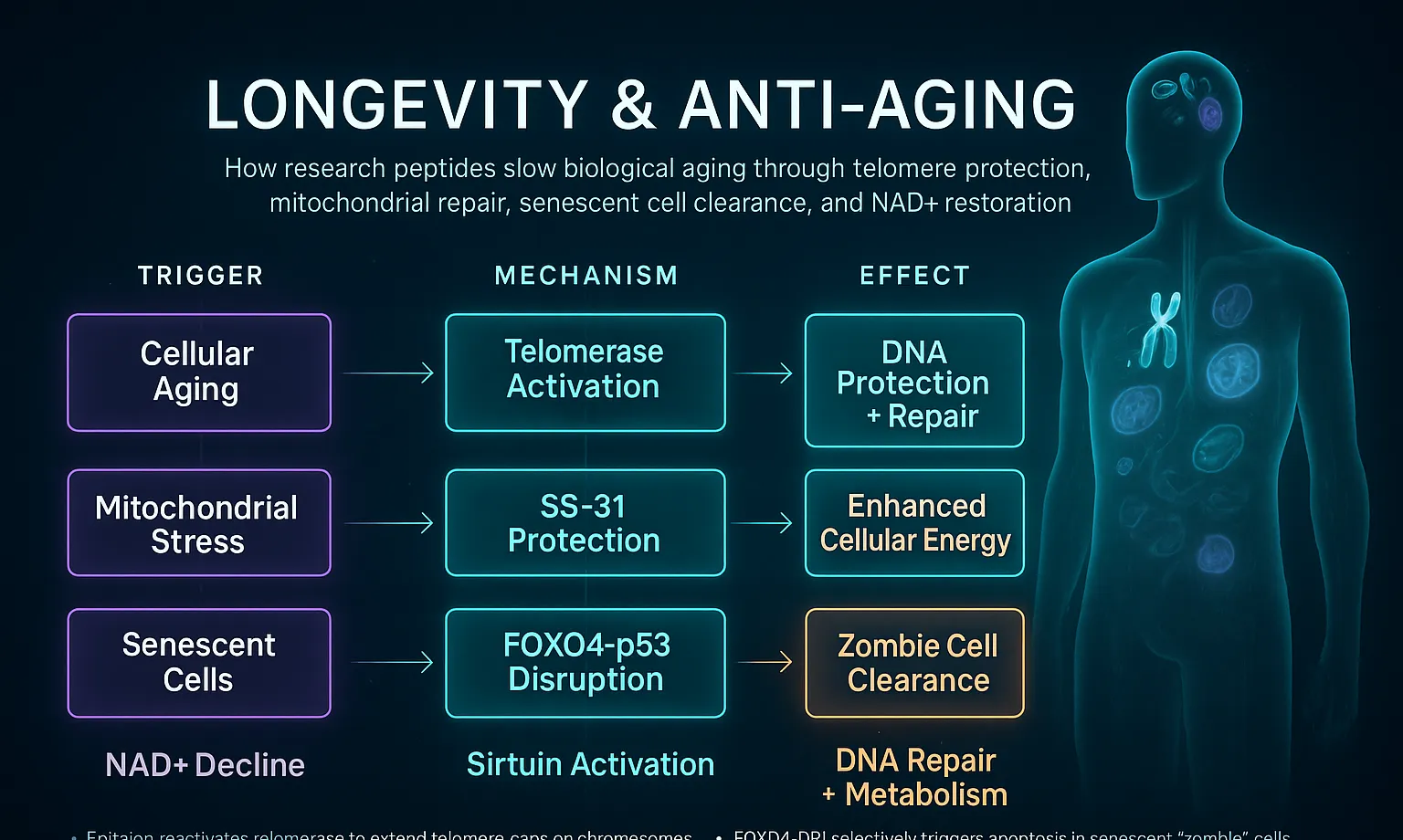
How Peptides Are Studied for Longevity
Longevity peptides target different hallmarks of aging. Epitalon activates telomerase, the enzyme that rebuilds telomere caps on chromosomes — research in animal models shows lifespan extension. MOTS-C is a mitochondrial-derived peptide that improves cellular energy metabolism and mimics some benefits of exercise.
SS-31 (Elamipretide) targets the inner mitochondrial membrane directly, improving electron transport efficiency and reducing oxidative damage. It's in clinical trials for heart failure and mitochondrial diseases. FOXO4-DRI is a senolytic peptide that selectively triggers death in senescent cells while sparing healthy ones.
NAD+ supplementation (via IV or injection) addresses the age-related decline in this critical coenzyme, supporting sirtuin activity, DNA repair, and cellular energy production.
Peptides Studied for Longevity
Epitalon
A telomere-targeting peptide for longevity and cellular rejuvenation.
MOTS-C
A mitochondrial peptide that mimics exercise — boosts metabolism and endurance.
AICAR
An AMPK-activating research compound (acadesine) studied as an exercise mimetic for endurance and fat metabolism; reached cardiac-surgery trials, never approved, and WADA-banned in sport.
SS-31 (Elamipretide)
A mitochondrial peptide for cellular energy, anti-aging, and organ protection.
Humanin
A neuroprotective peptide for brain health and cognitive longevity.
NAD+
A cellular energy molecule for DNA repair, metabolism, and anti-aging.
FOXO4-DRI
A senolytic peptide that selectively eliminates damaged zombie cells for anti-aging.
SLU-PP-332
A small-molecule ERR receptor agonist that acts like exercise inside your cells — driving mitochondrial biogenesis, fat oxidation, and endurance gains without any actual training.
Glutathione
The body's master antioxidant for cellular defense, immune support, detoxification, and skin health.
Bronchogen
A Khavinson bronchial tetrapeptide (Ala-Glu-Asp-Leu / AEDL) studied in rat lung models for respiratory-tissue repair; preclinical, no human data.
Testagen
A Khavinson testis tetrapeptide (Lys-Glu-Asp-Gly / KEDG) marketed for reproductive-tissue support; contains no steroid and is unrelated to testosterone, with a verified sequence but no reproductive-outcome studies.
Prostamax
A Khavinson prostate tetrapeptide (Lys-Glu-Asp-Pro / KEDP); the synthetic peptide has minimal direct evidence, with prostate clinical data belonging to the Prostatilen extract.
Cardiogen
A Khavinson cardiac tetrapeptide (Ala-Glu-Asp-Arg / AEDR) studied in review and cell-transport work for a role in cardiovascular inflammaging; preclinical and mechanistic only, no human trials.
Related Articles & Guides
articles
Hims Peptide Launch: What Ships, What Waits on FDA
Hims & Hers will sell sermorelin, glutathione and NAD+ by year-end. BPC-157 and five more wait on FDA rulemaking — the timeline, and where they sell now.
Buy Peptides With Crypto: Vendors & Discounts
Card networks keep dropping peptide sellers, so crypto is now the default. Which vendors take Bitcoin, who adds a crypto discount, and how it works.
Peptides for Long COVID: What the Trials Show
BPC-157, MOTS-c and microdosed GLP-1s are marketed for Long COVID while semaglutide and tirzepatide trials run. What's studied, what isn't.
Peptide Bioregulators: The Khavinson Family
A clear-eyed map of the Khavinson bioregulators — what each synthetic peptide has real evidence for, and what actually belongs to the tissue extracts.
reconstitution
Glutathione Reconstitution: 1500mg + 3mL Chart
300mg = 100 units. Glutathione uses far larger volumes than most peptides — dilution charts for 600mg and 1,500mg vials, syringe math, and storage.
Testagen Reconstitution: 20mg Vial Mixing Chart
Testagen has no validated human concentration. See how community resources describe mixing the 20mg vial, plus syringe-unit math and storage limits.
Prostamax Reconstitution: 20mg Vial Mixing Chart
Prostamax has no validated human concentration. See how community resources describe mixing the 20mg vial, plus syringe-unit math and storage limits.
Bronchogen Reconstitution: 20mg Vial Mixing Chart
Bronchogen has no validated human concentration. See how community resources describe mixing the 20mg vial, plus syringe-unit math and storage rules.
clinical
The $2.2B Race to Sell You Prescription BPC-157
Leerink pegs compounded peptides at a $2.2B telehealth market and Hims jumped 10% on the FDA vote. What the prescription route means for price and timing.
Are Peptides Legal in the US? What the FDA Vote Means
Most peptides aren't FDA-approved drugs — which isn't the same as illegal. The plain-English answer, and what the FDA's July vote did and didn't change.
FDA Panel Backs 6 Peptides for Compounding, Rejects DSIP
FDA advisers backed 6 of 7 peptides for compounding — Semax and Epitalon included — and rejected DSIP, all over staff objections. Every vote tally.
FDA Peptide Panel: Members Sell BPC-157, TB-500
AP flagged FDA's peptide panel for members who sell BPC-157 and TB-500. Here's how the July 23-24 vote actually broke down — 6 of 7 recommended.
results
Cardiogen Results: What to Realistically Expect
There is no human timeline data for Cardiogen. What community sources report, why it's mostly theoretical, and how to read it honestly.
Testagen Results: Week-by-Week Timeline
Testagen has no human trials at all — so what shapes its reported timeline? Labeled community reports and the Russian short-course convention.
Prostamax Results: Week-by-Week Timeline
Prostamax has no human efficacy trial — so what drives the reported timeline? Preclinical chromatin data and labeled community reports, week by week.
Bronchogen Results: Week-by-Week Timeline
Bronchogen has no human efficacy trials — so what drives the reported timelines? Rat COPD-model data and labeled community reports, week by week.
guides
Cardiogen Reconstitution: 20mg Mixing Chart
A 20mg Cardiogen vial plus 2mL bacteriostatic water gives 10mg/mL. Because community doses are tiny, dilution choice matters. Charts, storage, and steps.
Buy Cardiogen: Price, COA & Cost Per Week
Only 1 vetted Cardiogen source right now: $63.95 a vial, $3.20/mg. Codes save up to 10%. COA status and real cost per week.
Buy Testagen: Compare 2 Vendors, From $59.95
Compare 2 Testagen vendors side by side: from $59.95 a vial, best value $3.00/mg. Codes save up to 10%. Vial sizes, COA status, real cost per week.
SLU-PP-332 Reconstitution: Vial Mixing & Oral Cap Notes
The 30 mg lyophilized vial reconstitutes to 10 mg/mL. Oral caps need no mixing — but the bioavailability question changes the math.
dosing
Cardiogen Dosage: Community Protocols Explained
There is no trial-established Cardiogen dose. Community sources cluster around low-dose subcutaneous courses. The reconstitution math, explained.
Testagen Dosage Chart: 10-20 Day Course Protocol
A synthetic testis tetrapeptide with no validated human dose — and no steroid. What research-chem sources report, plus the extract-vs-synthetic caveat.
Prostamax Dosage Chart: 10-20 Day Course Protocol
A synthetic prostate tetrapeptide with no validated human dose. What research-chem sources report for short courses, plus the extract-vs-synthetic caveat.
Bronchogen Dosage Chart: 10-20 Day Course Protocol
A synthetic bronchial tetrapeptide with no validated dose. What research-chem sources report for short courses, plus the extract-vs-synthetic caveat.
benefits
Cardiogen Benefits: What the Research Shows
Cardiogen is marketed for the heart, but its evidence is a handful of Russian cell studies. What the AEDR peptide research supports — and what it doesn't.
Testagen for Reproductive Support: The Evidence
Testagen is marketed for testis and reproductive support, but its one verified study isn't about reproduction at all. What the KEDG peptide research shows.
Prostamax for Prostate Health: The Extract Caveat
The prostate-health reputation behind Prostamax belongs to a tissue extract, not the synthetic KEDP peptide. What the research actually reported.
Bronchogen for Bronchial Repair: Rat COPD Data
Bronchogen's lung-repair reputation traces to rat COPD models and bronchial cell cultures — not human trials. What the research actually reported.
side-effects
Testagen Side Effects: What the Evidence Shows
Despite the name, Testagen isn't testosterone — and its near-zero side-effect claim rests on almost no independent data. Here's the real picture.
Prostamax Side Effects: What the Evidence Shows
Its originators claim near-zero side effects, but independent safety data barely exists. What the research shows — and the risks it leaves out.
Bronchogen Side Effects: What the Evidence Shows
Its makers claim near-zero side effects, but independent respiratory safety data barely exists. What the rat studies show — and the risks left out.
AICAR Side Effects: What Human Trials Reported
The only human safety data comes from failed cardiac trials: uric-acid spikes, transient kidney effects, infusion-related low blood pressure.
buying-guide
Buy Prostamax: Price, COA & Cost Per Week
Only 1 vetted Prostamax source right now: $59.95 a vial, $3.00/mg. Codes save up to 10%. COA status and real cost per week.
Buy Bronchogen: Compare 2 Vendors, From $58
The 20mg Bronchogen vial has the lowest cost per mg — about 1.8x under the 10mg. 2 vendors scored on cost, COA, and cost per week.
Buy AICAR: Price, COA & Cost Per Week
Only one vetted AICAR source right now — its vial cost per mg, COA status, and real cost per week, checked.
Buy Glutathione: Compare 4 Vendors, From $15
Compare 4 Glutathione vendors side by side: from $15 a vial, best value $0.01/mg. Codes save up to 30%. Vial sizes, COA status, real cost per week.
comparison
AICAR vs MOTS-C: Two Paths to AMPK
AICAR and MOTS-C flip the same AMPK switch by two different routes. Both show promise in mice, neither is proven in humans. The mechanism split.
MOTS-C vs Metformin for Longevity: Key Differences
One is a 70-year-old diabetes drug, the other a mitochondrial peptide found in 2015. How MOTS-c and metformin compare on evidence, safety, and cost.
SLU-PP-332 vs MOTS-c: Two Exercise Mimetics
Synthetic ERR pan-agonist vs mitochondria-encoded AMPK activator. Same goal, opposite philosophies, and the stack rationale that ties them.
SS-31 vs MOTS-c: Mitochondrial Peptides
SS-31 stabilizes cardiolipin, MOTS-c activates AMPK — different targets, different results. Full comparison with dosing and research.
Price Comparisons
Compare Epitalon Prices
Find the best deals from trusted vendors
Compare SS-31 (Elamipretide) Prices
Find the best deals from trusted vendors
Compare MOTS-C Prices
Find the best deals from trusted vendors
Compare NAD+ Prices
Find the best deals from trusted vendors
Compare FOXO4-DRI Prices
Find the best deals from trusted vendors
Compare SLU-PP-332 Prices
Find the best deals from trusted vendors
Compare Glutathione Prices
Find the best deals from trusted vendors
Compare Bronchogen Prices
Find the best deals from trusted vendors
Compare AICAR Prices
Find the best deals from trusted vendors
Compare Testagen Prices
Find the best deals from trusted vendors
Compare Prostamax Prices
Find the best deals from trusted vendors
Compare Cardiogen Prices
Find the best deals from trusted vendors
Active Coupon Codes
Save on peptides from these verified vendors with exclusive discount codes.
Ion Peptide coupon code: 15% off
Use code thepeptidecatalog at checkout
EZ Peptides coupon code: 10% off
Use code thepeptidecatalog at checkout
Ascension Peptides coupon code: 50% off
Use code THEPEPTIDECATALOG at checkout
Glacier Aminos coupon code: 10% off
Use code thepeptidecatalog at checkout
Nura Peptide coupon code: 30% off
Use code thepeptidecatalog at checkout
Dynamic Peptide coupon code: 10% off
Use code thepeptidecatalog at checkout
Limitless Biotech coupon code: 15% off
Use code peptideinfo at checkout
BioLongevity Labs coupon code: 15% off
Use code thepeptidecatalog at checkout
Swiss Chems coupon code: 10% off
Use code THEPEPTIDECATALOG at checkout
Related Research Areas
Frequently Asked Questions
What's the most proven longevity peptide currently available?
NAD+ has the strongest human clinical data, with numerous studies showing improved cellular energy, DNA repair markers, and some aging biomarkers. Epitalon has impressive animal data but limited human studies. SS-31 is in Phase 3 trials for mitochondrial diseases.
Can longevity peptides actually extend human lifespan?
Direct lifespan data in humans doesn't exist yet — these compounds are too new. However, they target proven aging mechanisms (telomeres, mitochondria, senescence) that correlate with healthspan and longevity. Think of them as optimizing the biological systems that determine how well you age.
How long should longevity peptides be used?
Unlike acute interventions, longevity peptides are often used chronically or cyclically. Common protocols include 10-day epitalon cycles 2-4 times per year, periodic NAD+ infusions, or continuous low-dose MOTS-C. The goal is long-term optimization rather than short-term fixes.
Are there any risks to using longevity peptides?
Most longevity peptides have minimal acute side effects, but long-term effects are unknown. Theoretical concerns include over-activating cellular repair systems or interfering with natural aging processes that may serve protective functions. Conservative cycling approaches are generally recommended.
Should younger people use longevity peptides preventively?
This is debated. Some argue that prevention is key since aging damage accumulates gradually. Others suggest waiting until natural decline begins (typically 30s-40s). Younger individuals might focus on lifestyle optimization first, with peptides as tools for later decades.
This page is for educational and research purposes only. It does not constitute medical advice. Always consult a qualified healthcare professional before starting any peptide protocol.