Why MOTS-c and Metformin Get Compared
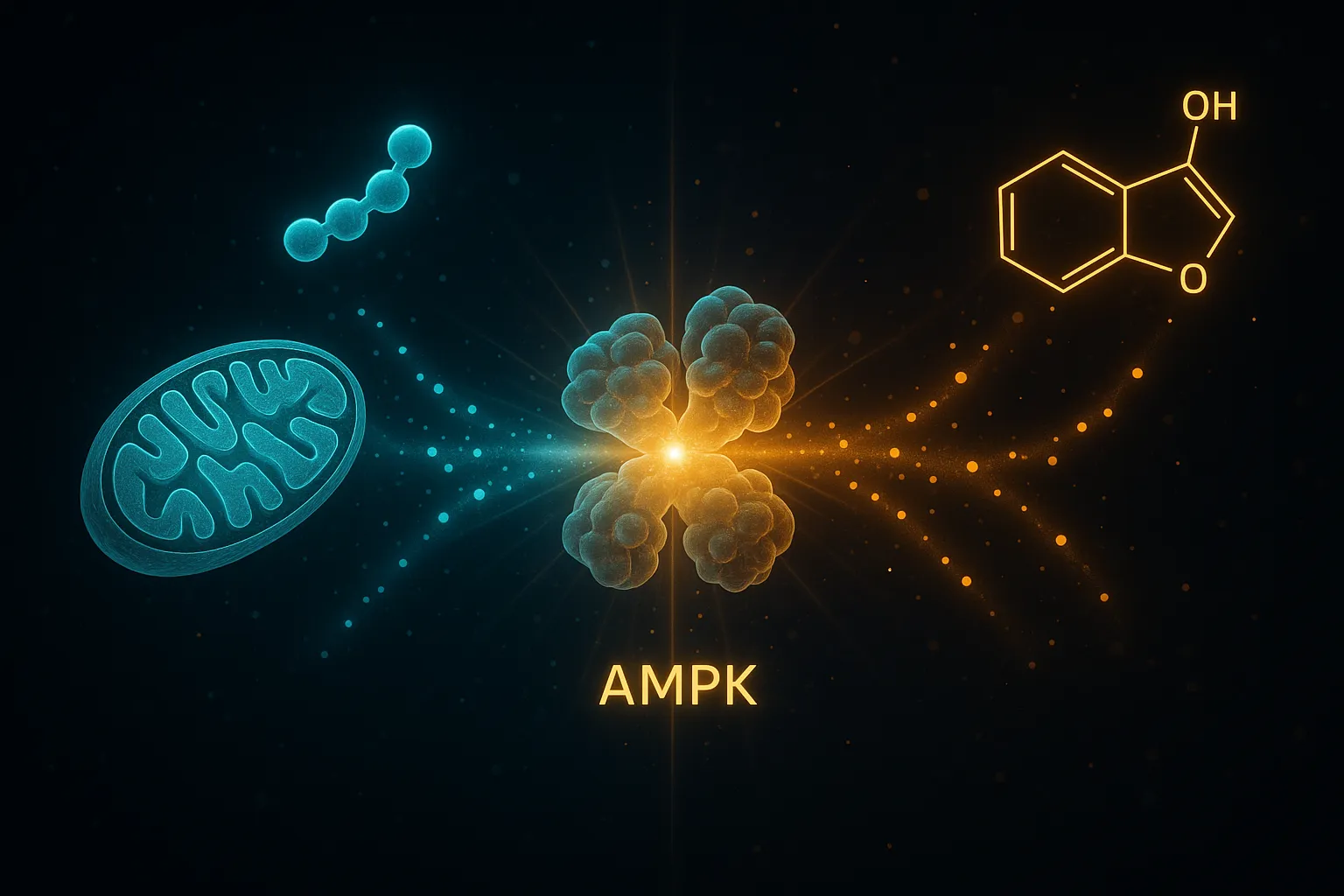
Both MOTS-c and metformin activate AMP-activated protein kinase (AMPK) — the cellular energy sensor that sits at the crossroads of metabolism, aging, and exercise adaptation. That shared downstream target is why longevity researchers and biohacking communities routinely discuss them in the same breath.
Research-context information only. MOTS-c is a research peptide not approved by the FDA. Metformin is FDA-approved for type 2 diabetes; any use outside that indication is off-label. Protocols, doses, and reactions reported below come from published research and self-reported community sources. This article reports what has been documented, not what should be done. Consult a licensed physician for personal medical decisions.
But shared AMPK activation does not mean shared mechanisms. Metformin has been prescribed since the 1950s, has been taken by hundreds of millions of people, and is currently being tested as an anti-aging drug in the TAME (Targeting Aging with Metformin) trial. MOTS-c was identified in 2015 as a mitochondrial-derived peptide — a 16-amino-acid signaling molecule encoded by mitochondrial DNA — and remains in the preclinical research stage with no published human dosing trials.
This comparison examines how each compound activates AMPK, where their mechanisms diverge, what level of evidence supports each, and what research profiles each one fits.
Quick Comparison
| Feature | MOTS-c | Metformin |
|---|---|---|
| Type | Endogenous mitochondrial-derived peptide | Synthetic biguanide pharmaceutical |
| Origin | Encoded by mitochondrial DNA (12S rRNA gene) | Derived from French lilac (Galega officinalis) |
| Primary mechanism | Folate cycle inhibition → AICAR accumulation → AMPK activation | Complex I inhibition → AMP:ATP ratio increase → AMPK activation |
| Route | Subcutaneous injection (research/community use) | Oral tablet |
| Reported dose range | 5-10 mg SC, 2-3x/week (community-reported) | 500-2,000 mg/day oral (prescribed range) |
| Evidence level | Preclinical (rodent + in vitro); no human dosing trials | Decades of RCTs; prescribed to 150M+ people globally |
| Regulatory status | Research peptide — not FDA-approved | FDA-approved for type 2 diabetes (1994) |
| Availability | Research peptide vendors | Prescription (generic, widely available) |
| Cost | ~$40-80/vial (research peptide pricing) | ~$4-30/month (generic prescription) |
| Known safety profile | No controlled human safety data | Well-characterized; GI side effects, rare lactic acidosis, B12 depletion |
How Each One Works
MOTS-c: A Mitochondrial Signal That Mimics Exercise
MOTS-c (Mitochondrial Open Reading Frame of the 12S rRNA Type-c) is a 16-amino-acid peptide encoded by mitochondrial DNA and secreted into the cytoplasm and circulation. The original discovery paper by Lee et al. (2015) identified MOTS-c as a mitochondrially encoded hormone that regulated metabolic homeostasis in mice (PMID: 25738459).
The mechanism proceeds through four documented steps:
-
Folate cycle disruption — MOTS-c inhibits the folate-methionine cycle, specifically targeting de novo purine biosynthesis. This disruption causes accumulation of the intermediate AICAR (5-aminoimidazole-4-carboxamide ribonucleotide).
-
AMPK activation via AICAR — AICAR is a known endogenous AMPK activator. Rather than changing the AMP:ATP ratio (the way metformin does), MOTS-c activates AMPK through a nucleotide-sensing pathway. Published research describes this as a distinct upstream signal that converges on the same downstream kinase (PMID: 25738459).
-
Nuclear translocation — Under metabolic stress, MOTS-c translocates from the cytoplasm to the nucleus, where it regulates nuclear gene expression. Kim et al. (2018) demonstrated this stress-responsive nuclear translocation occurs in an AMPK-dependent manner (PMID: 29983246).
-
Exercise-mimetic signaling — Reynolds et al. (2021) reported that MOTS-c expression in skeletal muscle increased 11.9-fold after exercise in human subjects and that exogenous MOTS-c treatment improved physical performance in young, middle-aged, and old mice (PMID: 33473109).
The exercise-mimetic characterization is important because it positions MOTS-c not as a pharmaceutical that overrides a pathway, but as a peptide that amplifies a signal the body already produces during physical activity.
Metformin: Complex I Inhibition and Systemic Metabolic Regulation
Metformin has been prescribed for type 2 diabetes since the 1950s in Europe and since 1994 in the United States. Despite decades of clinical use, the precise mechanism was debated until relatively recently. The current consensus, reviewed comprehensively by Fontaine (2018), centers on mitochondrial Complex I inhibition (PMID: 30619086).
The mechanism proceeds through several interconnected pathways:
-
Complex I inhibition — Metformin accumulates in mitochondria and inhibits Complex I of the electron transport chain. This reduces ATP production and increases the AMP:ATP ratio within cells — a direct energy-stress signal.
-
AMPK activation via energy stress — The elevated AMP:ATP ratio activates AMPK through canonical energy-sensing. This leads to increased glucose uptake in skeletal muscle, suppression of hepatic gluconeogenesis, and enhanced fatty acid oxidation.
-
mTOR suppression — AMPK activation by metformin leads to suppression of the mTOR (mechanistic target of rapamycin) pathway, which governs cell growth and proliferation. This mTOR-suppressing effect is one of the key mechanisms behind metformin's observed associations with reduced cancer incidence in epidemiological studies.
-
Gut microbiome modulation — Published research describes metformin's effects on gut microbial composition, including increased abundance of Akkermansia muciniphila and SCFA-producing bacteria. Some researchers have proposed that a significant portion of metformin's glucose-lowering effect may operate through the gut rather than through systemic AMPK activation alone.
-
Anti-inflammatory signaling — Metformin reduces NF-kB activation and circulating inflammatory markers (TNF-alpha, IL-6, CRP), effects that are at least partially AMPK-mediated.
Where the Mechanisms Diverge
The shared AMPK activation is real — but the upstream pathways, tissue specificity, and downstream consequences differ substantially.
| Divergence Point | MOTS-c | Metformin |
|---|---|---|
| How AMPK gets activated | AICAR accumulation (folate cycle inhibition) | AMP:ATP ratio increase (Complex I inhibition) |
| Primary tissue | Skeletal muscle (exercise-mimetic) | Liver (gluconeogenesis suppression) |
| Mitochondrial effect | Signals from mitochondria (encoded by mtDNA) | Inhibits mitochondrial Complex I directly |
| mTOR interaction | Limited published data on mTOR suppression | Well-documented mTOR suppression |
| Gut microbiome effects | No published data | Documented microbiome modulation |
| Nuclear gene regulation | Direct nuclear translocation under stress | Indirect via AMPK-mediated transcription factors |
| Exercise relationship | Expression increases with exercise; described as exercise-mimetic | Some evidence of blunting exercise adaptations in certain contexts |
| Endogenous vs. exogenous | Endogenous — body produces it naturally | Exogenous pharmaceutical — synthetic compound |
The exercise-adaptation point is worth noting. Reynolds et al. (2021) described MOTS-c as an exercise-induced regulator — its levels rise during physical activity and contribute to metabolic adaptation (PMID: 33473109). Metformin, by contrast, has been the subject of debate regarding whether it may partially blunt exercise-induced mitochondrial adaptations in some populations, though this remains contested in the literature.
The tissue specificity difference is equally significant. Metformin's dominant clinical effect operates through the liver — suppressing hepatic glucose output — with secondary effects in skeletal muscle and gut. MOTS-c's documented effects in preclinical models center on skeletal muscle metabolism and whole-body insulin sensitivity, with the exercise-mimetic framing emphasizing its role as a muscle-signaling peptide.
Published Research
Where MOTS-c Has Distinct Data
MOTS-c research is newer and exclusively preclinical or observational in humans. The key published findings include:
Exercise-mimetic effects. The Reynolds et al. (2021) study remains the strongest published evidence for MOTS-c's functional significance. Skeletal muscle MOTS-c levels increased 11.9-fold after exercise in human subjects, and exogenous MOTS-c improved physical performance across all age groups in mice (PMID: 33473109).
Metabolic homeostasis. Lee et al. (2015) demonstrated that MOTS-c treatment prevented age-dependent and high-fat-diet-induced insulin resistance in mice. The same study showed MOTS-c reduced diet-induced obesity and improved glucose tolerance (PMID: 25738459).
Nuclear gene regulation. Kim et al. (2018) showed MOTS-c translocates to the nucleus under metabolic stress, directly regulating adaptive nuclear gene expression — a unique mechanism for a mitochondrially encoded peptide (PMID: 29983246).
Declining levels with age. Observational human data describe declining circulating MOTS-c levels with age, raising the possibility that supplementation could restore youthful signaling. However, no interventional human studies have tested this hypothesis.
Where Metformin Has Distinct Data
Metformin's evidence base is orders of magnitude larger. Key areas of distinct data include:
The TAME trial. The Targeting Aging with Metformin trial is a landmark study designed by Barzilai and colleagues to test whether metformin can delay the onset of age-related multimorbidity in non-diabetic older adults. Published frameworks describe TAME as the first trial to use a pharmaceutical intervention targeting biological aging itself, rather than any single disease (PMID: 27304507).
Cancer risk reduction signals. A systematic review and meta-analysis by Decensi et al. (2010) reported a 31% reduction in cancer incidence among metformin users compared with users of other antidiabetic drugs (pooled relative risk 0.69, 95% CI 0.61-0.79). This association has been observed across multiple cancer types (PMID: 22448244).
Hallmarks of aging. Kulkarni et al. (2020) published a comprehensive review documenting metformin's effects across multiple hallmarks of aging — nutrient sensing, autophagy, inflammation, mitochondrial function, telomere attrition, and cellular senescence (PMID: 32333835).
Cardiovascular data. The UKPDS trial and subsequent long-term follow-up studies documented reduced cardiovascular mortality in overweight type 2 diabetes patients treated with metformin. This cardiovascular signal has been consistently observed across multiple independent studies.
Research Comparison
| Research Category | MOTS-c | Metformin |
|---|---|---|
| Human RCTs | None published | Hundreds (diabetes, cancer prevention, PCOS, aging) |
| Exercise interaction | Enhances adaptation (preclinical) | May attenuate adaptation in some contexts (debated) |
| Insulin sensitivity | Improved in rodent models | Improved in millions of patients |
| Cancer | No data | Epidemiological signal of ~30% reduced incidence |
| Cardiovascular | No data | UKPDS-documented mortality reduction |
| Aging/longevity | Preclinical lifespan extension in rodents | TAME trial in progress; epidemiological signals |
| Safety database | Preclinical toxicology only | Decades, 150M+ patients |
Dosing Comparison
| Parameter | MOTS-c (Community-Reported) | Metformin (Prescribed) |
|---|---|---|
| Route | Subcutaneous injection | Oral |
| Reported starting dose | Community sources describe 5 mg SC, 2-3x/week | Standard clinical initiation is 500 mg/day oral |
| Reported maintenance dose | Community sources describe 10 mg SC, 3x/week | Prescribed doses range from 1,000-2,000 mg/day |
| Frequency | 2-3 times per week (community protocols) | Daily or twice daily |
| Cycling | Community protocols describe 8-12 week cycles with 4-week breaks | Typically continuous (prescribed) |
| Storage | Requires reconstitution and refrigeration | Room temperature tablet |
| Onset | Community reports describe effects emerging over 2-4 weeks | Clinical glucose-lowering effects documented within 1-2 weeks |
All MOTS-c dosing information above is derived from community self-reports and preclinical rodent data, not from controlled human trials. Rodent studies have used intraperitoneal doses roughly equivalent to 0.5-5 mg/kg, but interspecies dose translation is imprecise.
Safety Profiles
The safety asymmetry between these two compounds is the single most important factor in any comparison.
Metformin: Decades of Human Data
Metformin's safety profile is among the best-characterized of any pharmaceutical compound. Published data from millions of patients document:
- Gastrointestinal effects — Nausea, diarrhea, and abdominal discomfort reported in 20-30% of patients, typically dose-dependent and often resolving over time. Extended-release formulations reduce GI incidence.
- Lactic acidosis — Rare (estimated 3-10 cases per 100,000 patient-years), primarily in patients with renal impairment or conditions that impair lactate clearance. The risk was historically overstated relative to the phenformin era.
- Vitamin B12 depletion — Long-term metformin use is associated with reduced B12 absorption in 10-30% of patients, with clinical deficiency in a smaller subset. Published guidelines recommend periodic B12 monitoring.
- Contraindications — Severe renal impairment (eGFR <30), acute conditions predisposing to lactic acidosis, contrast dye procedures.
- No hepatotoxicity — Unlike some other diabetes medications, metformin does not cause liver damage and is generally considered hepatoprotective.
MOTS-c: Limited Data
No controlled human safety data exist for exogenous MOTS-c administration. The available information:
- Preclinical toxicology — Published rodent studies have not reported significant adverse effects at the doses tested, but preclinical safety does not predict human safety with reliability.
- Community reports — Self-reported side effects from research-peptide users include injection-site reactions (redness, mild swelling) and transient fatigue. These reports are anecdotal, uncontrolled, and subject to recall and reporting bias.
- Endogenous context — MOTS-c is a naturally occurring peptide produced by the body's own mitochondria. Circulating levels rise during exercise. This endogenous origin is sometimes cited as a safety argument, but exogenous administration at supraphysiological doses does not necessarily replicate the safety profile of endogenous production.
- Unknown long-term effects — No data exist on the effects of chronic exogenous MOTS-c administration in humans.
The honest assessment: metformin's safety profile is supported by billions of patient-years of exposure data. MOTS-c's safety profile is essentially unknown in humans. This asymmetry should weigh heavily in any practical analysis.
Can They Be Combined?
No published human data exist on the combination of MOTS-c and metformin. Mechanistic analysis suggests theoretical complementarity:
Non-overlapping upstream pathways. Metformin activates AMPK by raising the AMP:ATP ratio through Complex I inhibition. MOTS-c activates AMPK through AICAR accumulation from folate cycle disruption. These are fundamentally different upstream signals converging on the same kinase — which raises the possibility that combined administration could produce additive AMPK activation without redundancy.
Tissue complementarity. Metformin's dominant clinical effects are hepatic (gluconeogenesis suppression) with secondary skeletal muscle activity. MOTS-c's documented preclinical effects are primarily in skeletal muscle. A combination could theoretically address both tissue compartments.
Concerns. Excessive AMPK activation carries its own risks — AMPK is a master energy sensor, and chronic overactivation could theoretically impair anabolic processes, suppress mTOR-dependent tissue repair, or interfere with normal exercise adaptation. No data exist to characterize these risks in the context of combined MOTS-c and metformin use.