Immune Support & Defense
Strengthen your immune system, fight infections, and restore immune balance. Research peptides enhance T-cell activity, activate antimicrobial defenses, and regulate cytokine responses to keep your body protected.
How It WorksImmune Support
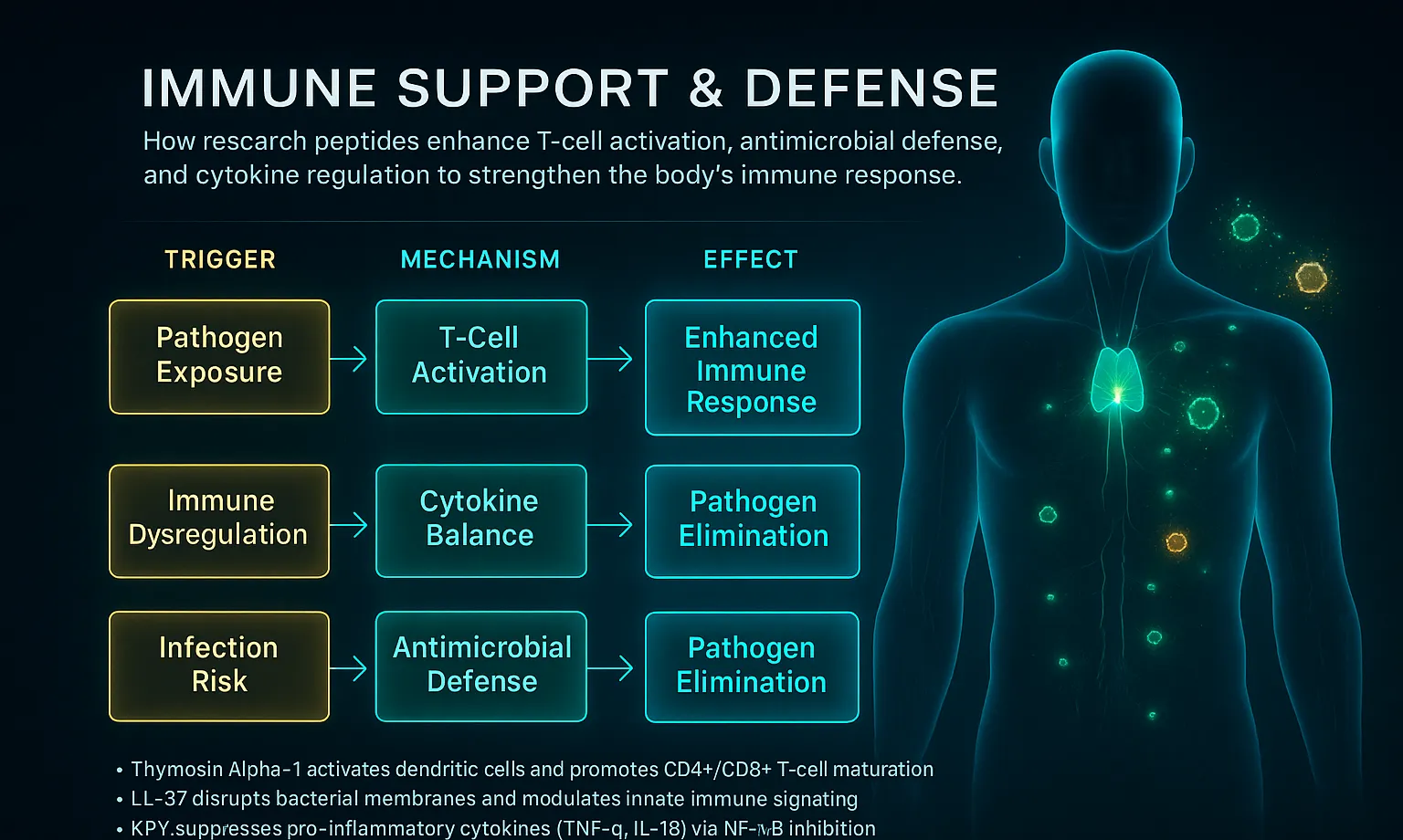
How Peptides Are Studied for Immune Support
Thymosin Alpha-1 is the most clinically validated immune peptide, approved in 35+ countries as Zadaxin for hepatitis B/C and immune support. It enhances T-cell maturation, dendritic cell function, and natural killer cell activity while modulating the Th1/Th2 balance without dangerous overstimulation.
LL-37 acts as a broad-spectrum antimicrobial, directly killing bacteria, viruses, and fungi through membrane disruption. It also disrupts biofilms — protective structures that shield bacterial colonies from antibiotics — and modulates inflammatory signaling.
VIP (Vasoactive Intestinal Peptide) is particularly relevant for complex immune dysregulation like CIRS (Chronic Inflammatory Response Syndrome) and mold illness, where it helps rebalance the innate immune system. Thymulin addresses age-related thymic decline by supporting T-cell differentiation and maturation.
Peptides Studied for Immune Support
Thymosin Alpha-1
An immune-boosting peptide used in 30+ countries for viral defense.
LL-37
An antimicrobial peptide for immune defense and wound healing.
KPV
An anti-inflammatory peptide for gut health and skin conditions.
Thymulin
A thymic peptide for immune regulation and hair regrowth support.
Thymalin
A thymus-derived peptide bioregulator studied in Russian clinical literature for immune balance and age-related immune decline; distinct from thymulin and thymosin alpha-1, and not FDA-approved.
VIP
An immune-rebalancing peptide for CIRS, mold illness, and neuroinflammation.
Glutathione
The body's master antioxidant for cellular defense, immune support, detoxification, and skin health.
Thymogen
A Khavinson thymus dipeptide (Glu-Trp / EW) isolated from Thymalin; Russian research reports immune-modulating effects, single-lab preclinical/clinical only.
Vilon
A Khavinson Lys-Glu (KE) dipeptide bioregulator studied in rodent and cell models for immune and geroprotective effects; no independent human trials.
Related Articles & Guides
reconstitution
Glutathione Reconstitution: 1500mg + 3mL Chart
300mg = 100 units. Glutathione uses far larger volumes than most peptides — dilution charts for 600mg and 1,500mg vials, syringe math, and storage.
Vilon Reconstitution: 20mg Vial Mixing Chart
Vilon has no validated human concentration. See how community resources describe mixing the 20mg vial, plus syringe-unit math and storage limits.
Thymogen Reconstitution: 20mg Vial Mixing Chart
Thymogen has no validated human concentration. See how community resources describe mixing the 20mg vial, plus syringe-unit math and storage limits.
Thymalin Reconstitution: 10mg Vial Mixing Chart
A 10mg Thymalin vial plus 1mL bacteriostatic water gives 10mg/mL. Published use was saline IM; community sources describe SC. Dilution charts and storage.
side-effects
Vilon Side Effects: What the Evidence Shows
Vilon's originators claim near-zero side effects, but independent safety data barely exists. What the research shows — and the risks it leaves out.
Thymogen Side Effects: What the Evidence Shows
Its makers call it nearly side-effect-free after decades of Russian use. Independent Western data barely exists — here's what that gap hides.
Thymalin Side Effects: What the Data Shows
Russian clinical reports call thymalin nearly side-effect-free — but independent Western safety data is essentially absent. What the gap means.
VIP Side Effects: 7 to Watch For
Transient hypotension hits most VIP users — but lipase elevation is the one to actually monitor. Full safety breakdown by frequency.
results
Vilon Results: Week-by-Week Timeline
Vilon has no human efficacy trials — so where do its timelines come from? Rodent and human-cell-culture mechanism data plus labeled community reports.
Thymogen Results: Week-by-Week Timeline
Thymogen has no modern human efficacy trial — so what shapes its reported timeline? Old Russian course data and labeled community reports, week by week.
Thymalin Results: Course-by-Course Timeline
Thymalin has no modern efficacy trial. Here's what the documented clinical course structure and labeled community reports describe, stage by stage.
Thymulin Results Timeline: What to Expect
Thymulin is an immune biomarker peptide, not a fast one. What research documents from week 1 to month 6 — and why most effects stay subclinical.
dosing
Vilon Dosage Chart: KE Dipeptide Course Protocol
Vilon is a synthetic Lys-Glu dipeptide with no validated human dose. What the Russian rodent data showed and how community course protocols run.
Thymogen Dosage: What the Research Shows
No modern trial set a Thymogen dose. Russian practice used ~100mcg short courses — here's the reconstitution math and why a 20mg research vial doesn't fit.
Thymalin Dosage Chart: 5-10mg IM Course Protocol
Thymalin is a thymus extract fraction, not thymulin or thymosin alpha-1. What Russian clinical literature documented vs community SC use.
Glutathione Dosage Chart: IV, Injectable & Strips
Oral glutathione is mostly destroyed in the gut -- three delivery routes that actually work, with protocols for each.
buying-guide
Where to Buy Vilon: Price & Vendor Guide
Vilon is a synthetic Lys-Glu dipeptide, not the Thymalin thymus extract. How to read a 275 Da COA, spot the mix-up, and what it really costs.
Buy Thymogen: Price, COA & Cost Per Week
Only 1 vetted Thymogen source right now: $67.95 a vial, $3.40/mg. Codes save up to 10%. COA status and real cost per week.
Buy Thymalin: Price, COA & Cost Per Week
Only 1 vetted Thymalin source right now: $59 a vial, $5.90/mg. Codes save up to 15%. COA status and real cost per week.
Buy Glutathione: Compare 4 Vendors, From $15
Compare 4 Glutathione vendors side by side: from $15 a vial, best value $0.01/mg. Codes save up to 30%. Vial sizes, COA status, real cost per week.
benefits
Vilon for Immune Aging: The Evidence
Vilon's immune and geroprotection claims rest on one Russian lab's rodent and cell data. Here's what the studies actually reported, and what they didn't.
Thymogen for Immune Support: The Evidence
Thymogen is the synthetic dipeptide pulled from Thymalin — its immune and anti-tumor claims trace to one Russian lab. Here's what the data shows.
Thymalin for Immune Support: The Evidence
Thymalin's immune claims rest on decades-old Russian data from a single research group — here's what the studies actually reported, and what they didn't.
LL-37 Benefits: Biofilm Breaker + 9 Immune Effects
LL-37 is an antimicrobial peptide studied for biofilm breakdown, immune defense, and wound healing. 9 effects ranked by research strength, cited data.
guides
Buy VIP: Compare 4 Vendors, From $58
Compare 4 VIP vendors side by side: from $58 a vial, best value $5.80/mg. Codes save up to 50%. Vial sizes, COA status, real cost per week.
Buy Thymosin Alpha-1: Compare 6 Vendors, From $42
Compare 6 Thymosin Alpha-1 vendors side by side: from $42 a vial, best value $5.80/mg. Codes save up to 50%. Vial sizes, COA status, real cost per week.
Buy LL-37: Compare 3 Vendors, From $45
Compare 3 LL-37 vendors side by side: from $45 a vial, best value $7.80/mg. Codes save up to 50%. Vial sizes, COA status, real cost per week.
Buy GHK-Cu + KPV: Price, COA & Cost Per Week
Only 1 vetted GHK-Cu + KPV source right now: $85 a vial, $1.21/mg. Codes save up to 10%. COA status and real cost per week.
articles
Best Peptides for Skin & Hair (2026 Beginner's Guide)
Ranking of peptides community sources describe for skin and hair — what each does, who it suits, what users self-report.
Best Peptides for Inflammation (2026 Beginner's Guide)
Ranking of the anti-inflammatory peptides — what each one does, who tends to use it, and what users actually report.
Best Peptides for Immune Support (2026 Beginner's Guide)
Ranking of the immune peptides — what each one does for innate, adaptive, or regulatory immunity, and what users actually report.
Best Peptides for Gut Health (2026 Beginner's Guide)
Ranking of the gut peptides — what BPC-157, KPV, and LL-37 do for the gut wall, who tends to use each, and what users actually report.
Price Comparisons
Compare KPV Prices
Find the best deals from trusted vendors
Compare LL-37 Prices
Find the best deals from trusted vendors
Compare Thymosin Alpha-1 Prices
Find the best deals from trusted vendors
Compare VIP Prices
Find the best deals from trusted vendors
Compare Glutathione Prices
Find the best deals from trusted vendors
Compare Thymalin Prices
Find the best deals from trusted vendors
Compare Thymogen Prices
Find the best deals from trusted vendors
Active Coupon Codes
Save on peptides from these verified vendors with exclusive discount codes.
Ion Peptide coupon code: 15% off
Use code thepeptidecatalog at checkout
EZ Peptides coupon code: 10% off
Use code thepeptidecatalog at checkout
Ascension Peptides coupon code: 50% off
Use code THEPEPTIDECATALOG at checkout
Glacier Aminos coupon code: 10% off
Use code thepeptidecatalog at checkout
Nura Peptide coupon code: 30% off
Use code thepeptidecatalog at checkout
Dynamic Peptide coupon code: 10% off
Use code thepeptidecatalog at checkout
Limitless Biotech coupon code: 15% off
Use code peptideinfo at checkout
BioLongevity Labs coupon code: 15% off
Use code thepeptidecatalog at checkout
Swiss Chems coupon code: 10% off
Use code THEPEPTIDECATALOG at checkout
Related Research Areas
Frequently Asked Questions
Which immune peptide is best for general immune support?
Thymosin Alpha-1 has the most clinical validation for general immune enhancement, with decades of use for viral infections, cancer support, and immune optimization. It's approved as a drug in many countries and has an excellent safety profile.
Can immune peptides be used during acute infections?
LL-37 and Thymosin Alpha-1 are sometimes used during infections, but timing matters. Early use may help the immune response, while late use during cytokine storms could be problematic. Many practitioners prefer using them preventively or during recovery phases.
Are immune peptides safe for people with autoimmune conditions?
This requires careful consideration. Thymosin Alpha-1 actually helps balance Th1/Th2 responses and may benefit some autoimmune conditions. However, immune stimulation could theoretically worsen others. KPV's anti-inflammatory effects may be safer for autoimmune patients.
How long should immune peptides be used?
Protocols vary widely. Thymosin Alpha-1 is often used cyclically (10-14 days per month) for maintenance or continuously during high-risk periods. LL-37 might be used for acute antimicrobial needs. VIP for CIRS follows specific Shoemaker protocol guidelines.
Can immune peptides prevent getting sick during cold and flu season?
While not proven to prevent illness definitively, immune peptides may reduce infection risk and severity by optimizing immune function. Thymosin Alpha-1 is popular for this purpose, especially among healthcare workers and frequent travelers.
This page is for educational and research purposes only. It does not constitute medical advice. Always consult a qualified healthcare professional before starting any peptide protocol.