reconstitutionJune 20, 2026·8 min read

VIP Reconstitution: 5mg + 5mL Chart

50mcg = 5 units at 1mg/mL. The mix differs for SubQ vs intranasal — dilution charts, syringe math, and nasal-spray prep, step by step.

VIP Reconstitution: 5mg + 5mL Chart

How to Reconstitute VIP

VIP (vasoactive intestinal peptide) ships as a lyophilized — freeze-dried — white powder in a sealed vial, and it has to be reconstituted with bacteriostatic water before either route of administration. What makes VIP different from most research peptides is that it is used two ways: subcutaneous (SubQ) injection in the common community protocol, and intranasal spray in the Shoemaker CIRS protocol. The powder and the water are the same; how the finished solution is measured and delivered is not.

This guide covers both. The mixing step is identical for either route — the dilution math, the syringe units, and the storage rules below apply to the powder-in-vial stage regardless of how VIP ends up being used. The difference shows up afterward: for injection the solution is drawn into an insulin syringe by units; for the intranasal route it is transferred into a nasal-spray bottle or dropper, where metering becomes the harder problem.

Research-context information only. VIP is a research peptide. Protocols, doses, and reactions reported below come from published research and self-reported community sources. This article reports what has been documented, not what should be done. Consult a licensed physician for personal medical decisions.

VIP is a prescription compound for CIRS protocols, and compounded nasal spray in particular is a pharmacy product. For the dosing schedule that follows reconstitution, see the VIP Dosing Guide. This is not medical advice.

New to bacteriostatic water? Start with what it is, how much to use per vial, and how long it lasts — or see the full Bacteriostatic Water Guide.

What You Need

Documented protocols call for the following:

  • VIP lyophilized vial — typically 5mg or 10mg
  • Bacteriostatic water (BAC water) — not sterile water, not saline
  • Insulin syringes — 1mL (100 unit), 29-31 gauge
  • Alcohol swabs — for cleaning vial tops
  • A clean, flat workspace
  • Empty sterile nasal-spray bottle or dropper — only if the intranasal route is being prepared

Why bacteriostatic water? It contains 0.9% benzyl alcohol that suppresses bacterial growth in the solution. Plain sterile water has no preservative, so documented guidance is to use the vial within 24 hours. A VIP protocol typically draws from one vial twice daily over many days, so community resources describe bacteriostatic water for that multi-dose window — up to 28 days refrigerated.

30ml bacteriostatic water vial — 0.9% benzyl alcohol multi-dose
Bac Water Made for Peptides
Don't risk a $300 peptide on generic bac water.
Most cloudy reconstitutions trace back to one thing — and it isn't the peptide. Sterile, non-pyrogenic, 0.9% benzyl alcohol — formulated for peptide reconstitution, not repackaged from generic stock.
0.9% benzyl alcohol Made for peptides 30 mL multi-dose
See why our bac water doesn't ruin peptides
30ml from $18.75 · Ships fast · Code thepeptidecatalog

Step-by-Step Reconstitution

The mixing steps below are the same whether the finished solution will be injected or sprayed. The route-specific handling comes after Step 5.

Step 1: Clean Everything

Protocols describe wiping the tops of both vials — VIP and bacteriostatic water — with alcohol swabs, then letting them air-dry for about 10 seconds. Community resources flag this as the step where contamination is most often introduced.

Step 2: Draw the Bacteriostatic Water

Protocols describe using a fresh insulin syringe to draw the chosen amount of BAC water. The amount added sets the concentration — see the dilution charts below.

For a 5mg vial, community resources most often document 5mL of BAC water, which produces a clean 1mg/mL (1,000mcg/mL) solution. For a 10mg vial, 10mL gives the same 1mg/mL ratio. The round concentration is what makes the 50mcg standard dose land on an easy syringe number.

Step 3: Add the Water to the VIP Vial

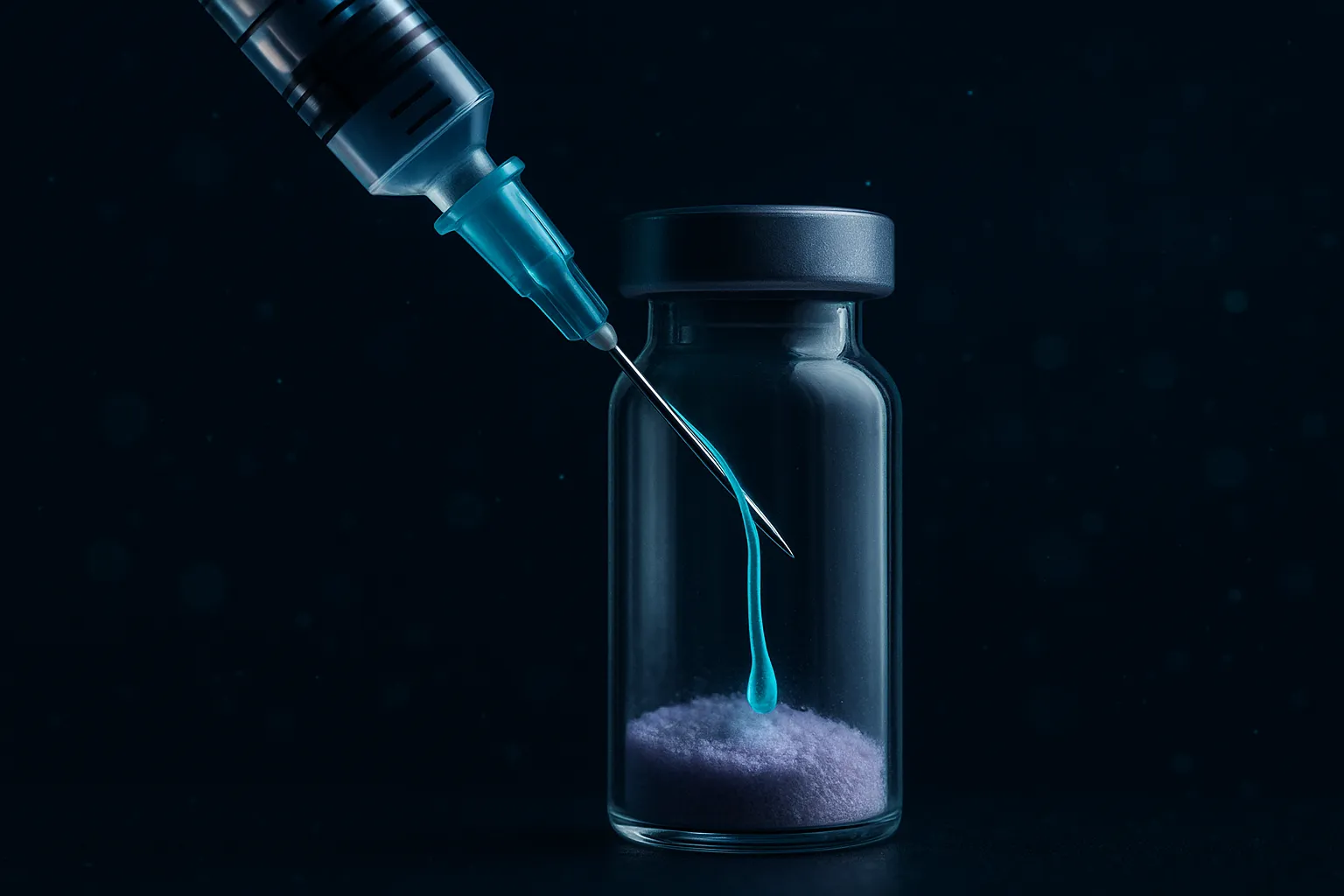
Protocols describe inserting the needle into the VIP vial at an angle, aiming at the glass wall rather than the powder, and letting the water trickle slowly down the inside of the vial.

Protocols describe directing the water at the glass wall rather than onto the powder — the gentle-stream technique is documented to protect the peptide's molecular structure. Larger BAC water volumes (5mL or 10mL) are usually added in two or three insulin-syringe draws.

Step 4: Let It Dissolve

Protocols describe swirling the vial gently with a slow rotating motion rather than shaking it. VIP typically dissolves within a minute or two into a clear, colorless solution.

If particles or cloudiness remain after several minutes of gentle swirling, community resources describe the material as suspect and discard it rather than use it.

Step 5: Prepare the Route

For subcutaneous injection: the vial is ready. Community protocols describe drawing the dose from the vial into a 100-unit insulin syringe by units — the Syringe Math section below covers the conversion.

For the intranasal route: community resources describe drawing the reconstituted solution out of the vial with a syringe and transferring it into an empty sterile nasal-spray bottle or dropper. The unsolved part is metering. A pharmacy-compounded VIP nasal spray delivers a calibrated 50mcg per actuation; a self-filled bottle's per-spray volume varies by bottle and is not calibrated, which is why the Shoemaker CIRS protocol relies on pharmacy-compounded sprays rather than home-filled ones. For context on where the intranasal route fits, the VIP Dosing Guide covers the Shoemaker phases.

Step 6: Store Correctly

Reconstituted vials are refrigerated immediately at 36-46°F (2-8°C), protected from light. With bacteriostatic water the solution is generally documented as stable for up to 28 days.

Dilution Chart

The two vial sizes VIP commonly ships in, both worked out to the standard 50mcg dose plus a 100mcg column for the occasional larger draw.

Why these water amounts? The recommended rows both land on 1mg/mL (1,000mcg/mL), which keeps the math simple: at that concentration a 50mcg dose is exactly 5 units on an insulin syringe. Adding less water concentrates the solution and shrinks the draw — at 2mL into a 5mg vial, 50mcg falls to just 2 units, which is harder to read accurately on the barrel.

Syringe Math

On a standard 100-unit insulin syringe, each "unit" mark equals 0.01mL, so the full barrel is 1mL. Once VIP is reconstituted, converting a target dose to syringe units depends on the dilution chosen.

Community reconstitution resources document the following conversion:

Concentration (mcg/mL) = Vial Size (mcg) ÷ Water Added (mL)

Then:

Units to draw = Desired Dose (mcg) ÷ Concentration (mcg/mL) × 100

Worked example: at the standard community-documented dilution — a 5mg (5,000mcg) vial plus 5mL bacteriostatic water — concentration is 1,000mcg/mL. Community protocols describe a 50mcg dose as 5 units (0.05mL) at that dilution, drawn twice daily.

Prefer not to calculate by hand? The Reconstitution Calculator takes the vial size, water amount, and target dose and returns the units.
Top VIP Vendors

Ranked by price, COA availability, and reputation

1
Ascension PeptidesCOA
10/10
10mg$8.00/mg
2
Ion PeptideCOA
9.8/10
10mg$7.90/mg
3
EZ PeptidesCOA
9.5/10
10mg$5.80/mg

Affiliate disclosure: vendor links in this article are affiliate links — The Peptide Catalog may earn a commission if you buy through them, at no additional cost to you.

Storage Rules

VIP is more stable as a powder than in solution, so storage guidance splits by state.

State Temperature Shelf Life
Lyophilized (powder) Refrigerated (2-8°C) 12+ months
Lyophilized (powder) Frozen (-20°C) 2+ years
Reconstituted (BAC water) Refrigerated (2-8°C) Up to 28 days
Reconstituted (sterile water) Refrigerated Use within 24 hours
Compounded nasal spray Refrigerated Pharmacy beyond-use date (30-90 days)

VIP Reconstitution Technique

Protocols describe keeping reconstituted VIP refrigerated and shielded from light, pulling the vial out only long enough to draw a dose, then returning it. The reconstituted solution is not frozen — freezing a liquid forms ice crystals that documented guidance describes as damaging to peptide structure. Only the dry powder is frozen for long-term storage.

Common Mistakes

Spraying Water Onto the Powder

Driving a fast stream of bacteriostatic water directly into the lyophilized cake is the most-cited mixing error. Protocols describe aiming the needle at the glass wall and letting the water run down gently to protect the peptide.

Shaking the Vial

Shaking foams the solution, which makes accurate volume measurement difficult and introduces air bubbles that interfere with drawing a clean dose. Protocols describe swirling gently rather than shaking.

Using Too Little Water

Under-diluting concentrates the solution and shrinks the draw. At 2mL into a 5mg vial the 50mcg dose is only 2 units — small enough that a half-unit error becomes a meaningful dosing error. Community resources describe using enough water that the standard dose lands on a comfortably readable number of units.

Treating a Home-Filled Nasal Bottle as Calibrated

This is the VIP-specific trap. Transferring reconstituted solution into an empty spray bottle produces a sprayable liquid, but the per-actuation dose is not metered the way a pharmacy-compounded spray is. The Shoemaker CIRS protocol's 50mcg-per-spray figure assumes a calibrated compounded product; a self-filled bottle does not deliver a verified per-spray dose.

Leaving It at Room Temperature

VIP degrades faster in solution than as powder. Protocols describe prompt refrigeration after mixing and minimizing counter time during each draw.

Reusing Needles

Each pass through the rubber stopper dulls the needle and raises contamination risk. Protocols describe a fresh syringe every time — they cost pennies.

How Many Doses Per Vial?

At the standard 50mcg dose:

5mg vial = 100 doses (50 days at the twice-daily 50mcg SubQ schedule) 10mg vial = 200 doses (100 days at the same schedule)

The intranasal Shoemaker protocol consumes VIP faster — at 4-8 sprays per day of 50mcg each, a 5mg vial covers far fewer days than the twice-daily injection schedule. The VIP Dosing Guide lays out both schedules in full.

Frequently Asked Questions

How much bacteriostatic water is added to a VIP vial?
For a 5mg vial, community protocols commonly describe 5mL of bacteriostatic water, which gives a 1mg/mL (1,000mcg/mL) concentration. At that dilution a 50mcg dose equals 5 units (0.05mL) on an insulin syringe. A 10mg vial is typically described with 10mL for the same clean 1mg/mL ratio.
How is VIP nasal spray prepared at home?
Community resources describe reconstituting the vial with bacteriostatic water the same way as for injection, then drawing the solution into an empty sterile nasal-spray bottle or dropper. The challenge is metering: each commercial pharmacy spray delivers a fixed 50mcg, while a self-filled bottle's per-spray volume varies. Compounded VIP nasal spray is a prescription product; calibrated metering is one reason the Shoemaker CIRS protocol uses pharmacy-compounded sprays.
Can sterile water be used instead of bacteriostatic water for VIP?
Bacteriostatic water contains 0.9% benzyl alcohol that suppresses bacterial growth, which is why protocols describe it for multi-dose vials used over days or weeks. Sterile water has no preservative, so documented guidance is to use the vial within 24 hours. For a twice-daily VIP protocol that draws from one vial repeatedly, bacteriostatic water is what published reconstitution resources describe.
How long does reconstituted VIP last?
Reconstituted VIP in bacteriostatic water is generally documented as stable for up to 28 days refrigerated at 2-8°C and protected from light. Compounded nasal sprays carry a pharmacy-assigned beyond-use date, typically 30-90 days. Lyophilized (powder) VIP that has not yet been mixed is far more stable and is kept refrigerated or frozen until use.
What syringe size is used for VIP injections?
At the standard 1mg/mL dilution a 50mcg dose is only 5 units, so protocols describe a 1mL (100-unit) insulin syringe with a 29-31 gauge needle, which makes small-volume draws easy to read. The same syringe is used to draw bacteriostatic water during mixing.

References

  1. Petkov, V., et al. (2003). Vasoactive intestinal peptide as a new drug for treatment of primary pulmonary hypertension. Journal of Clinical Investigation, 111(9), 1339-1346. PubMed — first human trial establishing inhaled/aerosolized VIP delivery, the basis for non-injectable VIP administration.
  2. Delgado, M., et al. (2004). The significance of vasoactive intestinal peptide in immunomodulation. Pharmacological Reviews, 56(2), 249-290. PubMed — review of VIP's broad immune-modulating activity, the rationale for the multi-week CIRS protocols that reconstitution supports.
  3. Aton, S.J., et al. (2005). Vasoactive intestinal polypeptide mediates circadian rhythmicity and synchrony in mammalian clock neurons. Nature Neuroscience, 8(4), 476-483. PubMed — establishes VIP's central neuropeptide role, context for the twice-daily dosing schedule the dilution math here serves.
  4. Shoemaker, R.C., et al. (2017). Intranasal VIP safely restores volume to multiple grey matter nuclei in patients with CIRS. Internal Medicine Review, 3(4), 1-14. — documents the intranasal 50mcg-per-spray protocol and its extended (>12 week, 6-8 spray/day) dosing, the source for the intranasal preparation discussed above.

This guide is for educational and informational purposes only. It is not medical advice. VIP is a prescription compound for CIRS protocols, and compounded nasal spray is a pharmacy product. Reconstituting and self-administering injectable or intranasal compounds carries inherent risks including infection, contamination, and dosing errors. Always use proper sterile technique. Consult a qualified healthcare provider before starting any VIP protocol.