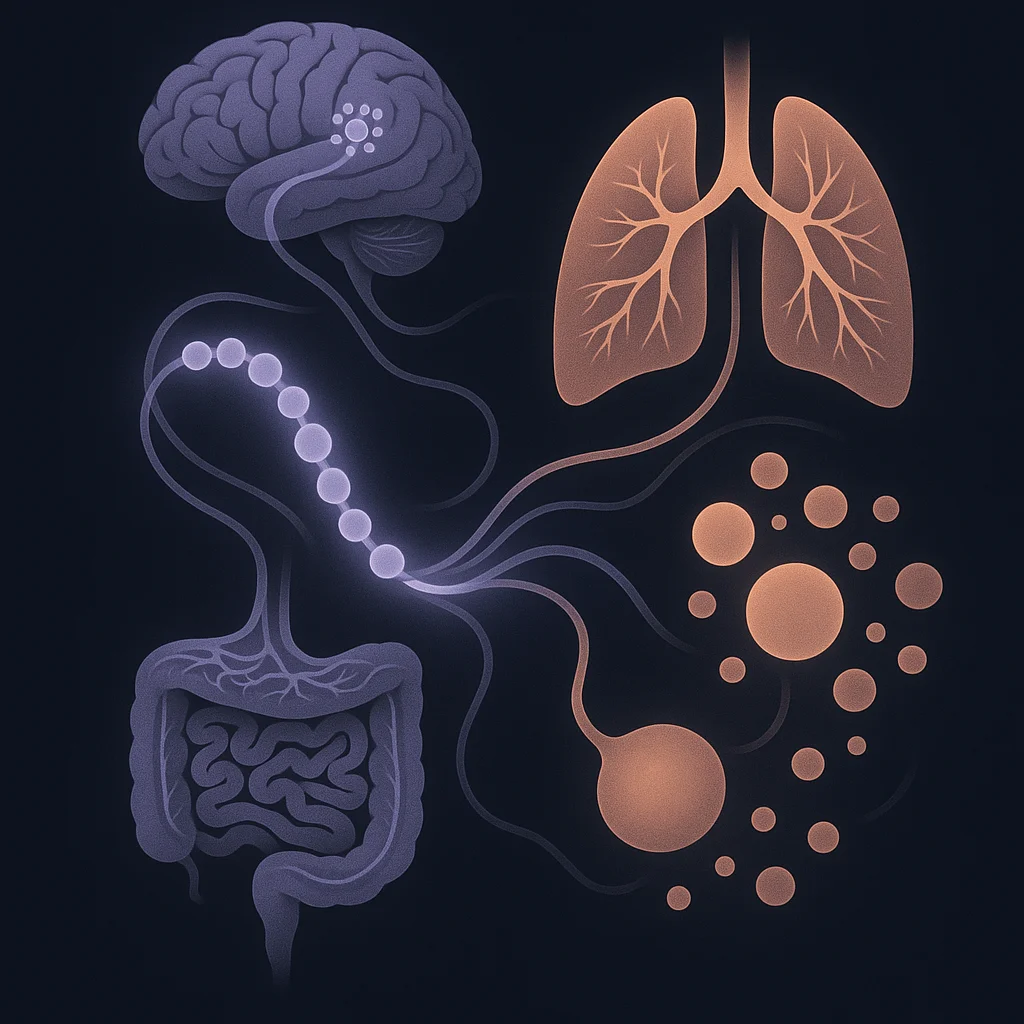
Vasoactive intestinal peptide (VIP) is a 28-amino-acid neuropeptide with regulatory roles spanning the immune, nervous, gastrointestinal, and cardiovascular systems. First isolated from porcine intestine in 1970, VIP has since been identified as one of the most abundant neuropeptides in the human body — present in the gut, brain, lungs, and immune cells.
Research-context information only. VIP (vasoactive intestinal peptide) is a research peptide. Protocols, doses, and reactions reported below come from published research and self-reported community sources. This article reports what has been documented, not what should be done. Consult a licensed physician for personal medical decisions.
Its primary clinical application is in the treatment of CIRS (Chronic Inflammatory Response Syndrome) from mold and biotoxin illness, where it serves as the final step in the Shoemaker protocol. But VIP's biological functions extend well beyond CIRS. This guide ranks 6 research-backed benefits by evidence quality, with cited studies for each.
How VIP Works
VIP signals through two G-protein coupled receptors: VPAC1 and VPAC2. Both receptors activate adenylyl cyclase, increasing intracellular cAMP — a second messenger that drives anti-inflammatory, vasodilatory, and neuroprotective cascades throughout the body.
VPAC1 is widely expressed on immune cells (T cells, macrophages, dendritic cells), the gut epithelium, and the brain. It mediates most of VIP's immune-modulatory and gastrointestinal effects. VPAC2 is concentrated in the suprachiasmatic nucleus (SCN), smooth muscle, and pancreas — driving circadian rhythm regulation and vasodilation.
This dual-receptor system explains VIP's unusually broad therapeutic profile. Unlike peptides that target a single pathway, VIP simultaneously modulates inflammation, gut function, neural signaling, and vascular tone through tissue-specific receptor expression (Delgado et al., 2004).
For dosing protocols, reconstitution, and cycling details, see our VIP Dosing Guide.
1. CIRS / Mold Illness Treatment
Evidence quality: Strong (human clinical data)
This is VIP's most clinically validated use. In the Shoemaker protocol for CIRS, intranasal VIP is administered as the final therapeutic step — after mold remediation, cholestyramine binding, MARCoNS eradication, and correction of inflammatory markers.
In clinical practice, intranasal VIP at 50 mcg per spray (4 sprays daily for 30 days) significantly reduced C4a and TGF-B1 — two key inflammatory markers in CIRS. Patients also showed restored estradiol and testosterone levels and improved quality of life scores.
A follow-up study using extended VIP therapy (6-8 sprays daily for 12+ weeks) demonstrated grey matter volume restoration in multiple brain nuclei using NeuroQuant MRI — a landmark finding showing VIP-driven neuroplasticity could reverse structural brain changes from chronic biotoxin exposure (Shoemaker et al., 2014).
Critical caveat: VIP only works when used at the right stage. Administering VIP with active mold exposure or persistent MARCoNS colonization can worsen the inflammatory cascade. The protocol prerequisites are non-negotiable.
Practical takeaway: If you have confirmed CIRS with completed Shoemaker protocol prerequisites, intranasal VIP is the evidence-backed final step. This requires a prescription and physician supervision.
2. Immune Modulation
Evidence quality: Strong (animal + extensive in-vitro data)
VIP is one of the most potent endogenous immunosuppressive molecules identified. It shifts the immune system from a pro-inflammatory Th1/Th17 response toward an anti-inflammatory Th2/Treg profile — without broadly suppressing immune function.
Key mechanisms include inhibition of TNF-alpha, IL-6, and IL-12 production by macrophages; suppression of NF-kB activation; and induction of regulatory T cells (Tregs). In animal models, VIP-generated CD4+CD25+ Tregs transferred suppression, inhibited delayed-type hypersensitivity, and prevented graft-versus-host disease (Gonzalez-Rey et al., 2005).
VIP also directly modulates dendritic cell function, promoting tolerogenic antigen presentation rather than inflammatory activation. This makes it relevant to autoimmune conditions where immune tolerance has broken down (Ganea et al., 2015).
Practical takeaway: VIP's immune effects are particularly relevant for CIRS patients (where immune dysregulation is central) and are being investigated for autoimmune conditions. This is not a general "immune booster" — it rebalances immune responses toward tolerance.
3. Gut Motility and GI Function
Evidence quality: Moderate (animal + physiological studies)
VIP was literally discovered in the gut, and it remains one of the most important regulators of gastrointestinal function. It acts as a neurotransmitter in the enteric nervous system, controlling smooth muscle relaxation, mucosal blood flow, electrolyte secretion, and intestinal barrier integrity.
VIP relaxes smooth muscle throughout the GI tract — in the esophagus, stomach, gallbladder, and intestines. It regulates the migrating motor complex (MMC), promotes mucus secretion via MUC2 upregulation, and modulates nutrient absorption. VIP-deficient animal models develop impaired GI motility and disrupted gut barrier function (Iwasaki et al., 2019).
In CIRS patients, GI dysfunction is extremely common — bloating, constipation, food sensitivities, and impaired motility. VIP therapy addresses this directly through its enteric nervous system effects rather than treating symptoms downstream.
Practical takeaway: VIP's gut effects are most clinically relevant in the context of CIRS-related GI dysfunction. For isolated gut motility issues without systemic inflammation, other interventions (BPC-157, prokinetics) may be more appropriate first-line options.

4. Neuroprotection
Evidence quality: Moderate (animal models)
VIP crosses the blood-brain barrier and is abundant in the central nervous system, where it protects neurons through multiple mechanisms. It inhibits microglial activation (the brain's inflammatory response), reduces production of TNF-alpha, IL-1-beta, and nitric oxide in the CNS, and promotes release of neurotrophic factors from glial cells.
In animal models of brain trauma, VIP prevented neuronal cell death by suppressing the inflammatory response of activated microglia. It also showed protective effects in models of Parkinson's disease, reducing dopaminergic neuronal loss and improving motor outcomes (Delgado & Ganea, 2003).
The grey matter restoration observed in CIRS patients receiving extended intranasal VIP therapy provides indirect human evidence for neuroprotective effects — though this was in the specific context of biotoxin-induced neuroinflammation, not general neurodegeneration.
Practical takeaway: Neuroprotection is a promising area for VIP research, but human data remains limited to the CIRS context. The intranasal route is particularly relevant here, as it provides more direct CNS access via olfactory pathways.
5. Circadian Rhythm Regulation
Evidence quality: Moderate (animal models, strong mechanistic data)
VIP is essential for normal circadian clock function. In the suprachiasmatic nucleus (SCN) — the brain's master clock — VIP-expressing neurons synchronize the firing patterns of individual clock cells. Without VIP signaling, the clock falls apart.
VIP-knockout mice lose circadian coordination: they show fragmented activity patterns, multiple circadian periods in constant darkness, and impaired light-mediated clock resetting. Daily application of a VPAC2 agonist restored both rhythmicity and synchrony to VIP-deficient SCN neurons (Aton et al., 2005).
This is clinically relevant for CIRS patients, who frequently report disrupted sleep-wake cycles, insomnia, and daytime fatigue. VIP therapy may restore circadian function as part of its broader CNS effects — though this has not been isolated as a standalone benefit in human studies.
Practical takeaway: VIP's role in circadian regulation is mechanistically well-established. For CIRS patients with sleep disruption, this is likely one mechanism through which VIP therapy improves quality of life. It is not validated as a standalone sleep intervention.
6. Pulmonary Function
Evidence quality: Moderate (small human trial)
VIP is a potent pulmonary vasodilator, and VIP-deficient states are associated with pulmonary hypertension. In the first human trial of VIP for primary pulmonary hypertension, inhaled VIP reduced mean pulmonary artery pressure, increased cardiac output, and improved mixed venous oxygen saturation in 8 patients with no significant side effects (Petkov et al., 2003).
VIP-knockout mice spontaneously develop pulmonary arterial hypertension with moderate-to-severe vascular remodeling — suggesting VIP is required for normal pulmonary vascular homeostasis.
More recently, IV aviptadil (synthetic VIP) received FDA Fast Track Designation for critical COVID-19 respiratory failure. A 60-day randomized controlled trial in 196 patients showed improved recovery and survival trends, supporting VIP's role in protecting pulmonary epithelial cells from inflammatory damage (Youssef et al., 2022).
Practical takeaway: Pulmonary hypertension and respiratory applications are promising but remain in early clinical stages. This is not a current practical use case for most people exploring VIP.
Ready to buy? Compare verified vendors on our best VIP sources page, or browse all coupon codes for up to 50% off.