LL-37 is the sole human cathelicidin — a 37-amino-acid antimicrobial peptide that serves as a critical first-line immune defense. Produced by neutrophils, macrophages, and epithelial cells across the body, it does far more than just kill microbes.
This guide covers the research-backed benefits of LL-37 in depth. For dosing protocols and reconstitution, see our LL-37 dosing guide. For a general overview and vendor pricing, see the LL-37 peptide page.
Research-context information only. LL-37 is a research peptide. Protocols, doses, and reactions reported below come from published research and self-reported community sources. This article reports what has been documented, not what should be done. Consult a licensed physician for personal medical decisions.
Important: All benefits discussed are based on published research (primarily in vitro and animal studies). No human clinical trials exist for injectable LL-37. This is not medical advice.
Broad-Spectrum Antimicrobial Activity
LL-37's primary biological function is as a direct antimicrobial agent. Unlike conventional antibiotics that target specific bacterial processes, LL-37 attacks the fundamental structure of microbial membranes.
Antibacterial Properties
LL-37 demonstrates activity against both Gram-positive and Gram-negative bacteria through a mechanism that is difficult for bacteria to develop resistance to:
- Mechanism: As a cationic (positively charged) amphipathic peptide, LL-37 is electrostatically attracted to the negatively charged lipopolysaccharides (LPS) on Gram-negative bacteria and lipoteichoic acid on Gram-positive bacteria. It then inserts into the membrane, forming toroidal pores that cause rapid cell lysis (Dürr et al., 2006)
- Selectivity: Human cell membranes are enriched in cholesterol and neutral phospholipids, making them resistant to LL-37's membrane-disrupting effects
- Spectrum: In vitro studies have reported activity against Staphylococcus aureus (including MRSA), Escherichia coli, Pseudomonas aeruginosa, Klebsiella pneumoniae, Streptococcus species, and other pathogens (Dürr et al., 2006)
Why this matters: LL-37's physical membrane disruption mechanism makes it inherently difficult for bacteria to develop resistance through the genetic mutations that render conventional antibiotics ineffective. Bacteria would need to fundamentally alter their membrane composition — a much more difficult evolutionary step.
Antiviral Activity
LL-37's antiviral properties represent a growing area of research interest:
- Influenza: Preclinical studies have reported that LL-37 can neutralize influenza virus particles and reduce viral replication in cell culture models
- HIV: Cell-culture work has reported reduced HIV-1 replication in the presence of LL-37
- Respiratory Syncytial Virus (RSV): In vitro studies have reported reduced RSV infectivity in epithelial cell models
- SARS-CoV-2: Recent research reported that LL-37 binds multiple domains of the SARS-CoV-2 spike protein — forming a "halo" of up to seven LL-37 molecules that inhibited spike–ACE2 receptor binding in vitro — and also bound the accessory proteins ORF7a and ORF8 (Roth et al., 2025)
Antifungal Activity
In vitro studies have reported antifungal activity for LL-37:
- Reported activity against Candida albicans — the most common cause of human fungal infection
- Proposed to disrupt fungal cell membranes through the same electrostatic mechanism used against bacteria
- Some reports suggest synergy with conventional antifungals, though clinical data are absent
Anti-Biofilm Activity

Perhaps LL-37's most clinically significant property beyond direct killing is its ability to disrupt bacterial biofilms — structured microbial communities encased in a protective extracellular matrix.
Why Biofilms Matter
Biofilms are implicated in approximately 80% of chronic infections. Bacteria within biofilms can be 100–1,000 times more resistant to antibiotics than their free-floating (planktonic) counterparts. Biofilms are central to:
- Chronic wound infections
- Implant-associated infections
- Chronic sinusitis
- Chronic Lyme disease (controversial but actively researched)
- Dental plaque and periodontal disease
LL-37's Anti-Biofilm Mechanisms
LL-37 attacks biofilms through multiple pathways:
- Direct biofilm disruption: In vitro studies have reported that LL-37 penetrates the extracellular polymeric substance (EPS) matrix and kills embedded bacteria, with reductions in established S. aureus biofilms documented across multiple reports (Memariani et al., 2023)
- Prevention of biofilm formation: At sub-inhibitory concentrations (as low as 0.5 µg/mL), LL-37 prevents initial bacterial attachment and biofilm development on surfaces (Overhage et al., 2008)
- Quorum sensing interference: LL-37 has been reported to disrupt bacterial communication systems that coordinate biofilm formation and virulence factor production (Overhage et al., 2008)
- Synergy with antibiotics: Reviews have summarized in vitro reports of LL-37 enhancing antibiotic activity against biofilms (Memariani et al., 2023)
A comprehensive 2023 review cataloged LL-37's antibiofilm properties across multiple bacterial species and characterized it as one of the most promising endogenous anti-biofilm agents (Memariani et al., 2023).
Ready to buy? Compare verified vendors on our best LL-37 sources page, or browse all coupon codes for up to 50% off.
Wound Healing
LL-37 is naturally upregulated at wound sites, where it orchestrates multiple aspects of the healing process.
Angiogenesis
Preclinical work has reported that LL-37 promotes new blood vessel formation, a key step in wound healing — proposed mechanisms include activation of formyl peptide receptor-like 1 (FPRL1) on endothelial cells. The translational relevance to subcutaneous dosing in humans is unknown.
Epithelial Repair
LL-37 has been reported to stimulate keratinocyte migration and wound re-epithelialization through transactivation of the epidermal growth factor receptor (EGFR), an effect that is independent of its antimicrobial activity (Tokumaru et al., 2005). This dual role — killing pathogens while simultaneously signaling tissue repair — is unusual among antimicrobial agents.
Practical Implications
The wound healing literature has translated into two phase II randomized controlled trials of topical LL-37:
- A multicenter phase IIb RCT in venous leg ulcers reported no significant improvement in the full population, though a subgroup with large ulcers showed potential benefit (Mahlapuu et al., 2021)
- A double-blind RCT of LL-37 cream in mildly infected diabetic foot ulcers reported enhanced healing rates (Miranda et al., 2023)
Reviews have proposed LL-37 as a candidate topical for polymicrobial infected wounds, combining anti-biofilm activity with wound-healing signaling.
Immune Modulation
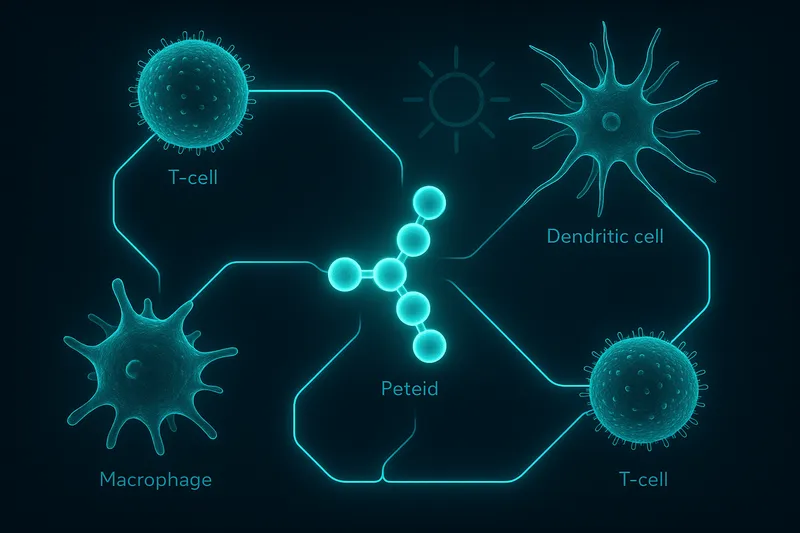
Beyond direct pathogen killing, LL-37 functions as a sophisticated immunomodulator — acting as a bridge between innate and adaptive immunity.
Immune Cell Recruitment
LL-37 has been reported to act as a chemoattractant, recruiting immune cells to sites of infection or injury:
- Neutrophils and monocytes: Reported recruitment via formyl peptide receptor signaling
- T-cells: Reported chemotactic activity for CD4+ T-lymphocytes, linking innate antimicrobial defense to adaptive immunity
- Mast cells: Reported activation with downstream histamine release
Cytokine and Inflammatory Modulation
LL-37 has a complex, context-dependent relationship with inflammation (Kahlenberg & Kaplan, 2013):
- LPS neutralization: LL-37 has been reported to bind and neutralize bacterial lipopolysaccharide (LPS), dampening excessive TLR4-driven inflammation
- TLR modulation: Modulates Toll-like receptor signaling, influencing the downstream inflammatory cascade
- Dual role: Can both promote inflammation (recruiting immune cells, activating TLRs) and resolve it (neutralizing LPS, modulating cytokine profiles) depending on concentration and context
This dual nature is why LL-37 is described as an "immunomodulator" rather than simply "immunostimulatory" — it helps calibrate the immune response rather than just amplify it (Kahlenberg & Kaplan, 2013).
Dendritic Cell Activation
LL-37 enhances dendritic cell (DC) maturation and antigen presentation:
- Promotes DC differentiation from monocytes
- Enhances antigen uptake and presentation to T-cells
- May improve vaccine responses by serving as a natural adjuvant
The Vitamin D Connection
The link between Vitamin D and LL-37 is one of the most significant discoveries in innate immunity research.
The Molecular Mechanism
In 2006, a landmark study in Science showed that Vitamin D directly induces LL-37 expression in macrophages and contributes to killing of intracellular Mycobacterium tuberculosis (Liu et al., 2006):
- Toll-like receptor activation upregulates the Vitamin D receptor (VDR) and the 1-hydroxylase that converts 25(OH)D to active 1,25(OH)₂D
- Active Vitamin D then binds the VDR, which activates the Vitamin D Response Element (VDRE) in the cathelicidin gene promoter
- This triggers transcription and production of hCAP18, which is cleaved to release active LL-37
Clinical Significance
This Vitamin D-LL-37 axis has been used to explain several clinical observations:
- Winter infection susceptibility: Lower Vitamin D levels in winter have been correlated with reduced LL-37 production and higher infection rates
- Tuberculosis and Vitamin D: The historical use of sunlight/Vitamin D for TB treatment may work partly through cathelicidin induction, consistent with the TLR/vitamin D macrophage pathway (Liu et al., 2006)
- COVID-19 and Vitamin D: The association between Vitamin D deficiency and worse COVID-19 outcomes has been hypothesized — though not proven — to be partially mediated by reduced LL-37 production
Practical Takeaway
Vitamin D status is described in the research as the most accessible lever on natural LL-37 production. This is why community protocols for exogenous LL-37 almost universally describe Vitamin D3 co-supplementation.
Potential Cancer Research
LL-37's role in cancer is an active and complex area of investigation. The relationship is not straightforward — LL-37 shows both anti-tumor and pro-tumor effects depending on cancer type.
Anti-Tumor Effects
Preclinical studies have reported LL-37-induced cancer cell death in several cancer types:
- Gastric cancer: Reports of apoptosis induction in gastric cancer cell lines
- Colon cancer: Reported antiproliferative effects in colon cancer cell lines
- Hematologic cancers: Reports of apoptosis in leukemia and lymphoma cells via caspase-independent pathways
- Ovarian cancer: Enhanced antitumor effects in preclinical models when LL-37 is combined with CpG oligodeoxynucleotides
The proposed selectivity for cancer cell membranes — which tend to carry more negative charge than normal cell membranes — is the basis for ongoing research into LL-37 fragments as candidate anticancer agents. All work to date is preclinical.
The Complexity
Important caveat: LL-37 has also been associated with promoting tumor growth in certain cancers, particularly breast, ovarian, and lung cancers, where it may promote angiogenesis and cell proliferation. This dual role makes blanket statements about LL-37 and cancer inappropriate and highlights the need for more research.
Gut Health Applications
LL-37's expression in intestinal epithelial cells makes it relevant to gastrointestinal health:
Intestinal Barrier Function
- LL-37 has been reported to strengthen tight junctions between intestinal epithelial cells in cell-culture models, supporting gut barrier integrity
- Preclinical work has linked LL-37 to enhanced intestinal epithelial wound healing in gut epithelial models
- This barrier-protective effect is often cited in discussions of "leaky gut" and intestinal permeability, though clinical evidence is absent
Inflammatory Bowel Disease (IBD)
- Altered cathelicidin expression has been observed in both Crohn's disease and ulcerative colitis patients
- LL-37's combined antimicrobial and barrier-protective properties make it a subject of interest in IBD research
- The peptide's ability to neutralize LPS may help reduce the inflammatory cascade triggered by bacterial translocation across a compromised gut barrier
Gut Microbiome Considerations
- LL-37 may selectively target pathogenic bacteria while relatively sparing beneficial commensal organisms, though this selectivity is concentration-dependent
- Its anti-biofilm properties could be relevant to gut biofilm-associated conditions