Gut Health & Inflammation
Heal your gut lining, reduce chronic inflammation, and restore digestive function. Research peptides repair tight junctions, calm inflammatory pathways like NF-κB, and rebalance the gut microbiome.
How It WorksGut Health
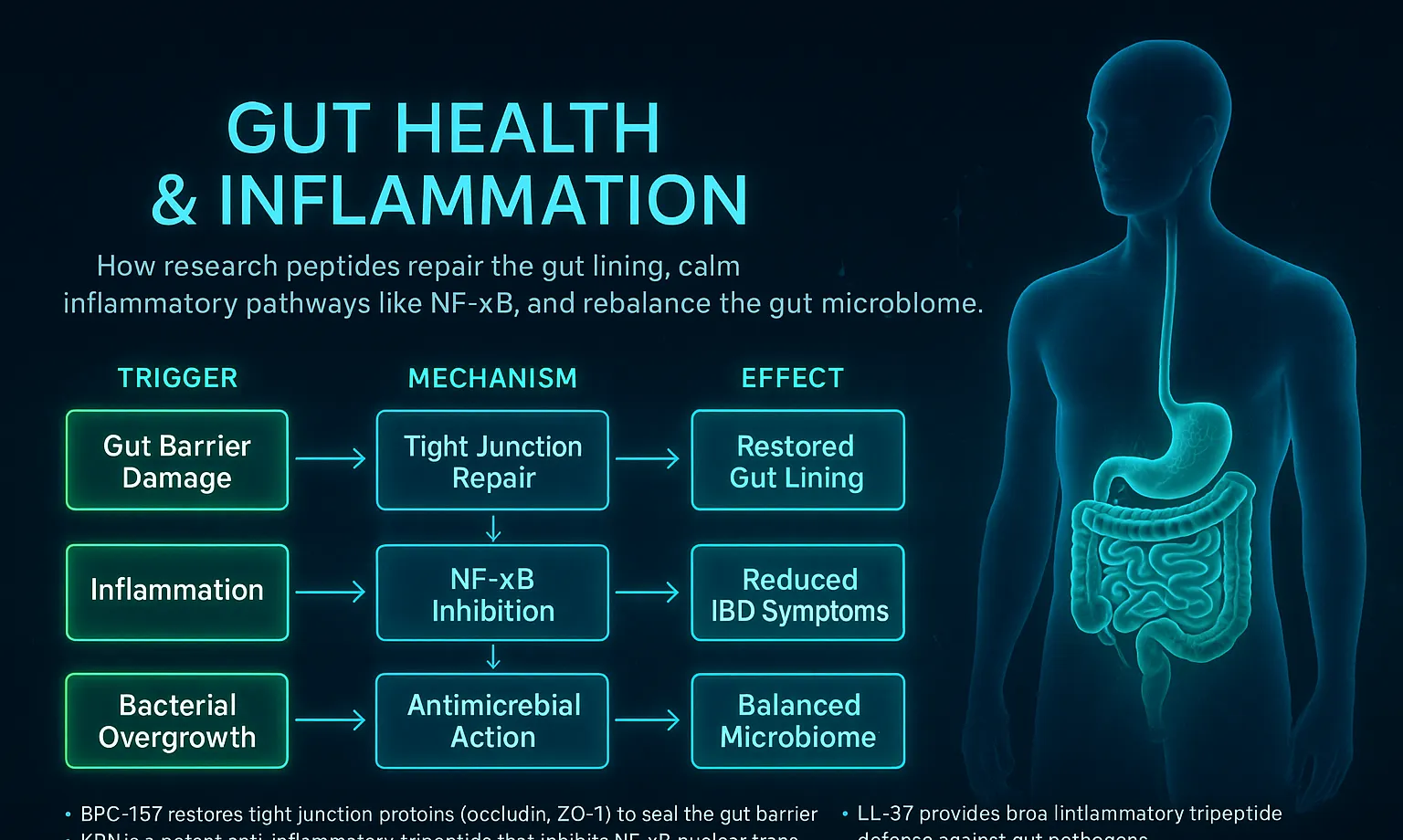
How Peptides Are Studied for Gut Health
BPC-157 is the most extensively studied peptide for gut healing, derived from a protein found in human gastric juice. Research shows it accelerates healing of gastric ulcers, intestinal anastomoses, and inflammatory bowel damage through multiple mechanisms including VEGF upregulation and nitric oxide modulation.
KPV is a tripeptide fragment of alpha-MSH that potently inhibits NF-κB — the master inflammatory switch. It reduces IL-6, TNF-α, and IL-1β levels, and has been studied specifically for IBD, Crohn's, and ulcerative colitis. Importantly, KPV does not cause the skin darkening associated with its parent molecule.
LL-37, the body's only cathelicidin antimicrobial peptide, directly kills gut pathogens while modulating immune responses. It's particularly relevant for biofilm-associated infections that resist conventional antibiotics.
Peptides Studied for Gut Health
Related Articles & Guides
articles
BPC-157 Use Up 33x: First Real-World Patient Data
A data firm screened 15 million medical records and found 1,039 documented BPC-157 users. Use rose 33-fold since 2020 — and the typical user changed.
BPC-157 Human Trial: US University Tests Rotator Cuff
A US university registered a randomized, placebo-controlled BPC-157 trial in shoulder surgery — 90 days of daily injections. What the protocol tests.
UCLA Reviewed 565 Peptide Studies: What It Found
UCLA orthopedists screened 565 studies on BPC-157, TB-500, GHK-Cu and three more. What the scoping review found — and the limit on its scope.
NVG-291 Phase 3 Begins: Nerve Repair Peptide Data
NervGen's NVG-291 starts Phase 3 screening after 2.6x GRASSP gains in chronic paralysis. What the nerve peptide is — and what's sourceable instead.
clinical
What Doctors Think About Peptides: New Survey Data
48% of physicians say patients disclosed peptide use last year — and 84% got their information from influencers, not doctors. The full survey data.
The $2.2B Race to Sell You Prescription BPC-157
Leerink pegs compounded peptides at a $2.2B telehealth market and Hims jumped 10% on the FDA vote. What the prescription route means for price and timing.
Are Peptides Legal in the US? What the FDA Vote Means
Most peptides aren't FDA-approved drugs — which isn't the same as illegal. The plain-English answer, and what the FDA's July vote did and didn't change.
FDA Panel Backs 6 Peptides for Compounding, Rejects DSIP
FDA advisers backed 6 of 7 peptides for compounding — Semax and Epitalon included — and rejected DSIP, all over staff objections. Every vote tally.
side-effects
Glow Blend Side Effects: Component-Level Breakdown
Flushing, taste changes, and brief lethargy lead. Community reports cluster around the GHK-Cu component. Full safety breakdown.
KPV Side Effects: Anti-Inflammatory Peptide Safety
Animal colitis models report clean safety. Community data adds mild injection-site reactions. Full safety breakdown.
KLOW Blend Side Effects: Component Research Review
Injection-site reactions lead. Flushing from GHK-Cu and brief lethargy from KPV cluster in community reports. Full safety breakdown.
BPC-157 Side Effects: What Animal and Human Data Show
Animal models report no toxicity. Community data clusters around injection-site irritation and brief fatigue. Full safety breakdown.
results
Glow Blend Results: Week-by-Week Timeline
Skin texture shifts by week 4 — but collagen density takes longer. Full 12-week Glow timeline for skin, wounds, and recovery.
LL-37 Results Timeline: Week-by-Week
Acute users describe shifts in 1-2 weeks; CIRS protocols run months. Full LL-37 timeline by use case, with biomarker watch and variability factors.
Wolverine Stack Results: Week-by-Week Timeline
Most users feel the difference by week 2 — but injection site matters more than dose. Full timeline from day 1 through month 3.
KPV Results: Week-by-Week Timeline
Most users notice gut changes by week 2 — but route choice changes everything. Full 12-week timeline for oral vs subcutaneous KPV.
guides
Glow Blend Reconstitution: 70mg + 2mL Chart
3.5mg = 10 units. Most mixing errors happen at the syringe math step. Step-by-step with dilution chart, syringe math, and storage rules.
Buy Glow Blend: Compare 5 Vendors, From $88
Compare 5 Glow Blend (BPC-157 + GHK-Cu + TB-500) vendors: from $88 a vial, best value $1.26/mg. Codes save up to 50%.
Buy LL-37: Compare 3 Vendors, From $45
Compare 3 LL-37 vendors side by side: from $45 a vial, best value $7.80/mg. Codes save up to 50%. Vial sizes, COA status, real cost per week.
Buy GHK-Cu + KPV: Price, COA & Cost Per Week
Only 1 vetted GHK-Cu + KPV source right now: $85 a vial, $1.21/mg. Codes save up to 10%. COA status and real cost per week.
benefits
Glow Blend: 3-Phase Collagen + Tissue Repair
GHK-Cu drives 71% of the Glow blend — but the two repair peptides are why it works. 5 effects ranked by evidence quality.
LL-37 Benefits: Biofilm Breaker + 9 Immune Effects
LL-37 is an antimicrobial peptide studied for biofilm breakdown, immune defense, and wound healing. 9 effects ranked by research strength, cited data.
KPV Peptide Benefits: Gut, Skin & Immune
KPV reduced colitis severity by 50%+ in animal models — and it works orally. 5 research-backed benefits with cited studies and evidence ratings.
Klow Blend: 4-Peptide Repair + NF-kB Control
KPV is why Klow exists — one anti-inflammatory pathway the other blends miss. 6 research-backed effects with cited studies.
buying-guide
Peptides Under $50/vial: 12 Picks
12 peptides priced under $50/vial with real vendor links — healing, cognitive, sexual, metabolic. $/mg shown for every pick so you can buy smart.
Peptide Stacks Under $200/Month
4 complete peptide protocols under $200/month — fat loss, healing, anti-aging, sleep. Per-peptide cost math, vendor picks, and which vial to buy.
Price Comparisons
Active Coupon Codes
Save on peptides from these verified vendors with exclusive discount codes.
Ion Peptide coupon code: 15% off
Use code thepeptidecatalog at checkout
EZ Peptides coupon code: 10% off
Use code thepeptidecatalog at checkout
Ascension Peptides coupon code: 50% off
Use code THEPEPTIDECATALOG at checkout
Glacier Aminos coupon code: 10% off
Use code thepeptidecatalog at checkout
Nura Peptide coupon code: 30% off
Use code thepeptidecatalog at checkout
Dynamic Peptide coupon code: 10% off
Use code thepeptidecatalog at checkout
Limitless Biotech coupon code: 15% off
Use code peptideinfo at checkout
BioLongevity Labs coupon code: 15% off
Use code thepeptidecatalog at checkout
Swiss Chems coupon code: 10% off
Use code THEPEPTIDECATALOG at checkout
Related Research Areas
Frequently Asked Questions
Which peptide is most effective for inflammatory bowel disease?
KPV specifically targets IBD inflammation through NF-κB inhibition and has human studies in ulcerative colitis. BPC-157 is more broadly healing and addresses the tissue damage component. Many researchers use both together — KPV for inflammation control, BPC-157 for tissue repair.
Can gut peptides help with leaky gut syndrome?
Yes, BPC-157 strengthens tight junction proteins and reduces intestinal permeability. KPV addresses the inflammatory component that damages gut barrier function. However, 'leaky gut' often requires addressing root causes like diet, stress, and microbiome imbalance alongside peptide therapy.
How long does it take to see gut health improvements?
Some people notice reduced bloating or digestive discomfort within days, but true gut lining repair typically takes 4-8 weeks. The gut regenerates every 3-5 days, but chronic inflammation needs time to resolve, and microbiome rebalancing can take months.
Are gut peptides safe with other digestive medications?
No major interactions are reported with common digestive meds, but timing matters. BPC-157 may enhance the healing effects of proton pump inhibitors for ulcers. Some researchers space peptides away from antibiotics to avoid potential interference, though this isn't well-established.
Can gut peptides be taken orally instead of injection?
BPC-157 shows some oral bioactivity and is sometimes taken orally for direct gut contact. However, injection provides more predictable systemic levels. LL-37 and KPV are typically injected subcutaneously for consistent absorption and systemic anti-inflammatory effects.
This page is for educational and research purposes only. It does not constitute medical advice. Always consult a qualified healthcare professional before starting any peptide protocol.