Injury Recovery & Tissue Repair
Recover faster from injuries, surgeries, and chronic tissue damage. Research peptides accelerate tendon, ligament, and muscle repair by boosting blood vessel growth, reducing inflammation, and stimulating collagen synthesis.
How It WorksInjury Recovery
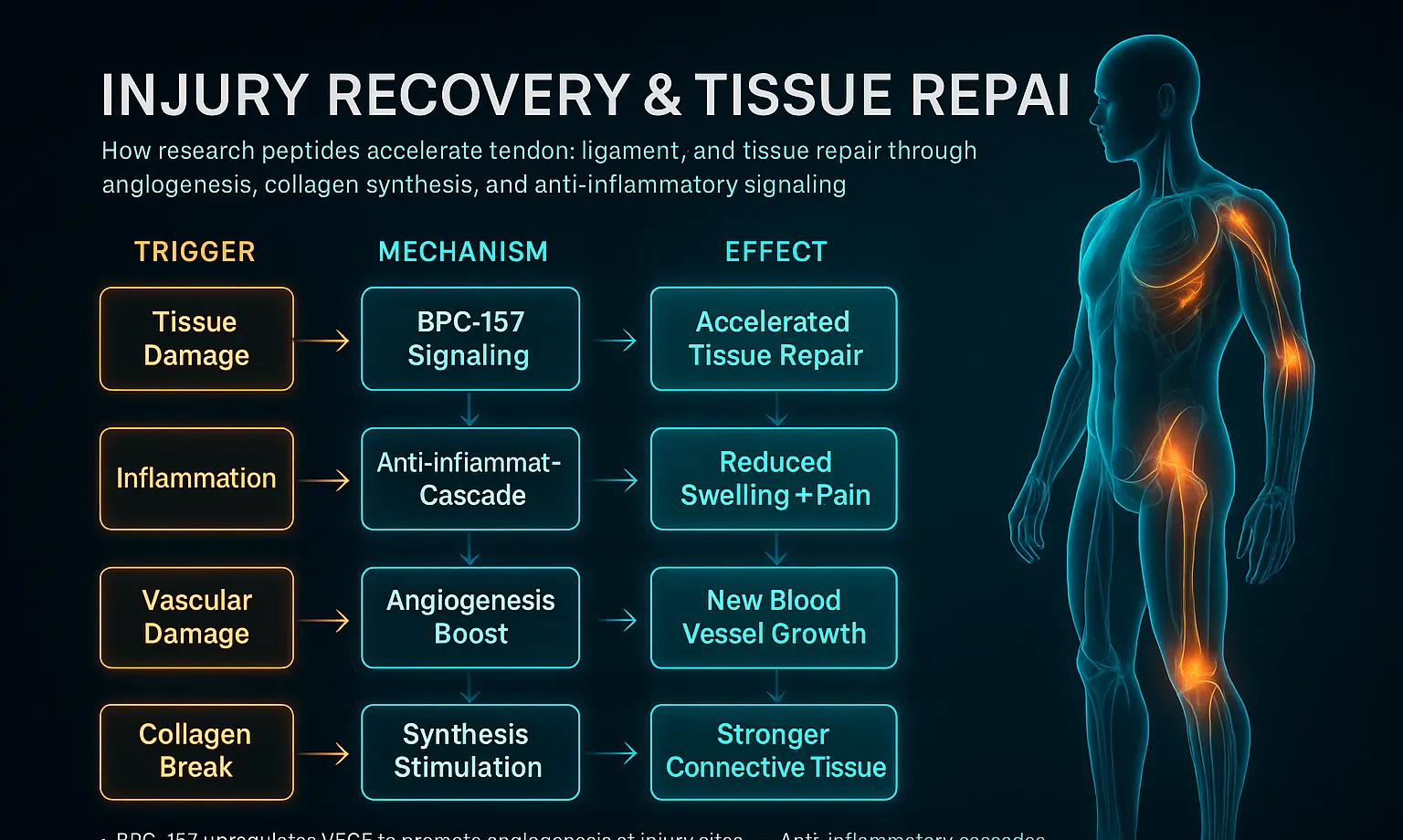
How Peptides Are Studied for Healing
BPC-157 (Body Protection Compound) is the most widely studied healing peptide, with over 100 animal studies showing accelerated healing of tendons, ligaments, muscle, gut lining, and bone. It works primarily through upregulating VEGF and growth factor expression, promoting angiogenesis at injury sites.
TB-500 (a fragment of Thymosin Beta-4) promotes cell migration and reduces inflammation through actin regulation. GHK-Cu is a copper-binding tripeptide that stimulates collagen synthesis, wound contraction, and has demonstrated anti-inflammatory properties.
These peptides are commonly stacked in research protocols — BPC-157 and TB-500 together (the 'Wolverine Stack') is one of the most popular combinations for comprehensive tissue repair support.
Peptides Studied for Injury Recovery
BPC-157
A healing peptide for tendons, joints, gut issues, and injury recovery.
TB-500
A tissue repair peptide for flexibility, injury recovery, and systemic healing.
Thymosin Beta-4
A full-spectrum healing peptide for tissue repair, cardiac support, and hair growth.
GHK-Cu
A copper peptide for anti-aging skin, wound healing, and hair regrowth.
ARA-290
An EPO-derived peptide studied for neuropathic pain, nerve repair, and anti-inflammatory tissue protection.
Cartalax
A Khavinson tripeptide (AED) studied in preclinical cell models for cartilage and connective-tissue gene regulation.
PDA (Pentadeca Arginate)
An arginate-salt analog of BPC-157 marketed for tissue repair; no PDA-specific human studies exist — evidence is extrapolated from BPC-157.
Related Articles & Guides
articles
UCLA Reviewed 565 Peptide Studies: What It Found
UCLA orthopedists screened 565 studies on BPC-157, TB-500, GHK-Cu and three more. What the scoping review found — and the limit on its scope.
NVG-291 Phase 3 Begins: Nerve Repair Peptide Data
NervGen's NVG-291 starts Phase 3 screening after 2.6x GRASSP gains in chronic paralysis. What the nerve peptide is — and what's sourceable instead.
Copper Peptide Injections Hit NPR: What the Data Shows
NPR put GHK-Cu injections on national radio September 7. What the human record actually covers, what the February FDA panel decides, and how buyers verify.
GLP-1 Hair Loss: 37% Higher Risk, New Genetic Data
A September 3 genetic study ties GLP-1 receptor activity to male-pattern hair loss — a different mechanism than the shedding seen in July's BMJ cohort.
guides
GHK-Cu Dosage Chart: SubQ & Topical
1.7mg/day SubQ = 10 units from a 50mg vial in 3mL. Daily dosing, 8 weeks on/8 off, plus how topical strength compares for skin use.
Glow Blend Reconstitution: 70mg + 2mL Chart
3.5mg = 10 units. Most mixing errors happen at the syringe math step. Step-by-step with dilution chart, syringe math, and storage rules.
Buy Glow Blend: Compare 5 Vendors, From $88
Compare 5 Glow Blend (BPC-157 + GHK-Cu + TB-500) vendors: from $88 a vial, best value $1.26/mg. Codes save up to 50%.
PDA Dosage: Pentadeca Arginate Protocols
PDA has no trial-established dose of its own — community protocols borrow BPC-157's numbers. The reconstitution math and an honest read on the evidence.
side-effects
Copper Uglies: How Long the GHK-Cu Purge Lasts
Copper peptide users report a 2-4 week flaking and breakout phase. What community sources describe, how long it runs, and what shortens it.
Glow Blend Side Effects: Component-Level Breakdown
Flushing, taste changes, and brief lethargy lead. Community reports cluster around the GHK-Cu component. Full safety breakdown.
TB-500 Side Effects: What Phase 2 Trial Data Shows
Injection-site reactions lead. Brief fatigue and mild flushing follow. Full safety breakdown from dermal-ulcer trial data.
KLOW Blend Side Effects: Component Research Review
Injection-site reactions lead. Flushing from GHK-Cu and brief lethargy from KPV cluster in community reports. Full safety breakdown.
clinical
What Doctors Think About Peptides: New Survey Data
48% of physicians say patients disclosed peptide use last year — and 84% got their information from influencers, not doctors. The full survey data.
The $2.2B Race to Sell You Prescription BPC-157
Leerink pegs compounded peptides at a $2.2B telehealth market and Hims jumped 10% on the FDA vote. What the prescription route means for price and timing.
Are Peptides Legal in the US? What the FDA Vote Means
Most peptides aren't FDA-approved drugs — which isn't the same as illegal. The plain-English answer, and what the FDA's July vote did and didn't change.
FDA Panel Backs 6 Peptides for Compounding, Rejects DSIP
FDA advisers backed 6 of 7 peptides for compounding — Semax and Epitalon included — and rejected DSIP, all over staff objections. Every vote tally.
results
Glow Blend Results: Week-by-Week Timeline
Skin texture shifts by week 4 — but collagen density takes longer. Full 12-week Glow timeline for skin, wounds, and recovery.
PDA Results: What to Realistically Expect
There's no human timeline data for PDA. What community sources report week by week, why it's borrowed from BPC-157, and how to read it honestly.
Cartalax Results: What to Realistically Expect
There is no human timeline data for Cartalax. What community sources report week by week, why it's mostly theoretical, and how to read it honestly.
ARA-290 Results: Week-by-Week Timeline
Trials ran 28-day courses but measured nerve regrowth out to 16 weeks. What the published ARA-290 data documented at each stage.
benefits
Glow Blend: 3-Phase Collagen + Tissue Repair
GHK-Cu drives 71% of the Glow blend — but the two repair peptides are why it works. 5 effects ranked by evidence quality.
Exosome Serums for Skin: Do They Work?
Exosome and growth-factor serums went viral — but what does the early evidence actually show, and which ingredients carry the proof?
PDA Benefits: What the Research Shows
PDA is sold as an upgraded BPC-157 for healing — but it has zero studies of its own. What the BPC-157 research supports, and what PDA can't claim.
Cartalax Benefits: What the Research Shows
Cartalax is an AED tetrapeptide studied for cartilage and joint repair. The 5 effects the cell and animal research supports, ranked by evidence strength.
comparison
GHK-Cu Topical vs Injectable: The Evidence Gap
Topical GHK-Cu has decades of clinical data; injectable has none in humans. Which route fits which goal -- and when do both make sense?
TB-4 vs TB-500: Full Peptide vs Fragment
TB-4 has extra signaling sequences TB-500 lacks — but costs more. Mechanisms, dosing, stability, and which to choose.
BPC-157 vs TB-500: Which Heals Faster?
Different mechanisms, different strengths. One is better for tendons, the other for systemic repair. Full comparison with stacking protocol.
buying-guide
Peptides Under $50/vial: 12 Picks
12 peptides priced under $50/vial with real vendor links — healing, cognitive, sexual, metabolic. $/mg shown for every pick so you can buy smart.
Peptide Stacks Under $200/Month
4 complete peptide protocols under $200/month — fat loss, healing, anti-aging, sleep. Per-peptide cost math, vendor picks, and which vial to buy.
Price Comparisons
Compare ARA-290 Prices
Find the best deals from trusted vendors
Compare BPC-157 Prices
Find the best deals from trusted vendors
Compare Cartalax Prices
Find the best deals from trusted vendors
Compare GHK-Cu Prices
Find the best deals from trusted vendors
Compare PDA (Pentadeca Arginate) Prices
Find the best deals from trusted vendors
Compare TB-500 Prices
Find the best deals from trusted vendors
Compare Thymosin Beta-4 Prices
Find the best deals from trusted vendors
Active Coupon Codes
Save on peptides from these verified vendors with exclusive discount codes.
Ion Peptide coupon code: 15% off
Use code thepeptidecatalog at checkout
EZ Peptides coupon code: 10% off
Use code thepeptidecatalog at checkout
Ascension Peptides coupon code: 50% off
Use code THEPEPTIDECATALOG at checkout
Glacier Aminos coupon code: 10% off
Use code thepeptidecatalog at checkout
Nura Peptide coupon code: 30% off
Use code thepeptidecatalog at checkout
Dynamic Peptide coupon code: 10% off
Use code thepeptidecatalog at checkout
Limitless Biotech coupon code: 15% off
Use code peptideinfo at checkout
BioLongevity Labs coupon code: 15% off
Use code thepeptidecatalog at checkout
Swiss Chems coupon code: 10% off
Use code THEPEPTIDECATALOG at checkout
Related Research Areas
Frequently Asked Questions
Can BPC-157 and TB-500 be used together safely?
The 'Wolverine Stack' (BPC-157 + TB-500) is commonly used in research because they work through complementary mechanisms. BPC-157 focuses on angiogenesis and growth factor upregulation, while TB-500 enhances cell migration and systemic repair. No negative interactions are reported.
How long should healing peptides be used after an injury?
Most research protocols run 4-8 weeks for acute injuries. The initial inflammatory phase benefits from immediate intervention, while tissue remodeling continues for months. Some researchers use them throughout the entire healing timeline, while others cycle on and off.
Do healing peptides work for chronic or old injuries?
Yes, though results may take longer. Chronic injuries often have stalled healing cascades or poor blood supply. BPC-157's angiogenic effects can 'restart' healing even in old injuries. Many report improvements in long-standing tendon or joint issues after 6-12 weeks.
Are healing peptides only for sports injuries?
No — these peptides are studied for surgical recovery, wound healing, gut repair, and general tissue maintenance. BPC-157 particularly has broad systemic healing effects beyond just musculoskeletal injuries.
What's the difference between local and systemic administration?
Local injection near the injury site provides targeted high concentrations, while systemic (subcutaneous) administration offers whole-body benefits. Many researchers combine both approaches — local for acute injuries, systemic for general recovery and maintenance.
This page is for educational and research purposes only. It does not constitute medical advice. Always consult a qualified healthcare professional before starting any peptide protocol.