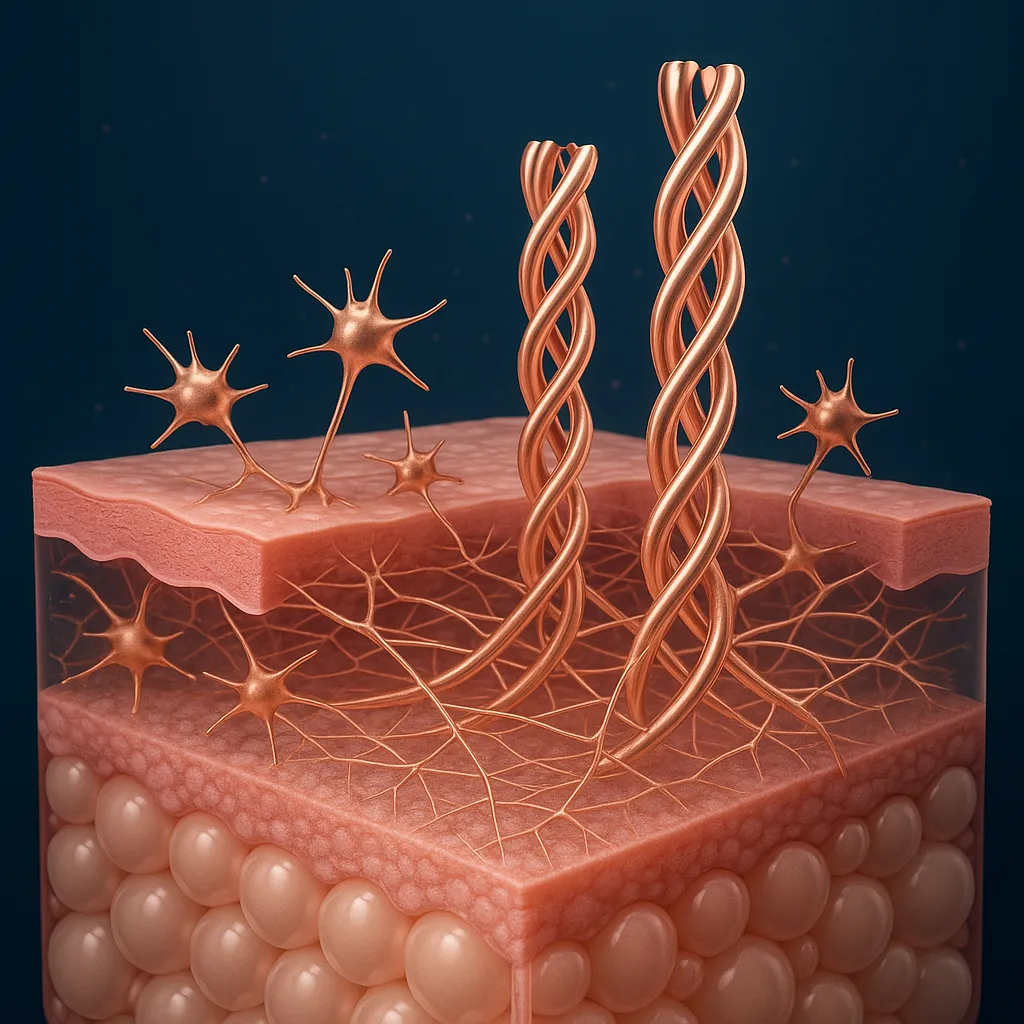
For readers searching "best peptides for skin and hair," the short answer most experienced users describe in community sources is this: skin and hair share underlying biology — the same dermal fibroblasts, the same Wnt/beta-catenin signaling, the same age-related decline in tissue-remodeling signals. Community sources commonly describe GHK-Cu as the foundation for any combined protocol because it's the only peptide on this list with documented evidence in both contexts. Hair-specific tools (PTD-DBM, thymulin) and skin-specific tools (the melanotans) layer onto that foundation.
Research-context information only. Peptides discussed below are research compounds. Protocols, doses, and reactions reported come from published research and self-reported community sources. This article reports what has been documented, not what should be done. Consult a licensed physician for personal medical decisions.
Evidence at a glance
Peptides covered below, sorted by clinical evidence strength. Each peptide also carries a parallel community-evidence grade reflecting real-world adoption. How we grade evidence.
Mechanistic case for skin/hair via systemic immune modulation; no dermatology RCTs.
This guide ranks the 5 peptides community sources most commonly describe for skin quality, hair growth, or both, in the order experienced users typically reach for them. Each entry explains what trial data and community usage describe for that peptide, who tends to choose it, and what self-reported community outcomes look like. Cycle structure, application mechanics, and bloodwork detail live in the linked deep-dive guides.
The Rankings
Bac Water Made for Peptides50% off
Don't risk a $300 peptide on generic bac water.
Most cloudy reconstitutions trace back to one thing — and it isn't the peptide. Sterile, non-pyrogenic, 0.9% benzyl alcohol — formulated for peptide reconstitution, not repackaged from generic stock.
✓ 0.9% benzyl alcohol✓ Made for peptides✓ 30 mL multi-dose
Best for: users prioritizing skin texture, tone, and firmness, optionally layered for hair follicle support.
GHK-Cu (glycyl-L-histidyl-L-lysine copper complex) is a naturally occurring tripeptide. Published research describes plasma levels averaging around 200 ng/mL at age 20 and declining to approximately 80 ng/mL by age 60 — a 60% reduction that tracks closely with documented skin aging.
The scope of GHK-Cu's biological activity is unusually broad. Gene expression studies using the Broad Institute's Connectivity Map identified over 4,000 human genes modulated by GHK (PMID:29986520) — roughly 6% of the human genome. These genes cluster in tissue remodeling, antioxidant defense, and anti-inflammatory pathways. For skin specifically, fibroblast culture studies described GHK-Cu stimulating production of type I and type III collagen, elastin, and glycosaminoglycans at concentrations achievable through both topical and injectable delivery (PMID:3169264). The copper ion serves as a required cofactor for lysyl oxidase, the enzyme that cross-links collagen and elastin into mechanically strong fibers.
Beyond structural proteins, published research describes GHK-Cu as a remodeling coordinator — increasing synthesis of metalloproteinases that break down damaged collagen while simultaneously stimulating new collagen synthesis. The hair follicle connection runs through the same pathways: GHK-Cu's stimulation of extracellular matrix extends to perifollicular tissue, and published research describes upregulation of dermal papilla cell function and suppression of TGF-beta (which is documented as elevated in balding scalp tissue).
Community reports cluster around three themes: visible texture and tone improvement at 4-8 weeks of consistent topical use, scar tissue softening over 8-16 weeks, and modest hair-follicle support when layered into hair protocols. The most common community caveat is that injectable GHK-Cu produces more consistent systemic effects than topical-only protocols.
Best for: users prioritizing UV protection or with documented MC1R variants and high UV-damage risk.
Melanotan-1 (afamelanotide) is a synthetic analog of alpha-melanocyte-stimulating hormone. Published research describes it as selectively activating the melanocortin 1 receptor (MC1R), driving genuine de novo eumelanin synthesis — the dark, photoprotective pigment that absorbs UV radiation and neutralizes free radicals.
Melanotan-1 reached FDA approval (as afamelanotide) for erythropoietic protoporphyria — a condition where patients cannot tolerate any sunlight. The Harms et al. EPP trial reported afamelanotide implants increasing pain-free time in sunlight by a clinically significant margin, demonstrating that the eumelanin produced was functionally photoprotective. For users without EPP, the same MC1R activation mechanism is described as upregulating DNA repair enzymes in melanocytes and keratinocytes, enhancing the skin's documented ability to fix UV-induced pyrimidine dimers (the lesions that initiate skin cancer).
The MC1R selectivity matters because published pharmacology describes it as not significantly activating MC3R (metabolic regulation), MC4R (appetite, sexual function), or MC5R (exocrine glands) at standard doses. That selectivity is what trial data describe as producing pigmentation without the nausea, appetite suppression, or sexual side effects that characterize less selective melanocortin agonists.
Community reports cluster around three themes: gradual pigmentation development over 2-4 weeks, durable tan persistence after dosing ends, and a clean side-effect profile relative to melanotan-2 in self-reported community timelines.
3. Melanotan-2 — the more potent (and heavier-trade-off) tanning option
Best for: users who want a more aggressive tanning response and accept the documented side-effect profile, with dermatological monitoring.
Melanotan-2 is a cyclic heptapeptide analog of alpha-MSH. Published research describes it as activating melanocortin receptors non-selectively — hitting MC1R (pigmentation), MC3R (energy homeostasis), MC4R (sexual function and appetite), and MC5R (exocrine secretion). This broad receptor profile makes it more potent for tanning than melanotan-1 in published clinical research, but also produces a side-effect profile that extends well beyond skin.
The Dorr et al. phase I trial described measurable tanning across face, trunk, and extremities after just five low-dose subcutaneous injections, with quantitative reflectance measurements confirming increased melanin density. The trade-off documented in trials and community reports: MC4R activation produces appetite suppression and sexual arousal effects (which led to the development of PT-141 for that specific application), and nausea and facial flushing are commonly described during the loading phase.
The melanoma question requires direct attention. Case reports in the dermatological literature have documented new nevi during melanotan-2 use, changes in existing moles, and rare melanoma diagnoses in melanotan-2 users. The relationship is not definitively causal in the published literature — melanoma has a long latency period and many confounders — but the concern is biologically plausible because MC1R stimulation drives melanocyte proliferation alongside melanin production. Trial protocols and community sources commonly describe baseline mole mapping and 3-6 month dermatological skin checks as standard during melanotan-2 use.
Community reports cluster around faster and darker tanning than melanotan-1, alongside the documented loading-phase side effects. Users who later switch from melanotan-2 to melanotan-1 commonly describe the side-effect reduction as the primary motivation.
Best for: users with androgenetic alopecia layering a Wnt-pathway tool onto an existing hair-loss protocol.
PTD-DBM (protein transduction domain-Dishevelled binding motif) represents a different mechanistic approach to hair loss than hormonal interventions. Rather than blocking DHT or increasing scalp blood flow, published research describes PTD-DBM as directly reactivating the Wnt/beta-catenin signaling pathway — the master regulator of hair follicle stem cell activation.
The target is CXXC5 — a negative feedback regulator that suppresses Wnt/beta-catenin signaling by binding Dishevelled. Published research describes CXXC5 expression as elevated in balding scalp tissue, dampening the Wnt signal that would otherwise activate hair follicle stem cells and push dormant follicles into anagen (the growth phase). The Lee et al. 2017 study from the Yonsei group reported PTD-DBM disrupting the CXXC5-Dvl interaction in mouse models, stimulating both hair regrowth in shaved models and wound-induced hair follicle neogenesis.
Subsequent research from the same group described CXXC5 as mediating DHT-induced hair loss via prostaglandin D2 (PGD2), positioning PTD-DBM as mechanistically complementary to finasteride — finasteride reduces DHT production upstream, while PTD-DBM counteracts a documented downstream effect on follicle signaling. Human clinical data is at the preclinical stage.
Community reports vary widely, which is itself a signal that responses are individual at this stage of evidence. Users in community sources commonly describe topical application 2-3 times per week after microneedling, with a 3-6 month evaluation window before assessing response.
5. Thymulin — the zinc-dependent immune-modulating hair tool
Best for: users with immune-mediated hair loss (alopecia areata).
Thymulin is a nonapeptide hormone produced by thymic epithelial cells. Published research describes an absolute requirement for zinc binding — the metal ion is required in an equimolar ratio for the peptide to bind its receptor (Dardenne et al. 1989). Without zinc, thymulin is functionally inert. Community sources commonly describe zinc co-supplementation as mandatory.
Thymulin's connection to hair growth was established through organ culture studies using human hair follicles. The Meier et al. 2012 study reported thymic peptides modulating human hair follicle growth directly through local follicle-level signaling, distinct from systemic immune effects. The immune connection matters specifically for alopecia areata — community sources commonly describe thymulin's immunomodulatory properties as restoring immune tolerance to follicular tissue while its direct follicular effects support regrowth.
For androgenetic alopecia (pattern baldness), the published evidence is weaker — the hair loss mechanism is hormonal rather than immunological in the trial literature, and thymulin's influence on DHT-driven miniaturization is less established. Community usage commonly describes thymulin specifically for immune-mediated patterns.
Community reports cluster around 3-6 month timelines before visible regrowth becomes evaluable, with users in community sources commonly describing combined zinc + thymulin protocols and emphasizing baseline serum zinc testing.
Community usage and trial-evidence patterns map cleanly onto reader profiles. Here's how the picks above tend to break down across common audiences:
Skin rejuvenation users prioritizing wrinkles, texture, and firmness typically choose GHK-Cu as the foundation. No other peptide on this list carries the same depth of evidence for collagen, elastin, and extracellular matrix remodeling. Community sources commonly describe topical at 1-2% concentration for 8-12 weeks, with subcutaneous layering for users wanting accelerated results.
Users prioritizing UV protection or with MC1R variants and high UV-damage risk typically choose melanotan-1 — published research describes it as having FDA approval for EPP, clinical-trial data, and selective MC1R activation that minimizes off-target effects.
Users prioritizing more aggressive tanning who accept the trade-offs sometimes choose melanotan-2 with dermatological monitoring. Community sources commonly describe melanotan-1 as the alternative when photoprotection is the goal without the side-effect profile.
Users with androgenetic alopecia (male or female pattern baldness) commonly layer PTD-DBM onto existing finasteride or minoxidil protocols. Published research describes the Wnt-pathway mechanism as complementary to hormonal interventions. Community usage commonly describes a 3-6 month evaluation window.
Users with immune-mediated hair loss (alopecia areata) typically choose thymulin. Community sources commonly describe it as the targeted choice because published research describes both an immunological signal (autoimmune follicular attack) and a direct follicular signal — with zinc co-supplementation mandatory.
Users with combined skin and hair goals commonly run GHK-Cu as the foundation, layering PTD-DBM for hair-specific Wnt activation in androgenetic patterns or thymulin + zinc in immune-mediated patterns. Melanotan-1 is added when UV protection is also a priority.
What Trial and Community Data Describe as Signals of Effect
Three signals appear consistently in published research and community sources, in this order:
Weeks 1-4: Skin signals. Community reports on GHK-Cu commonly describe early texture and tone improvements at 4 weeks of consistent topical application. Melanotan-1 community timelines describe gradual pigmentation onset at 2-4 weeks. Hair signals do not appear in this window — community sources commonly describe hair follicle cycling as too slow for early-window evaluation.
Months 2-3: Hair early signals. Community reports on PTD-DBM and thymulin commonly describe reduced shedding and finer vellus hair appearance at 6-8 weeks, but community sources commonly describe these as preliminary signals rather than visible density change.
Months 3-6: Hair density evaluation. Community sources commonly describe the 3-6 month window as the earliest reliable assessment point for hair protocols. Trichoscopic measurement of hair density per square centimeter and vellus-to-terminal ratios are described in published research and community guidance as more objective than subjective evaluation.
Bloodwork. Trial protocols and community guidance commonly describe baseline serum zinc as essential before thymulin (and informative for any hair protocol — zinc deficiency independently causes telogen effluvium in published research). Hair-loss-specific hormone panels (free and total testosterone, DHT, DHEA-S, thyroid, ferritin) are commonly described in community sources.
For melanotan protocols specifically, community sources and published guidance describe baseline dermatological skin check with mole mapping as standard before introducing any melanocyte-stimulating compound.
Stacking Patterns Community Sources Describe
Skin and hair peptides operate through distinct mechanisms in published research, which is why community usage commonly describes layered protocols:
Skin rejuvenation pairing — GHK-Cu + Melanotan-1: GHK-Cu addresses the structural matrix; melanotan-1 addresses the UV defense system. Community sources commonly describe topical GHK-Cu twice daily alongside subcutaneous melanotan-1 2-3 times per week.
Hair regrowth layered protocol — PTD-DBM + GHK-Cu + Zinc: PTD-DBM reactivates Wnt/beta-catenin; GHK-Cu supports the perifollicular extracellular matrix and suppresses TGF-beta in published research; zinc supports follicular enzyme systems and thymulin activity. Community sources commonly describe PTD-DBM topically after microneedling 2-3 times weekly, GHK-Cu on alternate days, and oral zinc daily.
Immune-mediated hair loss layered protocol — Thymulin + GHK-Cu + Zinc: For alopecia areata specifically, community sources commonly describe thymulin addressing the immune component, GHK-Cu supporting follicular recovery once immune attack subsides, and zinc supporting thymulin activity.
Combinations community sources commonly describe avoiding: Melanotan-1 and melanotan-2 layered together — published research describes them as competing for the same MC1R receptor, with the combination adding side effects without proportionate benefit.
Maquart FX, et al. Stimulation of collagen synthesis in fibroblast cultures by the tripeptide-copper complex glycyl-L-histidyl-L-lysine-Cu2+. FEBS Lett. 1988.