PT-141 (bremelanotide) was literally born from Melanotan-2. When researchers discovered that MT-2 caused powerful sexual arousal as a "side effect" during tanning studies, they engineered a modified version to target sexual function specifically — that became PT-141 (Hadley & Dorr, 2006).
Despite sharing a molecular ancestor, these two peptides serve fundamentally different purposes. This guide breaks down exactly where they overlap, where they diverge, and which one fits your goals.
Side-by-side evidence
Outcomes where both peptides have published data. Each cell carries two grades: clinical evidence (human-RCT depth for this specific outcome) and community evidence (real-world adoption). How we grade evidence.
| Outcome | Melanotan II | PT-141 |
|---|---|---|
| Sexual arousal / libido | Clinical:Weak Community:Strong Strong libido and erectogenic effects reported by users; not FDA-approved. | Clinical:Strong Community:Moderate FDA-approved (bremelanotide) for HSDD in premenopausal women. |
| Tanning effect | Clinical:Weak Community:Strong Reliably increases melanogenesis — primary draw for many users. | Clinical:Preliminary Community:Moderate Minimal tanning effect; metabolite lacks MT-2's MC1R activity. |
| Side effect burden | Clinical:Weak Community:Strong Nausea, BP changes, mole darkening, and rare melanoma reports — meaningful safety concerns. | Clinical:Moderate Community:Moderate Nausea (~40%), flushing, transient BP rise; cleaner safety profile than MT-2. |
Quick Comparison
| Feature | PT-141 (Bremelanotide) | Melanotan-2 |
|---|---|---|
| Primary use | Sexual function (desire + arousal) | Tanning (with sexual side effects) |
| FDA status | ✅ Approved (HSDD in women) | ❌ Not approved for any indication |
| Receptor targets | MC3R, MC4R (brain) | MC1R, MC3R, MC4R, MC5R (body-wide) |
| Tanning effect | Minimal to none | Significant |
| Sexual enhancement | Strong, targeted | Strong, but untargeted |
| Typical dose | 500 mcg–1 mg (as needed) | 250–500 mcg (daily during loading) |
| Dosing pattern | On-demand before activity | Daily loading → weekly maintenance |
| Nausea severity | Moderate (40%) | Severe during loading (80-90%) |
| Mole/skin changes | No | Yes — requires monitoring |
| Appetite effects | Minimal | Significant suppression |
The Origin Story: How PT-141 Came From MT-2
Understanding the relationship between these peptides explains their differences:
1990s: Researchers at the University of Arizona developed MT-2 as a tanning agent. During Phase I trials, male subjects unexpectedly reported spontaneous erections (Dorr et al., 1996).
1998: Wessells et al. confirmed MT-2's erectogenic properties in a double-blind trial — 8 of 10 men with psychogenic ED developed clinically apparent erections (Wessells et al., 1998).
2000s: Palatin Technologies modified MT-2's structure to create bremelanotide (PT-141), retaining MC3R/MC4R selectivity for sexual function while reducing MC1R activity (tanning) and improving the pharmacological profile.
2019: PT-141 received FDA approval (as bremelanotide) for hypoactive sexual desire disorder (HSDD) in premenopausal women, following successful RECONNECT Phase III trials (Kingsberg et al., 2019).
MT-2 never progressed past Phase I for tanning. Its sexual effects remained a "side effect" rather than a feature.
Mechanism of Action: Same Family, Different Targets
Both peptides work through the melanocortin receptor system, but their selectivity profiles are dramatically different.
PT-141: Precision Targeting
PT-141 primarily activates MC3R and MC4R in the hypothalamus — the brain region controlling sexual desire and arousal. This triggers:
- Dopamine release in reward/motivation circuits
- Enhanced neural signaling for sexual desire
- Increased genital arousal through central (not peripheral) mechanisms
This is fundamentally different from PDE5 inhibitors (Viagra, Cialis) which work on blood vessels. PT-141 makes you want sex; PDE5 inhibitors help the mechanics. They can even be combined.
Melanotan-2: Broad Activation
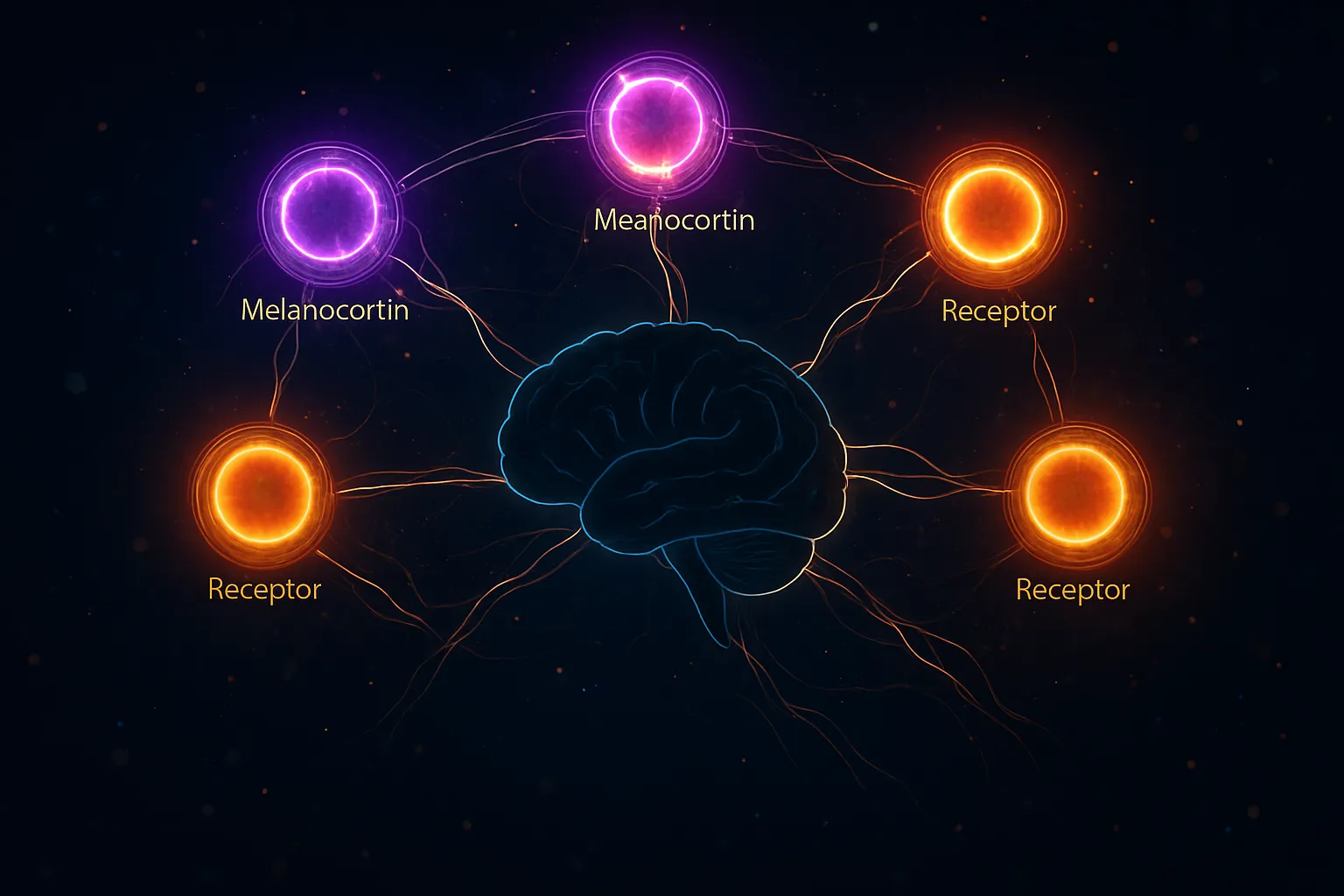
MT-2 activates all five melanocortin receptor subtypes:
- MC1R → Melanin production (tanning)
- MC3R → Energy homeostasis, sexual arousal
- MC4R → Appetite regulation, sexual function, erectile response
- MC5R → Sebaceous gland function
This non-selective binding is why MT-2 produces tanning AND sexual effects AND appetite suppression AND nausea — it's hitting every melanocortin pathway at once.
Sexual Function: Head-to-Head
Both peptides enhance sexual function, but through different approaches:
Desire & Arousal
| Metric | PT-141 | MT-2 |
|---|---|---|
| Onset of sexual effects | 15-30 minutes | 1-4 hours |
| Duration | 4-6 hours | Variable (may persist) |
| Effect on desire | Strong, consistent | Strong but unpredictable |
| Effect on arousal | Central + some genital | Central + genital |
| Clinical evidence | Phase III (1,267 women) | Phase I only |
| Works for women | Yes (FDA-approved) | Anecdotal reports |
For Erectile Dysfunction
PT-141 is the clear winner for ED:
- Purpose-built for the indication
- Works via central arousal (complements PDE5 inhibitors)
- On-demand dosing matches sexual activity timing
- Clinical data in men with psychogenic ED
MT-2 can help ED as a side effect, but:
- Requires daily dosing during loading (not on-demand)
- ED benefits come bundled with tanning, nausea, appetite loss
- No dose optimization for sexual function specifically
- Sexual effects are less predictable in timing
Ready to buy? Compare verified vendors on our best PT-141 sources page, or browse all coupon codes for up to 50% off.