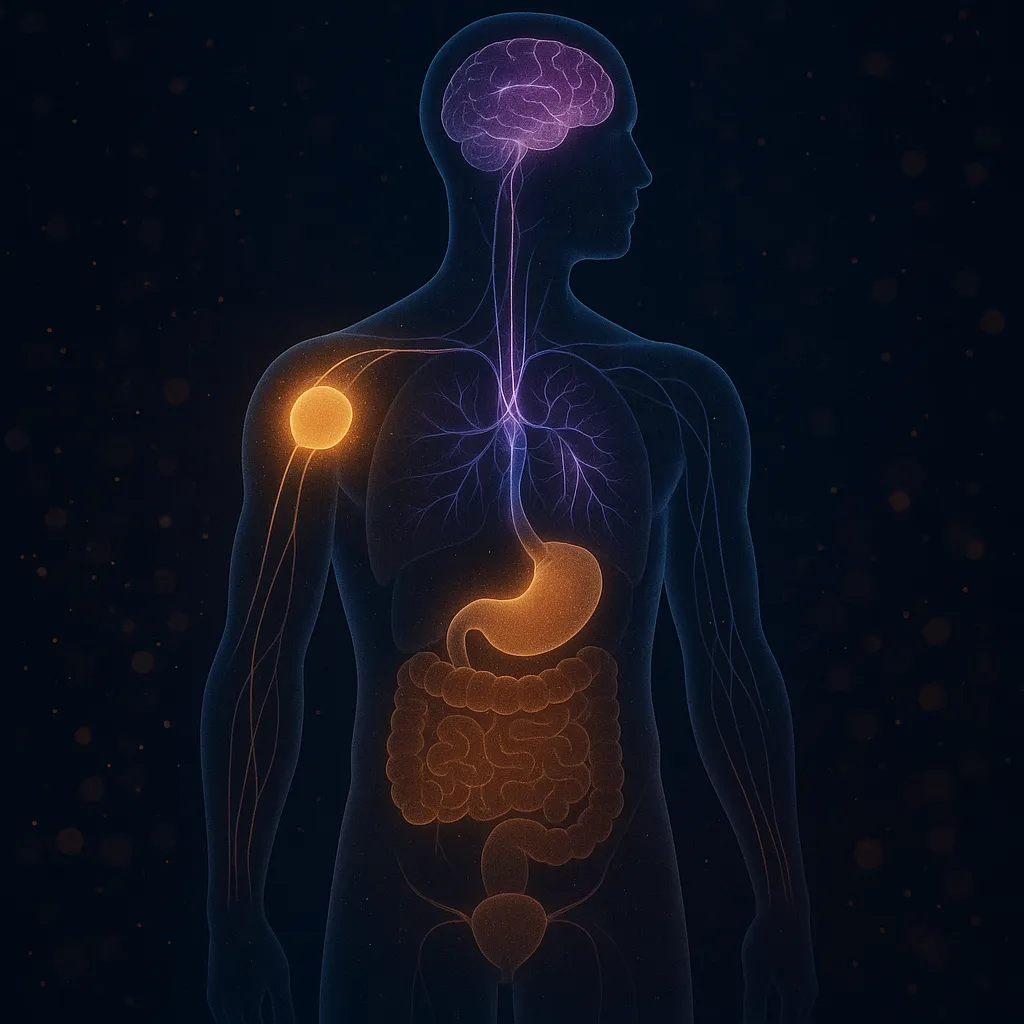
Melanotan-2 (MT-2) is a synthetic cyclic heptapeptide analog of alpha-melanocyte-stimulating hormone (alpha-MSH). Most people know it as a tanning peptide, but that undersells what it does. MT-2 activates two distinct melanocortin receptor subtypes — MC1R and MC4R — producing effects that span skin pigmentation, sexual function, appetite regulation, body composition, and neuroprotection.
Research-context information only. Melanotan-2 is a research peptide. Protocols, doses, and reactions reported below come from published research and self-reported community sources. This article reports what has been documented, not what should be done. Consult a licensed physician for personal medical decisions.
This guide ranks 6 research-backed MT-2 benefits by evidence strength. Every claim links to published data, and each section notes whether the evidence comes from human trials, animal models, or in-vitro work. No hype — just what the science shows.
For dosing protocols, see our Melanotan-2 Dosing Guide. For reconstitution and storage, see the Melanotan-2 Reconstitution Guide.
How Melanotan-2 Works
MT-2 is a non-selective melanocortin agonist. It binds to multiple melanocortin receptor subtypes, but its primary effects come through two:
MC1R (Melanocortin-1 Receptor) — expressed on melanocytes in the skin. Activation triggers eumelanin synthesis via the cAMP/PKA pathway, increasing dark pigment production. This is the tanning mechanism. A Phase I trial confirmed that just 5 low-dose subcutaneous injections produced measurable pigmentation changes in the face, upper body, and buttock (Dorr et al., 1996).
MC4R (Melanocortin-4 Receptor) — expressed in the hypothalamus and other CNS regions. Activation modulates sexual arousal, appetite, and energy expenditure. This is why MT-2 causes spontaneous erections, reduces food intake, and may influence body composition independently of caloric restriction.
Unlike PT-141 (bremelanotide), which was engineered for MC4R selectivity, MT-2 hits both receptors simultaneously. That makes it more versatile but also explains its broader side-effect profile. For a detailed comparison, see PT-141 vs Melanotan-2.
1. Skin Pigmentation (Tanning)
Evidence level: Strong — Human clinical trials
This is MT-2's most established benefit and the reason it was originally developed. Researchers at the University of Arizona created MT-2 as a potential skin cancer chemopreventive agent — the idea being that increased melanin production could protect fair-skinned individuals from UV damage.
In a Phase I single-blind, placebo-controlled trial, 3 male volunteers received subcutaneous MT-2 injections (0.01-0.03 mg/kg) on alternating days for 2 weeks. All subjects showed increased pigmentation in the face, upper body, and buttock — even without deliberate UV exposure (Dorr et al., 1996).
The mechanism is straightforward: MC1R activation on melanocytes upregulates tyrosinase activity, driving conversion of tyrosine to eumelanin (the dark, photoprotective form of melanin). This is the same pathway activated by UV exposure, but MT-2 amplifies it far beyond what sunlight alone achieves.
Practical takeaway: Most users report visible tanning within 7-14 days of a daily loading protocol (250-500 mcg/day subcutaneous). Even individuals with Fitzpatrick Type I-II skin (naturally very fair) achieve noticeable pigmentation. Minimal UV exposure — as little as 10-15 minutes of incidental sunlight — accelerates results significantly.
2. Sexual Function and Arousal
Evidence level: Strong — Human clinical trials (both sexes)
MT-2's sexual effects were discovered accidentally during the Phase I tanning trials when subjects reported spontaneous erections lasting 1-5 hours after injection. This led to a focused research program that ultimately produced PT-141.
In a double-blind, placebo-controlled crossover study of 20 men with psychogenic or organic erectile dysfunction, subcutaneous MT-2 initiated erections in 17 of 20 subjects — without any sexual stimulation. The effect was dose-dependent and distinct from PDE5 inhibitors because it works centrally, through hypothalamic MC4R activation rather than peripheral vasodilation (Hadley, 2005).
A separate placebo-controlled trial in men with organic ED found MT-2 initiated subjectively reported erections in 12 of 19 injections versus only 1 of 21 placebo doses (Wessells et al., 1998).
Critically, MT-2 also enhances sexual function in women. Research documented increased sexual desire and genital arousal in female subjects — a finding that led directly to the development of bremelanotide (PT-141), now FDA-approved for hypoactive sexual desire disorder in premenopausal women (Hadley & Dorr, 2006).

Practical takeaway: Sexual effects typically appear within hours of the first dose. They are dose-dependent — higher loading doses produce stronger effects. Unlike PDE5 inhibitors, MT-2 enhances desire and arousal (central mechanism), not just blood flow. For users primarily seeking sexual benefits, PT-141 may be a better option due to its MC4R selectivity and fewer pigmentation side effects.
3. Appetite Suppression
Evidence level: Moderate — Animal studies (no human trials)
MT-2 is a potent appetite suppressant through MC4R activation in the hypothalamus. This is well-established in rodent models but has not been tested in dedicated human appetite trials.
In rats, central administration of MT-2 suppressed food intake by approximately 30% in a dose-dependent manner. However, tachyphylaxis (tolerance) develops rapidly — within 3-5 days of continuous dosing, food intake returns to baseline levels (Cote et al., 2010).
The intermittent dosing solution is notable: when researchers alternated MT-2 infusion with off-periods, each reapplication produced a full anorectic response. This intermittent protocol resulted in robust fat and weight loss that exceeded continuous dosing (Cote et al., 2010).
Practical takeaway: Most human users report noticeable appetite suppression during the first 3-7 days of loading, consistent with the animal data showing rapid onset followed by tolerance. This is an incidental benefit rather than a primary use case. For dedicated appetite/weight management, melanocortin-based drugs like semaglutide or tirzepatide are far better studied in humans.
4. Body Composition
Evidence level: Moderate — Animal studies
Beyond acute appetite suppression, MT-2 appears to reduce body mass through mechanisms independent of caloric restriction. This is a subtle but important distinction from simple appetite suppression.
In a 40-day central infusion study in rats, MT-2 suppressed appetite dose-dependently, but food intake returned to control levels relatively quickly. Despite this, body mass remained persistently reduced in both MT-2 groups compared to controls. The researchers concluded that long-term body mass loss is only partially mediated by caloric restriction — melanocortin system activation appears to increase energy expenditure independently (Cote et al., 2017).
Practical takeaway: Some users report easier weight management during MT-2 cycles, which aligns with the animal data suggesting metabolic effects beyond appetite alone. However, these are rodent studies with central (brain) infusion — not subcutaneous injection. The relevance to human subcutaneous dosing is uncertain.
5. UV Photoprotection
Evidence level: Moderate — Mechanistic (supported by epidemiological data)
MT-2 was originally developed as a skin cancer prevention agent. The rationale: increased eumelanin acts as a natural broadband UV absorber, protecting DNA from ultraviolet radiation damage.
Melanin functions as both a physical UV shield and an antioxidant, scavenging reactive oxygen species generated by UV exposure. Epidemiological data consistently shows lower skin cancer incidence in individuals with higher baseline melanin (Brenner & Hearing, 2008).
By upregulating eumelanin production, MT-2 theoretically shifts fair-skinned individuals toward a more photoprotected phenotype. However, this benefit comes with an important caveat: MT-2 also stimulates melanocyte proliferation, which has raised concerns about potential effects on existing moles and nevi. See our Melanotan-2 Side Effects guide for the full safety breakdown.
Practical takeaway: The photoprotective benefit is real in principle — more melanin means more UV protection. But MT-2 is not approved for skin cancer prevention, and the melanocyte stimulation that produces tanning could theoretically promote existing atypical nevi. Always get a baseline dermatological exam before starting MT-2. See our Melanotan-2 Bloodwork Guide for monitoring recommendations.
6. Neuroprotection
Evidence level: Preliminary — Animal studies only
This is MT-2's least-discussed benefit, but the preclinical data is intriguing. Melanocortin receptors are widely expressed in the central and peripheral nervous system, and alpha-MSH analogs have demonstrated neuroprotective properties across multiple models.
MT-2 significantly enhanced recovery of sensory function following sciatic nerve crush injury in rats at a dose of 20 mcg/kg every 48 hours, subcutaneously. The same study showed partial protection from cisplatin-induced toxic neuropathy — a common chemotherapy side effect (Catania et al., 2003).
Practical takeaway: Neuroprotection is a preclinical finding only. No human studies exist for this application. It is included here for completeness because the mechanism — melanocortin receptor activation in neural tissue — is well-characterized, and it may explain some of the subjective cognitive effects users occasionally report.
Ready to buy? Compare verified vendors on our best Melanotan II sources page, or browse all coupon codes for up to 50% off.