Skin Health & Hair Growth
Reverse skin aging, regrow thinning hair, and heal skin damage. Research peptides boost collagen synthesis, activate hair follicle stem cells, and stimulate melanin production for healthier skin and fuller hair.
How It WorksSkin & Hair
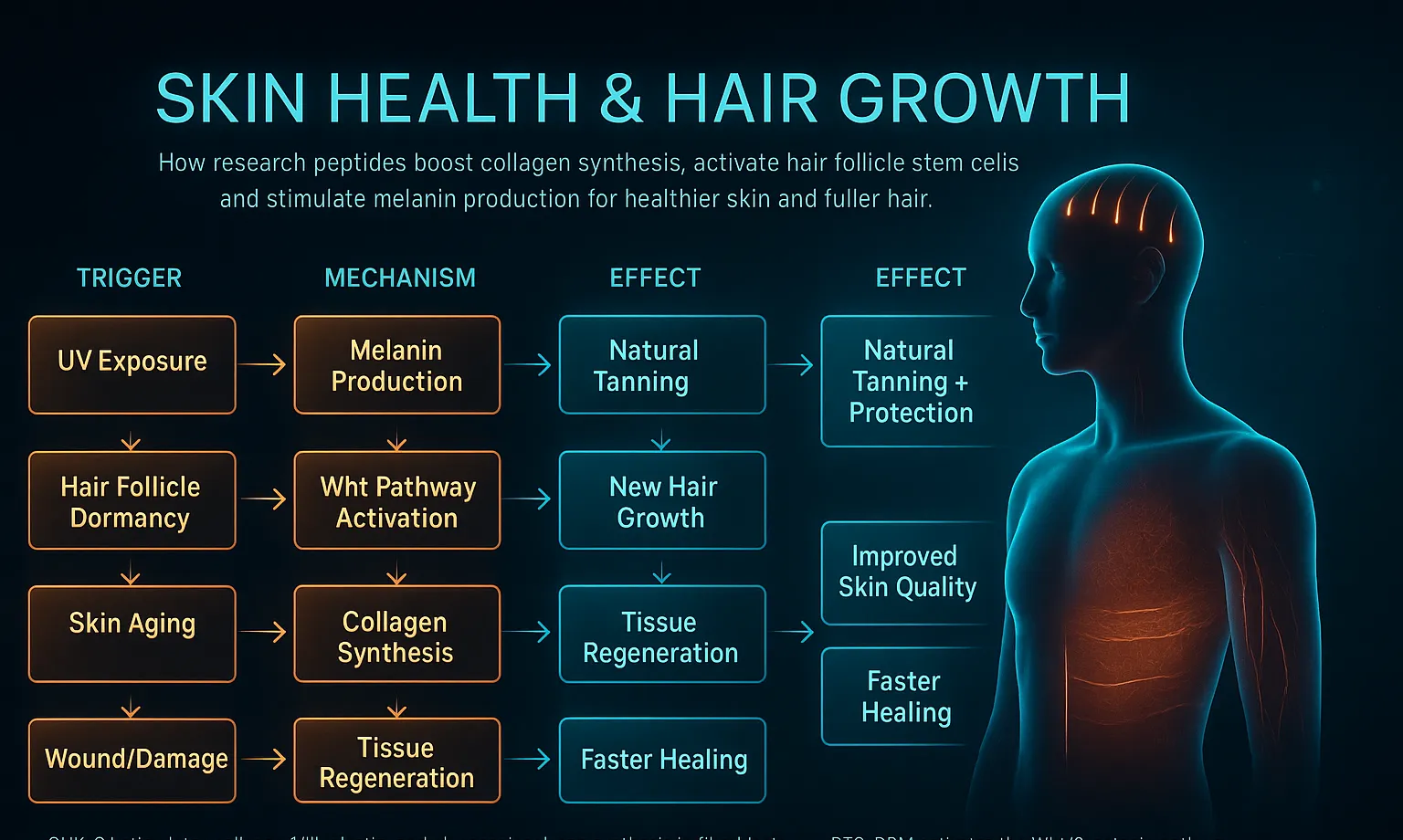
How Peptides Are Studied for Skin & Hair
GHK-Cu (copper tripeptide) is the most studied peptide for skin rejuvenation. It stimulates collagen I and III synthesis, activates fibroblasts, promotes wound healing, and has demonstrated anti-inflammatory properties. It naturally occurs in human plasma but declines with age.
PTD-DBM targets hair loss by activating the Wnt/β-catenin pathway through inhibition of CXXC5, a negative regulator of hair follicle growth. Research shows it can stimulate new follicle formation and increase existing follicle size. It's typically applied topically, often with microneedling for enhanced penetration.
Melanotan I and II stimulate melanocyte activity through MC1R, producing a tan without UV exposure. Melanotan I is more selective (FDA-approved as Scenesse for sun sensitivity disorders), while Melanotan II is non-selective and also affects appetite and libido through MC3R/MC4R.
Peptides Studied for Skin & Hair
GHK-Cu
A copper peptide for anti-aging skin, wound healing, and hair regrowth.
Melanotan I
A tanning peptide that stimulates melanin production for UV protection.
Melanotan II
A fast-acting peptide for tanning, libido enhancement, and appetite control.
PTD-DBM
A Wnt-activating compound for hair follicle regeneration.
SNAP-8
A topical cosmetic anti-wrinkle peptide — an elongation of Argireline marketed to soften expression lines. Evidence is limited cosmetic data; no injectable trials.
Thymulin
A thymic peptide for immune regulation and hair regrowth support.
Glutathione
The body's master antioxidant for cellular defense, immune support, detoxification, and skin health.
Related Articles & Guides
articles
UCLA Reviewed 565 Peptide Studies: What It Found
UCLA orthopedists screened 565 studies on BPC-157, TB-500, GHK-Cu and three more. What the scoping review found — and the limit on its scope.
Copper Peptide Injections Hit NPR: What the Data Shows
NPR put GHK-Cu injections on national radio September 7. What the human record actually covers, what the February FDA panel decides, and how buyers verify.
GLP-1 Hair Loss: 37% Higher Risk, New Genetic Data
A September 3 genetic study ties GLP-1 receptor activity to male-pattern hair loss — a different mechanism than the shedding seen in July's BMJ cohort.
Can You Mix Peptides in the Same Syringe?
Which peptide pairs get combined in one syringe, which never are, and why pre-blended vials sidestep the question. Sorted by pH, stability and sterility.
guides
GHK-Cu Dosage Chart: SubQ & Topical
1.7mg/day SubQ = 10 units from a 50mg vial in 3mL. Daily dosing, 8 weeks on/8 off, plus how topical strength compares for skin use.
Glow Blend Reconstitution: 70mg + 2mL Chart
3.5mg = 10 units. Most mixing errors happen at the syringe math step. Step-by-step with dilution chart, syringe math, and storage rules.
Buy Glow Blend: Compare 5 Vendors, From $88
Compare 5 Glow Blend (BPC-157 + GHK-Cu + TB-500) vendors: from $88 a vial, best value $1.26/mg. Codes save up to 50%.
SNAP-8 Reconstitution: 10mg Vial to Serum
A 10mg SNAP-8 vial is meant for a topical serum, not injection. How the community reconstitutes it, the concentration math, storage, and honest limits.
side-effects
Copper Uglies: How Long the GHK-Cu Purge Lasts
Copper peptide users report a 2-4 week flaking and breakout phase. What community sources describe, how long it runs, and what shortens it.
Glow Blend Side Effects: Component-Level Breakdown
Flushing, taste changes, and brief lethargy lead. Community reports cluster around the GHK-Cu component. Full safety breakdown.
Melanotan-1 Side Effects: Nausea and Mole Changes
Nausea hits early. Mole darkening is the watch-for. Full safety breakdown from afamelanotide trials and community data.
KLOW Blend Side Effects: Component Research Review
Injection-site reactions lead. Flushing from GHK-Cu and brief lethargy from KPV cluster in community reports. Full safety breakdown.
results
Glow Blend Results: Week-by-Week Timeline
Skin texture shifts by week 4 — but collagen density takes longer. Full 12-week Glow timeline for skin, wounds, and recovery.
SNAP-8 Results: What to Realistically Expect
There's no rigorous timeline for SNAP-8. What cosmetic sources report week by week, why it's borrowed from Argireline, and how to read it honestly.
Thymulin Results Timeline: What to Expect
Thymulin is an immune biomarker peptide, not a fast one. What research documents from week 1 to month 6 — and why most effects stay subclinical.
Melanotan-1 Results: Tanning Timeline
Clinical data shows melanin density climbing by day 7 and peaking near day 15. Full timeline from first dose through month 6, with what affects it.
benefits
Glow Blend: 3-Phase Collagen + Tissue Repair
GHK-Cu drives 71% of the Glow blend — but the two repair peptides are why it works. 5 effects ranked by evidence quality.
Exosome Serums for Skin: Do They Work?
Exosome and growth-factor serums went viral — but what does the early evidence actually show, and which ingredients carry the proof?
SNAP-8 Benefits: What the Cosmetic Research Shows
SNAP-8 is sold as a topical 'Botox alternative' for expression lines — but the data is thin. What the cosmetic evidence supports, and what it can't.
Glutathione Benefits: Your Cells' #1 Shield
The liver benefit gets overlooked, but glutathione's real edge is broader than most realize. 7 research-backed effects ranked by evidence.
dosing
SNAP-8 Dosage: A Topical Anti-Wrinkle Peptide
SNAP-8 is a topical cosmetic peptide, not an injectable. The serum concentrations formulas use, the DIY conventions, and an honest read on the evidence.
Glutathione Dosage Chart: IV, Injectable & Strips
Oral glutathione is mostly destroyed in the gut -- three delivery routes that actually work, with protocols for each.
buying-guide
Buy Glutathione: Compare 4 Vendors, From $15
Compare 4 Glutathione vendors side by side: from $15 a vial, best value $0.01/mg. Codes save up to 30%. Vial sizes, COA status, real cost per week.
Peptides Under $50/vial: 12 Picks
12 peptides priced under $50/vial with real vendor links — healing, cognitive, sexual, metabolic. $/mg shown for every pick so you can buy smart.
comparison
GHK-Cu Topical vs Injectable: The Evidence Gap
Topical GHK-Cu has decades of clinical data; injectable has none in humans. Which route fits which goal -- and when do both make sense?
PT-141 vs Melanotan 2: Key Differences
PT-141 is FDA-approved for sexual function, MT-2 is not — but MT-2 adds tanning. Side-by-side on effects, safety, and cost.
Melanotan 1 vs 2: Safety vs Potency
Melanotan 1 vs 2: MT-2 tans faster and adds libido effects, but MT-1 runs cleaner. Side-by-side on tanning speed, sexual effects, nausea, and safety.
Price Comparisons
Compare GHK-Cu Prices
Find the best deals from trusted vendors
Compare Glutathione Prices
Find the best deals from trusted vendors
Compare Melanotan I Prices
Find the best deals from trusted vendors
Compare Melanotan II Prices
Find the best deals from trusted vendors
Compare SNAP-8 Prices
Find the best deals from trusted vendors
Active Coupon Codes
Save on peptides from these verified vendors with exclusive discount codes.
Ion Peptide coupon code: 15% off
Use code thepeptidecatalog at checkout
EZ Peptides coupon code: 10% off
Use code thepeptidecatalog at checkout
Ascension Peptides coupon code: 50% off
Use code THEPEPTIDECATALOG at checkout
Glacier Aminos coupon code: 10% off
Use code thepeptidecatalog at checkout
Nura Peptide coupon code: 30% off
Use code thepeptidecatalog at checkout
Dynamic Peptide coupon code: 10% off
Use code thepeptidecatalog at checkout
Limitless Biotech coupon code: 15% off
Use code peptideinfo at checkout
BioLongevity Labs coupon code: 15% off
Use code thepeptidecatalog at checkout
Swiss Chems coupon code: 10% off
Use code THEPEPTIDECATALOG at checkout
Related Research Areas
Frequently Asked Questions
Which peptide is most effective for anti-aging and skin improvement?
GHK-Cu has the strongest research base for comprehensive skin anti-aging. It stimulates collagen, reduces inflammation, promotes wound healing, and has decades of safety data. Many consider it the gold standard among cosmetic peptides.
Can hair growth peptides regrow hair in completely bald areas?
PTD-DBM shows promise for reactivating dormant follicles, but completely bald areas (where follicles are permanently miniaturized) are challenging for any treatment. Best results are seen with recent hair loss or areas with visible but miniaturized hairs.
Are melanotan peptides safe for long-term tanning use?
Melanotan I (Scenesse) has FDA approval and better safety data, while Melanotan II has more systemic effects and less long-term research. Both should be used cyclically rather than continuously, with careful attention to mole changes and skin monitoring.
How long does it take to see results from skin and hair peptides?
Skin improvements from GHK-Cu typically become visible after 6-12 weeks of consistent use. Hair regrowth peptides require 3-6 months minimum, as hair cycles are slow. Tanning peptides work within days to weeks depending on the compound.
Can skin peptides be combined with other anti-aging treatments?
Yes, GHK-Cu often enhances other treatments like microneedling, laser therapy, or topical retinoids. The peptide's wound healing properties can help recovery from aesthetic procedures. However, introduce treatments gradually to assess tolerance.
This page is for educational and research purposes only. It does not constitute medical advice. Always consult a qualified healthcare professional before starting any peptide protocol.