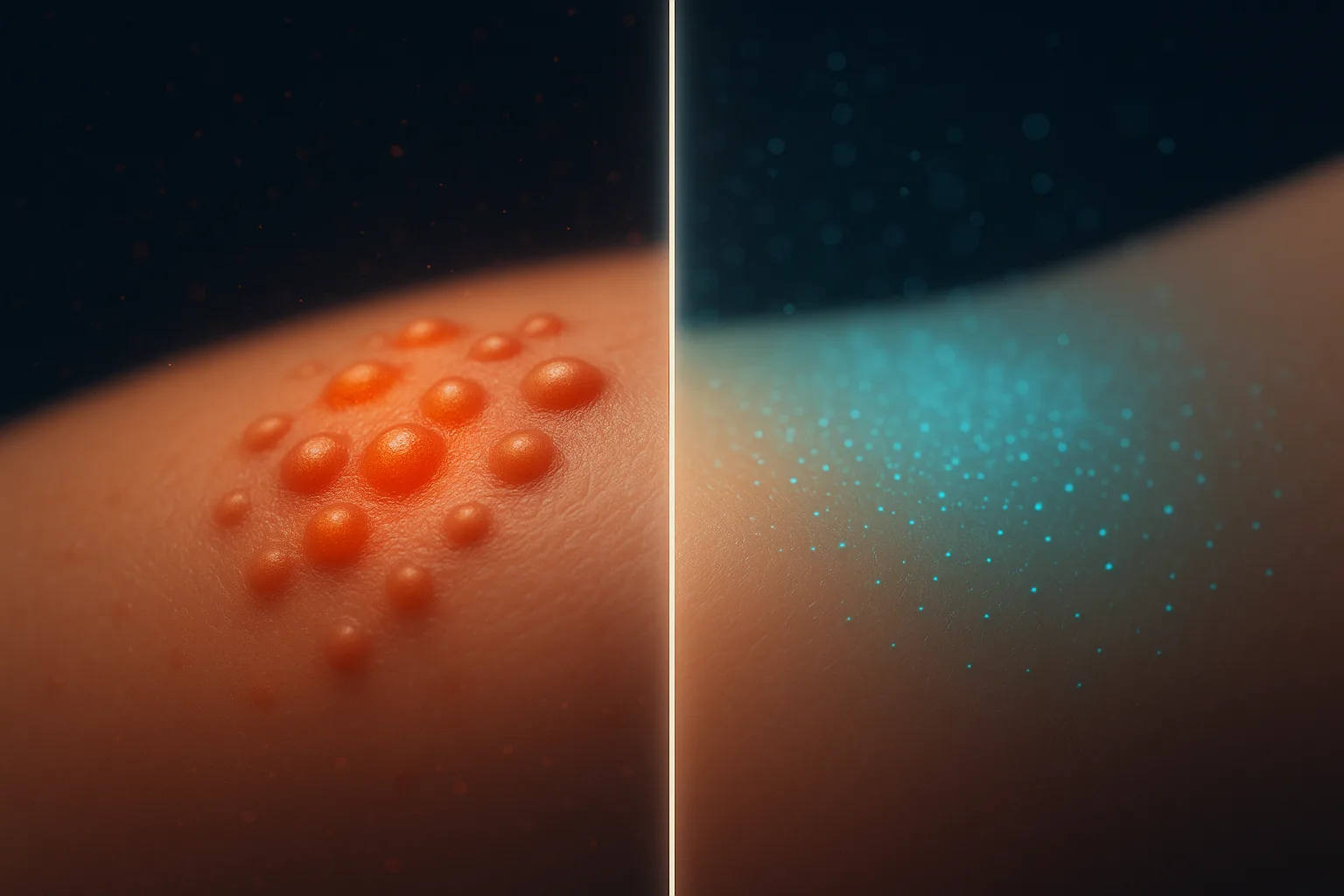
Search interest in "copper uglies" has climbed alongside copper peptide skincare itself, and the phrase is now a fixture in community threads on GHK-Cu. It borrows the structure of "retinol uglies" — the idea that a product accelerating skin turnover can make the surface look worse before it looks better. What the phrase actually describes, according to the people using it, is a stretch of dullness, fine flaking, and small congestion-style bumps in the first weeks of a copper peptide routine.
The published record and the community record do not line up neatly here, and that gap is the most useful thing to understand up front. Cosmetic and dermatologic studies of topical GHK-Cu at standard concentrations describe minimal local irritation and no pattern of acneiform eruption (Pickart & Margolina, PMID 29986520). A 2025 review of topical GHK explicitly catalogues the formulation problems the peptide presents — stability, penetration, and delivery-vehicle irritation among them (Mortazavi et al., PMID 39963574) — without describing a purge phase. So the timeline below is a community artifact, reported consistently enough to be worth mapping, but not measured in any trial.
Research-context information only. GHK-Cu is a research peptide, and topical copper peptide products are cosmetics. Reactions, timelines, and adjustment strategies reported below come from published research and self-reported community sources. This article reports what has been documented, not what should be done. Consult a licensed dermatologist or physician for personal skin and medical decisions.
What "Copper Uglies" Actually Describes
The phrase covers a cluster of appearance changes rather than a single event. Community accounts group them as follows:
Dullness or a grey cast in the first several days, described as the skin looking flat rather than luminous.
Fine flaking, typically around the nose, chin, and hairline, described as sheeting rather than patchy.
Small congestion-style bumps, most often reported in areas where the user already had congestion — the jawline and forehead being the two most commonly named.
Temporary loss of makeup grip, mentioned frequently enough in community threads to be part of the standard description.
What community sources consistently do not describe as part of the pattern: burning, swelling, spreading rash, or bumps appearing in zones that were previously clear. Those are described in community threads as a different problem entirely, and the distinction section below covers how sources separate them.
No published study has measured an adjustment phase for topical GHK-Cu, so every figure in this table is drawn from self-reported community accounts rather than trial data.
Window
What community sources report
How often it is described
Days 1-4
Nothing, or a mild tingle on application
Majority of accounts
Days 5-10
Dullness, first fine flaking, texture feels uneven
Most commonly reported onset
Weeks 2-3
Peak of the reported phase — flaking plus small congestion bumps surfacing
The window most accounts describe as the worst
Weeks 3-4
Flaking resolving, bumps clearing, texture reported as smoother than baseline
Most accounts describe resolution here
Weeks 5-6
Continued roughness
Minority of accounts, most often tied to daily application from day one
The 2-4 week figure is the one that recurs most across community sources. Accounts describing a longer phase disproportionately mention starting at daily frequency, which is the variable the concentration section below returns to.
Why a Turnover-Accelerating Active Produces This Shape of Complaint
The mechanistic case that community sources make for the purge framing rests on documented GHK-Cu activity, even though the purge itself is not documented.
GHK-Cu's characterised role in skin is matrix remodelling. It stimulates fibroblast proliferation and modulates collagen, elastin, and glycosaminoglycan synthesis (Pickart & Margolina, PMID 29986520), and it upregulates matrix metalloproteinase-2 expression in fibroblast culture (Siméon et al., PMID 11045606). Matrix metalloproteinases are the enzymes that break down existing extracellular matrix — remodelling requires clearing old tissue as well as laying down new. The 2015 pathway review frames GHK as a signal that pushes skin toward a repair state across a wide set of genes (Pickart, Vasquez-Soltero & Margolina, PMID 26236730).
The community inference is that a signal driving clearance and renewal simultaneously would plausibly surface existing congestion faster than it would resolve on its own. That is a mechanistic hypothesis proposed by users, not a finding. The published research documents the remodelling activity; it does not connect that activity to a visible adjustment phase, and no study has tested the link.
A second explanation appears just as often in community threads and gets less attention: the delivery vehicle. The 2025 topical GHK review specifically identifies formulation and penetration-enhancer choices as an unresolved problem in copper peptide cosmetics (Mortazavi et al., PMID 39963574), and penetration research shows copper tripeptide distributes differently across skin layers depending on the vehicle (Hostynek, Dreher & Maibach, PMID 20721598; Mazurowska & Mojski, PMID 18350235). Occlusive, lipid-rich bases are the format community sources most often name when reporting congestion — which points at the base as readily as at the peptide.
Purge, Irritation, or Reaction — How Community Sources Separate Them
This is the distinction that matters most in community discussion, because the three patterns are described as having different resolutions.
Pattern
How community sources describe it
Reported course
Adjustment / "purge"
Bumps confined to zones that already congested; flaking; no burning
Resolves over 2-4 weeks in most accounts
Vehicle irritation
Stinging or tightness on application; diffuse redness; worse with occlusive bases
Reported as resolving on switching format, not on persisting
Contact reaction
Diffuse burning, swelling, or rash spreading to previously clear areas
Described in community sources as a reason to stop and seek dermatologist assessment
Published topical research supports the third row being treated separately: contact-allergic reaction to copper tripeptide complexes is documented as rare but real in the cosmetic safety record (Pickart & Margolina, PMID 29986520). The first two rows have no equivalent published characterisation.
Post-procedure context is one of the few places the published record touches this territory. A controlled study of topical copper tripeptide on CO2 laser-resurfaced skin tracked erythema and healing in a setting where the skin barrier was deliberately compromised (Miller et al., PMID 16847171) — the closest formal analogue to an irritated-barrier scenario, and a reminder that barrier state, not just the active, shapes what the surface does.
Concentration and Frequency Are the Two Variables Sources Cite
Cosmetic GHK-Cu formulations in the research literature sit in the 0.1-3% range (Pickart & Margolina, PMID 29986520), which is a wide spread — the top of that range is thirty times the bottom. Community accounts describing a milder or absent adjustment phase cluster around two things: a formulation at the lower end of that range, and 2-3 applications per week rather than daily for the first month.
Two further points recur in community sourcing discussions:
Concentration is frequently undisclosed. Many cosmetic products list copper tripeptide-1 on the ingredient list without a percentage, which means the variable community sources identify as most important is often not visible to the buyer.
Layering is a reported confounder. Accounts that pair a copper peptide with an exfoliating acid or a retinoid in the same routine describe rougher adjustment phases, and community sources attribute the result to the combination rather than to the copper peptide alone.
For a breakdown of what to look for on a label and how the common formats differ, the copper peptide face cream comparison covers concentration, format, and layering in more depth.
Shop these topicals
Cosmetic skincare products covered in this guide. Prices set by the vendor and may change.
Affiliate disclosure: links above are paid affiliate links — we may earn a commission at no extra cost to you. Cosmetic products; not intended to diagnose, treat, cure, or prevent any disease.
The Injectable and Blend Routes Report a Different Picture
"Copper uglies injections" and "copper uglies klow" both appear as live search variants, so it is worth being precise about what changes by route.
Injectable GHK-Cu community reports do not cluster around a surface purge. They cluster around brief post-injection facial flushing and a metallic taste in the first hour — effects attributed by community sources to the copper component's vasodilatory action rather than to skin turnover. The GHK-Cu side effects breakdown covers the injectable adverse-event picture by route, and the topical vs injectable comparison covers why the evidence bases differ so sharply.
Copper-containing blends are the harder case. KLOW combines GHK-Cu with KPV, BPC-157, and TB-500, and community threads discussing skin-surface changes on KLOW rarely isolate which component is responsible. No published research characterises the blend as a unit, which means any attribution of a skin change to the copper component specifically is inference. Community accounts on blends are correspondingly noisier than the single-peptide topical accounts.
Reconstitution technique is a separate variable for anyone on the injectable route, and the mixing math plus the expected solution tint are covered in the GHK-Cu reconstitution guide.
Bac Water Made for Peptides
Don't risk a $300 peptide on generic bac water.
Most cloudy reconstitutions trace back to one thing — and it isn't the peptide. Sterile, non-pyrogenic, 0.9% benzyl alcohol — formulated for peptide reconstitution, not repackaged from generic stock.
✓ 0.9% benzyl alcohol✓ Made for peptides✓ 30 mL multi-dose
Note on labelling: the approaches below come from r/peptides, r/SkincareAddiction, and copper peptide community threads. None are validated by published research, and none constitute medical or dermatological advice.
Community-reported management strategies:
Frequency reduction. Community sources most consistently describe dropping to 2-3 applications per week for the first month, then increasing only once the surface stays calm — the change most often credited in these accounts with shortening the phase.
Barrier support alongside. Accounts describe pairing the copper peptide with a bland ceramide or occlusive moisturiser on non-application nights, and describe the flaking component resolving faster on this pattern.
Stopping the layering. Community sources describe pausing acids and retinoids for the adjustment window rather than running them concurrently.
Format switching. Where the reported problem is congestion rather than flaking, community accounts describe moving from a lipid-rich balm to a lightweight serum base.
Patch testing before the face. Patch-testing a new cosmetic active on the inner forearm before facial use is a commonly cited dermatology practice, and community sources describe applying that convention to copper peptide products specifically.
Community accounts also describe a distinct pattern of stopping outright: when the picture matches the contact-reaction row above — diffuse burning, swelling, or spread into previously clear skin — the described response is discontinuation and dermatologist assessment rather than pushing through.
What the Published Research Does and Does Not Cover
Worth being explicit about the boundaries, because the gap is wide.
Documented: GHK-Cu's effects on fibroblast proliferation, collagen and glycosaminoglycan synthesis, matrix metalloproteinase-2 expression, and broad gene-expression modulation. Skin penetration behaviour across layers and vehicles. Minimal irritation at cosmetic concentrations in cosmetic safety dossiers. Rare contact-allergic reaction. Behaviour on deliberately compromised post-laser skin.
Not documented: any adjustment or purge phase. Any timeline for one. Any relationship between GHK-Cu concentration and congestion. Any comparison of vehicle formats for congestion risk. Any characterisation of copper-containing blends as a unit.
The practical consequence is that the 2-4 week figure circulating in community threads has the shape of a finding without the backing of one. It is a consistent self-report across a large number of users, which is worth something, and it is not a measured outcome, which is worth remembering.
Frequently Asked Questions
What are the copper uglies?
"Copper uglies" is the community nickname for the rough-looking adjustment phase some people describe in the first weeks of using a copper peptide product — dullness, fine flaking, and small congestion-style bumps. It is a self-reported community pattern, not a documented clinical finding. Published topical GHK-Cu research describes minimal irritation at cosmetic concentrations (Pickart & Margolina, PMID 29986520).
How long do the copper uglies last?
Community sources most often describe a 2-4 week window, with a smaller group reporting up to six weeks when the product was applied daily from the start. No published study has measured this timeline, and the range comes entirely from self-reported user accounts.
Is the copper uglies phase the same as an allergic reaction?
Community sources distinguish them by pattern and location. Congestion-style bumps clustered where the user already broke out are described as the adjustment pattern; diffuse burning, swelling, or spreading rash across areas that were previously clear is described in community sources as a reason to stop and seek a dermatologist's assessment.
Does GHK-Cu concentration change how rough the adjustment phase is?
Concentration and frequency are the two variables community sources cite most. Cosmetic research formulations sit in the 0.1-3% range (Pickart & Margolina, PMID 29986520), and community reports describe milder adjustment phases at the low end of that range and at 2-3 applications per week rather than daily.
Do injectable GHK-Cu and copper-containing blends cause the same thing?
The reported picture differs by route. Injectable community reports cluster around brief post-injection flushing and metallic taste rather than a surface purge. Users of copper-containing blends such as KLOW describe skin-surface changes in community threads, but no published research characterizes this.
For educational and research purposes only. This is not medical advice. Topical copper peptide products are cosmetics and are not intended to diagnose, treat, cure, or prevent any disease. GHK-Cu is not FDA-approved for any indication. Consult a healthcare provider or licensed dermatologist before use.