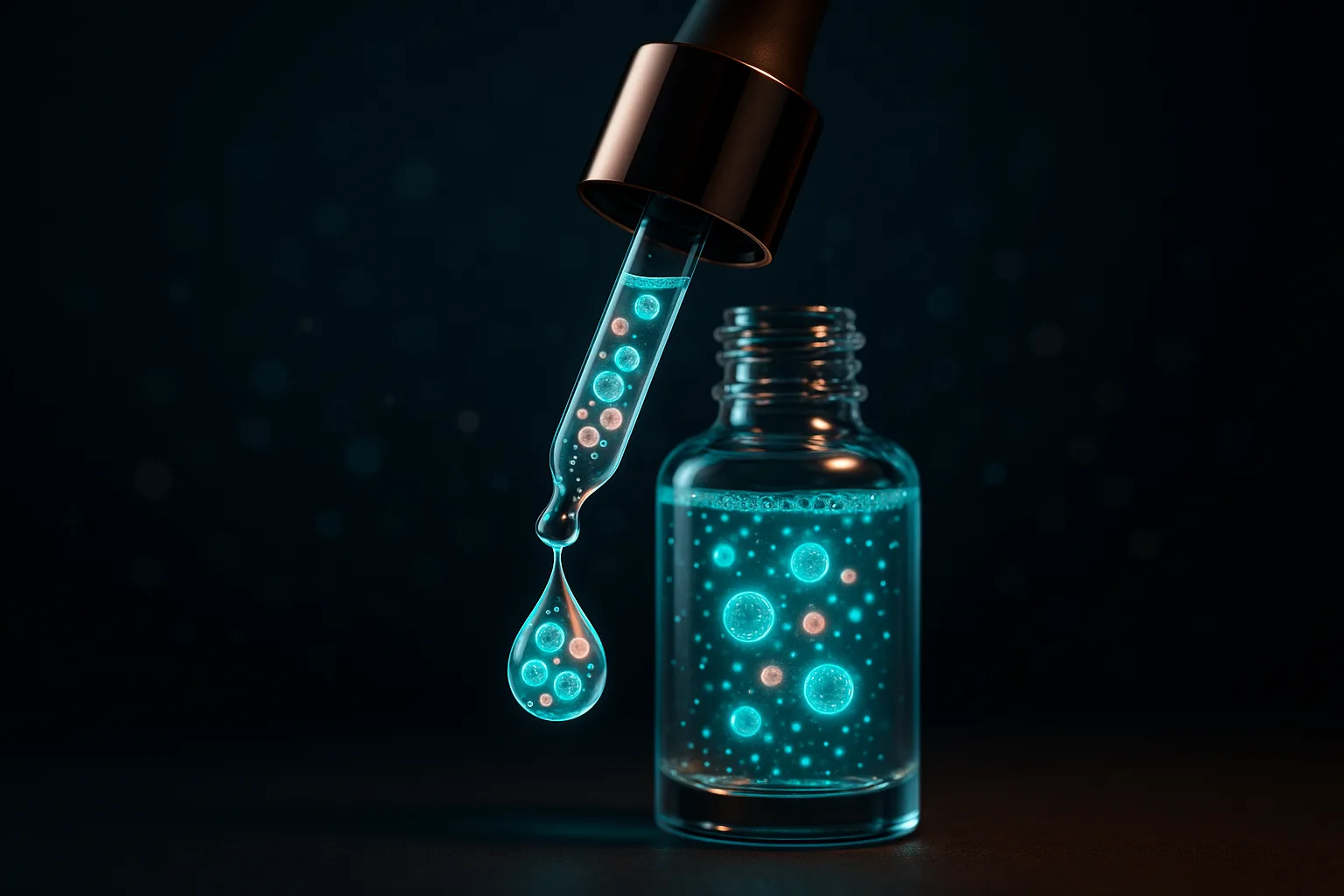
Exosome serums became one of the most-searched skincare categories of the last two years, fueled by clinic treatments, dermatologist videos, and bold marketing claims about "regenerating" skin. The reality is more nuanced. The strongest published exosome data comes from clinic procedures — microneedling and laser sessions paired with exosomes — not from a bottle you apply at home. For an at-home serum, the more dependable evidence sits with the supporting cast: growth factors like EGF and well-studied actives like niacinamide, tranexamic acid, and alpha arbutin that are often formulated alongside the exosomes.
So "do exosome serums work?" splits into two questions. Do the exosomes themselves carry the appearance changes? The controlled at-home evidence is still thin. Does a well-built exosome-and-growth-factor serum produce the hydration, glow, and gradual texture improvements people describe? The supporting-ingredient literature makes that more plausible — and that's the lens this guide uses.
Research-context information only. GHK-Cu is a research peptide; exosome and growth-factor serums are cosmetic products. Topical exosome products are not FDA-approved, and the FDA has issued public safety notices about unapproved exosome products marketed for therapeutic uses. Claims, ingredients, and timelines reported below come from published research and self-reported sources and describe appearance-based cosmetic effects only — not treatment of any medical condition. Consult a licensed physician or dermatologist for personal skin-health decisions.
Affiliate disclosure: This guide names and links to products from vendors we have affiliate relationships with — we may earn a commission at no extra cost to you. Prices are set by the vendor and may change.
What Exosomes and Growth Factors Actually Are
Exosomes are nanoscale vesicles that cells secrete to shuttle signaling cargo — proteins, lipids, and messenger RNA — between cells. In skincare, the pitch is that applying exosomes topically delivers those signals to the skin's surface. A 2024 systematic review of topical exosome and peptide therapies reported that, across the studies that met inclusion criteria, topical exosomes increased collagen deposition, accelerated wound healing, and improved overall cosmesis (PMID 38633728). The review's authors also flagged the limitation that runs through this whole category: the controlled clinical literature on cosmetic exosome products specifically is small.
Growth factors are a related but distinct idea. Rather than a vesicle carrying mixed cargo, a growth factor like EGF (epidermal growth factor) is a single signaling protein involved in skin-cell turnover. Topical EGF has a longer cosmetic research history than exosomes. A 2012 three-month study of a barley-bioengineered, human-like EGF serum applied twice daily reported statistically significant improvement in the appearance of fine lines and wrinkles, skin texture, and pore size, with changes apparent within the first month and building over the study (PMID 22527430). A separate study reported that skin-permeable EGF and fibroblast growth factor helped protect against UV-induced damage and the appearance of wrinkles (PMID 24305427).
Most products marketed as "exosome serums" are really hybrids — exosomes plus growth factors plus a stack of supporting cosmetic actives. The Nura Exosome & Growth Factor Serum is a good example of that format: exosomes and EGF for the signaling layer, then acetyl hexapeptide-8, niacinamide, tranexamic acid, and alpha arbutin for tone, texture, and surface smoothing.

What the Early Evidence Does — and Doesn't — Show
Here's the honest split between what's well-supported and what's still aspirational.
Better supported (procedure-paired and supporting actives):
- A 2024 split-face observational study reported that sides treated with exosomes alongside microneedling and CO2 laser showed greater improvements in texture, hydration, elasticity, and pigmentation than the comparison sides (PMID 40892048). The signal is real — but it's tied to procedures done in a clinic.
- Topical EGF serums have repeatable cosmetic data for fine lines, texture, and pore appearance over a 1-to-3-month window (PMID 22527430).
- The supporting actives are individually well-studied (see the next section).
Still thin (stand-alone at-home exosome claims):
- There are few controlled trials of a stand-alone cosmetic exosome serum, applied at home with no procedure, measured against vehicle. Reviewers across the literature describe the at-home exosome evidence base as early-stage.
- Marketing language about "regeneration" or "repair" outruns the published cosmetic evidence and, importantly, crosses from cosmetic into drug-claim territory.
The practical read: a quality exosome-and-growth-factor serum is a reasonable cosmetic choice if the formula is built on evidence-backed actives — but the exosome fraction should be treated as a promising bonus, not the proven engine.
The Supporting Actives That Carry the Proof
The ingredients alongside the exosomes are where much of the dependable cosmetic evidence lives.
Acetyl hexapeptide-8 (sold as Argireline) is a peptide studied for the look of expression lines. A clinical study in Chinese subjects reported reduced periorbital wrinkle depth, and a more recent serum study reported static-wrinkle appearance improvements over 12 weeks (PMID 23607739). Reviewers note its large molecule size limits how deeply it penetrates, so formulation matters.
Niacinamide has some of the strongest cosmetic data of any topical. A controlled study reported that topical niacinamide significantly improved the appearance of fine lines and wrinkles, hyperpigmented spots, red blotchiness, and skin texture versus control in aging facial skin (PMID 16029679). It also supports the skin's barrier.
Tranexamic acid is studied mainly for the appearance of uneven pigmentation. A double-blind randomized split-face trial evaluated topical 5% tranexamic acid for melasma in Asian subjects (PMID 22506692), and it's commonly paired with niacinamide in tone-evening formulas.
Alpha arbutin is a tyrosinase-inhibiting active used for brightening and a more even-looking tone; published research also describes it helping defend against UVA-induced photoaging changes (PMID 39376600).
Stacked together, these are the ingredients most likely to drive the tone and texture changes people attribute to an "exosome serum" — which is exactly why the full formula, not the exosome buzzword, is what to evaluate.
A Realistic Timeline
Sources describe a layered timeline rather than a single before-and-after moment.
- Weeks 1–3 — hydration and glow. The most commonly reported early change is a more hydrated, smoother-looking surface and a "glow." This is the fastest and most consistent signal users describe.
- Weeks 4–8 — tone and clarity. Pigmentation and red-blotchiness changes from niacinamide, tranexamic acid, and alpha arbutin tend to emerge here; the niacinamide study reported texture and spot improvements building over an 8-to-12-week range (PMID 16029679).
- Weeks 6–12 — firmness and texture. The EGF and peptide layer is where firmness and fine-line appearance changes are described — the EGF serum study reported improvements building from the first month onward across three months (PMID 22527430).
Consistency matters more than intensity. The studies that report changes use daily application over weeks, not occasional use.
How to Choose an Exosome Serum
Because the exosome category itself is loosely regulated, the most useful signals come from the formula and the brand's honesty.
- Read the full ingredient list. Evidence-backed actives — EGF, niacinamide, tranexamic acid, alpha arbutin, acetyl hexapeptide-8 — are a better signal than the word "exosome" on the label.
- Watch the claims. Cosmetic-appropriate language ("appears more hydrated," "looks smoother," "helps even the look of tone") is the right register. "Repairs," "regenerates," or "treats" are drug claims a cosmetic isn't cleared to make — a red flag.
- Check handling. Exosomes are fragile; reputable products address stability and storage rather than ignoring it.
- Consider layering. A surface-focused serum and a GHK-Cu copper peptide cream target different things, which is why some routines and bundles pair them. Introduce one product at a time and patch-test.
For readers who want the serum plus a copper-peptide cream in one step, the Nura Skincare Bundle pairs the exosome-and-growth-factor serum with a GHK-Cu copper peptide cream. The exosome serum on its own is the lighter entry point.
Ready to compare options? The cosmetic picks below are appearance-focused topicals; the buy widget that follows surfaces live vendor offers for injectable GHK-Cu if a copper-peptide protocol is the goal instead.
Shop these topicals
Cosmetic skincare products covered in this guide. Prices set by the vendor and may change.
Affiliate disclosure: links above are paid affiliate links — we may earn a commission at no extra cost to you. Cosmetic products; not intended to diagnose, treat, cure, or prevent any disease.