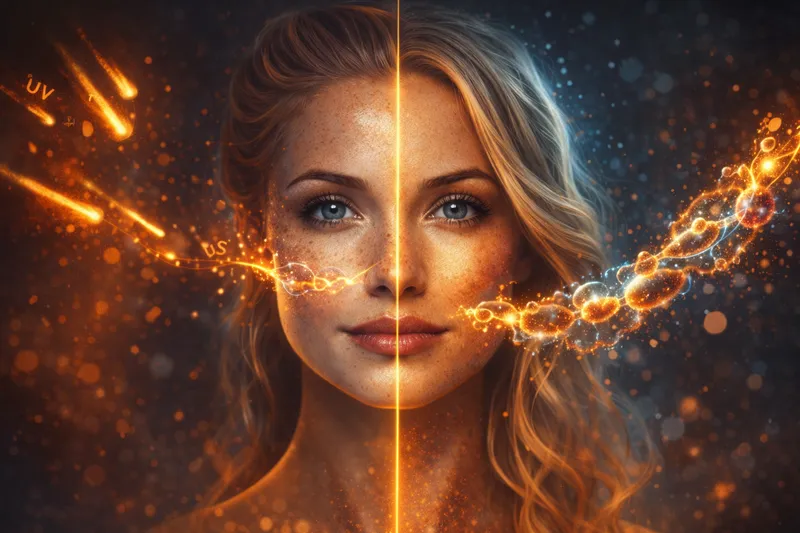
Melanotan-1 (MT-1) is one of the most misunderstood peptides in the entire peptide space. Most people think of it as a "tanning peptide" — but the tanning is actually the least important part.
What MT-1 really does is fix a core biological defect that causes fair-skinned people to burn instead of tan. And that defect lives inside the type of melanin you naturally produce.
Once you understand the biology, MT-1 stops looking like a cosmetic compound — and starts looking like a legitimate photoprotective biohacking tool.
Let's break this down the right way.
The 2 Types of Melanin: Eumelanin vs. Pheomelanin
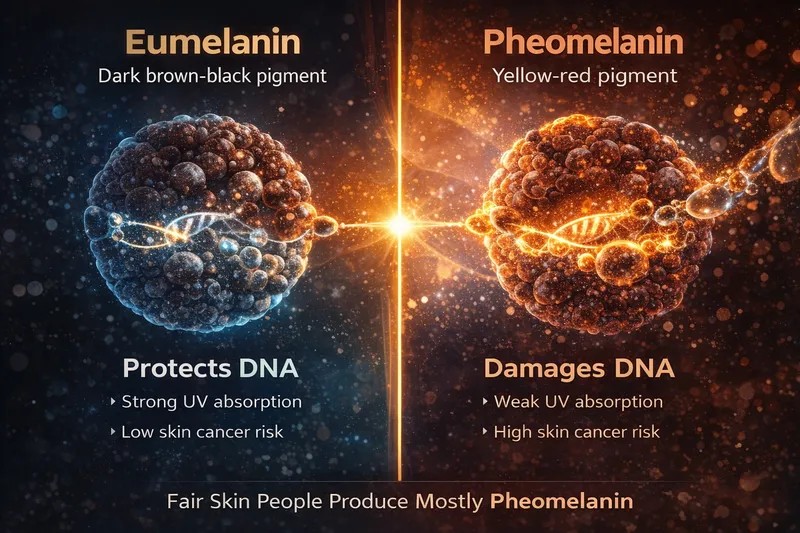
Humans produce two pigments, and they behave completely differently:
1. Eumelanin
2. Pheomelanin
Research confirms this dichotomy: eumelanin is UV-absorbent and protective, while pheomelanin acts as a photosensitizer that can amplify UV damage.
The Key Problem
Fair-skinned people produce mostly pheomelanin and very little eumelanin, even when they try to tan.
This means:
- They don't tan well
- They burn fast
- Their melanin doesn't shield DNA
- UV exposure generates oxidative stress, not tanning
This is not behavioral — it is genetic.
The melanocortin pathway that produces eumelanin simply doesn't activate strongly enough.
How Melanotan-1 Fixes This Problem
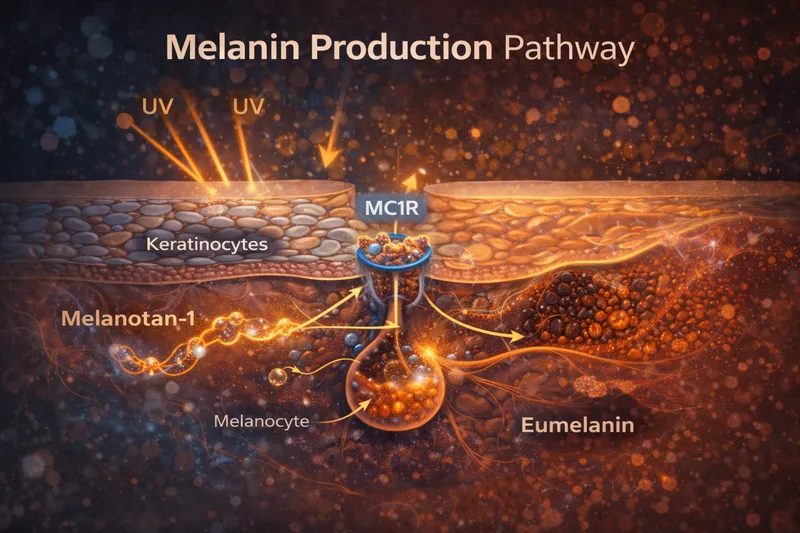
Melanotan-1 is a synthetic analog of α-MSH (alpha-melanocyte stimulating hormone), the hormone your body uses to trigger melanin production. First synthesized in 1980, it has higher activity and stability than the natural hormone.
But MT-1 has special properties:
It selectively activates the MC1R receptor
This is the eumelanin switch.
It bypasses the natural deficiency in fair-skinned individuals
Even people with naturally weak MC1R function can still respond to MT-1.
It produces almost exclusively eumelanin, not pheomelanin
This is why pigmentation from MT-1 looks deeper, brown/olive rather than orange/red.
It creates a UV-protective "pre-tan"
This is protective, not cosmetic. Clinical research shows MT-1 acts synergistically with UV light — meaning the combination provides more protection than either alone.
Ready to source Melanotan-1? Compare verified vendors with COA testing and exclusive discount codes on our Best Places to Buy Melanotan-1 page, or check current deals for up to 50% off.
MT-1 vs. MT-2: Why They Are NOT the Same
The article is about MT-1, but it's important to differentiate from Melanotan-2:
| Feature |
Melanotan-1 (MT-1) |
Melanotan-2 (MT-2) |
| Receptor |
MC1R only |
MC1R + MC3R + MC4R |
| Melanin Type |
Eumelanin |
Mixed |
| Libido Effects |
Minimal |
Significant |
| Nausea |
Minimal |
More common |
| Skin Tone |
Natural brown/olive |
Can be orange-tinted |
| Speed |
Gradual (4-8 weeks) |
Faster (1-2 weeks) |
| FDA Status |
Approved as Afamelanotide |
Not approved |
For photoprotection, MT-1 is the superior molecule. For more on how these peptides differ, see our comparison of Melanotan peptides.
Why Fair-Skinned People Burn: The Scientific Explanation
Burning happens when UVB radiation damages DNA faster than the skin can protect itself or repair itself.
The factors:
1. Low eumelanin = low UV absorption
Eumelanin efficiently absorbs UV radiation and dissipates it as heat, protecting DNA from photodamage. Fair skin has very little.
2. High pheomelanin = unstable under UV
When UV hits pheomelanin, it can create free radicals that damage skin further. Studies show that irradiated pheomelanin generates significant superoxide radicals, while eumelanin produces none — explaining why pale/red-haired individuals burn "from the inside out."
3. Slow melanogenesis
Fair skin doesn't ramp up melanin production until after UV damage already occurred. MT-1 changes this.
How MT-1 Provides UV Protection (The Real Science)
1. Increases Eumelanin Density
More eumelanin = more UV absorbed safely.
2. Broad Spectrum Protection
Eumelanin absorbs both UVA and UVB. Sunscreen rarely does both well.
3. Deeper Dermal Distribution
Melanin sits in the supranuclear caps of skin cells — little "hats" that shield DNA. More eumelanin = bigger hats.
4. Prevents UV-Induced ROS
Eumelanin is antioxidant, pheomelanin is pro-oxidant. MT-1 shifts the balance. This isn't theoretical — laboratory studies confirm eumelanin provides photoprotection while pheomelanin photosensitizes skin cells.
5. Creates Tan Without DNA Damage
- Normal tanning = damage → melanogenesis as a rescue response
- MT-1 tan = melanogenesis → then UV exposure
MT-1 vs. Sunscreen: A Scientific Comparison
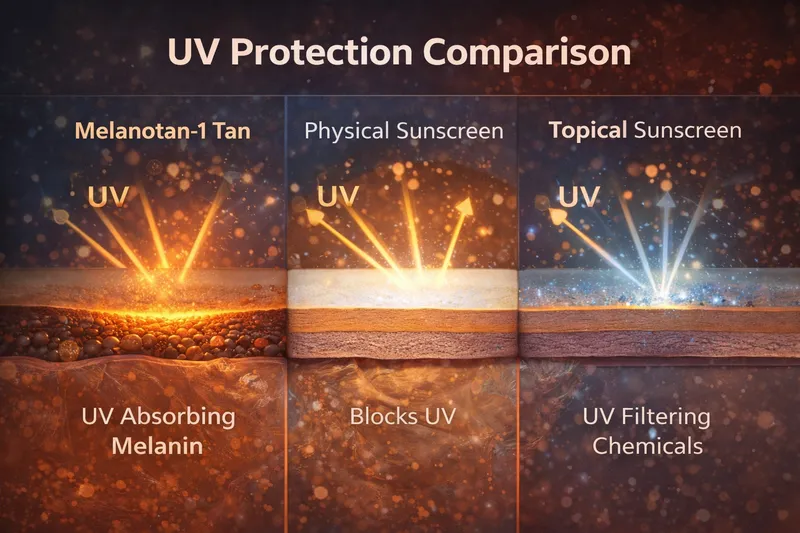
Topical Sunscreen
- Works only where applied
- Must be reapplied
- Doesn't penetrate into melanocyte pathways
- Can wash/sweat off
- UVA protection often weak
- SPF is based only on UVB protection
- No DNA repair enhancement
Useful, but limited.
Physical (Mineral) Sunscreen
- Zinc oxide / titanium dioxide
- Blocks UVA+UVB
- Best option besides staying inside
- But still external only
Melanotan-1
Works from inside the skin.
What MT-1 does that sunscreen cannot:
- Builds intracellular UV shields
- Enhances melanin-based photoprotection
- Protects where sunscreen is missed
- Reduces ROS generation
- Creates protection 24/7, not only when applied
- Protects during accidental UV exposure
The strongest protection is when BOTH are used:
MT-1 tan + sunscreen = maximum possible protection short of avoiding sun entirely
Why MT-1 Might Be the Best "Anti-Aging Peptide" Nobody Talks About
UV radiation causes 80–90% of visible skin aging, including:
- Wrinkles
- Elastin breakdown
- Collagen damage
- Pigmentation issues
- Skin cancer risk
MT-1 reduces the direct cause — UV damage — instead of treating symptoms afterward. Compare this to peptides like GHK-Cu which repair damage after it occurs. MT-1 is proactive anti-aging.
For a complete overview of peptide categories and how they work, see our guide on What Are Peptides.
Why MT-1 Never Went Mainstream (The Real Reason)
It actually did get FDA approval — but only as Afamelanotide (brand name Scenesse), an implant for a rare disorder called erythropoietic protoporphyria (EPP). This approval validated MT-1's safety and efficacy for photoprotection.
Why not for cosmetic tanning?
- Cosmetic FDA pathways are complicated
- Melanin + "tanning" gets instantly misunderstood
- Peptides cannot be patented, severely limiting the profit potential for any company pursuing FDA approval
Without patent protection, no company can recoup the hundreds of millions required for clinical trials. So MT-1 became popular underground instead of mainstream.
Who Researches Melanotan-1 Most
1. Fair-skinned people (Fitzpatrick I–II)
The ones who cannot naturally produce eumelanin.
2. Anyone who burns easily
People who scorch after 5–10 minutes outside.
3. Outdoor workers & athletes
Daily UV exposure compounds over decades.
4. Anti-aging enthusiasts
UV damage is the #1 driver of skin aging.
5. People who want controlled, gradual pigmentation
Without the orange tint of MT-2.
Conclusion
Melanotan-1 isn't just a tanning peptide — it's a melanin-pathway correction tool.
It gives fair-skinned people access to the UV-protective eumelanin their bodies cannot make on their own.
That means:
- ✓ Less burning
- ✓ Less photoaging
- ✓ Less oxidative stress
- ✓ Theoretical reduction in UV-induced damage
- ✓ A natural, healthy tan
Based on current research, MT-1 represents one of the most studied photoprotective peptides — though more clinical data is needed before drawing definitive conclusions about long-term benefits.