Side-by-side evidence
Outcomes where both peptides have published data. Each cell carries two grades: clinical evidence (human-RCT depth for this specific outcome) and community evidence (real-world adoption). How we grade evidence.
| Outcome | TB-500 | Thymosin Beta-4 |
|---|---|---|
| Actin-binding / cell migration | Clinical:Weak Community:Strong 7-amino-acid active fragment (Ac-LKKTETQ) carries the actin-binding motif. | Clinical:Weak Community:Moderate Full 43-amino-acid peptide; activates the complete native signaling cascade including secondary domains. |
| Tendon and tissue healing (rodent) | Clinical:Weak Community:Strong Improved tendon repair and tensile strength in rodent models. | Clinical:Weak Community:Moderate Similar healing effect plus broader signaling; data overlap with TB-500 in most studies. |
| Cost per mg | Clinical:Moderate Community:Strong Lower per-mg cost — the smaller fragment is cheaper to synthesize. | Clinical:Moderate Community:Moderate Significantly more expensive per mg due to longer synthesis and lower availability. |
| Human clinical evidence | Clinical:Preliminary Community:Strong No completed RCTs. | Clinical:Preliminary Community:Moderate Early-phase trials in dry-eye and post-MI; otherwise data overlap with TB-500. |
Parent Peptide vs Active Fragment
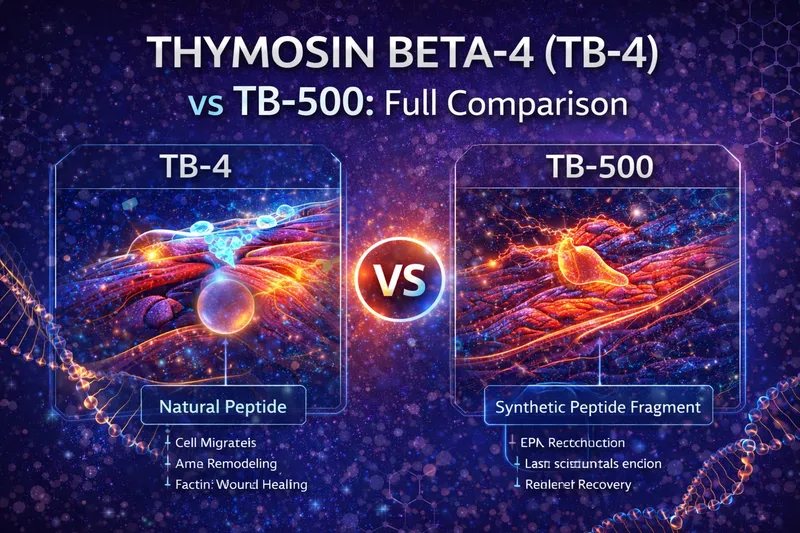
Thymosin Beta-4 (TB-4) is the full 43-amino acid endogenous peptide. TB-500 is a synthetic fragment of TB-4 — specifically the 7-amino acid active region (Ac-LKKTETQ, residues 17–23) responsible for actin binding and cell migration signaling.
This is one of the most frequently asked questions in peptide research. They are related but not interchangeable.
For a complete deep dive into TB-4, see our Thymosin Beta-4 Benefits.
Mechanism Comparison
TB-4 (Full Peptide)
TB-4 is the body's primary actin-sequestering molecule. As the full-length peptide, it activates the complete native signaling cascade:
- Actin sequestration — maintains G-actin reservoir for cell migration
- Angiogenesis — upregulates VEGF for new blood vessel formation
- Anti-inflammatory — reduces IL-1β and TNF-α
- Progenitor cell activation — mobilizes epicardial and satellite stem cells
- Anti-fibrotic — reduces excessive scar tissue formation
TB-4 provides the full biological context — some downstream effects may require the complete peptide sequence.
TB-500 (Fragment)
TB-500 contains the core active region of TB-4. It retains the primary mechanism but in a smaller, more stable package:
- Actin binding — same core LKKTETQ motif that drives cell migration
- Cell migration signaling — promotes fibroblast and keratinocyte movement
- Enhanced stability — smaller molecule degrades less readily
- Superior distribution — penetrates tissues more easily due to lower molecular weight
TB-500 may lack some of TB-4's broader signaling — particularly the full progenitor cell activation cascade — but delivers the core repair signal more efficiently.
Quick Comparison Table
| Feature | TB-4 (Thymosin Beta-4) | TB-500 |
|---|---|---|
| Structure | 43 amino acids (full peptide) | 7 amino acids (active fragment) |
| Molecular weight | ~4,921 Da | ~843 Da |
| Origin | Endogenous — naturally produced | Synthetic — lab-manufactured |
| Stability | Lower (larger molecule) | Higher (smaller, more resistant) |
| Tissue distribution | Broad (carried by platelets) | Extremely broad (small molecule diffusion) |
| Core mechanism | Complete actin + multi-pathway | Targeted actin-binding & migration |
| Progenitor cell activation | Yes (full cascade) | Unclear (may be partial) |
| Anti-fibrotic | Strong evidence | Extrapolated from TB-4 data |
| Published research | Extensive (Nature, PNAS, etc.) | Limited direct studies |
| Cost | Higher | Lower |
| Typical dose | 2–5 mg, 2x/week | 2–5 mg, 2x/week |
Ready to buy? Compare verified vendors on our best thymosin beta-4 sources page, or browse all coupon codes for up to 50% off.