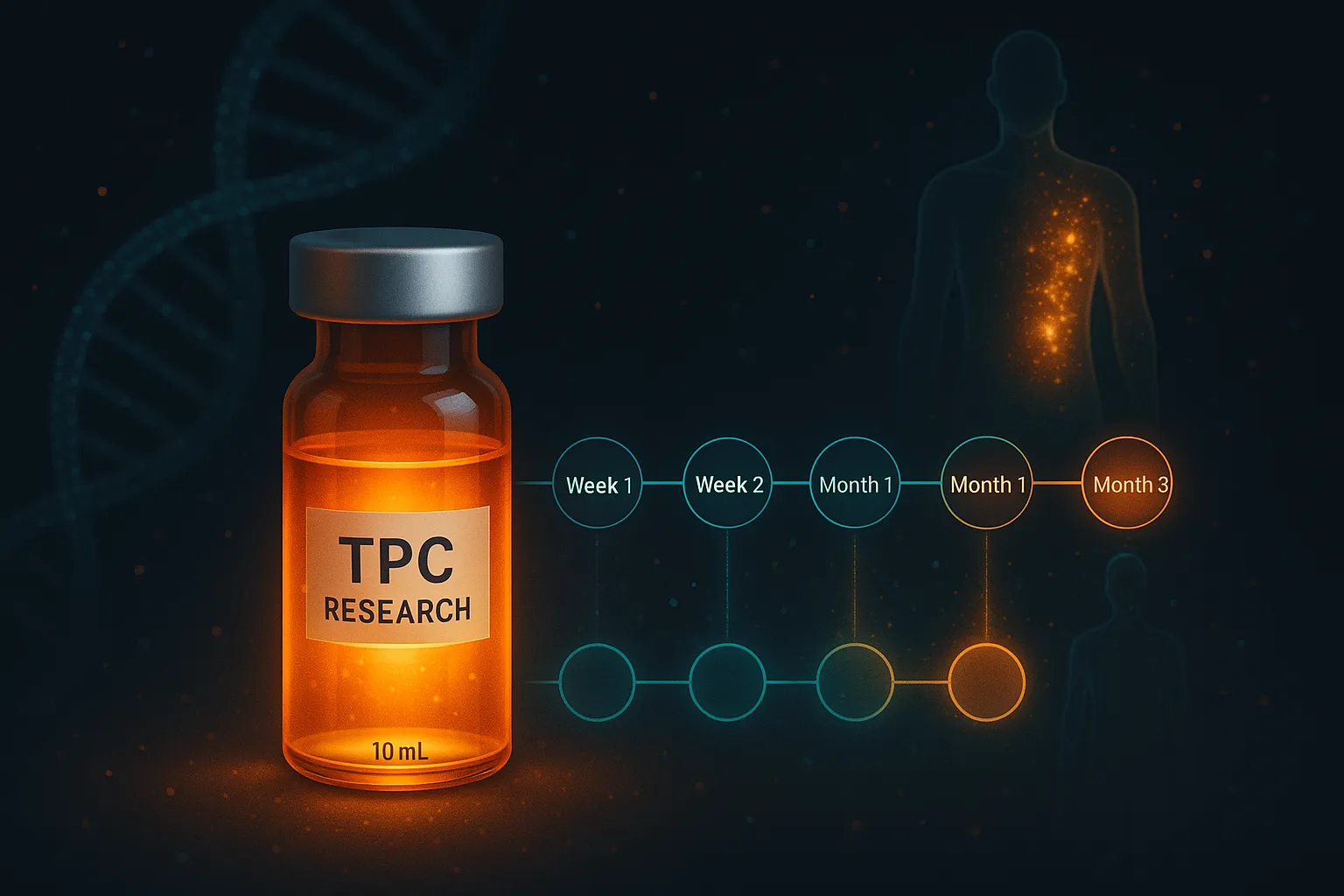
Week 2: Days 8-14
This is the inflection point. Week 2 is where most users report the first clear "it's working" moment.
What's happening biologically:
- BPC-157 has established early angiogenesis — new capillaries are forming at the injury site, improving oxygen and nutrient delivery. Fibroblast recruitment is underway, with tendon and ligament cells beginning to migrate into the damaged area via the FAK-paxillin pathway (Chang et al., 2011).
- TB-500 has reached tissue saturation. Actin remodeling is enabling repair cells to populate the injury site. Collagen deposition begins, organized more functionally than typical scar tissue (Sosne et al., 2010).
What most users report:
- Pain reduction of 30-50% compared to baseline
- Noticeably improved range of motion, especially in joint injuries
- Ability to perform daily activities that were previously uncomfortable
- Reduced morning stiffness — injuries feel less "locked up" upon waking
- Visible swelling reduction for superficial injuries
The injection site effect becomes obvious here. Users injecting near the injury consistently report faster improvement than those injecting at a distant site (abdomen for a shoulder injury, for example). Among users who started with abdominal injections and reported minimal improvement by day 10-12, switching to near-site injection is commonly described as producing a noticeable difference within days.

Weeks 3-4
Weeks 3-4 represent the most productive healing window. This is where structural repair — not just inflammation management — becomes measurable.
What's happening biologically:
- BPC-157 is driving active tissue remodeling. In animal models, Chang et al. (2014) demonstrated improved collagen alignment and measurable tensile strength gains in tendons at this timepoint. Growth hormone receptor expression is upregulated in fibroblasts, amplifying the structural repair response (Chang et al., 2014).
- TB-500 continues organizing collagen fiber architecture, reducing the ratio of immature type III collagen (scar tissue) to mature type I collagen (functional tissue). Its anti-fibrotic properties help ensure the repaired tissue has functional architecture rather than disorganized scarring (Sosne et al., 2010).
What most users report:
- 50-70% improvement in the target injury
- Ability to progressively load the injured tissue — light exercise, resistance work with the affected area
- Joint injuries show meaningful mobility gains
- Tendon pain with activity decreasing significantly
- Muscle injuries approaching functional recovery for moderate strains
- The injury "feels different" — less boggy, less inflamed, more solid when palpated
The combination advantage is clearest here. BPC-157 alone drives strong local repair, but TB-500's systemic collagen organization and cell migration effects mean the quality of repair tissue is often superior. The Lee & Padgett (2021) retrospective case series found that patients receiving BPC-157 combined with Thymosin Beta-4 showed improvements in knee pain scores, though the small sample size limits generalizability (Lee & Padgett, 2021).
For acute injuries: Many moderate soft tissue injuries are 60-80% resolved by week 4. Some users begin considering whether to continue or taper.
For chronic injuries: Week 4 is typically when the first meaningful structural improvement appears. Pain may have improved earlier (inflammation management), but the tissue itself is just entering active remodeling. This is not the time to stop.
Weeks 5-8
The standard Wolverine Stack protocol runs 8 weeks. Weeks 5-8 represent the maturation and consolidation phase.
What's happening biologically:
- BPC-157: Load-to-failure testing in animal models shows progressive strength gains beyond week 4, with treated tendons approaching normal tissue strength by weeks 6-8 (Staresinic et al., 2006). Angiogenesis matures — new blood vessels stabilize and become functional infrastructure rather than fragile new growth.
- TB-500: Continued collagen remodeling and tissue maturation. The transition from repair to functional tissue continues.
What most users report:
- Acute injuries: substantially healed. Most moderate strains, sprains, and soft tissue injuries are 80-95% resolved
- Chronic injuries: 50-70% improvement. Active remodeling continues but is often still in progress
- Return to near-full training capacity for acute injuries
- Progressive loading tolerance for chronic conditions
- Some users begin tapering dose (dropping to 250mcg/day or every-other-day dosing)
When to stop vs continue:
- Stop at 8 weeks if the acute injury is resolved or chronic injury has plateaued. Healing effects continue after cessation — the repaired tissue persists.
- Continue to 12 weeks if chronic injuries are still actively improving at week 8. Stable progress means the healing cascade is still productive.
- Stop and reassess if no measurable improvement appears by week 6. Check: dose adequate? Injection near the site? Peptide quality verified via COA? See our Wolverine Stack Dosing Guide for protocol adjustment.
Months 2-3
Extended protocols (8-12 weeks) are appropriate for chronic injuries, severe structural damage, or post-surgical recovery.
What to expect:
- Chronic tendinopathies (6+ months old): Most users report 60-80% improvement by month 3. The timeline is roughly double that of acute injuries because chronic conditions involve degenerative changes that require more extensive tissue remodeling.
- Post-surgical recovery: The Wolverine Stack is most commonly added 1-2 weeks after surgery (once acute wound healing has begun). By month 3, users frequently report faster-than-expected recovery benchmarks compared to their surgeon's standard timeline.
- Ligament injuries: Ligaments are avascular and heal slowly regardless of intervention. Month 3 often represents the first substantial functional improvement for significant ligament damage.
- Continued remodeling after stopping: Tissue remodeling continues for 3-6 months after the active peptide protocol ends. The Wolverine Stack accelerates the initiation and early phases of repair — the later remodeling occurs naturally.
Cycling for extended use:
The most common approach for injuries requiring more than 8 weeks:
- Weeks 1-8: Standard 500mcg/day protocol
- Weeks 9-12: Off (receptor sensitivity reset)
- Weeks 13-20: Second cycle if needed
Most users find that healing effects continue during the off period. A second cycle is warranted if improvement plateaued during the first cycle but the injury is not fully resolved. Diminishing returns typically appear after 2-3 cycles for the same injury.
Results by Injury Type
Different tissues heal at different rates. The Wolverine Stack accelerates each, but the baseline timelines vary significantly.
Tendon Injuries (Tendinitis, Tendinopathy, Partial Tears)
Tendons are avascular — they rely on diffusion for nutrient delivery, which makes BPC-157's angiogenic properties especially valuable here.
| Timeframe |
Expected Progress |
| Week 1-2 |
Pain reduction 30-40%, reduced morning stiffness |
| Week 3-4 |
Improved collagen alignment, tensile strength gains beginning |
| Week 5-8 |
Approaching functional recovery for acute tendinitis; chronic tendinopathy 40-60% improved |
| Week 9-12 |
Chronic tendinopathy 60-80% improved; continued remodeling |
Common targets: Achilles tendinopathy, rotator cuff tendinitis, patellar tendinitis, tennis/golfer's elbow.
Ligament Injuries (Sprains, Partial Tears)
Ligaments heal slower than tendons due to even lower vascularity and higher mechanical demand.
| Timeframe |
Expected Progress |
| Week 1-2 |
Swelling reduction, pain decrease at rest |
| Week 3-4 |
Early structural improvement, joint stability beginning to improve |
| Week 5-8 |
Measurable stability gains, progressive loading tolerance |
| Week 9-12+ |
Continued strengthening; severe sprains may need a second cycle |
Note: Complete ligament ruptures (grade III) typically require surgical repair. The Wolverine Stack can support post-surgical healing but cannot reattach fully separated tissues.
Muscle Tears and Strains
Muscle has better blood supply than tendon or ligament, so baseline healing is faster. BPC-157 reduces fibrosis (scar tissue formation) while TB-500 organizes collagen architecture for functional rather than fibrotic repair.
| Timeframe |
Expected Progress |
| Week 1 |
Reduced edema, pain decrease 40-50% |
| Week 2-3 |
Functional improvement, reduced fibrosis vs untreated healing |
| Week 4-6 |
Near-complete recovery for moderate strains |
| Week 6-8 |
Significant tears approaching full function |
Animal models of muscle crush injury showed BPC-157 improved healing macroscopically, microscopically, and functionally at all investigated intervals (Novinscak et al., 2008).
Joint Pain and Arthritis
Joint conditions involve multiple tissue types — cartilage, synovium, ligaments, tendons — which is why the Wolverine Stack's multi-mechanism approach is particularly relevant.
| Timeframe |
Expected Progress |
| Week 1-2 |
Reduced synovial inflammation, decreased joint stiffness |
| Week 3-4 |
Improved range of motion, reduced pain with movement |
| Week 5-8 |
Progressive functional improvement |
| Week 9-12+ |
Chronic joint conditions continue improving; OA-related degeneration responds slowest |
The Lee & Padgett (2021) study specifically examined intra-articular BPC-157 for knee pain, with 91.6% of patients reporting significant improvement (Lee & Padgett, 2021).
Gut Healing
GI tissue has the fastest turnover rate in the body — the intestinal epithelium replaces itself every 3-5 days. BPC-157 was originally studied for gastrointestinal protection and repair.
| Timeframe |
Expected Progress |
| Days 3-5 |
Measurable mucosal improvement in animal models |
| Week 1-2 |
Reduced GI symptoms (bloating, discomfort, reflux) |
| Week 3-4 |
Substantial improvement in IBS-type symptoms |
| Week 5-8 |
Full protocol for chronic GI conditions (leaky gut, post-NSAID damage) |
Note: For gut-specific protocols, oral BPC-157 provides direct mucosal contact and may be more effective than injection. The Wolverine Stack blend is designed for injection — if gut healing is your primary goal, consider standalone oral BPC-157 alongside or instead of the injectable blend.
Post-Surgical Recovery
The Wolverine Stack is most commonly introduced 7-14 days post-surgery, after initial wound closure has occurred.
| Timeframe |
Expected Progress |
| Week 1-2 |
Accelerated inflammation resolution, reduced post-surgical swelling |
| Week 3-4 |
Enhanced tissue repair at surgical site |
| Week 5-8 |
Faster return to physical therapy milestones |
| Week 9-12 |
Often ahead of standard recovery timelines |
Important: A surgeon should be consulted before any peptide protocol is added post-surgery. Timing matters — starting too early could theoretically interfere with initial wound closure processes.
Factors That Affect Results
Injection Site: The Most Underrated Variable
Community reports consistently describe injection near the injury site as the single most impactful variable for results. BPC-157 achieves higher local tissue concentrations with proximal injection. TB-500 works systemically regardless, so a single near-site injection delivers both local BPC-157 concentration and systemic TB-500 coverage.
Practical guidance:
- Knee, shoulder, elbow injuries: Inject subcutaneously within 2-3 inches of the injury
- Back/spine issues: Inject in the lower back fat pad near the affected area
- Systemic recovery or gut healing: Abdominal injection is fine since TB-500 circulates and BPC-157's gut effects work systemically
Dose: 250mcg vs 500mcg Per Peptide
The standard 500mcg/day blend dose delivers 250mcg of each peptide. For most injuries, this is sufficient. Higher doses (750-1000mcg/day blend) are used for:
- Acute post-surgical recovery
- Severe or multiple simultaneous injuries
- Injuries that haven't responded to standard dosing after 3-4 weeks
- Loading phases in the first 2-4 weeks before dropping to maintenance
See the Wolverine Stack Dosing Guide for detailed protocol options.
Injury Age: Acute vs Chronic
| Injury Age |
Expected Timeline |
Why |
| 0-4 weeks (acute) |
4-6 weeks to substantial improvement |
Active inflammatory phase — peptides accelerate existing processes |
| 1-6 months (subacute) |
6-8 weeks |
Healing has slowed but tissue is still somewhat responsive |
| 6+ months (chronic) |
8-12 weeks |
Stalled healing must be reactivated; degenerative changes require more remodeling |
| Years (degenerative) |
12+ weeks, often multiple cycles |
Extensive tissue damage; may need surgical evaluation first |
Training and Activity Level
Controlled progressive loading during a Wolverine Stack protocol actually improves outcomes. Tissue needs mechanical stimulus to remodel along functional lines. Complete rest produces weaker repair tissue.
The balance: Light-to-moderate loading of the injured tissue starting in weeks 2-3, progressing gradually. Avoid full-intensity training or movements that reproduce sharp pain. The goal is to signal the repair tissue about the mechanical demands it needs to meet.
Sleep, Nutrition, and Recovery Basics
BPC-157 and TB-500 accelerate natural healing mechanisms — they don't replace them. If the foundations are compromised, results will be slower:
- Protein: 0.8-1g per pound bodyweight supports collagen and tissue synthesis
- Sleep: 7-9 hours. Growth hormone release during deep sleep is when much of the repair occurs
- Vitamin C: Cofactor for collagen synthesis. 500-1000mg/day
- Hydration: Dehydrated tissue heals slower
When to Adjust the Protocol
Signs It's Working
- Progressive pain reduction week over week
- Improved range of motion or function
- Decreased swelling or tissue "bogginess"
- Better tolerance of activity and loading
Signs the Protocol Needs Adjusting
- No improvement by week 3: Check injection site (switch to near-site if using abdominal), verify peptide quality (COA with HPLC purity), consider dose increase
- Improvement plateaued early: If progress stalled at week 4-5, a brief 1-week break followed by resuming can sometimes restart progress
- Pain worse with peptide use: Rare, but stop the protocol and reassess. Rule out infection, fracture, or conditions requiring surgical intervention
When the Wolverine Stack May Not Work
- Complete structural disruptions — fully ruptured tendons, complete ACL tears need surgery first
- Active infections — the issue is infection, not healing speed
- Advanced degenerative conditions — severely degenerated cartilage with bone-on-bone contact is beyond peptide acceleration
- Unrealistic timelines — a 3-year chronic tendinopathy will not resolve in 10 days
For a deeper dive into what each peptide contributes to the healing process, see our Wolverine Stack Benefits Guide.