articlesMay 19, 2026·14 min read

Peptide Stacking: 13 Best Combos & Doses

Not all stacks are equal — 3 combos stand out for synergy. 13 stacks with exact doses, timing, and which combos to avoid.

Peptide Stacking: 13 Best Combos & Doses

Peptide stacking — combining two or more peptides for complementary effects — is widely discussed among researchers and biohackers. This guide reports the combinations community sources most often describe and the mechanistic rationale behind why they are paired.

Research-context information only. Compounds discussed below are research peptides and supplements; some are investigational drugs not approved by the FDA. Protocols, doses, and reactions reported come from published research and self-reported community sources. Possession or use of investigational drugs outside an authorized clinical trial may be illegal in your jurisdiction. This article reports what has been documented, not what should be done. Consult a licensed physician for personal medical decisions.

What is Peptide Stacking?

Peptide stacking refers to using multiple peptides simultaneously for complementary or additive effects. The described rationale is combining peptides that act through different mechanisms to broaden results while limiting side effects.

Why community sources describe stacking:

  • Synergy: two peptides acting together are described as producing effects greater than either alone
  • Multi-pathway activation: targeting multiple biological systems simultaneously
  • Balance: one peptide can offset side effects attributed to another
  • Efficiency: reaching a goal faster than single-peptide protocols

CJC-1295 + Ipamorelin

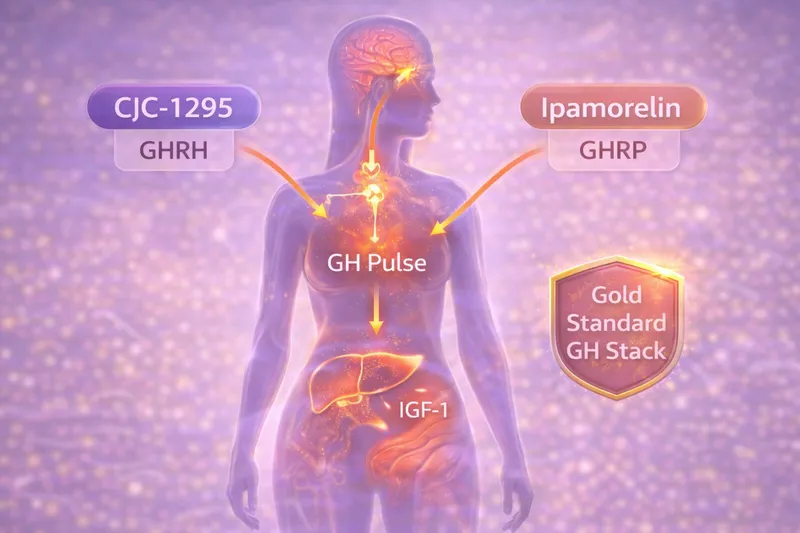
CJC-1295 + Ipamorelin stack - the gold standard for GH optimization

This is the most frequently described peptide pairing for growth-hormone optimization in community sources — often referred to as the "gold standard" of GH stacking.

Why they are paired:

CJC-1295 is a GHRH analog (Growth Hormone Releasing Hormone). It signals the pituitary gland to produce and release growth hormone — effectively pressing the "go" button on GH production.

Ipamorelin is a GHRP (Growth Hormone Releasing Peptide). It acts through a different pathway — the ghrelin receptor — amplifying the GH pulse and making the pituitary more responsive to GHRH signals.

The synergy:

Peptide Role What it does
CJC-1295 GHRH Initiates GH release, extends the pulse duration
Ipamorelin GHRP Amplifies the pulse magnitude, primes the pituitary

When combined, the GHRH (CJC-1295) creates a sustained signal while the GHRP (Ipamorelin) amplifies the response. Community sources describe this combination as producing markedly larger GH pulses than either peptide alone.

Why Ipamorelin specifically?

Ipamorelin is the most selective GHRP — it does not significantly raise cortisol or prolactin the way GHRP-6 or GHRP-2 do. Community sources describe this as making it well-suited to longer protocols with fewer side effects like hunger spikes.

Community protocols describe:

  • Dosing together AM and/or PM
  • CJC-1295 (no DAC): 100-300mcg per dose
  • Ipamorelin: 200-300mcg per dose
  • Administration on an empty stomach, 30+ min before food

Learn more about CJC-1295 | Learn more about Ipamorelin


Sermorelin + GHRP-2
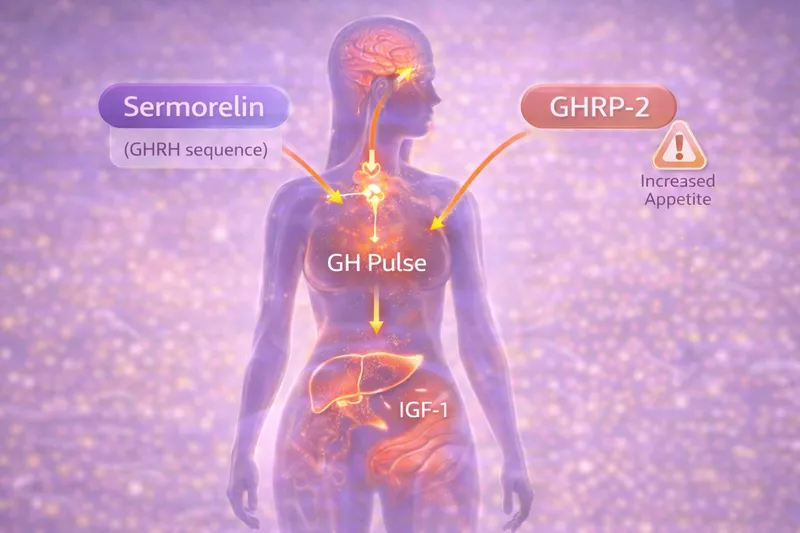
Sermorelin + GHRP-2 stack - aggressive GH release

A more aggressive pairing described by community sources seeking stronger GH output alongside appetite increase.

Why they are paired:

Sermorelin is the natural 29-amino-acid GHRH sequence — the same molecule the hypothalamus produces. It has a shorter half-life than CJC-1295, which community sources describe as creating more natural pulsatile GH release.

GHRP-2 is one of the most potent GHRPs available. Community sources describe it as producing stronger GH pulses than Ipamorelin, but with more pronounced appetite stimulation and slight cortisol/prolactin elevation.

The synergy:

Peptide Strength Trade-off
Sermorelin Natural GHRH sequence, well-studied Shorter duration, needs frequent dosing
GHRP-2 Very potent GH release Increases hunger, slight cortisol bump

Together, they are described as producing strong GH pulses. Community sources commonly associate this pairing with:

  • Muscle-building phases (the hunger increase aiding a caloric surplus)
  • Aggressive recovery protocols
  • Users who have plateaued on milder stacks

Audiences that commonly choose this over CJC+Ipamorelin:

  • Hard gainers seeking appetite stimulation
  • Users seeking maximum short-term GH output
  • Users who tolerate hunger increases well

Learn more about Sermorelin | Sermorelin Benefits | GHRP-2 Benefits | Learn more about GHRP-2


MK-677 + Ipamorelin
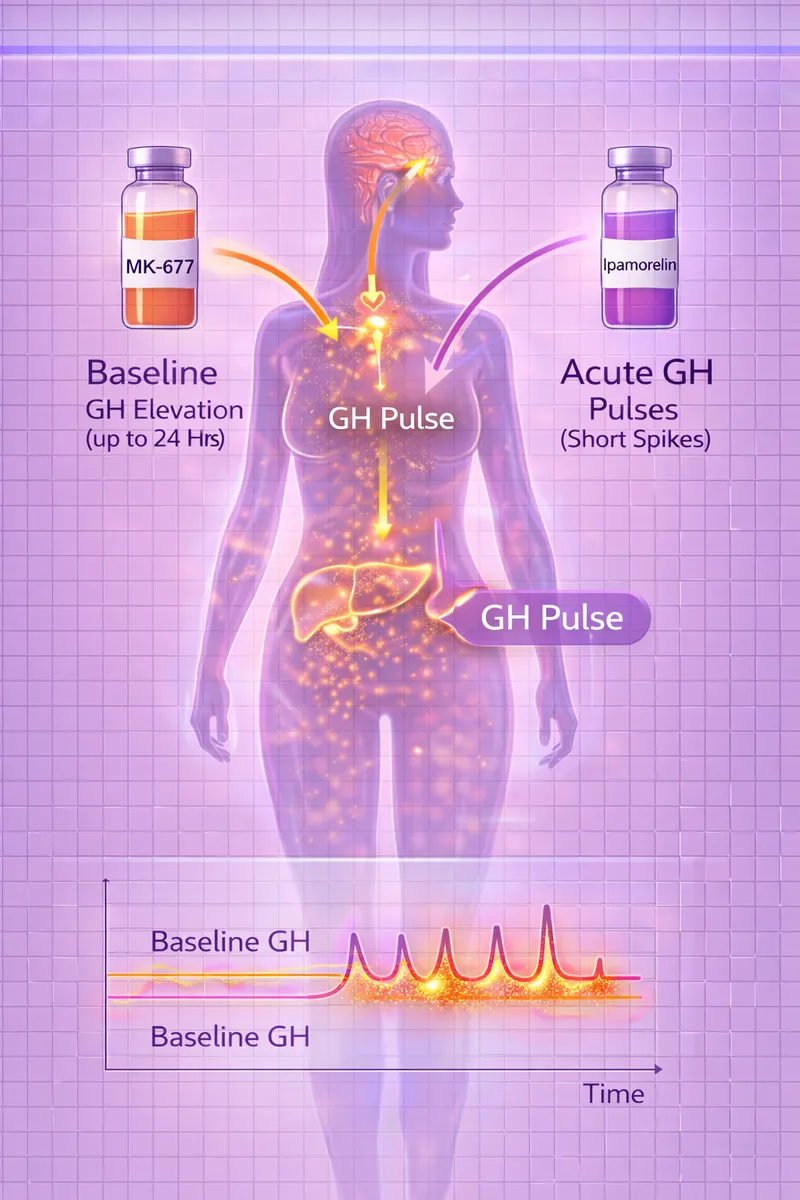
MK-677 + Ipamorelin stack - oral and injectable GH combination

An oral + injectable combination community sources describe for sustained GH elevation.

Why they are paired:

MK-677 (Ibutamoren) is an oral ghrelin mimetic with a 24-hour half-life. It provides baseline GH elevation throughout the day but is associated with significant water retention and hunger.

Adding Ipamorelin is described as creating acute GH spikes on top of the MK-677 baseline, particularly around training or before bed.

The synergy:

  • MK-677 provides sustained, low-level GH elevation (oral, once daily)
  • Ipamorelin adds acute GH pulses at chosen times
  • The combination is described as mimicking more natural GH patterns while maximizing total output

Considerations:

  • MK-677's water retention can mask fat loss visually
  • Hunger can be significant — community sources describe planning nutrition around it
  • Some community sources describe using MK-677 only at night to minimize daytime hunger

Learn more about MK-677 | MK-677 Benefits | Browse all Growth Peptides


CJC-1295 + MK-677

A combination of injectable GHRH with an oral ghrelin mimetic community sources describe for broad GH elevation.

Why they are paired:

CJC-1295 is a GHRH analog that:

  • Stimulates pituitary GH release
  • Creates sustained GH pulses (especially with the DAC version)
  • Works through the GHRH receptor pathway

MK-677 is an oral ghrelin mimetic that:

  • Activates ghrelin receptors (hunger + GH)
  • Provides 24-hour baseline GH elevation
  • Uses oral dosing — no injections needed
  • Is widely reported to improve sleep quality

The synergy:

Aspect CJC-1295 MK-677
Route Injectable Oral
Pathway GHRH receptor Ghrelin receptor
Duration Pulsatile (hours) Sustained (24hr half-life)
GH pattern Acute spikes Elevated baseline

Together, CJC-1295 is described as creating strong GH pulses while MK-677 maintains an elevated baseline between doses — a profile community sources characterize as more youthful, with both peaks and sustained levels.

Considerations:

  • MK-677 causes water retention — scale weight commonly increases
  • Strong appetite stimulation — community sources describe planning nutrition around it
  • Both compounds are widely reported to improve sleep
  • Blood glucose is commonly monitored (MK-677 can affect insulin sensitivity)

Community protocols describe:

  • CJC-1295 (no DAC): 100-300mcg before bed
  • MK-677: 10-25mg once daily (evening preferred)
  • Some community sources describe CJC-1295 DAC weekly + daily MK-677 for convenience

Common audience:

  • Users seeking broad GH elevation
  • Users who prefer oral dosing for daily use
  • Hard gainers who benefit from appetite increase
  • Users prioritizing sleep-quality improvements

Learn more about CJC-1295 | Learn more about MK-677


Ready to buy? Compare verified vendors on our best CJC-1295 sources page, or browse all coupon codes for up to 50% off.
Healing Peptide Stacks

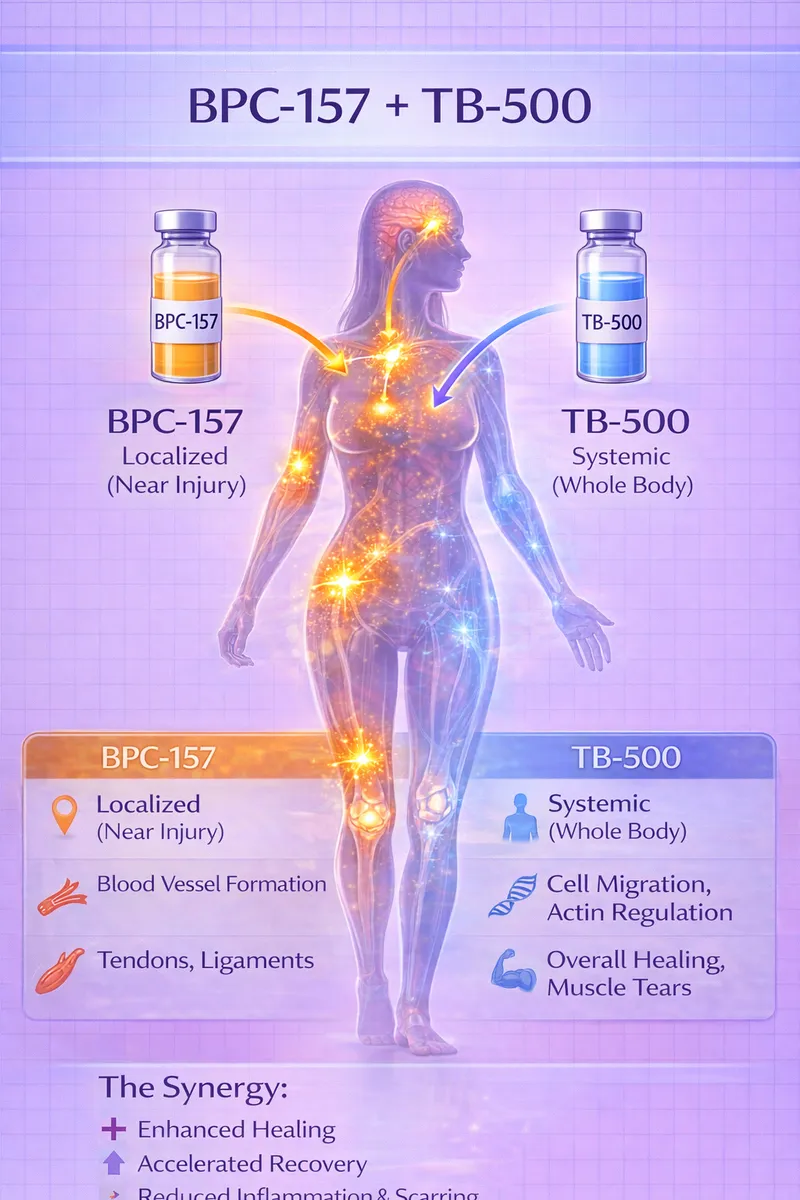
BPC-157 + TB-500

BPC-157 + TB-500 stack - the ultimate healing combination

The most frequently described healing combination in community sources for injury recovery.

Why they are paired:

BPC-157 (Body Protection Compound) is a 15-amino-acid peptide derived from gastric juice. Preclinical research describes it acting through multiple mechanisms:

  • Promotes angiogenesis (new blood vessel formation)
  • Upregulates growth-factor receptors
  • Modulates nitric-oxide pathways
  • Protects and supports the gut lining

TB-500 (Thymosin Beta-4 fragment) is a 43-amino-acid peptide that research describes as:

  • Promoting cell migration to injury sites
  • Increasing actin production (a cellular structure protein)
  • Reducing inflammation systemically
  • Supporting flexibility and reduced scar tissue

The synergy:

Aspect BPC-157 TB-500
Reach Localized (works best near injection site) Systemic (works throughout body)
Mechanism Blood vessel formation, growth factors Cell migration, actin regulation
Best for Tendons, gut, localized injuries Systemic healing, flexibility, muscle tears
Half-life Short (inject near injury) Long (can inject anywhere)

Together, BPC-157 is described as handling localized repair while TB-500 provides systemic healing support. Community sources commonly describe injecting BPC-157 subcutaneously near the injury site while injecting TB-500 anywhere (it is systemic).

Common use cases described:

  • Joint injuries and tendonitis
  • Muscle tears and strains
  • Overuse injuries from training
  • Post-surgical recovery
  • Chronic inflammation

Community protocols describe:

  • BPC-157: 250-500mcg daily, injected near the injury site
  • TB-500: 2-5mg twice weekly (loading), then 2-5mg weekly (maintenance)
  • Duration: 4-8 weeks depending on injury severity

Learn more about BPC-157 | TB-500 Benefits | Learn more about TB-500 | Browse all Healing Peptides


BPC-157 + GHK-Cu

A regeneration pairing community sources describe for tissue remodeling.

Why they are paired:

GHK-Cu (copper peptide) is a naturally occurring tripeptide that research describes as:

  • Activating genes involved in tissue remodeling
  • Promoting collagen and elastin synthesis
  • Having antioxidant and anti-inflammatory effects
  • Attracting immune cells for repair

Combined with BPC-157's angiogenic and growth factor effects, this stack excels at:

  • Skin healing and anti-aging
  • Tendon and ligament repair (collagen-rich tissues)
  • Scar tissue remodeling
  • Hair and nail health

The synergy:

BPC-157 creates the blood supply and growth signals. GHK-Cu provides the building blocks and remodeling instructions. Together, they accelerate tissue regeneration with improved quality.

Learn more about GHK-Cu | GHK-Cu Benefits


Weight Loss Stacks

Semaglutide + Tesamorelin

A metabolic pairing community sources describe for targeting weight loss from multiple angles.

Why they are paired:

Semaglutide is a GLP-1 receptor agonist that:

  • Substantially reduces appetite and food cravings
  • Acts on brain satiety centers
  • Slows gastric emptying (prolonged fullness)
  • Improves insulin sensitivity

Tesamorelin is a GHRH analog that:

  • Specifically targets visceral (belly) fat
  • Reduced trunk fat by roughly 15-20% in clinical trials
  • Was associated with preserved lean mass during weight loss in trials
  • Improved lipid markers in trials

The synergy:

Peptide Primary Effect Secondary Benefits
Semaglutide Appetite suppression, caloric deficit Blood sugar control, reduced cravings
Tesamorelin Visceral fat mobilization Lean mass preservation, improved lipids

Semaglutide is described as creating the caloric deficit through appetite control, while tesamorelin is described as preferentially mobilizing fat (especially visceral fat) and protecting muscle mass.

Why community sources describe this combination as complementary:

  • Different mechanisms: GLP-1 (appetite) + GHRH (fat mobilization)
  • Complementary timing: semaglutide weekly, tesamorelin daily
  • Lean-mass preservation: tesamorelin's GH effects were associated with preserved lean mass during a deficit in trials
  • Targeted fat loss: visceral fat specifically reduced

Community protocols describe:

  • Semaglutide: starting at 0.25mg weekly, titrating up to 1-2.4mg
  • Tesamorelin: 2mg daily subcutaneous injection
  • Duration: 3-6+ months

Learn more about Semaglutide | Learn more about Tesamorelin | Browse all Weight Loss Peptides


Tirzepatide + AOD-9604

An advanced weight-loss pairing combining dual-agonist activity with targeted fat mobilization.

Why they are paired:

Tirzepatide is a dual GLP-1/GIP agonist — more potent than semaglutide alone:

  • Up to 20-25% body-weight loss in clinical trials
  • Strong appetite suppression
  • Dual hormone-pathway activation

AOD-9604 is a fat-burning fragment of growth hormone that research describes as:

  • Stimulating lipolysis (fat breakdown)
  • Having no effect on blood sugar or IGF-1
  • Specifically targeting fat metabolism
  • Potentially supporting cartilage repair

The synergy:

Tirzepatide is described as handling the behavioral side (eating less), while AOD-9604 is described as enhancing fat mobilization without the full effects of growth hormone.

Common audience:

  • Users seeking broad weight loss
  • Users who have plateaued on a GLP-1 alone
  • Users concerned about muscle loss (AOD has no anabolic effects to interfere with)

Learn more about Tirzepatide | AOD-9604 Benefits | Learn more about AOD-9604


Retatrutide — The Triple-Agonist Powerhouse

Retatrutide is not technically a "stack" — it is three mechanisms in one molecule.

What makes it distinct:

Retatrutide is a triple-agonist targeting:

  • GLP-1 — appetite suppression and blood-sugar control
  • GIP — enhanced insulin response and metabolic signaling
  • Glucagon — direct fat burning and thermogenesis

Why the glucagon receptor matters:

Unlike semaglutide (GLP-1 only) or tirzepatide (GLP-1 + GIP), retatrutide adds glucagon activation. Glucagon directly mobilizes fat stores and increases energy expenditure — combining reduced intake with increased expenditure.

Clinical results:

Phase 2 trials reported up to 24% body-weight loss at 48 weeks — among the highest of any weight-loss compound studied to date.

The synergy within one molecule:

Receptor Effect Contribution
GLP-1 Appetite suppression Eat less, feel satisfied
GIP Metabolic enhancement Better nutrient handling
Glucagon Fat mobilization Active thermogenesis

Is retatrutide combined with other peptides?

Because it is already a triple-agonist, adding other GLP-1s is described as redundant and potentially hazardous. Some community sources describe combining it with:

  • Tesamorelin — for additional visceral-fat targeting
  • BPC-157 — for GI support (some report nausea)

Learn more about Retatrutide


Semaglutide + MOTS-c

A metabolic pairing community sources describe as combining appetite control with cellular energy enhancement.

Why they are paired:

Semaglutide addresses the intake side:

  • Reduces appetite and cravings
  • Acts on brain satiety centers
  • Creates a sustainable caloric deficit

MOTS-c addresses the expenditure side:

  • Activates AMPK (a cellular energy sensor)
  • Acts as an "exercise mimetic"
  • Enhances fat oxidation
  • Improves insulin sensitivity

The synergy:

Aspect Semaglutide MOTS-c
Primary action Reduce intake Increase expenditure
Mechanism GLP-1 receptor AMPK activation
Metabolic effect Blood sugar control Fat oxidation
Feel Less hungry More energetic

Together, the pairing is described as producing a caloric deficit (semaglutide) plus enhanced fat burning and metabolic efficiency (MOTS-c) — characterized as dieting alongside cellular-level exercise.

Common audience:

  • Users seeking metabolic benefits beyond appetite suppression
  • Users interested in longevity + weight loss
  • Users seeking the "exercise mimetic" effects of MOTS-c during a cut

Learn more about Semaglutide | Learn more about MOTS-c


Longevity & Recovery Stacks

Epitalon + NAD+

A cellular-longevity pairing community sources describe as targeting aging at the DNA level.

Why they are paired:

Epitalon (Epithalon) is described as activating telomerase:

  • Helps maintain telomere length
  • Regulates circadian rhythm via the pineal gland
  • Studied for anti-aging effects in Russian research

NAD+ is essential for cellular energy:

  • Powers mitochondrial function
  • Required for DNA repair (PARP enzymes)
  • Activates sirtuins (longevity genes)
  • Declines significantly with age

The synergy:

Epitalon works on telomere protection (DNA ends), while NAD+ supports DNA repair and cellular energy. Together, they address aging from two complementary angles:

Target Epitalon NAD+
DNA protection Telomere maintenance DNA repair enzymes
Cellular energy Pineal/circadian Mitochondrial function
Aging pathway Telomerase activation Sirtuin activation

Learn more about Epitalon | Learn more about NAD+ | Browse all Longevity Peptides


MOTS-c + SS-31

A mitochondrial-optimization pairing community sources describe for energy and metabolic health.

Why they are paired:

MOTS-c is a mitochondrial-derived peptide that:

  • Acts as an "exercise mimetic"
  • Activates AMPK (an energy sensor)
  • Improves insulin sensitivity
  • Enhances fat oxidation

SS-31 (Elamipretide) is described as protecting mitochondria:

  • Targets cardiolipin in the mitochondrial membrane
  • Improves ATP production efficiency
  • Reduces oxidative stress
  • Enhances exercise capacity

The synergy:

MOTS-c is described as signaling cells to behave as if exercising (metabolic benefits), while SS-31 is described as supporting optimal mitochondrial performance. Together, they are characterized as a metabolic and energy-optimization pairing.

Learn more about MOTS-c | Learn more about SS-31


Cognitive Stacks

Semax + Selank

The Russian nootropic pairing community sources describe for focus and calm.

Why they are paired:

Semax is a nootropic peptide that research describes as:

  • Increasing BDNF (brain-derived neurotrophic factor)
  • Enhancing focus and mental clarity
  • Providing stimulating, energizing effects
  • Supporting learning and memory

Selank is an anxiolytic peptide that research describes as:

  • Reducing anxiety without sedation
  • Modulating the GABA system
  • Having immunomodulatory effects
  • Promoting calm focus

The synergy:

Aspect Semax Selank
Energy Stimulating Calming
Focus Sharp, driven Calm, clear
Mood Elevated, motivated Reduced anxiety
Best for Productivity, learning Stressful situations, social anxiety

Together, Semax is described as providing cognitive drive while Selank reduces anxiety and jitters. Community sources characterize the result as calm, focused productivity.

Community protocols describe:

  • Both typically used intranasally
  • Semax: 200-600mcg, 1-2x daily
  • Selank: 200-400mcg, 1-2x daily
  • Use at the same time, or Semax AM / Selank PM

Semax Benefits | Learn more about Semax | Selank Benefits | Learn more about Selank | Browse all Cognitive Peptides


Stacking Principles Community Sources Describe

1. Start Low, Go Slow

Community sources commonly describe beginning with lower doses of each peptide than used alone — increases are reversible, side effects less so.

2. Timing

  • GH peptides: commonly used on an empty stomach, separated from food by 30+ minutes
  • GHRH + GHRP: commonly dosed together for synergy
  • BPC-157: described as usable with or without food
  • GLP-1 agonists: typically once weekly, same day each week

3. Cycling

Not all peptides are cycled, but many community protocols describe breaks:

  • GH peptides: 8-12 weeks on, 4 weeks off (or continuous with monitoring)
  • Healing peptides: used until healed, then stopped
  • GLP-1 agonists: often used long-term for maintenance

4. Tracking Response

Community sources commonly describe keeping notes on:

  • Energy levels
  • Sleep quality
  • Body-composition changes
  • Side effects
  • Injection-site reactions

5. Quality First

Community sources emphasize peptides from verified vendors with third-party COA (Certificate of Analysis) testing. Contaminated or underdosed peptides are described as ineffective.


Combinations Community Sources Advise Against

Not all combinations are described as beneficial:

  • Multiple GHRPs together (GHRP-2 + GHRP-6 + Ipamorelin): diminishing returns, increased side effects
  • Multiple GLP-1 agonists (semaglutide + tirzepatide): described as hazardous, with no added benefit
  • Too many peptides at once: community sources describe a 2-3 ceiling, adding complexity gradually

Conclusion

Peptide stacking is described as enhancing results when approached thoughtfully. The reported key is understanding why each peptide is included and how they complement each other.

Combinations community sources most commonly describe:

  • CJC-1295 + Ipamorelin for GH optimization
  • BPC-157 + TB-500 for healing
  • Semaglutide + Tesamorelin for weight loss

Selection is then adjusted to the goal and individual response.

Explore all peptides in our catalog | Browse by category

Frequently Asked Questions

What stacking protocols are documented for growth-hormone peptides?
Community sources most commonly describe CJC-1295 + Ipamorelin as the default GH-peptide pairing. CJC-1295 (a GHRH analog) initiates growth-hormone release while Ipamorelin (a GHRP) acts on the ghrelin receptor; community sources describe the combination as producing larger GH pulses than either alone, with Ipamorelin selected for not raising cortisol or prolactin the way GHRP-6 or GHRP-2 do.
What stacking protocols are documented for healing peptides?
BPC-157 + TB-500 is the most frequently described healing combination in community sources. Published preclinical research describes BPC-157 as promoting localized angiogenesis near the injection site, while TB-500 (a thymosin beta-4 fragment) is described as supporting systemic cell migration and reduced inflammation.
What stacking protocols are documented for weight-loss peptides?
Semaglutide + Tesamorelin is a commonly described weight-loss pairing. Semaglutide acts on the GLP-1 receptor to reduce appetite, while tesamorelin is a GHRH analog studied for visceral-fat reduction. Community sources describe the pairing as complementary because the two act through different pathways.
What peptide combinations do community sources advise against?
Community sources commonly advise against combining multiple GHRPs (GHRP-2 + GHRP-6 + Ipamorelin), multiple GLP-1 agonists (semaglutide + tirzepatide), or running more than two to three peptides at once. These combinations are described as producing diminishing returns alongside increased side-effect risk.
What is peptide stacking?
Peptide stacking refers to combining two or more peptides simultaneously for complementary effects. The described rationale is pairing peptides that act through different biological mechanisms to broaden results while limiting side effects.

This article is for educational purposes only. Always consult a healthcare professional before starting any peptide protocol.