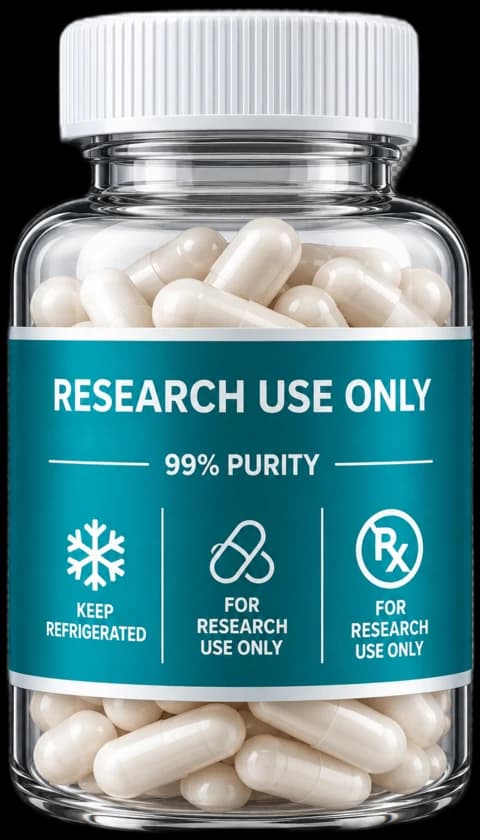
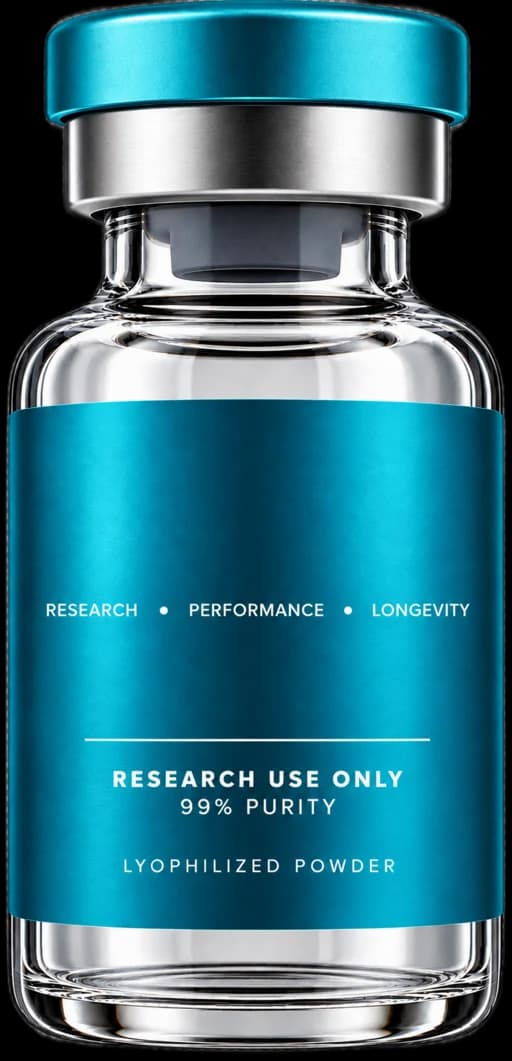
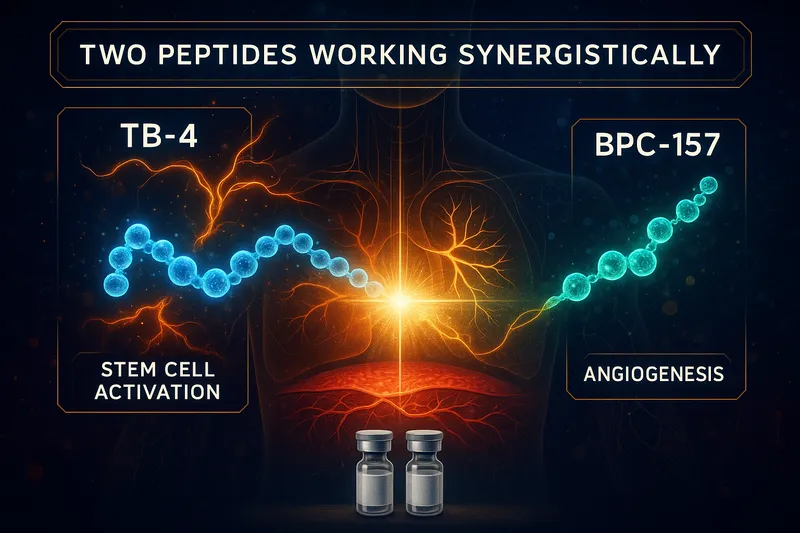
 The combination of Thymosin Beta-4 (TB-4) and BPC-157 is the most frequently discussed healing peptide stack in research communities — and for good reason. These two peptides work through entirely different mechanisms, target complementary aspects of the repair process, and have both been independently studied across a wide range of tissue types.
But "frequently discussed" isn't the same as "well-studied together." Here's what we know, what we can reasonably infer from the individual research, and where the evidence has gaps.
Looking for TB-500 (the fragment) + BPC-157? That's the classic "Wolverine Stack." See our Wolverine Stack: BPC-157 & TB-500 Guide for detailed mechanism comparisons, dosing tables, and results timelines specific to the TB-500 fragment. This article focuses on full-length Thymosin Beta-4 — the complete 43-amino-acid protein — and how it differs from and potentially exceeds TB-500 when stacked with BPC-157.
Table of Contents
- Why Stack TB-4 and BPC-157?
- How TB-4 and BPC-157 Complement Each Other
- Injury-Specific Stacking Rationale
- Research Dosing Considerations
- Example Research Protocols
- Adding TB-500 to the Stack
- Adding GHK-Cu to the Stack
- Safety Considerations
- What the Evidence Does NOT Support
- References
1. Why Stack TB-4 and BPC-157? {#why-stack}
The fundamental principle of peptide stacking is non-overlapping mechanisms. You don't stack two peptides that do the same thing — you stack peptides that cover different aspects of the same goal.
TB-4 and BPC-157 are the textbook case:
| Aspect |
TB-4 |
BPC-157 |
| Primary mechanism |
Actin sequestration → cell migration |
Nitric oxide modulation → cytoprotection |
| Angiogenesis pathway |
VEGF via Notch signaling |
VEGF via VEGFR2-Akt-eNOS |
| Anti-inflammatory |
NF-κB suppression (direct) |
NO system normalization (indirect) |
| Growth factors |
Progenitor cell activation |
EGF/GH receptor upregulation |
| Unique strength |
Structural repair, cardiac regeneration |
Gut healing, dopamine stabilization |
| Origin |
Endogenous (naturally produced) |
Gastric juice-derived (semi-synthetic) |
They both promote healing. They both reduce inflammation. They both drive angiogenesis. But they do all of this through different molecular pathways — meaning they can work simultaneously without competing for the same receptors or saturating the same signaling cascades.
2. How TB-4 and BPC-157 Complement Each Other {#mechanisms}
TB-4 and BPC-157 target different phases of tissue repair through non-overlapping molecular pathways. TB-4 drives actin-mediated cell migration, NF-κB suppression, and progenitor cell activation; BPC-157 drives nitric oxide modulation, VEGF/growth factor receptor upregulation, and cytoprotection. Together, they cover the healing cascade from acute inflammation through remodeling.
For a detailed side-by-side mechanism comparison with phase-by-phase tables, see our Wolverine Stack guide — the mechanisms apply equally to full-length TB-4, with the added advantage that TB-4 retains signaling domains (progenitor cell activation, anti-fibrotic switch) that the TB-500 fragment lacks.
What Full-Length TB-4 Adds Over TB-500
This is the key differentiator for this stack. TB-500 is a synthetic fragment containing TB-4's actin-binding domain, but full-length TB-4 (43 amino acids) retains additional functional domains:
- Progenitor cell mobilization — TB-4 activates epicardial progenitors in the heart (Smart et al., 2007) and satellite cells in muscle (Tokura et al., 2010). These regenerative capabilities may not be fully replicated by the TB-500 fragment.
- Anti-fibrotic signaling — TB-4 modulates the balance between productive healing and scar formation across tissue types (Kleinman et al., 2023).
- Full NF-κB suppression cascade — TB-4's interaction with PINCH-1 and ILK for direct NF-κB inhibition (Qiu et al., 2011) involves domains beyond the TB-500 fragment.
- Clinical trial data — Phase I safety data exists for full-length TB-4 (Ruff et al., 2010), including a first-in-human Phase I study of recombinant TB-4 in healthy volunteers that reported no serious adverse events (Wang et al., 2021). TB-500 has no equivalent human trial data.
The trade-off: TB-500's smaller molecular weight (~845 Da vs ~4,921 Da) may allow faster tissue penetration. Full-length TB-4 provides the complete signaling cascade at the cost of slower distribution.
3. Injury-Specific Stacking Rationale {#injury-specific}
Tendon & Ligament Injuries
Both peptides have strong tendon data:
- TB-4: Improved MCL biomechanical properties and more evenly organized collagen fibers at 4 weeks in a rat model (Xu et al., 2013)
- BPC-157: Accelerated Achilles tendon-to-bone healing through VEGF and GH receptor pathways (Chang et al., 2011)
Combined rationale: TB-4 provides the actin-driven cell migration and organized collagen scaffolding; BPC-157 provides growth factor amplification and additional angiogenic support through a separate VEGF pathway.
Muscle Injuries
- TB-4: Satellite cell activation and myoblast chemotaxis — the primary mechanism for muscle fiber regeneration (Tokura et al., 2010)
- BPC-157: Reduced fibrosis and accelerated functional recovery in muscle crush models (Novinscak et al., 2008)
Combined rationale: TB-4 recruits the repair cells; BPC-157 creates a more favorable healing environment (reduced fibrosis, improved blood flow) for those cells to work in.
Wound Healing & Surgical Recovery
Combined rationale: TB-4 handles the structural repair and anti-scarring; BPC-157 provides systemic cytoprotection and is particularly relevant if the surgery involves the GI tract.
Neurological Injuries
- TB-4: Neuroprotection and neurorestoration in TBI models — reduced lesion volume, enhanced neurogenesis (Xiong et al., 2012)
- BPC-157: Neuroprotection in TBI models and dopaminergic system stabilization (Sikiric et al., 2016)
Combined rationale: Both show neuroprotective effects through different pathways. TB-4 through actin/angiogenesis; BPC-157 through NO/neurotransmitter modulation.
Joint & Inflammatory Conditions
- TB-4: NF-κB suppression, anti-fibrotic effects, tissue remodeling
- BPC-157: NO normalization, growth factor support, NSAID-gastroprotection (Sikiric et al., 2006)
Combined rationale: If the injury involves chronic inflammation requiring NSAID use, BPC-157 provides gastroprotection while TB-4 handles structural repair. This addresses both the injury and the side effects of conventional treatment.
Ready to buy? Compare verified vendors on our best thymosin beta-4 sources page, or browse all coupon codes for up to 50% off.
4. Research Dosing Considerations {#dosing}
Important: No published study has tested TB-4 and BPC-157 in combination with optimized combined dosing. The following is extrapolated from individual peptide research protocols.
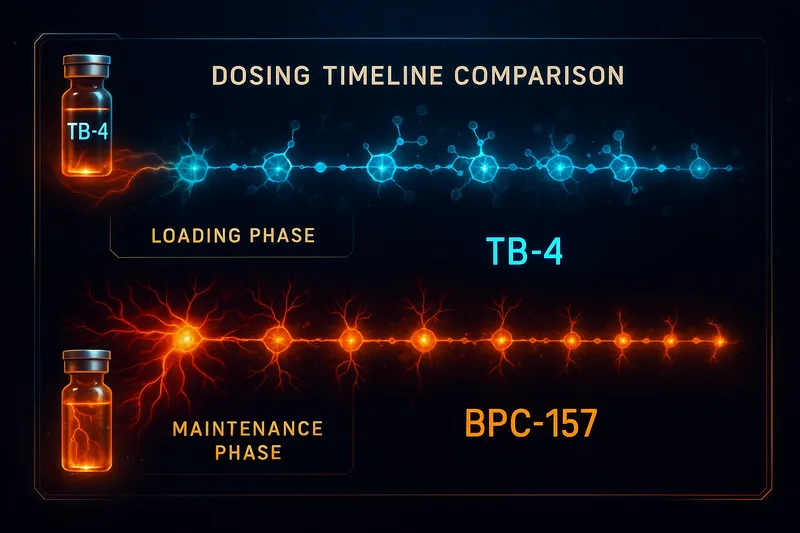
Individual Dosing Ranges (From Published Research)
| Peptide |
Loading Phase |
Maintenance Phase |
Route |
| TB-4 |
5–10 mg/week (2–4 weeks) |
2–5 mg/week |
Subcutaneous (SC) |
| BPC-157 |
200–600 µg/day |
200–400 µg/day |
SC or oral |
TB-4 dosing is derived from animal model extrapolations and Phase I safety data (Ruff et al., 2010). BPC-157 dosing is extrapolated from the extensive animal literature (Sikiric et al., 2018).
Combined Protocol Considerations
When stacking, the general research approach is:
- Maintain standard individual doses — since mechanisms don't overlap, there's no pharmacological reason to reduce either dose
- Align timing with injury phase — both peptides benefit from a loading phase during acute healing
- Match injection site to injury — local/peri-lesional for localized injuries; systemic (SC abdomen) for multi-tissue or systemic conditions
- Same injection timing is acceptable — different mechanisms mean no competition for receptors. Can be administered at the same time, at different injection sites
Duration Considerations
| Injury Type |
Suggested Stack Duration |
Rationale |
| Acute soft tissue |
4–8 weeks |
Covers inflammatory + proliferative + early remodeling phases |
| Tendon/ligament |
8–12 weeks |
Tendons are slow healers; longer remodeling needed |
| Post-surgical |
4–8 weeks |
Focus on acute healing and anti-fibrotic remodeling |
| Chronic injury |
8–16 weeks |
Chronic conditions require longer anti-fibrotic and remodeling support |
| Neurological |
8–12+ weeks |
Neural repair is the slowest tissue process |
5. Example Research Protocols (Educational) {#protocols}
The following templates represent commonly discussed research model protocols. They are extrapolated from published animal studies — not clinical recommendations.
Protocol A: Acute Tendon/Ligament Injury
Goal: Maximize healing during the acute and proliferative phases of connective tissue repair.
| Phase |
TB-4 |
BPC-157 |
Duration |
| Loading |
2.5 mg SC, 3×/week |
250 µg SC (near injury), 2×/day |
Weeks 1–2 |
| Transition |
2.5 mg SC, 2×/week |
250 µg SC, 1×/day |
Weeks 3–4 |
| Maintenance |
2.5 mg SC, 1×/week |
250 µg SC, 1×/day or as needed |
Weeks 5–12 |
Rationale: Front-loaded TB-4 for tissue saturation; BPC-157 near the injury for local growth factor support. Both tapered as acute healing completes.
Protocol B: Post-Surgical Recovery
Goal: Accelerate wound healing, reduce inflammation, minimize scarring.
| Phase |
TB-4 |
BPC-157 |
Duration |
| Acute |
2.5 mg SC, 3×/week |
250 µg SC, 2×/day |
Weeks 1–2 |
| Recovery |
2.5 mg SC, 2×/week |
250 µg SC or oral, 1×/day |
Weeks 3–6 |
Rationale: TB-4 for anti-fibrotic and collagen-organizing effects; BPC-157 for cytoprotection and NO-mediated healing. If GI surgery, BPC-157 oral route provides direct mucosal support.
Protocol C: Chronic Injury / Overuse
Goal: Address stalled healing, remodel existing scar tissue, reduce chronic inflammation.
| Phase |
TB-4 |
BPC-157 |
Duration |
| Steady-state |
2.5 mg SC, 2×/week |
250 µg SC, 1×/day |
Weeks 1–12+ |
Rationale: No aggressive loading for chronic conditions — steady delivery for sustained anti-fibrotic and remodeling effects. Longer duration to address mature scar tissue.
Protocol D: Muscle Recovery (Athletic)
Goal: Accelerate post-injury or post-exercise muscle recovery.
| Phase |
TB-4 |
BPC-157 |
Duration |
| Loading |
2.5 mg SC, 3×/week |
250 µg SC, 2×/day |
Weeks 1–2 |
| Maintenance |
2.5 mg SC, 1–2×/week |
250 µg SC, 1×/day |
Weeks 3–6 |
Rationale: TB-4 for satellite cell activation and myoblast recruitment; BPC-157 for anti-fibrotic environment and additional angiogenesis through NO pathway.
6. Adding TB-500 to the Stack {#adding-tb500}
Some research protocols add TB-500 — the synthetic active fragment of TB-4 (amino acids 17–23) — to the stack.
Rationale
- TB-500's smaller molecular weight (~845 Da vs. TB-4's ~4,921 Da) allows faster tissue penetration
- TB-500 carries the core actin-binding mechanism with enhanced distribution
- TB-4 provides the full signaling cascade including progenitor activation and additional anti-fibrotic domains
Triple Stack Consideration
| Peptide |
Role in Stack |
Typical Research Dose |
| TB-4 |
Full signaling cascade, progenitor activation |
2.5 mg SC, 2–3×/week |
| TB-500 |
Actin migration + enhanced tissue penetration |
2–5 mg SC, 2×/week |
| BPC-157 |
Growth factors, NO modulation, cytoprotection |
250 µg SC, 1–2×/day |
When This Makes Sense
The triple combination is most discussed in research for:
- Severe, multi-tissue injuries
- Complex surgical recovery
- Cases where maximizing tissue coverage is prioritized
For the detailed TB-4 vs TB-500 comparison, see our dedicated comparison. For TB-500 vs BPC-157, see our BPC-157 vs TB-500 comparison.
7. Adding GHK-Cu to the Stack {#adding-ghkcu}
GHK-Cu (copper peptide) adds a fourth non-overlapping mechanism focused on copper-dependent collagen synthesis and extracellular matrix remodeling.
How GHK-Cu Complements the Stack
| Mechanism |
TB-4 |
BPC-157 |
GHK-Cu |
| Cell migration |
✓ (actin) |
✓ (FAK-paxillin) |
— |
| Angiogenesis |
✓ (Notch/VEGF) |
✓ (VEGFR2) |
✓ (mild) |
| Collagen synthesis |
Indirect |
Via GH receptor |
✓ (direct, copper-dependent) |
| Anti-inflammatory |
✓ (NF-κB) |
✓ (NO system) |
✓ (mild) |
| ECM remodeling |
✓ |
✓ |
✓ (primary strength) |
| Skin/cosmetic |
✓ |
— |
✓ (primary application) |
GHK-Cu is most relevant when dermal healing, scar remodeling, or cosmetic outcomes are important goals alongside structural repair.
Why GHK-Cu Pairs Especially Well with Full-Length TB-4
The TB-4 + BPC-157 + GHK-Cu triple stack is particularly compelling because each peptide owns a distinct phase of extracellular matrix (ECM) repair:
- TB-4 clears the way — its anti-fibrotic properties prevent excessive scar tissue, while progenitor cell activation seeds the repair zone with fresh cells
- BPC-157 builds the infrastructure — VEGF-driven angiogenesis establishes blood supply, and growth factor receptor upregulation amplifies repair signals
- GHK-Cu refines the final product — copper-dependent collagen synthesis produces organized, mature collagen fibers rather than disorganized scar tissue. GHK-Cu also upregulates decorin (which regulates collagen fibril diameter) and downregulates TGF-β1 (reducing fibrosis)
GHK-Cu Dosing in the Stack
| Peptide |
Route |
Typical Research Dose |
Frequency |
| TB-4 |
SC injection |
2.5 mg |
2–3×/week |
| BPC-157 |
SC injection (near injury) |
250 µg |
1–2×/day |
| GHK-Cu |
SC injection or topical |
1–2 mg SC or topical cream |
Daily |
GHK-Cu can be administered topically for superficial wounds/skin healing or subcutaneously for deeper tissue targets. The topical route is unique among healing peptides and makes GHK-Cu easy to add without additional injections.
For complete GHK-Cu protocols, see our GHK-Cu Dosing Guide.
8. Safety Considerations {#safety}
Individual Safety Profiles
TB-4: Phase I clinical trial showed no serious adverse events at IV doses up to 1,260 mg in healthy volunteers. No clinically significant changes in vital signs, ECG, or labs (Ruff et al., 2010). A more recent first-in-human study of recombinant TB-4 confirmed favorable safety (Wang et al., 2021).
BPC-157: No reported lethal dose in published animal studies, even at very high concentrations. However, human clinical trial data is extremely limited (Sikiric et al., 2018).
Combined Safety Considerations
No published study has evaluated the safety of TB-4 and BPC-157 administered together. The theoretical safety case rests on:
- Non-overlapping mechanisms — they don't compete for receptors
- Different metabolic pathways — no expected pharmacokinetic interaction
- Individual safety data — both show favorable individual safety profiles
However, the absence of combined safety data means this remains theoretical.
Shared Theoretical Concerns
Both TB-4 and BPC-157 promote angiogenesis and cell migration — processes that could theoretically support tumor growth. While neither peptide has been shown to cause cancer, both should be avoided by anyone with active malignancy. The combined angiogenic effect of the stack is a consideration that has not been evaluated.
Injection Site Reactions
Standard for any subcutaneous peptide:
- Mild redness or irritation
- Occasional swelling
- Generally transient and self-resolving
- Using separate injection sites for each peptide reduces local irritation
9. What the Evidence Does NOT Support {#limitations}
Being transparent about the limits of current evidence:
No Combined Studies
As of this writing, no published peer-reviewed study has tested TB-4 and BPC-157 together in the same model. The stacking rationale is based on:
- Individual mechanism data for each peptide
- The non-overlapping pathway principle
- Theoretical complementarity
This is a reasonable scientific inference — but it is an inference, not direct evidence.
No Combined Human Data
Neither peptide has extensive human efficacy data individually (TB-4 has Phase III corneal data; BPC-157 has none). Combined human data does not exist.
Not a Guaranteed Outcome
Even with complementary mechanisms, individual biology, injury type, severity, timing, and dosing all affect outcomes. Stacking two evidence-backed peptides doesn't guarantee additive results.
Not a Replacement for Medical Care
Serious injuries — fractures, complete tendon ruptures, surgical emergencies — require medical treatment. Peptide research is about augmenting recovery, not replacing standard care.