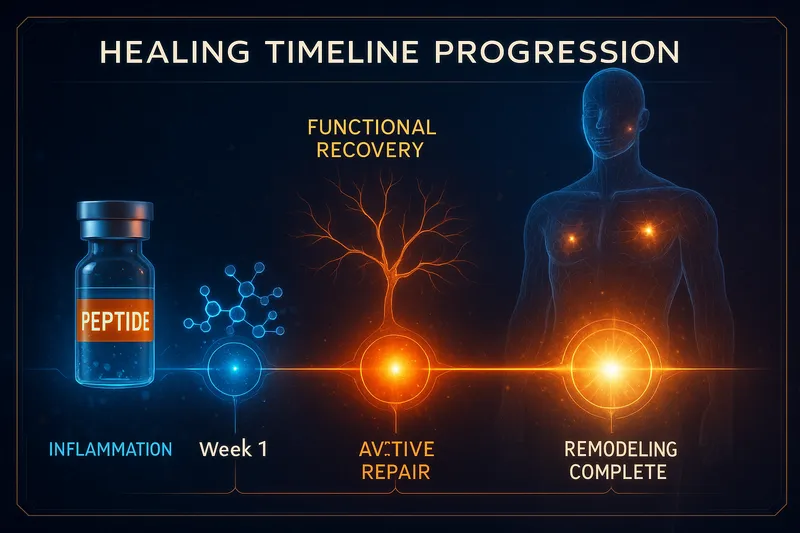
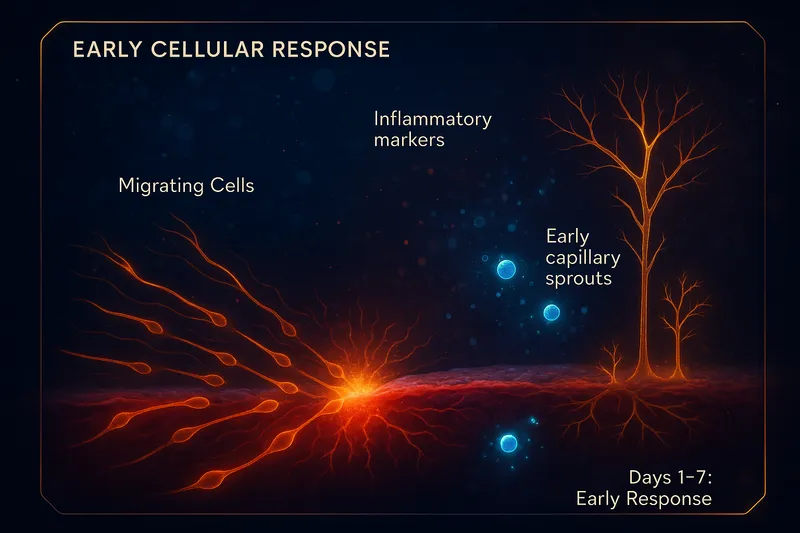
Phase 2: Weeks 2–3 — Active Tissue Repair
The second and third weeks represent the most active repair phase in most TB-4 studies. Angiogenesis is now established, stem cells are mobilizing, and new tissue formation is accelerating.
What the Research Shows
Spinal cord injury: In rats with experimentally induced spinal cord compression, TB-4 treatment resulted in significantly improved locomotor scores by day 14. Histological analysis showed reduced cavitation, decreased inflammatory cell infiltration, and preserved neuronal architecture in the injured spinal cord. By day 14, treated animals showed meaningfully better motor function than saline controls (Cheng et al., 2014).
Traumatic brain injury: Xiong et al. demonstrated that TB-4 treatment after controlled cortical impact in rats promoted neurogenesis, angiogenesis, and oligodendrogenesis in the injury border zone. By day 14, treated animals showed improved spatial learning and sensorimotor function compared to controls (Xiong et al., 2012).
Dermal wounds in diabetic models: In db/db diabetic mice with burn wounds, TB-4 treatment significantly accelerated wound closure by day 14 compared to untreated controls. The improvement was associated with downregulation of RAGE (receptor of advanced glycation end products) and enhanced angiogenesis at the wound site (Kim et al., 2014).
Hair follicle activation: TB-4 treatment in wound-adjacent skin promoted hair follicle stem cell migration to the wound bed and differentiation by weeks 2–3. Hair follicle bulge stem cells expressing markers of active differentiation were observed at significantly higher rates in TB-4-treated wounds (Philp et al., 2007).
What Users Commonly Report
Weeks 2–3 are where the research consistently shows the largest separation between TB-4-treated and control groups:
- Measurable acceleration in wound closure (skin, corneal)
- Improved functional scores (neurological, motor)
- Visible new blood vessel formation at injury sites
- Reduced scar tissue formation compared to controls
- Early signs of hair regrowth in wound-adjacent areas
This is typically the phase where, in controlled studies, the benefits of TB-4 become statistically significant and functionally meaningful.
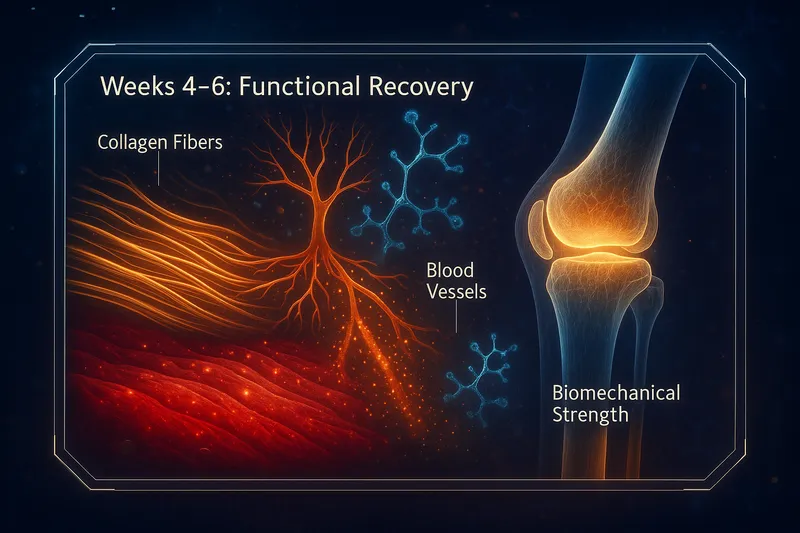
Phase 3: Weeks 4–6 — Functional Recovery
By weeks 4–6, the initial repair processes are maturing. New blood vessels are stabilizing, provisional tissue is being replaced by more organized structures, and functional outcomes become increasingly apparent.
What the Research Shows
Cardiac repair: In mice with myocardial infarction, TB-4 treatment resulted in preserved cardiac function at 4 weeks post-injury. Echocardiography showed significantly better ejection fraction and reduced scar size in TB-4-treated hearts compared to controls. The mechanism involved both early myocyte survival (via ILK/Akt activation) and subsequent neovascularization through epicardial progenitor activation (Bock-Marquette et al., 2007).
Corneal healing: Phase 2/3 clinical trials using topical TB-4 (RGN-259) for neurotrophic keratopathy and dry eye disease evaluated outcomes at 4–6 week timepoints. These ongoing trials represent the most advanced clinical testing of TB-4, with earlier studies showing significant improvement in corneal staining scores by week 4 (Sosne, 2018).
Spinal cord remodeling: Continued locomotor improvement in spinal cord injury models was observed through 6 weeks, with TB-4-treated rats showing progressively better Basso-Beattie-Bresnahan scores. Histological examination at 6 weeks revealed reduced glial scarring and greater preservation of white matter tracts (Cheng et al., 2014).
What Users Commonly Report
The 4–6 week window is characterized by:
- Consolidation of functional gains — improvements plateau but stabilize
- Tissue maturation — provisional repair tissue becomes more organized
- Reduced inflammation reaching baseline levels
- Improved biomechanical properties of healed tissue
- Continued but slowing improvement in functional outcomes
Phase 4: Weeks 7–12 — Tissue Remodeling
The tissue remodeling phase is the longest and most subtle. Collagen is reorganized from disordered scar tissue into more functional arrangements, blood vessels mature and prune, and tissue gradually approaches its pre-injury biomechanical properties.
What the Research Shows
Cardiac remodeling: Long-term follow-up studies in cardiac injury models show that TB-4's benefits persist and even continue to improve through 8–12 weeks. Dubé et al. reviewed evidence showing that TB-4 protein therapy promoted sustained cardiac repair, with ongoing vascular remodeling and reduced fibrosis observed at these later timepoints (Dubé et al., 2012).
Dermal scar quality: In dermal wound healing studies, TB-4-treated wounds showed superior collagen organization at 8–12 weeks compared to controls. The improvement in scar quality — rather than just closure speed — suggests TB-4 influences the remodeling phase, not just the initial repair (Kleinman & Sosne, 2016).
Neurological recovery: In traumatic brain injury models, functional improvements continued to accrue through 90 days post-injury, with TB-4-treated animals showing better performance on cognitive and motor tasks. The ongoing improvement was associated with continued neurogenesis and synaptic remodeling in the injury penumbra (Xiong et al., 2012).
What Users Commonly Report
- Improved quality of healed tissue (less fibrotic, more organized)
- Gradual restoration of function in previously impaired areas
- Reduced long-term scarring compared to what would be expected
- Plateau of measurable improvements in most parameters
Phase 5: Beyond 12 Weeks — Long-Term Outcomes
Few TB-4 studies extend beyond 12 weeks, making this phase the least well-characterized. However, the data that does exist suggests that TB-4's early interventions create lasting structural benefits.
What the Research Shows
Regenerative aging: Bock-Marquette et al. (2023) reviewed TB-4's potential in anti-aging regenerative therapies, noting that early TB-4 intervention in cardiac models produced structural benefits that were maintained long-term. The hypothesis is that TB-4's activation of progenitor cell populations during the critical early repair window creates tissue improvements that persist after treatment ends (Bock-Marquette et al., 2023).
Neurodegenerative implications: Pardon (2018) reviewed TB-4's anti-inflammatory potential in the central nervous system, noting that the peptide's ability to modulate microglial activation could have implications extending well beyond acute injury — potentially influencing long-term neurodegeneration trajectories (Pardon, 2018).
Key Principle
TB-4 appears to work primarily by optimizing the body's own repair processes during a critical early window. The long-term outcomes are a consequence of better-quality initial repair — not ongoing TB-4 activity. This is an important distinction: TB-4 is not something you take indefinitely. It's most relevant during the active healing period.
Timeline by Injury Type
Different tissues heal at different rates, and TB-4's timeline varies accordingly. Here's what the research suggests for specific injury categories:
Skin and Dermal Wounds
| Timepoint |
Expected Research Outcome |
| Days 1–3 |
Increased cell migration, reduced inflammation |
| Days 4–7 |
Accelerated wound contraction, early angiogenesis |
| Weeks 2–3 |
Significant wound closure advantage over controls |
| Weeks 4–6 |
Improved scar quality, collagen organization |
| Weeks 8–12 |
Superior long-term cosmetic and structural outcome |
Based on: Malinda et al., 1999; Kim et al., 2014; Kleinman & Sosne, 2016
Corneal Injuries
| Timepoint |
Expected Research Outcome |
| Days 1–7 |
Reduced inflammation, accelerated re-epithelialization |
| Weeks 2–4 |
Improved corneal clarity, reduced neovascularization |
| Weeks 4–6 |
Significant improvement in corneal staining scores |
Based on: Sosne et al., 2002; Sosne, 2018
Cardiac Injury
| Timepoint |
Expected Research Outcome |
| Days 1–4 |
Activation of ILK/Akt survival pathway, reduced apoptosis |
| Days 7–14 |
Epicardial progenitor activation, early neovascularization |
| Weeks 4–6 |
Improved ejection fraction, reduced scar size |
| Weeks 8–12 |
Sustained cardiac function improvement |
Based on: Bock-Marquette et al., 2004; Bock-Marquette et al., 2007; Smart et al., 2007
Neurological Injury (TBI / Spinal Cord)
| Timepoint |
Expected Research Outcome |
| Days 1–7 |
Reduced neuroinflammation, preserved neuronal architecture |
| Weeks 2–4 |
Improved motor and cognitive scores |
| Weeks 4–8 |
Continued functional improvement, neurogenesis |
| Weeks 8–12+ |
Ongoing but decelerating improvement |
Based on: Xiong et al., 2012; Cheng et al., 2014; Morris et al., 2010
Factors That Affect the Timeline
The research identifies several variables that influence how quickly TB-4's effects manifest:
Injury Severity
More severe injuries take longer to respond, but also show larger absolute improvements with TB-4. In the spinal cord injury study, more severe compressions showed greater relative improvement with TB-4 treatment, though baseline recovery was lower (Cheng et al., 2014).
Timing of Administration
Earlier administration generally produces better outcomes. In cardiac studies, pre-treatment with TB-4 before coronary ligation produced the strongest results, but even post-injury administration within the first days was beneficial (Bock-Marquette et al., 2004).
Tissue Vascularity
Well-vascularized tissues (muscle, skin) respond faster than poorly vascularized tissues (tendons, cartilage). TB-4's angiogenic properties help compensate for poor baseline vascularity, but the process takes longer in avascular tissues.
Diabetic wound models show TB-4 remains effective but with a delayed timeline compared to healthy animals. The diabetic burn wound study showed significant improvement by day 14, but the magnitude of the effect was somewhat reduced compared to non-diabetic models (Kim et al., 2014).
Route of Administration
Local (topical, injection at site) versus systemic (intraperitoneal, subcutaneous) administration affects the speed of local tissue response. Topical TB-4 in corneal studies showed effects within days, while systemic administration in cardiac studies required a slightly longer onset period.
TB-4 vs BPC-157: Timeline Differences
TB-4 and BPC-157 are often compared as healing peptides, and their timelines differ based on their distinct mechanisms:
| Factor |
TB-4 |
BPC-157 |
| Primary mechanism |
Actin sequestration, cell migration |
NO system modulation, VEGF upregulation |
| Fastest effect |
Cell migration (hours) |
Cytoprotection (hours) |
| Anti-inflammatory peak |
Days 3–7 |
Days 1–3 |
| Angiogenesis onset |
Days 3–14 |
Days 3–7 |
| Stem cell activation |
Days 7–21 |
Not a primary mechanism |
| Tissue remodeling |
Weeks 4–12 |
Weeks 2–8 |
| Unique advantage |
Stem/progenitor cell activation |
GI stability, systemic cytoprotection |
TB-4 tends to have a broader but somewhat slower action profile than BPC-157. BPC-157's cytoprotective effects manifest quickly, while TB-4's stem cell activation pathway takes longer but addresses a repair mechanism BPC-157 doesn't directly engage.
For a detailed comparison of stacking these peptides, see our TB-4 and BPC-157 Stack Guide.
What TB-4 Will NOT Do
Setting realistic expectations is important. Based on the research:
- TB-4 will not produce overnight results. The fastest documented effects (cell migration) occur within hours at the cellular level, but functional improvement takes days to weeks.
- TB-4 will not regenerate completely destroyed tissue. It enhances and accelerates existing repair mechanisms — it doesn't create tissue from nothing.
- TB-4 will not replace surgical intervention when surgery is indicated. It may improve surgical outcomes as an adjunct, but it's not a substitute.
- Results in humans may differ from animal models. The vast majority of TB-4 research is preclinical. Human clinical trial data is limited primarily to ocular applications.
- Individual timelines will vary. Age, injury severity, metabolic status, and other factors create significant variation in response timelines.