How to Reconstitute AICAR
AICAR arrives as a lyophilized powder that has to be dissolved before any measured use. Unlike research peptides with a well-worn community dosing convention, AICAR has no standardized human concentration on record. The only human dosing ever documented was an intravenous hospital protocol for the same molecule — sold in trials as acadesine — and that protocol failed its definitive endpoint.
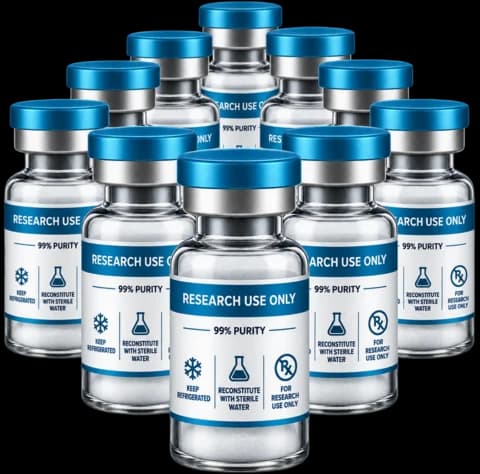
That single fact frames this entire guide. AICAR (5-aminoimidazole-4-carboxamide ribonucleotide) is a synthetic small-molecule AMP-mimetic that activates the AMPK energy pathway. Interest traces almost entirely to a mouse study where sedentary animals ran roughly 44% farther after dosing (Narkar 2008, PMID 18674809) — the "exercise in a pill" headline. No human study has reproduced that. So every dilution figure below is a mixing convention drawn from community resources, not a validated protocol. Vendors typically supply AICAR as a 50mg vial, which is the vial size anchored throughout this guide.
Research-context information only. AICAR is an investigational drug not approved by the FDA. Protocols, doses, and reactions reported below come from published clinical trials and self-reported community sources. This article reports what has been documented, not what should be done. Possession or use of investigational drugs outside an authorized clinical trial may be illegal in your jurisdiction. Consult a licensed physician for personal medical decisions.
On the dilution math specifically: because AICAR was never approved for any indication, there is no standardized human concentration or fill volume in the medical literature. The numbers in the charts below are what community resources document for a research setting — reconstitution conventions describing how much compound sits in each syringe unit at a given fill, not a dose recommendation or an efficacy target.
New to bacteriostatic water? Start with what it is, how much to use per vial, and how long it lasts — or see the full Bacteriostatic Water Guide.
What You Need
Community reconstitution resources describe the following supplies:
- AICAR lyophilized vial — commonly supplied as a 50mg vial
- Bacteriostatic water (BAC water) — not sterile water, not saline
- Insulin syringes — 1mL (100 unit), 29-31 gauge
- Alcohol swabs — for cleaning vial tops
- A clean, flat workspace
Why bacteriostatic water? It contains 0.9% benzyl alcohol that suppresses bacterial growth in the solution. Plain sterile water has no preservative, so community references describe using such a vial within 24 hours. Bacteriostatic water extends the documented window to about 28 days refrigerated — the relevant factor whenever a single 50mg vial is drawn from more than once.

Step-by-Step Reconstitution
Step 1: Clean Everything
Community resources describe wiping the tops of both vials (AICAR and BAC water) with alcohol swabs, then letting them air dry for about 10 seconds. Community sources emphasize this step for preventing contamination.
Step 2: Draw the Bacteriostatic Water
Protocols describe using a fresh insulin syringe to draw the chosen amount of bacteriostatic water. The amount added is what sets the concentration — the dilution charts below show how that plays out for a 50mg vial.
Step 3: Add Water to the Powder Vial
Community resources describe inserting the needle into the AICAR vial at an angle, aiming at the glass wall rather than directly at the powder, and letting the water trickle down the side of the vial slowly.
The water is not squirted directly onto the powder. Aggressive mixing can shear the compound and degrade the solution, so the documented technique is gentle.
Step 4: Let It Dissolve
Protocols describe swirling the vial with a slow rotating motion rather than shaking it. AICAR generally dissolves within a minute or two into a clear, colorless solution. If visible particles remain after several minutes of gentle swirling, community resources describe treating the vial as suspect rather than injecting it.
Step 5: Store It Immediately
Reconstituted vials are described as going straight into refrigeration at 36-46F (2-8C). With bacteriostatic water, community storage references cite up to 28 days of stability.
Dilution Chart
The chart below is anchored to a 50mg vial. Every figure is a mixing convention that community resources document — it describes how much compound lands in each syringe unit at a given fill, not a target dose. There is no validated human AICAR dose to convert against.
For a 50mg (50,000mcg) vial, the conventions community resources most often describe are:
| BAC water added | Concentration | Per 0.1mL (10 units) | Per 1.0mL (100 units) |
|---|---|---|---|
| 1mL | 50,000mcg/mL | 5,000mcg | 50,000mcg (full vial) |
| 2mL | 25,000mcg/mL | 2,500mcg | 25,000mcg |
| 3mL | ~16,667mcg/mL | ~1,667mcg | ~16,667mcg |
The 2mL fill is the most commonly cited convention because it produces clean, round numbers on a U-100 syringe. None of these rows implies a recommended dose — they only translate a fill volume into compound-per-unit.
Syringe Math
Community resources describe the same two-step conversion used for any reconstituted compound:
Concentration = Compound Amount (mcg) ÷ Water Added (mL)
Units on syringe = Target Amount (mcg) ÷ Concentration (mcg/mL) × 100
Reconstitution is unit-conversion math, not a dose recommendation. A 50 mg vial in 2 mL gives 25 mg/mL, so 2.5 mg of compound sits at the 10-unit mark on a U-100 syringe (2,500 ÷ 25,000 × 100 = 10 units). That number only tells you where the plunger lands for a given amount of compound — it is not a claim that 2.5 mg is an appropriate or effective amount to use. The Reconstitution Calculator runs the same math from any vial size and water volume.
A note on where community figures come from. Injectable AICAR "protocols" circulating in fitness communities trace back to the mouse study (Narkar 2008, PMID 18674809), which used 500 mg/kg/day subcutaneously. Rodent milligram-per-kilogram figures do not scale to humans by simple bodyweight math, and no human study has tested any injected AICAR dose for body composition or endurance. The only human dosing on record is the intravenous acadesine cardioplegia protocol from the cardiac-surgery trials (Mangano 1997, PMID 9002496; RED-CABG, PMID 22782417), which was infused in a hospital over hours and is unrelated to any at-home mixing convention.
Storage Rules
Community storage references and general peptide-handling guidance describe the following for AICAR:
| State | Temperature | Documented shelf life |
|---|---|---|
| Lyophilized (powder) | Room temp | Months, but frozen is preferred |
| Lyophilized (powder) | Refrigerated | Extended |
| Lyophilized (powder) | Frozen (-20C) | Longest |
| Reconstituted (BAC water) | Refrigerated | Up to 28 days |
| Reconstituted (sterile water) | Refrigerated | Use within 24 hours |
Figures are community-reported and manufacturer-stated estimates; actual shelf life varies with compound purity, packaging integrity, and storage conditions.
Community protocols for multi-vial storage describe keeping unopened vials frozen and reconstituting only what will be used inside the roughly 28-day preservative window. AICAR has a short biological half-life, which is why community write-ups also mention frequent dosing and complaints about cost — context that belongs to usage discussion, not to the mixing step.
Ready to buy? Compare verified vendors on our best AICAR sources page, or browse all coupon codes for up to 50% off.