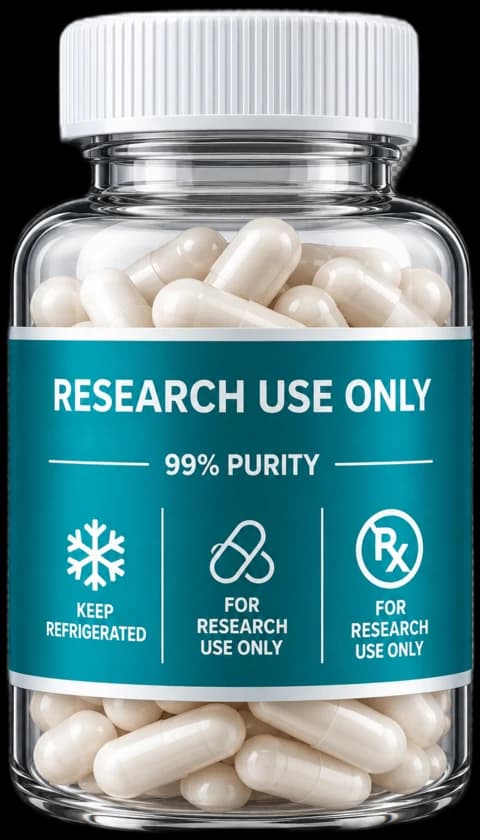
Search results for a "Dihexa timeline" tend to present a tidy week-by-week schedule — clarity in a few days, memory gains by week two, and so on. That framing implies a body of human data that does not exist. Dihexa (CAS 1401708-83-5, also labeled PNB-0408) has never been studied in a placebo-controlled human trial, so there is no clinically established onset window for it at all.
What does exist falls into two very different source classes that are easy to blur together: animal-model readouts from preclinical research, and self-reported anecdote from community forums and vendor copy. This article keeps the two strictly separated and labels which is which at every step, because the distinction is the entire story. It also discloses a fact most competing timelines omit — the foundational Dihexa mechanism papers were retracted in 2025 for image manipulation.
Research-context information only. Dihexa is a research peptide. Protocols, doses, and reactions reported below come from published research and self-reported community sources. This article reports what has been documented, not what should be done. Consult a licensed physician for personal medical decisions.
How Dihexa Is Proposed to Work (Relevant to Timing)
Dihexa is a synthetic oligopeptide derived from angiotensin IV. The proposed mechanism — described in papers that were later retracted — is that it potentiates hepatocyte growth factor (HGF) signaling at the c-Met receptor, driving dendritic spine formation and synaptogenesis. That synaptogenesis framing is where the popular "builds new connections fast" timeline narrative originates.
Two points matter for anyone reading an onset schedule. First, the two core mechanism papers establishing the HGF/c-Met story (Kawas 2012, PMID 22129598; Benoist 2014, PMID 25187433) were retracted in April 2025 (retraction notices PMID 40312092 and PMID 40312093) following a Washington State University investigation that found the lead author altered images across her dissertation and multiple co-authored papers. A third widely-cited paper (McCoy 2013, PMID 23055539) — the source of the often-repeated "seven orders of magnitude more potent than BDNF" line — carries a 2021 Expression of Concern. That potency figure came from an assay-specific in-vitro spine-density measurement (picomolar Dihexa vs nanomolar BDNF); it does not mean Dihexa is millions of times more effective in a living brain.
Second, synaptic remodeling in animal models unfolds over days of repeated dosing and task training, not minutes. So even the proposed mechanism does not predict an instant effect — and none of this is human data.
Preclinical Onset Data (Animal Models — Not a Human Timeline)
The cleanest independent support for Dihexa is a 2021 study from a Chinese group (Sun et al., Brain Sciences, PMID 34827486) in APP/PS1 Alzheimer's-model mice. Treated mice showed improved Morris water maze performance — reduced escape latency emerging across roughly days 4–5 of the training protocol — alongside increased synaptophysin and reduced inflammatory markers (IL-1β, TNF-α), reportedly via PI3K/AKT signaling.
That "days 4–5" figure is the closest thing to an onset signal in the literature, and it is repeatedly miscast online as a human timeline. It is not. It is a rodent learning-task readout measured over a fixed water-maze training schedule, in a single small animal study, in a disease model. Mouse training days do not convert to human days, and a Morris water maze score is not a measure of subjective focus or clarity in a person. The earlier rodent work (McCoy 2013, flagged) likewise reported maze-learning improvements over training days in rats, with the same translation caveat.
Bottom line on the preclinical class: it shows measurable effects in rodents over days of dosing-plus-training, the best of it is one clean independent study, and it tells you nothing reliable about if or when a human would notice anything.
Ready to buy? The single research-grade, COA-checked Dihexa source we track:
5mg · sold research-use-only · we may earn a commission
Community-Reported Onset: "Week 1" (Anecdotal, Not Established)
Everything in this and the following two sections is community-reported — drawn from forums such as LongeCity, vendor copy, and individual write-ups. None of it is from a controlled trial, and the "week" structure below reflects how community sources tend to organize their anecdotes, not a validated schedule.
Within the first several days, self-reported community accounts most commonly describe subtle changes: sharper mental clarity, easier word-finding or verbal fluency, and a sense of "mental connectivity." Some users in community sources report mild mood or motivation shifts in this window. Crucially, the community feedback is inconsistent — a meaningful share of reports describe no noticeable effect at all in the first week, and a subset describe early adverse effects (headache, brain fog, irritability) rather than benefit. There is no placebo control behind any of these accounts, so expectancy and ordinary day-to-day variation cannot be separated from a drug effect.
Bac Water Made for Peptides
Don't risk a $300 peptide on generic bac water.
Most cloudy reconstitutions trace back to one thing — and it isn't the peptide. Sterile, non-pyrogenic, 0.9% benzyl alcohol — formulated for peptide reconstitution, not repackaged from generic stock.
✓ 0.9% benzyl alcohol✓ Made for peptides✓ 30 mL multi-dose
Community-Reported Onset: "Weeks 2–4" (Anecdotal, Not Established)
Across weeks two through four, the most consistent community pattern is that those who report an effect describe it building gradually rather than arriving all at once — accumulating clarity, memory recall, and focus over one to two-plus weeks of daily use. This "builds over time" narrative is community-reported and aligns loosely with the synaptogenesis framing, but it is anecdote layered on a mechanism story whose foundational papers were retracted.
It is worth restating plainly: there is no placebo-controlled human data supporting a two-to-four-week ramp, or any other timeline. Community reports also diverge sharply here — some describe continued gains, others describe early benefits fading, and others maintain they felt nothing throughout. Route and form add more noise to the picture: community sources discuss oral capsules, plain powder, and transdermal (often DMSO-based) preparations, and frequently repeat the now-retracted claim that oral Dihexa is reliably brain-penetrant. That claim cannot be treated as established.
Community-Reported Onset: "Weeks 5–8" (Anecdotal, Not Established)
Past the first month, community discussion shifts from onset to maintenance and cycling. Self-reported community protocols commonly describe once-daily dosing with on/off cycling, motivated partly by the absence of any long-term human safety data and partly by a community perception of diminishing returns or tolerance over continued use. Some users in community sources report sustained benefit at this stage; others report that effects plateaued or faded.
A frequently repeated "half-life ~12.8 days" figure circulates in vendor copy as a rationale for spaced or cyclical dosing. That number has no verifiable peer-reviewed source and should not be treated as a pharmacokinetic fact. As with the earlier windows, there is no controlled human evidence establishing what happens at weeks five through eight — only divergent anecdote.
The Closest Human Evidence — and It Was Negative
There is no human Dihexa trial, but the same HGF/c-Met drug program did reach human testing through Athira Pharma's fosgonimeton (ATH-1017). Sources conflict on the exact relationship: some describe fosgonimeton as a phosphate prodrug of Dihexa, while Athira has described a structurally distinct molecule — so it is most accurate to call it the same program, structurally distinct, with conflicting public descriptions. It should not be presented as Dihexa itself.
Its Phase 2/3 LIFT-AD Alzheimer's trial failed its primary endpoint (announced September 3, 2024; global statistical test −0.08, P = .70). This is the closest human-trial evidence anywhere in the class, and it was negative. That does not prove anything about Dihexa's subjective effects in healthy users, but it is the relevant clinical context — and the reason no validated human timeline exists.
Factors That Affect What People Report
Community-reported variability appears to track several factors, all anecdotal:
Route and form. Oral capsules, powder, and transdermal/DMSO preparations are all in community use, with ongoing debate about absorption. No human pharmacokinetic data resolves it.
Dose. Community-reported doses commonly cluster around 5–20 mg/day, with new users often citing ~5 mg and some reporting 20–30 mg. These figures come from vendor copy and forums, not pharmacokinetic studies, and there is no established human dose.
Product purity. As a research chemical, Dihexa's identity and purity depend entirely on the supplier's COA; HPLC purity claims (often ~≥98%) vary by source.
Expectancy. With no placebo control behind any community report, expectation effects cannot be separated from any drug effect.
What If You See Nothing
A substantial share of community reports describe no perceptible effect from Dihexa, across all of the windows above. Given that there is no placebo-controlled human data, no established dose, and a mechanism whose foundational papers were retracted, an absence of noticeable effect is fully consistent with the current evidence — it does not necessarily indicate a defective product, the wrong route, or an insufficient duration. The honest summary is that no one can presently say what a "working" Dihexa timeline looks like in humans, because that timeline has never been measured.
Frequently Asked Questions
Is there a clinical timeline for how fast Dihexa works in humans?
No. Dihexa has never been tested in a placebo-controlled human trial, so there is no clinically established onset window. Published timing data comes only from rodent models, and the foundational mechanism papers from the original Washington State University lab were retracted in April 2025 for image manipulation. Any week-by-week schedule found online reflects community-reported anecdote, not validated human data.
What does the preclinical research actually show about onset?
In an independent 2021 APP/PS1 Alzheimer's-model mouse study (PMID 34827486), treated mice showed reduced escape latency in the Morris water maze across days of training. That is a rodent learning-task readout measured over a training period, not a human timeline. It cannot be translated into 'days' or 'weeks' for a person, and it is a single small animal study.
Angiotensin IV background: the AT4/spatial-learning research line that Dihexa was built on (Wright & Harding 1995; Wright 1999) predates the retracted Dihexa-specific papers.
References
Sun X, et al. Dihexa improves cognition in APP/PS1 mice via PI3K/AKT signaling. Brain Sciences. 2021. PMID 34827486 — clean, independent preclinical study; source of the rodent days-4–5 Morris-water-maze onset readout.
McCoy AT, et al. Evaluation of metabolically stabilized angiotensin IV analogs. J Pharmacol Exp Ther. 2013. PMID 23055539 — Expression of Concern (2021); source of the assay-specific "potency vs BDNF" figure and earlier rat maze-learning timing.
Kawas LH, et al. Mechanism of angiotensin IV-derived modifiers of HGF/Met. J Pharmacol Exp Ther. 2012. PMID 22129598 — RETRACTED 2025; original HGF mechanism framing.
Retraction notice for Kawas 2012. 2025. PMID 40312092 — documents the retraction.