NSI-189's most-referenced figure is about 40-80 mg per day, taken orally once daily. Unlike most research nootropics, that range is not pulled from forum guesswork: it is inherited directly from the doses used in NSI-189's human depression trials, which ran 40 mg and 80 mg/day arms. The catch is what those trials found. The pivotal Phase 2 study failed its primary endpoint, and the drug was never approved, so the dose people use is trial-derived but not validated for cognitive enhancement in anyone.
NSI-189 is also not a peptide. It is a synthetic small molecule (a benzylpiperazine-aminopyridine) originally developed by Neuralstem as a neurogenic candidate for major depressive disorder. This guide reports the dose figures community sources reference, where they trace back to, and the trial record behind them — not a recommended protocol.
Research-context information only. NSI-189 is an investigational drug not approved by the FDA; its clinical program was discontinued, and material sold today is a research chemical labeled not for human consumption. Protocols, doses, and reactions reported below come from published clinical trials and self-reported community sources. This article reports what has been documented, not what should be done. Possession or use of investigational drugs outside an authorized clinical trial may be illegal in your jurisdiction. Consult a licensed physician for personal medical decisions.
Quick Reference: Protocol
There is no clinically-established cognitive-enhancement protocol to publish, because no trial has validated one. What does exist is a community-used range that maps cleanly onto the doses used in the depression trials. The table below reports the figures that appear in vendor listings and forum discussion, organized by the forms NSI-189 is sold in. Every value is trial-derived or vendor-reported, not enhancement-validated.
| Form | Reported daily figure | Reported frequency | Source class |
|---|---|---|---|
| Phosphate powder (1 g) | ~40-80 mg/day referenced | Once daily, oral | Trial doses + vendor copy |
| Phosphate capsules (20 mg) | ~40-80 mg/day referenced | Once daily, oral | Trial doses + vendor copy |
| Free-base powder (1 g) | ~40-80 mg/day referenced | Once daily, oral | Trial doses + vendor copy |
The 40 mg and 80 mg figures are exactly the two active-arm doses tested in the Phase 2 trial; the Phase 1B study also ran a 120 mg/day arm. Community sources commonly describe time-limited courses and on/off cycling, loosely mirroring the trial windows (28 days in Phase 1B, up to 12 weeks in Phase 2) — but no human safety data exists for any cycle length beyond those ≤12-week trial exposures.
Routes of Administration
NSI-189 is an oral small molecule, and the oral route is both the dominant community route and the route used in every human trial. That alignment is unusual for a research nootropic and is worth noting.
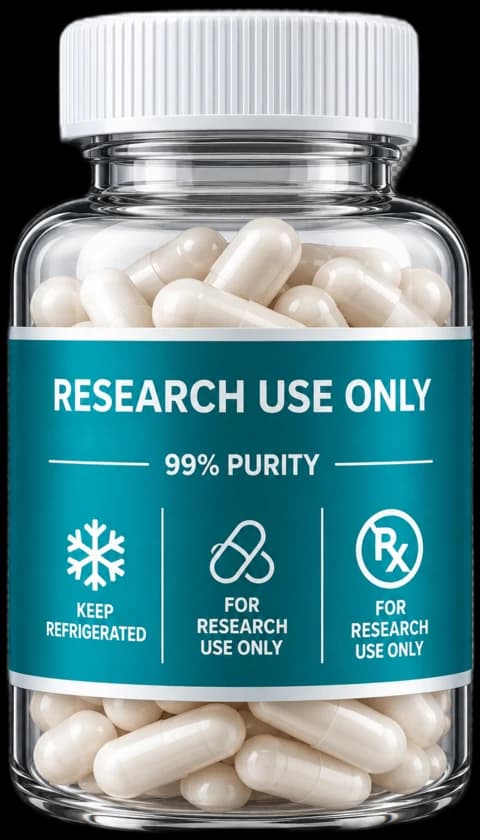
- Oral (capsules or powder): Capsules at 20 mg each and loose phosphate or free-base powder are the standard forms. Once-daily oral dosing matches the trial protocol. The phosphate salt is the form used in the clinical trials and is described by vendors as having better solubility and stability than the free base.
- Sublingual: Occasionally mentioned in forums, but it has no pharmacokinetic basis in the published record and was not a route studied in the trials.
There is no injectable or reconstituted route in the documented record, and no human data supports anything other than oral use.
Reconstitution Quick Reference
NSI-189 does not have a reconstitution step. It is an oral small molecule sold as phosphate powder, free-base powder, or 20 mg capsules — not a lyophilized peptide that gets mixed with bacteriostatic water — so no vial/diluent/concentration dilution table applies to it.
| Form | Preparation | Dosing unit | Note |
|---|---|---|---|
| Phosphate capsules (20 mg) | None — pre-measured | Per capsule | Trial-used salt form |
| Phosphate powder (1 g) | Weighed dry, taken orally | Per measured mg | Requires an accurate milligram scale |
| Free-base powder (1 g) | Weighed dry, taken orally | Per measured mg | Less commonly stocked than phosphate |
Powder is generally described as being kept dry, sealed, and stored cool away from light. Purity and identity depend entirely on the supplier's certificate of analysis; vendor copy commonly claims roughly 98-99% by HPLC, which should be verified against the current COA. The material is labeled not for human consumption.