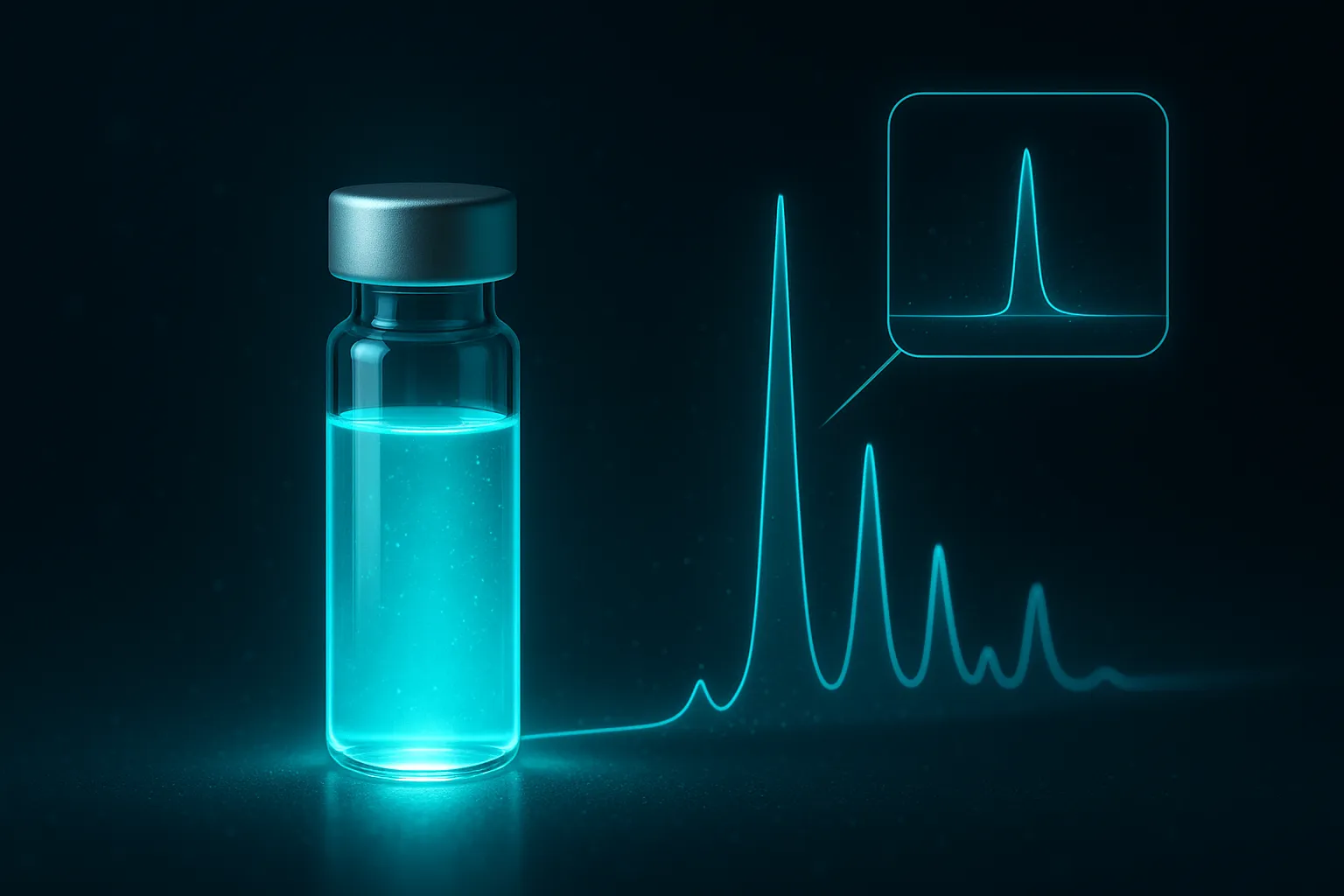
Almost every peptide certificate leads with one number: purity, usually stated as 98% or 99%. It is the figure vendors quote, the figure buyers screenshot, and the figure most people stop reading after. It is also the figure that tells you the least about whether the material is what it claims to be or safe for its labeled research use.
A purity percentage is necessary but not sufficient. It describes how much of the sample is the main peak — it does not confirm that the main peak is the right molecule, and it says nothing about what the rest of the sample is. That remaining fraction, the part below the headline number, is where the meaningful risk lives, and only a specific set of tests can tell you what it contains. This is how to read past the purity line.
Research-context information only. Compounds discussed below are research peptides and supplements; some are investigational drugs not approved by the FDA. Protocols, doses, and reactions reported come from published research and self-reported community sources. Possession or use of investigational drugs outside an authorized clinical trial may be illegal in your jurisdiction. This article reports what has been documented, not what should be done. Consult a licensed physician for personal medical decisions.
Key takeaways
- Purity is not safety. A 99% figure tells you how much of the sample is the main peak — nothing about whether the peak is safe or correct.
- Identity is a separate test. Mass spectrometry (LC-MS) confirms the molecule is the one on the label. A pure sample can be purely the wrong compound.
- The other 1% is the real question. Related-substances (impurity) profiling reports what the non-target fraction actually is — the part regulators treat as the safety issue.
- Safety screens go further. Endotoxin (LAL), sterility (TAMC/TYMC), and heavy-metals testing check for contamination a purity number never sees.
- Look for a verifiable third-party report — with identity, related substances, and a report number you can confirm with the lab — not just a percentage.
What a purity percentage actually measures
The purity figure on most research-peptide certificates comes from High-Performance Liquid Chromatography (HPLC). The instrument separates the components of a dissolved sample and a detector records each one as a peak. The software integrates the area under every peak, and the largest peak — assumed to be the target compound — is reported as a percentage of the total.
So "99% pure by HPLC" means the main peak accounts for 99% of the total peak area the detector saw. It is a real measurement, and it is a good one. But read literally, it makes two quiet assumptions:
- That the main peak is the compound on the label.
- That the other 1% is unimportant.
Neither assumption is safe on its own, and the rest of a thorough certificate exists precisely to test them.
The problem is the other 1%
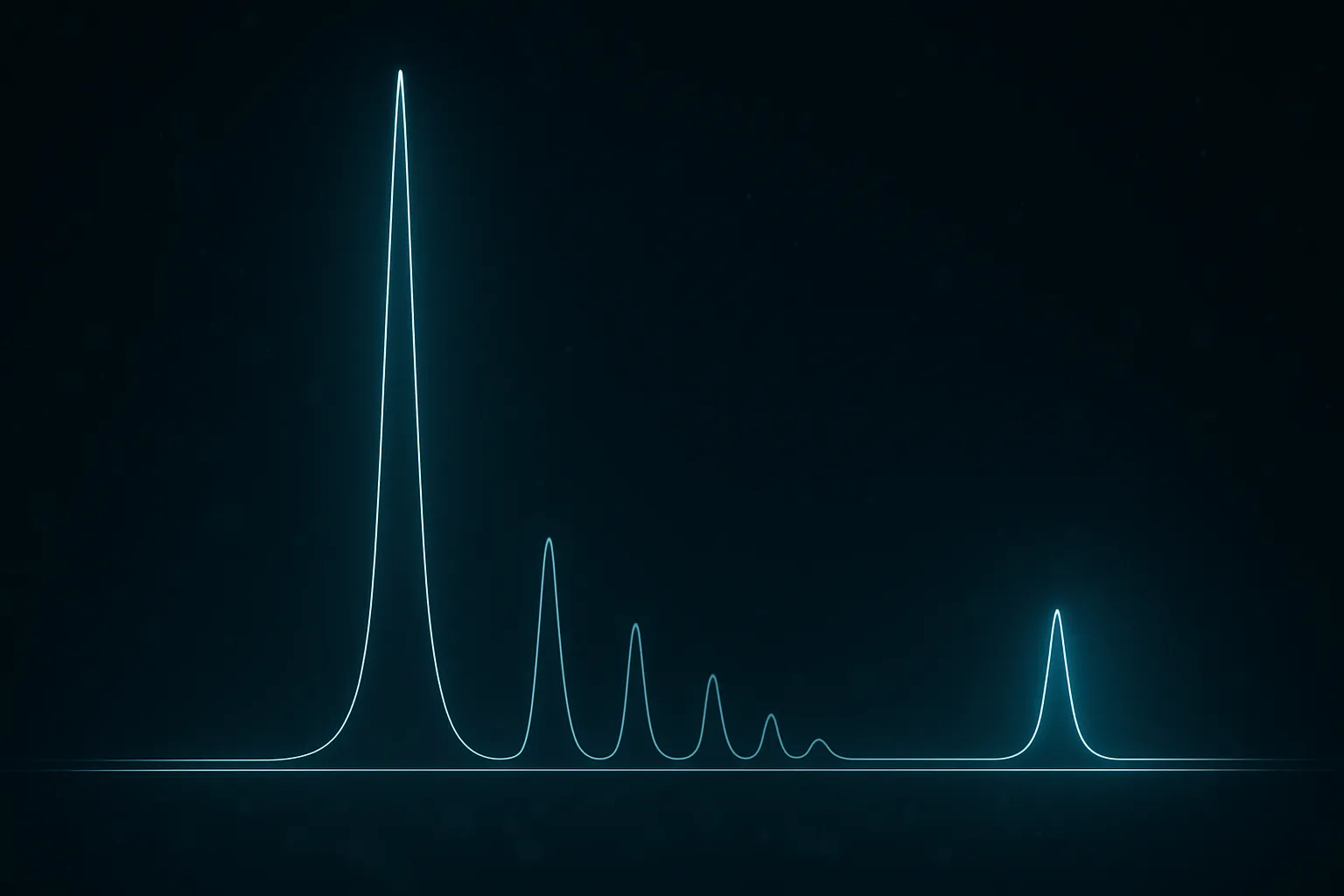
Research peptides are built by solid-phase synthesis — amino acids added one at a time to a growing chain. The process is never perfect. Every coupling step has a small failure rate, and those failures accumulate into a predictable family of byproducts:
- Deletion sequences — chains missing one or more amino acids because a coupling step didn't complete.
- Truncation sequences — chains that stopped growing early.
- Incomplete-deprotection byproducts — leftover chemical protecting groups that were never fully removed.
- Aggregates and dimers — peptide molecules stuck to each other.
Collectively these are called related substances, and in a 99%-pure vial they make up that final 1%. A bare purity number rolls all of them into a single "everything else" figure. It does not tell you whether that 1% is one benign, well-understood byproduct or a dozen unidentified fragments.
Regulators treat that fraction as the actual safety question. FDA guidance covering synthetic peptide generics asks that any new specified impurity above 0.5% of the drug substance be individually identified and justified — explicitly including its potential to provoke an immune response. In other words, the regulatory bar is set inside the fraction a purity headline discards.
That concern is not just procedural. A published risk assessment of synthetic peptide drugs concluded that peptide-related impurities can carry immunogenicity risk and warrant characterization rather than being treated as inert filler (PMID 37467878).
So the takeaway is not that a 99% figure is bad. It is that the number by itself cannot distinguish a clean batch from a contaminated one — because the difference between them lives in a part of the sample the percentage summarizes away.
Purity and identity are different questions
There is a second gap a purity figure leaves open: it never confirms what the main peak is.
A sample can be 99% one single compound and still be 99% the wrong compound. Purity measures homogeneity; it does not measure identity.
Answering the identity question takes mass spectrometry (often written LC-MS or LC-MS/MS), which measures the molecular weight of the main peak and compares it to the theoretical weight of the labeled peptide. If the measured mass matches, the molecule is very likely the one named on the vial. If it doesn't, a high purity figure is describing a pure sample of something else.
This gap is not just theoretical. If a certificate reports purity but never confirms identity, a very pure sample of the wrong compound would pass the only test on the page — precisely the failure a mass-spec identity check exists to catch. Reading a purity-only certificate means trusting a number that was never designed to answer the question most buyers think it answers.
The dedicated peptide lab Freedom Diagnostics Testing builds its entire posture around this pairing. Its published policy is that HPLC confirms purity, LC-MS confirms identity, and it "never issue[s] one without the other" — a direct acknowledgment that the two measurements answer different questions and that neither substitutes for the other.
The tests at a glance
A certificate that goes beyond a purity headline draws on a small set of complementary analyses. Each answers a question the others can't:
| Test | What it measures | What it catches (why it matters) |
|---|---|---|
| HPLC purity | Main-peak area as a % of the total | How much is the target — but not what the rest is |
| LC-MS / mass-spec identity | Molecular weight of the main peak | Whether it's the right molecule, not a pure impostor |
| Related substances | Each impurity peak, broken out | What the non-target fraction actually contains |
| Endotoxin (LAL) | Bacterial-toxin load | Pyrogen contamination a purity figure never sees |
| Sterility (TAMC / TYMC) | Viable microbial growth | Bacterial, yeast, and mold contamination |
| Heavy metals | As, Cd, Pb, Hg at trace levels | Toxic-element carryover from synthesis |
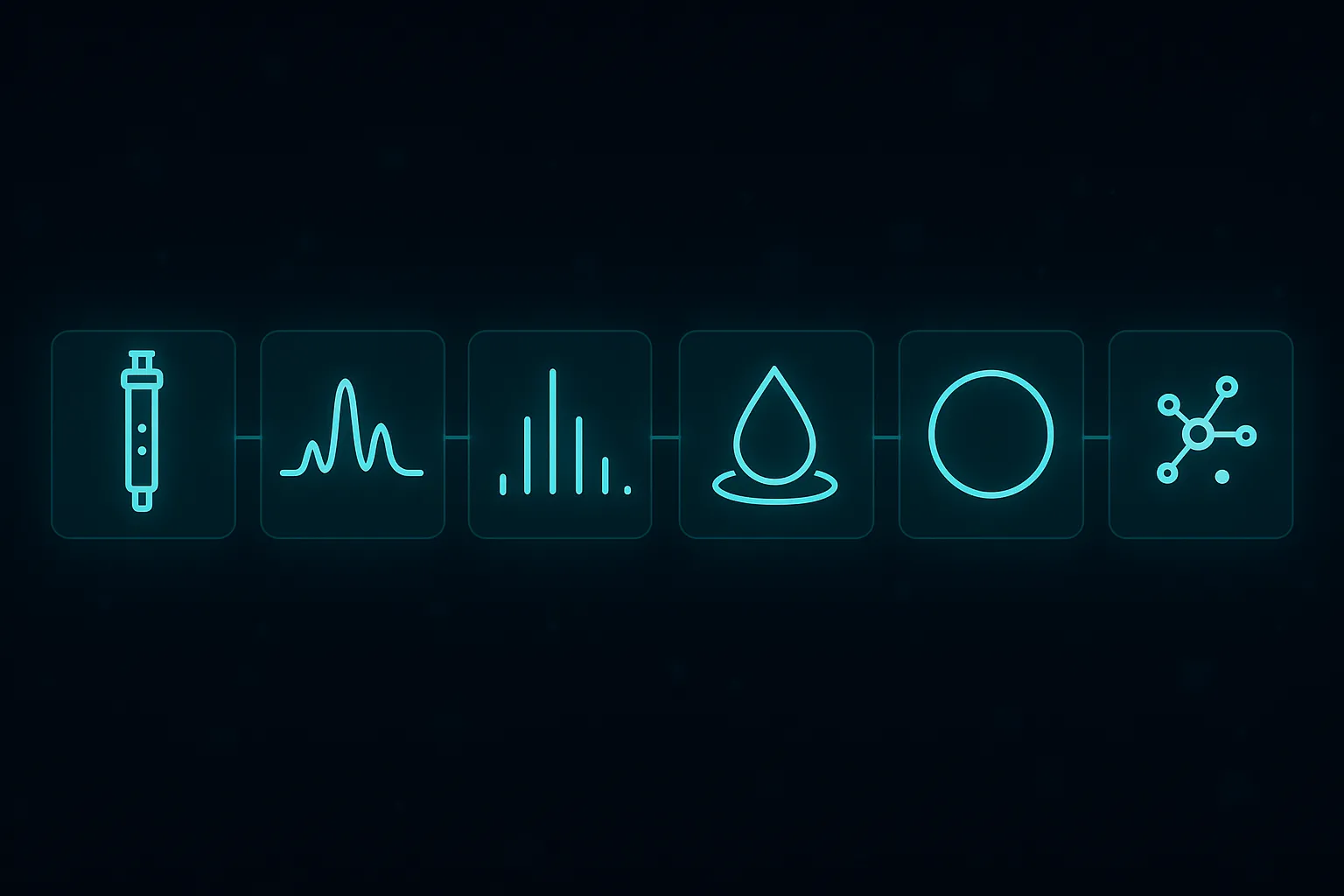
The first three rows are the ones that separate a thorough certificate from a marketing figure. The last three are safety screens that matter most for anything reconstituted for lab use.
Where these reports come from
The independent lab most commonly cited across the research-peptide market is Janoshik Analytical (based in Prague). Its published service list covers HPLC purity and mass-spectrometry identity confirmation, plus a separate contaminant-screening menu for endotoxin (LAL), sterility (TAMC and TYMC), and heavy metals.
Each Janoshik report carries a number that can be confirmed with the lab directly — which is what makes an independent result verifiable rather than merely printed.
A second example is Freedom Diagnostics Testing, which is narrower and stricter: purity and identity, always issued together, on fast turnaround. Janoshik offers the broader multi-panel menu; Freedom Diagnostics offers the tightly-paired core. Both are third-party — the point that matters most, because a certificate is only as independent as the entity that signed it.
How to read the certificate in front of you
Working from the certificate you actually have, the questions that separate a real test result from a formatted number are short:
- Is identity confirmed, not just purity? Look for a mass-spectrometry result with a measured molecular weight, not only an HPLC percentage.
- Is the non-target fraction broken out? A related-substances table or a visible chromatogram (the actual trace, with peaks and a baseline) is far harder to fabricate than a single typed figure.
- Does it name the method, not just the number? "99.4% by RP-HPLC" is a measurement; "99% pure" is a claim.
- Was a named third-party lab involved? An independent lab with a verifiable report number can, in principle, be contacted to confirm the result.
- Does the batch number match your vial? A certificate that can't be tied to the material in hand documents someone else's batch.
The batch-matching and forgery side of this — how fabricated certificates have actually been used — is covered in depth in our companion guide, how to verify a peptide COA. This page is about what a genuine certificate should contain; that one is about confirming a certificate is genuine at all.