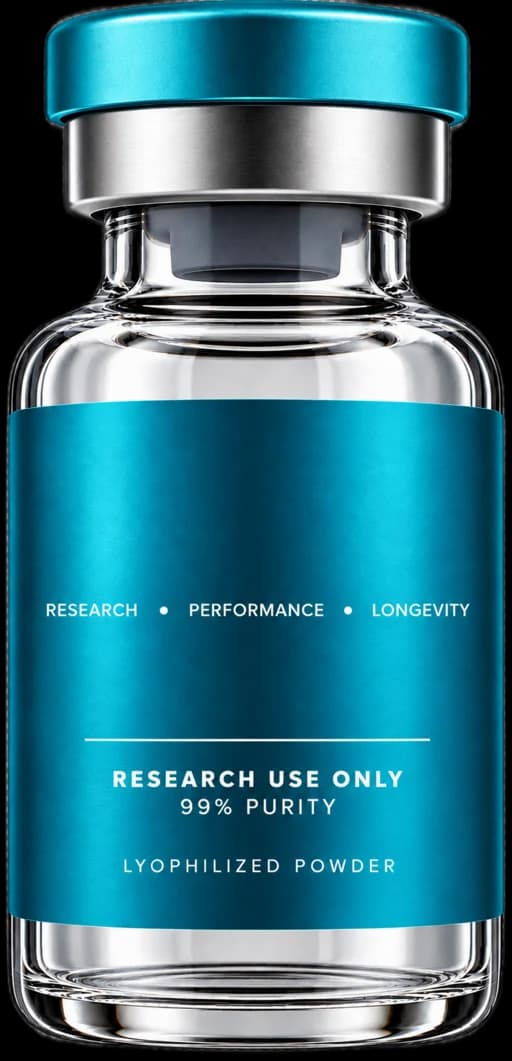
Prostamax ships as a dry, lyophilized (freeze-dried) powder, so it has to be dissolved in liquid before it can be measured. That dissolving step is called reconstitution, and mechanically it is a unit-conversion exercise: adding a known volume of bacteriostatic water turns a fixed mass of powder into a measurable solution that can be drawn on a syringe. Reconstitution math describes how much peptide sits in each syringe unit — it is not a dose recommendation, and this guide reports conventions rather than instructing anyone to use the compound.
One thing has to be stated plainly up front: there is no validated human concentration for Prostamax. It is commonly sold as a 20mg research vial, so the worked examples below anchor to that 20mg figure, but every mixing number here is a community-reported convention, not a clinical protocol. Prostamax is the synthetic tetrapeptide Lys-Glu-Asp-Pro (KEDP), and its published record as a synthetic peptide is thin.
Research-context information only. Prostamax is a research peptide. Protocols, doses, and reactions reported below come from published research and self-reported community sources. This article reports what has been documented, not what should be done. Consult a licensed physician for personal medical decisions.
The reason no "correct" concentration exists is that the synthetic peptide has barely been studied in humans. The verified published record for the synthetic KEDP sequence is limited to laboratory work on chromatin and gene expression [PMID 23221144] — not a prostate-function trial, and not a human pharmacokinetic study that would establish a target concentration or a per-injection amount. Just as important, synthetic Prostamax (the isolated Lys-Glu-Asp-Pro sequence) is distinct from Prostatilen, the polypeptide prostate-tissue extract that most of the older, single-lab Russian prostate literature actually examined. Extract findings are not evidence for the synthetic powder, and synthetic Prostamax should not be presented as a proven agent for prostate conditions. Both facts mean the mixing figures below exist only to make a research powder measurable, and nothing here should be read as a concentration that has been shown safe or effective for people.
What You Need
Community resources describe assembling the following before reconstituting a research peptide vial:
- The sealed Prostamax vial (commonly sold as a 20mg research vial)
- Bacteriostatic water — the most commonly referenced diluent because the benzyl alcohol in it is described as suppressing microbial growth across a multi-use vial
- A U-100 insulin syringe for measuring, and optionally a larger syringe (1–3 mL) for adding the water
- Alcohol swabs for wiping both rubber stoppers
- A clean, flat surface and, for storage afterward, a refrigerator

Step-by-Step Reconstitution
The steps below describe the sequence community resources document for reconstituting a lyophilized research peptide. They are reported here as a general convention, not as directions to perform.
- Community resources describe letting a cold vial reach room temperature first, then wiping both the Prostamax and bacteriostatic-water stoppers with an alcohol swab.
- A measured volume of bacteriostatic water is drawn into the transfer syringe — the volume chosen sets the final concentration (see the chart below).
- The most consistent point in community guidance is that the water is aimed down the inner glass wall of the vial so it runs down the side, rather than being sprayed directly onto the powder. Direct high-pressure spray onto the peptide is described as a common cause of degradation.
- Resources describe letting the vial sit until the powder dissolves on its own, and swirling gently if needed — never shaking, which is reported to foam and stress the peptide.
- Once the solution is clear, community handling notes describe refrigerating it and labeling the vial with the reconstitution date.
Dilution Chart
The table reports how community resources convert a 20mg vial into a per-unit figure at several common water volumes. These are unit conversions for a research powder, all community-reported and unverified for human use — none represents a recommended concentration. On a U-100 insulin syringe, one unit equals 0.01 mL.
| BAC water added | Concentration (community-reported) | Mass per unit (0.01 mL) |
|---|---|---|
| 1 mL | 20 mg/mL | 200 mcg per unit |
| 2 mL | 10 mg/mL | 100 mcg per unit |
| 4 mL | 5 mg/mL | 50 mcg per unit |
| 5 mL | 4 mg/mL | 40 mcg per unit |
The total amount in the vial (20 mg) never changes — more water simply spreads that same mass across more volume, lowering the mass per unit. That is why the volume choice is a measurement convenience, not a dose decision.
Syringe Math
The calculation here is arithmetic that converts a mass into a number of syringe units. It is not a dose recommendation, and no reference amount below is endorsed.
As a worked conversion: if a community resource references a 1 mg reference amount from a 20mg vial reconstituted in 2 mL (10 mg/mL, or 100 mcg per unit), that converts to 10 units on a U-100 syringe — 1,000 mcg ÷ 100 mcg per unit = 10 units. Halve the water to 1 mL and the same 1 mg reference converts to 5 units, because each unit now holds 200 mcg. The math is purely a mass-to-volume translation; the mass itself comes from community convention, not from any validated protocol, since no human target amount for Prostamax has been established.
Storage Rules
Storage figures for reconstituted research peptides come from general community and manufacturer handling conventions, not from stability data validated for Prostamax specifically. Community resources commonly describe keeping the reconstituted vial refrigerated at roughly 2–8°C, protected from light, and discarding it after about 28 days once bacteriostatic water is used. Repeated freeze-thaw cycles are described as degrading peptides, so freezing a reconstituted vial is generally discouraged in community guidance. The lyophilized powder before mixing is reported to be far more stable, which is why resources describe reconstituting only when a vial is about to be used.
Ready to buy? Compare verified vendors on our best Prostamax sources page, or browse all coupon codes for up to 50% off.