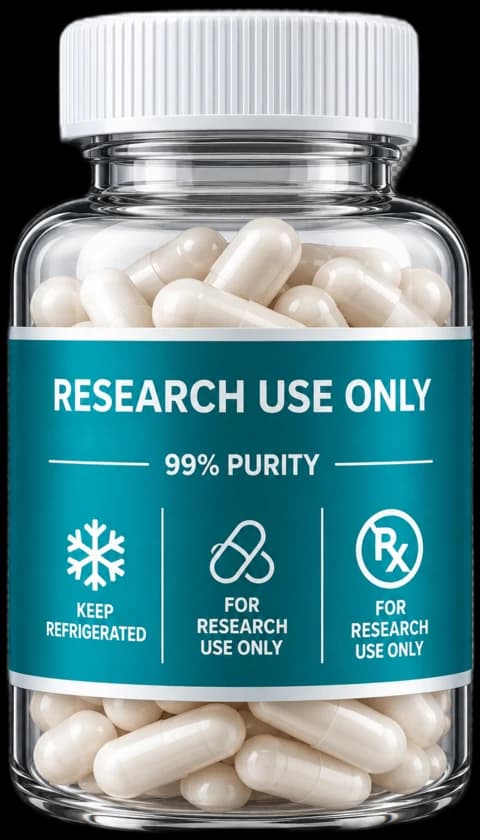
Dihexa (CAS 1401708-83-5; also labeled PNB-0408) is a synthetic oligopeptide derived from angiotensin IV, developed in the Harding and Wright labs at Washington State University and later commercialized through M3 Biotechnology and Athira Pharma. It is discussed in nootropic communities almost entirely for one proposed property: a strong, BDNF-like effect on synapse formation. This article sorts the claims by source class — what was demonstrated in animals or cell culture, what came from papers that have since been retracted, and what is purely community-reported.
The integrity context matters before any benefit is listed. Several of Dihexa's foundational mechanism papers were retracted in 2025 after a WSU investigation found image manipulation by the lead author. There are no published human clinical trials of Dihexa, and the closest human evidence in its drug class — Athira's fosgonimeton — failed its Phase 3 Alzheimer's endpoint in 2024. Each claimed benefit below is labeled by its evidence source so the reader can weigh it directly.
Research-context information only. Dihexa is a research peptide. Protocols, doses, and reactions reported below come from published research and self-reported community sources. This article reports what has been documented, not what should be done. Consult a licensed physician for personal medical decisions.
How Dihexa Works (Proposed — and Partly Retracted)
The proposed mechanism is that Dihexa potentiates hepatocyte growth factor (HGF) signaling at the c-Met (MET) receptor, downstream of PI3K-AKT, driving dendritic spine formation and synaptogenesis. That HGF/c-Met framing is the basis for the "BDNF-like" description repeated across vendor copy and forums.
The two papers that originally established this mechanism have been retracted. Kawas et al. 2012 (PMID 22129598), which introduced the HGF-dimerization framing, was retracted in 2025 (retraction notice PMID 40312092). Benoist et al. 2014 (PMID 25187433), which tied the procognitive effect to HGF/c-Met dependence, was retracted in 2025 (retraction notice PMID 40312093). Both retractions followed a WSU finding that the lead author altered images in her dissertation and multiple co-authored papers. The mechanism should therefore be read as proposed — in papers later retracted — not as established fact. For background on the broader angiotensin IV / AT4 system the work was built on, see Wright and Harding 1995 (PMID 7768321) and Wright et al. 1999 (PMID 10234025); those reviews predate Dihexa and concern the receptor system, not Dihexa itself. Dose and route discussion belongs to the community sources covered later, not to any validated human protocol.
Procognitive Effects in Alzheimer's-Model Mice (Independent Preclinical)
The cleanest support that survives the retractions is independent. Sun et al. 2021 (PMID 34827486), published in Brain Sciences by a Chinese research group with no tie to the WSU lab, tested Dihexa in APP/PS1 transgenic mice — a standard Alzheimer's disease model. The authors reported improved Morris water maze performance (reduced escape latency over the training days), increased synaptophysin (a synaptic-density marker), and lower IL-1β and TNF-α, with effects attributed to PI3K/AKT signaling.
This is the strongest piece of evidence in Dihexa's favor, and it is important to frame it accurately: it is a small rodent study in a disease model, not a human trial, and not a measure of cognitive enhancement in healthy people. It reports that Dihexa improved a memory readout and synaptic markers in mice. It does not establish that the same holds in humans, where no data exist. Its value is that it is independent of the retracted work and reaches a directionally similar finding through a stated mechanism.
Ready to buy? The single research-grade, COA-checked Dihexa source we track:
5mg · sold research-use-only · we may earn a commission
The "Seven Orders of Magnitude vs BDNF" Claim (Flagged Source, In-Vitro Only)
The single most-repeated benefit claim is that Dihexa is "seven orders of magnitude more potent than BDNF" at building synapses. That number comes from McCoy et al. 2013 (PMID 23055539), which carries a 2021 Expression of Concern. The figure describes an in-vitro dendritic-spine assay in which picomolar Dihexa produced spine density comparable to nanomolar BDNF — a potency ratio in a specific cell-culture readout.
Two caveats are essential. First, the source is flagged. Second, even taken at face value, an assay-specific potency ratio is not a measure of whole-organism effect: it does not mean Dihexa is millions of times more effective in a living brain, where absorption, distribution, and signaling context all differ. The same McCoy 2013 paper reported that Dihexa reversed scopolamine-induced deficits and improved learning in aged rats in the Morris water maze — again, animal data, from a paper now carrying an Expression of Concern. The potency claim is best read as an in-vitro figure from a concern-flagged source, not as a demonstrated cognitive multiplier.
Synaptogenesis in Precursor Analog Work (Clean, But Not Dihexa-Specific)
Some of the synaptogenesis framing predates Dihexa and rests on cleaner work. Benoist et al. 2011 (PMID 21719467) reported that Nle1-angiotensin IV analogs promoted synaptogenesis and dendritic spine formation. That paper is not implicated in the retractions, which is why it is cited here — but it studied Nle1-AngIV analogs and did not name or test Dihexa itself. It supports the idea that this chemical lineage can influence synapse formation in models; it is precursor evidence, not direct evidence for the marketed compound.
The pattern across the preclinical record is consistent in direction — angiotensin IV-derived analogs, including Dihexa in the independent Sun 2021 work, are reported to influence synaptic markers and maze learning in animals. The pattern is also uniformly preclinical, and its original mechanistic core is retracted.
Community-Reported Benefits in Humans (Anecdotal — Including No Effect)
Because no human trials exist, every human-use report is anecdotal. Community sources — forums such as LongeCity and vendor copy — commonly describe improved mental clarity, focus, memory, verbal fluency, a sense of "mental connectivity," and sometimes mood or motivation. Self-reported community timelines describe onset within a few days, building over one to two weeks or longer. These reports are not placebo-controlled and carry no source verification.
The community signal is also inconsistent: some users in these sources report no noticeable effect at all. Reported forms include research powder, oral capsules, and transdermal preparations (often DMSO-based), and the oral-versus-transdermal debate in forums frequently repeats the now-retracted claim that Dihexa is reliably brain-penetrant when taken orally. None of this constitutes evidence of efficacy; it is community-reported experience, presented as such.
Where the Human Evidence Stands
The closest thing to human evidence in Dihexa's class is not Dihexa. Athira Pharma's fosgonimeton (ATH-1017) targets the same HGF/c-Met program; descriptions of its exact relationship to Dihexa conflict across sources (some describe it as a phosphate prodrug of Dihexa, while Athira describes a structurally distinct molecule), so it is best characterized as the same program, structurally distinct, with conflicting public descriptions. Its Phase 2/3 LIFT-AD Alzheimer's trial failed its primary endpoint, announced September 3, 2024 (global statistical test −0.08, P = .70). That outcome is the nearest human-tested result in the class, and it was negative — it is reported here for context, not as evidence that Dihexa itself works or fails.
Dihexa is sold as a research chemical, not a supplement or approved drug, and is not for human consumption. Community-reported doses (commonly 5-20 mg/day in forum and vendor sources) are not derived from human pharmacokinetic data and are not guidance. There is no established human dose, no published human safety data, and no monograph.
Bac Water Made for Peptides
Don't risk a $300 peptide on generic bac water.
Most cloudy reconstitutions trace back to one thing — and it isn't the peptide. Sterile, non-pyrogenic, 0.9% benzyl alcohol — formulated for peptide reconstitution, not repackaged from generic stock.
✓ 0.9% benzyl alcohol✓ Made for peptides✓ 30 mL multi-dose
Only animal and in-vitro studies exist — no human clinical trials of Dihexa have been published. The cleaner independent support is Sun et al. 2021 (PMID 34827486), which reported improved maze performance and synaptic markers in Alzheimer's-model mice. Several foundational mechanism papers from the original lab were retracted in 2025 for image manipulation.
Is Dihexa really 'seven orders of magnitude more potent than BDNF'?
That figure traces to McCoy et al. 2013 (PMID 23055539), which carries a 2021 Expression of Concern. It described an in-vitro dendritic-spine assay (picomolar Dihexa vs nanomolar BDNF), not whole-brain effect. It does not mean Dihexa is millions of times more effective in a living brain — it is an assay-specific potency number from a flagged source.
What do community users report about Dihexa?
Community sources (forums such as LongeCity and vendor copy) describe improved clarity, focus, memory, and verbal fluency, with onset commonly reported within a few days and building over 1-2 weeks. Reports are inconsistent, and some users describe no effect. None of this is placebo-controlled human data.
Dihexa dosing guide — community-reported forms, routes, and the unverified half-life claim, with research-context framing.
Dihexa results timeline — what preclinical readouts and anecdotal reports describe over days versus weeks.
NSI-189 benefits — a neurogenesis-focused research compound that, unlike Dihexa, reached a Phase 2 human depression trial.
P-21 benefits — a Cerebrolysin-derived neurogenesis compound whose evidence, like Dihexa's, stops short of human trials.
Adamax benefits — an adamantane-modified Semax analog whose evidence, like Dihexa's, stops short of human data — but here almost no dedicated studies exist at all.
References
Sun M, et al. Dihexa improves learning and memory in APP/PS1 mice. Brain Sciences. 2021. PMID 34827486. (Independent preclinical support.)
McCoy AT, et al. Evaluation of metabolically stabilized angiotensin IV analogs. J Pharmacol Exp Ther. 2013. PMID 23055539. (Expression of Concern, 2021 — source of the BDNF-potency claim.)
Kawas LH, et al. Mimics of the dimerization domain of HGF. J Pharmacol Exp Ther. 2012. PMID 22129598. (Retracted 2025.)