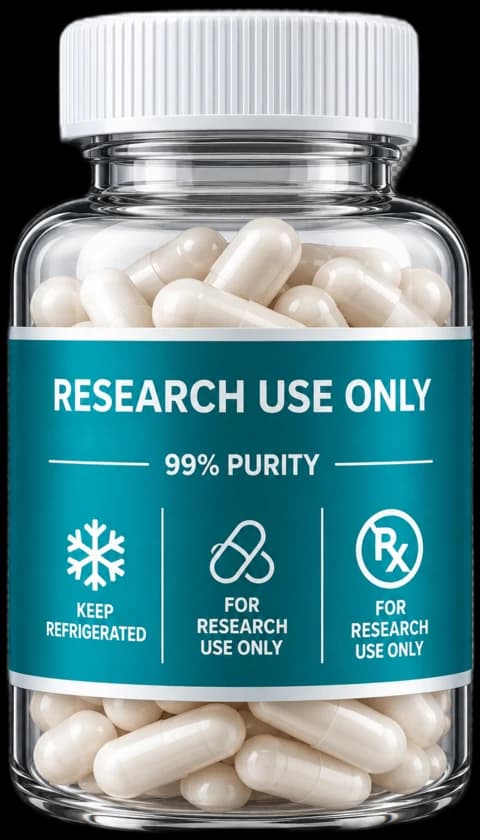
Dihexa has no established human dose. It has never been studied in a human clinical trial, so the figures that circulate — most commonly 5-20 mg per day, once daily, with some references reaching 20-30 mg — come entirely from vendor copy and forum threads such as LongeCity, not from pharmacokinetic data. Community sources also disagree on route, splitting between oral capsules and transdermal application in a DMSO carrier.
Research-context information only. Dihexa is a research peptide. Protocols, doses, and reactions reported below come from published research and self-reported community sources. This article reports what has been documented, not what should be done. Consult a licensed physician for personal medical decisions.
Dihexa is a synthetic angiotensin-IV-derived oligopeptide whose proposed procognitive mechanism appears in papers later retracted. This guide reports the dose figures community sources reference, the route debate, and the research-integrity context behind both — not a recommended protocol.
There is no standard protocol to publish here, because no human trial has defined one. The table below reports the ranges that appear in vendor listings and forum discussion, organized by the forms Dihexa is sold in. Every value is anecdotal and vendor-derived.
| Form |
Reported daily figure |
Reported frequency |
Source class |
| Research powder |
~5-20 mg/day referenced |
Once daily |
Vendor copy + forums |
| Capsules (e.g. 5 mg/cap) |
~5-20 mg/day referenced |
Once daily |
Vendor copy + forums |
| Transdermal (DMSO carrier) |
~5-20 mg/day referenced |
Once daily |
Vendor copy + forums |
New-user references cluster near 5 mg, with some sources reaching 20-30 mg. Cycling on and off is commonly described, with no human safety data behind any duration. These are reported figures, not a recommendation: Dihexa has no established human dose and no human trials.
A "half-life of about 12.8 days" appears in some vendor copy. No verifiable peer-reviewed source supports that number, so it should not be treated as established.
Routes of Administration
Community discussion splits across three forms, with no human pharmacokinetic data to settle which, if any, delivers the compound effectively.
- Oral (powder or capsules): The argument that oral Dihexa reaches the brain traces directly to the Washington State University work retracted in 2025. With those papers retracted, the brain-penetration basis for the oral route is no longer on solid footing.
- Transdermal (DMSO carrier): Forums frequently describe topical application mixed with DMSO as a penetration enhancer. DMSO carries skin-reaction and contamination-handling considerations of its own, and community sources report skin reactions at the application site.
- Injectable: Some vendors list an injectable form. Community discussion of this route is comparatively sparse, and no human data exists for any route.
Frequency is usually described as once daily across all forms.
Handling Quick Reference
Dihexa is sold as a research chemical — typically powder, capsules, or a transdermal/DMSO preparation — not as a reconstituted injectable peptide, so there is no standard bacteriostatic-water dilution table for it. Powder is generally described as being kept dry, sealed, and stored cool away from light; purity depends entirely on the supplier's certificate of analysis (vendors commonly claim roughly 98% by HPLC). It is labeled not for human consumption.
Because no human dose has been validated, any volume or concentration figure circulating in community sources is anecdotal rather than a documented protocol.
Ready to buy? The single research-grade, COA-checked Dihexa source we track:
Affiliate disclosure: vendor links in this article are affiliate links — The Peptide Catalog may earn a commission if you buy through them, at no additional cost to you.
Where These Numbers Come From
The dose figures above are not anchored to any human study, because none exists. They come from vendor product pages and forum threads (LongeCity and similar), which is why this guide frames them as reported rather than recommended.
The compound's reputation rests on preclinical animal and in-vitro work, much of which is now compromised. A Washington State University investigation found that the lead author altered images in her dissertation and at least four co-authored papers from 2011-2014. The two core mechanism papers were retracted in April 2025 (Kawas 2012, PMID 22129598, retraction notice PMID 40312092; Benoist 2014, PMID 25187433, retraction notice PMID 40312093), and a third carries a 2021 Expression of Concern (McCoy 2013, PMID 23055539). The widely repeated claim that Dihexa is "seven orders of magnitude more potent than BDNF" originates from that flagged McCoy paper and reflects an assay-specific in-vitro spine-density measurement — picomolar Dihexa versus nanomolar BDNF in one assay — not a millions-fold advantage in a living brain.
The proposed mechanism — potentiating hepatocyte growth factor signaling at the c-Met receptor to drive dendritic spine formation — therefore rests largely on retracted work and should be read as proposed, not established. The cleaner independent support is a 2021 study in APP/PS1 Alzheimer's-model mice (Sun 2021, PMID 34827486), which reported improved Morris water maze performance and increased synaptophysin via PI3K/AKT. That is a small rodent study, not human evidence. The background angiotensin-IV/AT4 literature it builds on is independent and intact (Wright & Harding 1995, PMID 7768321; Wright 1999, PMID 10234025; Benoist 2011, PMID 21719467, which studied Nle1-AngIV analogs rather than Dihexa itself).
The closest human evidence in this drug class is not Dihexa at all. Athira Pharma's fosgonimeton (ATH-1017), part of the same HGF/c-Met program, failed the primary endpoint of its Phase 2/3 LIFT-AD Alzheimer's trial in September 2024. Sources conflict on whether fosgonimeton is a prodrug of Dihexa or a structurally distinct molecule, so it should not be read as evidence for or against Dihexa specifically — only as the nearest human data point in the program, and a negative one.
Stacking Protocols
Community sources sometimes describe pairing Dihexa with cholinergic or other nootropic compounds, but there is no trial-validated stacking protocol and no human safety data for any combination. Because Dihexa itself has never been characterized in humans, layering additional unapproved research chemicals compounds the uncertainty rather than resolving it. This guide does not report specific stack doses, as none rest on documented human evidence.
Side Effects & Safety
Human safety data for Dihexa does not exist. Preclinical toxicology is limited and not comprehensively characterized, and no verifiable human toxicology has been published.
- Community-reported (anecdotal): headache, brain fog or mental fatigue, irritability, anxiety, nausea or other GI upset, appetite and sleep changes, blood-pressure changes, and skin reactions with transdermal-DMSO use.
- Theoretical (mechanistic): the HGF/c-Met pathway governs growth, proliferation, and angiogenesis and is dysregulated in some cancers, so chronic potentiation raises a theoretical oncological concern. This is mechanistic reasoning, not a demonstrated effect.
- Reports are inconsistent: some community sources describe no perceptible effect at all, and there is no placebo-controlled human data to separate signal from expectation.
Core Supplies for This Protocol
The essentials for running any reconstituted injectable: cold storage, accurate syringes, alcohol prep pads, and metabolic tracking.
As an Amazon Associate, The Peptide Catalog earns from qualifying purchases.
Full catalog →