Dosing GuideAugust 27, 2026·7 min read

Enclomiphene Dosage: Trial Doses & Half-Life

Phase 3 trials dosed enclomiphene 12.5 and 25 mg once daily. What studies documented on its ~10-hour half-life, AM timing, and 12-24 week window.

Enclomiphene Dosage: Trial Doses and Half-Life

The enclomiphene doses on record come straight from its trials: the Phase 3 program dosed 12.5 mg and 25 mg once daily by mouth (Kim et al., 2016), and the earlier pharmacodynamic study compared those same two strengths and characterized a plasma half-life near 10 hours — the reason every trial dosed it once per day (Wiehle et al., 2013). This guide reports those figures as documented data points, not as instructions.

Research-context information only. Enclomiphene is an investigational drug not approved by the FDA. Protocols, doses, and reactions reported below come from published clinical trials and self-reported community sources. This article reports what has been documented, not what should be done. Possession or use of investigational drugs outside an authorized clinical trial may be illegal in your jurisdiction. Consult a licensed physician for personal medical decisions.

Enclomiphene is an oral selective estrogen receptor modulator (SERM) — the trans-isomer of clomiphene citrate — studied as a fertility-sparing route to raising the body's own testosterone. Below is what the trials documented on the dose, half-life, timing, study duration, and the bloodwork researchers tracked.

Quick Reference: Trial-Documented Dosing

Parameter What the trials documented
Trial dose 12.5 mg and 25 mg once daily (Kim 2016)
Route Oral capsule (small molecule, no injection)
Timing Once daily; morning dosing used in trial protocols
Frequency Once per day
Half-life ~10 hours plasma (Wiehle 2013) — the once-daily rationale
Study duration ~12-24 weeks (defined trial windows)
Market format 12.5 mg capsules most common; some 25 mg
Reconstitution None — shelf-stable oral capsule
Regulatory status Completed Phase 3; never FDA-approved

These values report what published trials used and measured. They are not a dosing recommendation.

12.5 mg vs 25 mg: What Trials Used and What the Market Sells

Both strengths appear across the clinical record. The pharmacodynamic study (Wiehle et al., 2013) directly compared 12.5 mg and 25 mg once-daily oral enclomiphene and documented a dose-related response — both raised total testosterone, LH, and FSH, with 25 mg producing somewhat larger hormone increases than 12.5 mg. The Phase 3 studies (Kim et al., 2016) carried both doses forward, and mean total testosterone rose from a baseline near 205 ng/dL into roughly the 410-450 ng/dL range across the arms.

On the research-chemical market, 12.5 mg per capsule is the most common format — the strength carried through the trial program — with some vendors also listing 25 mg. The reported difference between the two is a trial data point, not a titration instruction: the studies documented what each strength did, they did not tell readers which to take. For how capsules are priced and what a certificate of analysis must confirm, see the enclomiphene buying guide.

Half-Life and Once-Daily Timing

Enclomiphene's dosing cadence follows from its pharmacokinetics. Because it is the trans-isomer of clomiphene, it clears the body far faster than the longer-lasting, more estrogenic zuclomiphene fraction that accumulates on racemic clomiphene. Wiehle and colleagues (2013) characterized enclomiphene as orally active with a plasma half-life in the region of 10 hours, and that short half-life is the pharmacological rationale the trials cited for once-daily administration rather than the every-few-days schedule sometimes used with clomiphene.

Trial protocols administered the daily dose in the morning. Every controlled study in the program used the once-daily oral route, so the once-a-day cadence is the single most consistent feature of the documented dosing.
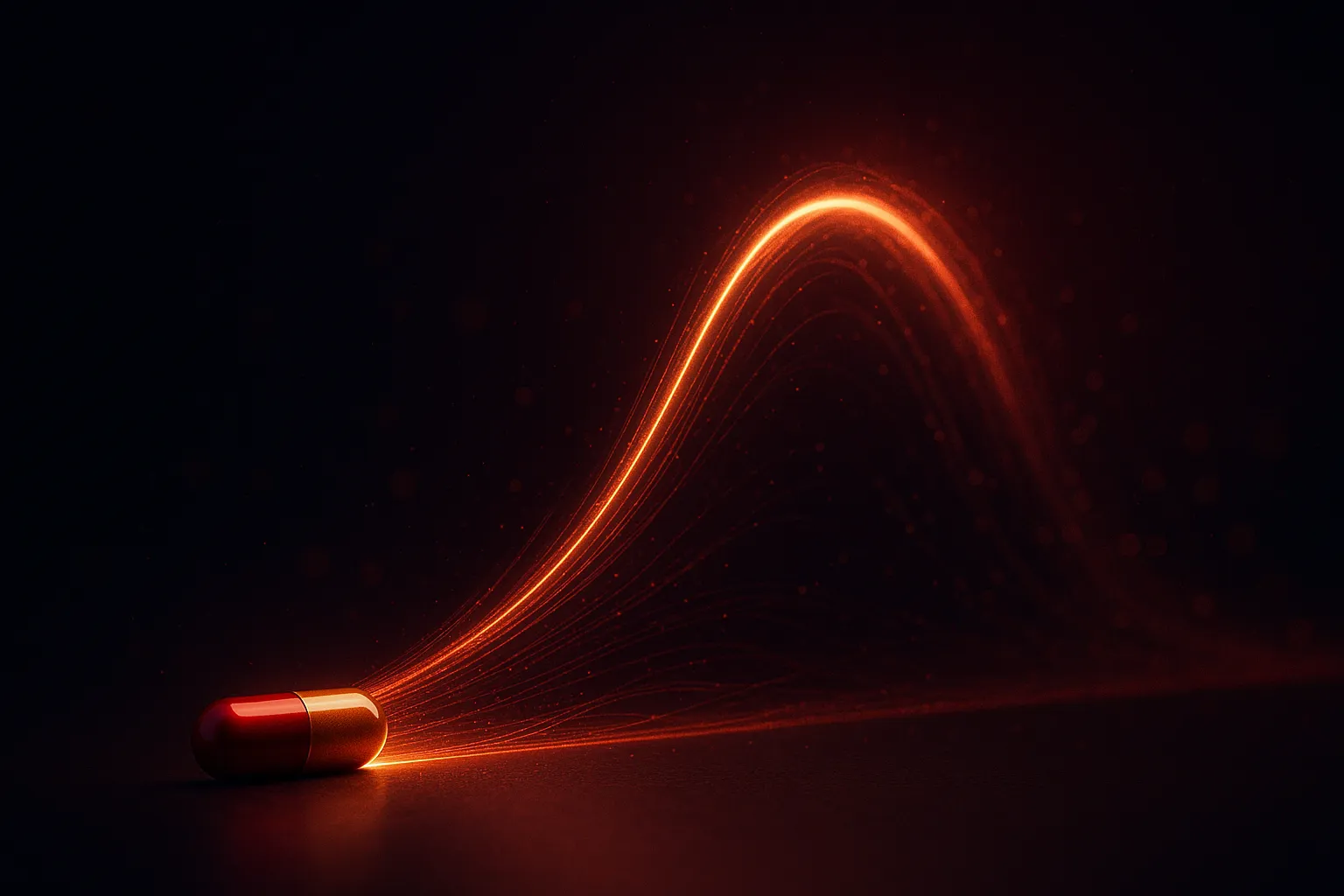
Enclomiphene half-life and once-daily dosing rationale

Study Durations: The 12-24 Week Window

The controlled studies ran for defined windows, not open-ended cycles. The Kaminetsky (2013) proof-of-principle study reported outcomes at three and six months, and the Phase 3 studies (Kim et al., 2016) dosed daily across a multi-week treatment period, with reported study durations clustering in the 12-24 week range. A randomized Phase 2 trial (Wiehle et al., 2014) followed the same daily-dosing structure over its treatment window.

Reported this way, the duration is a trial fact — how long the studies ran — not a recommended "cycle." The research record does not define an on/off cycling schedule for enclomiphene the way community protocols do for injectable peptides.

What Bloodwork the Trials Tracked

Across the program, researchers measured a consistent panel to characterize the compound's effect:

  • Total testosterone — the primary endpoint; rose from ~205 ng/dL baseline into the ~410-450 ng/dL range on daily dosing (Kim 2016).
  • Luteinizing hormone (LH) and follicle-stimulating hormone (FSH) — the upstream gonadotropins; both rose, confirming the effect came from a reawakened pituitary signal (Wiehle 2013).
  • Estradiol — tracked because enclomiphene blocks estrogen feedback at the hypothalamus and pituitary.
  • Semen parameters / sperm concentration — the defining measured result was preservation of sperm counts that topical testosterone reduced (Kaminetsky 2013, Kim 2016).

This describes what the studies measured to document the compound's action — it is not a monitoring protocol for personal use.

Ready to buy? Compare verified vendors on our best Enclomiphene sources page, or browse all coupon codes for up to 50% off.
Where to buy Enclomiphene
One verified, COA-tested Enclomiphene source
The verified, COA-tested source we track for Enclomiphene — shipped with a certificate of analysis. Research use only.
COA verified $0.11/mg Swiss Chems
Save 10%THEPEPTIDECATALOGat checkout
Buy at Swiss Chems — $79.95
750mg · sold research-use-only · we may earn a commission

Where These Numbers Come From

The dose-finding evidence sits in one paper more than any other. Wiehle and colleagues (2013) ran the pharmacodynamic and pharmacokinetic study that compared 12.5 mg against 25 mg once-daily oral enclomiphene, documented significant total-testosterone increases after two weeks alongside rises in LH and FSH, and characterized the ~10-hour half-life that made once-daily dosing appropriate. That study is why the trial dose is expressed as 12.5-25 mg once daily.

Enclomiphene and the hormone axis the trials measured

The proof-of-principle work (Kaminetsky et al., 2013) compared oral enclomiphene with testosterone gel and reported that both reached similar testosterone levels, but only enclomiphene raised gonadotropins and preserved sperm counts. The randomized Phase 2 trial (Wiehle et al., 2014) reproduced the coordinated response — testosterone up, gonadotropins up, oligospermia prevented — and the two parallel Phase 3 studies (Kim et al., 2016) confirmed it at scale in obese hypogonadal men. A review of the compound (Rodriguez et al., 2016) framed this oral, fertility-sparing, once-daily route as its main point of differentiation from standard testosterone therapy.

Self-Reported Community Use

The following describes self-reported community patterns, not clinical trial protocols and not guidance. No controlled trial evaluated the uses below; they come from forum and community sources and are reported here only because readers search for them.

  • Every-other-day dosing: Some community sources describe splitting or spacing the dose to every other day. This departs from every trial, which dosed once daily; the ~10-hour half-life (Wiehle 2013) is the pharmacokinetic reason trials chose a daily schedule.
  • Post-cycle (PCT) use: Community reports commonly describe enclomiphene in post-anabolic-cycle recovery, on the rationale that it lifts LH and FSH. No trial in the published program studied enclomiphene as a post-cycle agent — the controlled evidence is entirely in secondary hypogonadism.
  • Alongside testosterone therapy: Community discussion sometimes pairs it with testosterone to preserve fertility. This is outside the trial context, where enclomiphene was studied as an alternative to — not an add-on to — testosterone gel. For a structured comparison of the two routes, the sibling TRT resource covers enclomiphene vs TRT in depth; that is where the on-TRT question belongs.

These patterns are self-reported community signals, explicitly not clinical guidance, and are not endorsed here.

Honest Limits

Enclomiphene completed Phase 3 development for secondary hypogonadism but was never FDA-approved, so no finished pharmaceutical product exists. The material sold by research-chemical vendors is labeled for laboratory research use only and not for human consumption. Because it is unapproved, there is no regulated dose, no dispensing pharmacist, and no manufacturer quality guarantee behind the capsule — which is why the isomer-identity question covered in the buying guide matters. Legality of purchase and possession varies by jurisdiction.

Bacteriostatic Water for Injectable Stack Partners

Enclomiphene itself is an oral capsule and needs no reconstitution. Injectable hormone-support compounds sometimes discussed alongside it — such as HCG or gonadorelin — are reconstituted with bacteriostatic water in documented protocols; the dosing and dilution math for those compounds is covered in their own guides, not here.

30ml bacteriostatic water vial — 0.9% benzyl alcohol multi-dose
Bac Water Made for Peptides50% off
Don't risk a $300 peptide on generic bac water.
Most cloudy reconstitutions trace back to one thing — and it isn't the peptide. Sterile, non-pyrogenic, 0.9% benzyl alcohol — formulated for peptide reconstitution, not repackaged from generic stock.
0.9% benzyl alcohol Made for peptides 30 mL multi-dose
See why our bac water doesn't ruin peptides
Ships fast · 50% off with code thepeptidecatalog

Frequently Asked Questions

What dose did enclomiphene trials use?
The Phase 3 program (Kim et al., 2016) dosed enclomiphene at 12.5 mg and 25 mg once daily by mouth in overweight men with secondary hypogonadism. Both arms raised total testosterone from a baseline near 205 ng/dL into roughly the 410-450 ng/dL range. The earlier pharmacodynamic study (Wiehle et al., 2013) compared the same two strengths and documented significant testosterone, LH, and FSH increases at both. This article reports what the trials documented, not a recommended dose.
What is the difference between 12.5 mg and 25 mg enclomiphene?
Across the trial program both strengths raised testosterone and gonadotropins; the pharmacodynamic work (Wiehle et al., 2013) reported a dose-related response, with 25 mg producing somewhat larger hormone increases than 12.5 mg. The research-chemical market most commonly sells 12.5 mg capsules — the strength carried through the Phase 3 studies — with some vendors also listing 25 mg. The reported figures are trial data points, not a titration instruction.
What is enclomiphene's half-life?
Pharmacokinetic analysis (Wiehle et al., 2013) characterized enclomiphene — the trans-isomer of clomiphene — as clearing far faster than the longer-lasting zuclomiphene fraction, with a plasma half-life in the region of 10 hours. That short half-life is the pharmacological rationale the trials cited for once-daily oral dosing, and every subsequent study administered it once per day.
How long did enclomiphene trials run?
The controlled studies ran for defined windows rather than open-ended cycles: the Kaminetsky (2013) proof-of-principle study reported outcomes at three and six months, and the Phase 3 studies (Kim et al., 2016) dosed daily across a multi-week treatment period. Reported study durations cluster in the 12-24 week range. These are trial durations, not a prescribed cycle length.
What did trials measure to track enclomiphene's effect?
The studies tracked total testosterone, luteinizing hormone (LH), follicle-stimulating hormone (FSH), estradiol, and semen parameters including sperm concentration (Kaminetsky 2013, Wiehle 2014, Kim 2016). The defining measured result was that enclomiphene raised testosterone and gonadotropins while preserving sperm counts that testosterone gel reduced. This describes what researchers measured, not a monitoring protocol for personal use.
Is enclomiphene FDA-approved?
No. Enclomiphene completed Phase 3 trials for secondary hypogonadism but was never approved by the FDA, so no finished pharmaceutical product exists. The material sold by research-chemical vendors is labeled not for human consumption. Everything here reports published trial data, not medical advice.

References

  1. Kaminetsky J, Werner M, Fontenot G, Wiehle RD. Oral enclomiphene citrate stimulates the endogenous production of testosterone and sperm counts in men with low testosterone: comparison with testosterone gel. J Sex Med. 2013;10(6):1628-1635. PMID: 23530575
  2. Wiehle RD, Fontenot GK, Willett MS, et al. Testosterone restoration using enclomiphene citrate in men with secondary hypogonadism: a pharmacodynamic and pharmacokinetic study. BJU Int. 2013;112(8):1188-1200. PMID: 23875626
  3. Wiehle RD, Fontenot GK, Wike J, et al. Enclomiphene citrate stimulates testosterone production while preventing oligospermia: a randomized phase II clinical trial comparing topical testosterone. Fertil Steril. 2014;102(3):720-727. PMID: 25044085
  4. Kim ED, McCullough A, Kaminetsky J. Oral enclomiphene citrate raises testosterone and preserves sperm counts in obese hypogonadal men, unlike topical testosterone: restoration instead of replacement. BJU Int. 2016;117(4):677-685. PMID: 26496621
  5. Rodriguez KM, Pastuszak AW, Lipshultz LI. Enclomiphene citrate for the treatment of secondary male hypogonadism. Expert Opin Pharmacother. 2016;17(11):1561-1567. PMID: 27337642