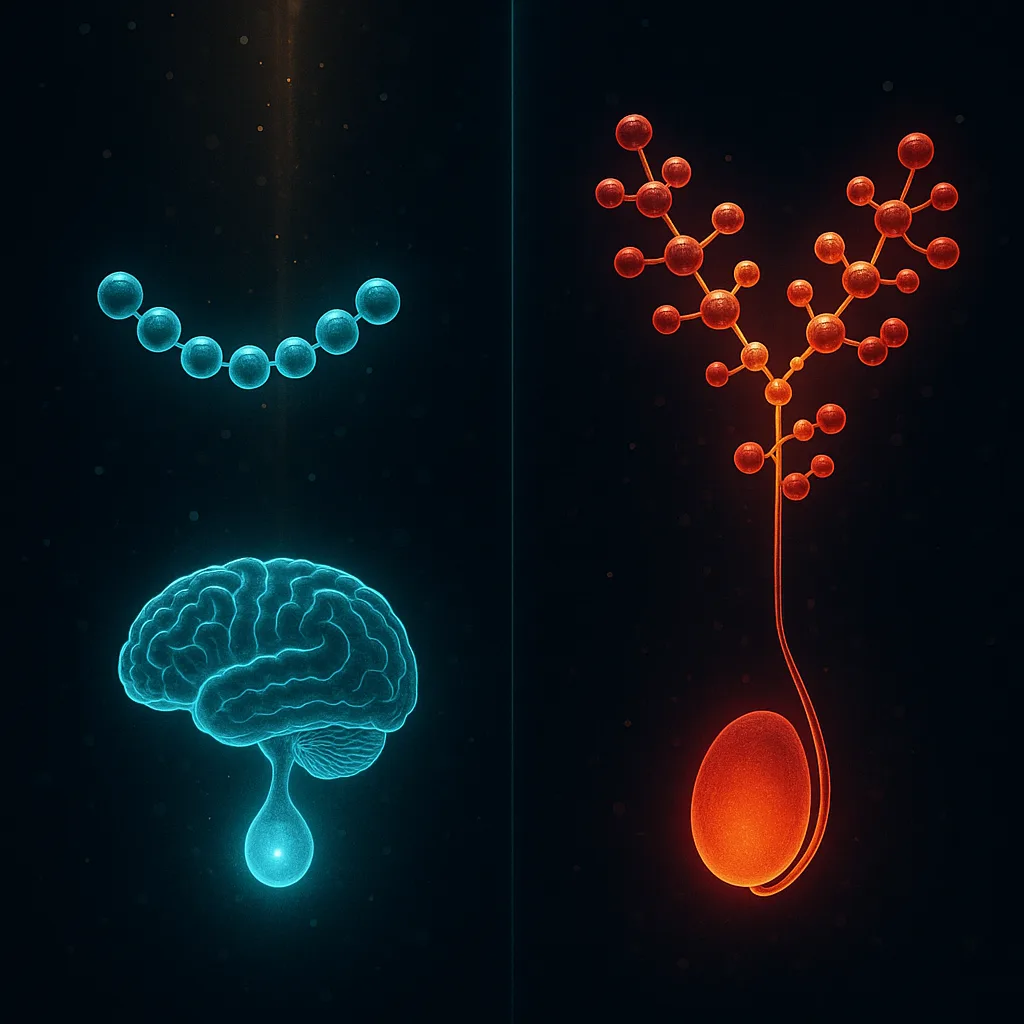
Gonadorelin and HCG are both used alongside testosterone therapy for the same job: keeping the testes working while exogenous testosterone shuts down the body's own signal. They are not doing the same thing to get there. Gonadorelin is synthetic GnRH — it acts at the top of the hypothalamic-pituitary-gonadal axis, on the pituitary, asking it to release LH and FSH. HCG skips the pituitary entirely and binds the LH receptor on testicular Leydig cells directly, one step further down the same cascade.
That single step is the entire comparison. The popular framing — that gonadorelin is the more "natural" choice because it works through the body's own pathway — describes the mechanism accurately and then draws the wrong conclusion from it. Working through more of the pathway means depending on more of the pathway. On the published evidence, HCG is the more effective and far more predictable of the two for maintaining testicular function and spermatogenesis during testosterone therapy.
Research-context information only. HCG (human chorionic gonadotropin) is the active ingredient in FDA-approved products for hypogonadotropic hypogonadism and infertility; research-peptide and compounded forms are not FDA-approved and are sold for research purposes only. Gonadorelin is the active ingredient in FDA-approved products for evaluating hypothalamic-pituitary-gonadal function and for inducing ovulation in hypothalamic amenorrhea; those US products are no longer marketed, and research-peptide and compounded forms are not FDA-approved. Protocols, doses, and reactions reported below come from clinical trials and community sources. This article reports what has been documented, not what should be done. Consult a licensed physician for personal medical decisions.
This article covers where each compound acts, why the pulse pattern matters more than the dose for gonadorelin, what the trial data actually measured on each side, and the honest list of places gonadorelin still wins.
Quick Comparison
| Gonadorelin | HCG | |
|---|---|---|
| What it is | Synthetic GnRH decapeptide (10 amino acids) | Glycoprotein hormone, ~237 amino acids across two subunits |
| Where it acts | Pituitary gonadotroph GnRH receptor | LH/CG receptor (LHCGR) on testicular Leydig cells |
| Position on the axis | Top — one step above the pituitary's output | Bottom — bypasses the pituitary entirely |
| Requires a responsive pituitary | Yes | No |
| Requires pulsatile delivery | Yes, per published pharmacology | No |
| Raises FSH as well as LH | Yes, in principle — both gonadotropins are released | No — LH-receptor agonism only |
| Half-life | ~2-10 min distribution, ~10-40 min terminal | ~24-36 hours |
| Direct intratesticular testosterone data on suppressed men | None published | Yes (PMID 15713727) |
| Published efficacy delivery method | Portable infusion pump, doses every 60-120 min | Subcutaneous or intramuscular injection, every 2-3 days |
| Typical research-vendor format | 2 mg lyophilized vial | 5,000 IU lyophilized vial |
What Each Compound Is
Gonadorelin
Gonadorelin is the synthetic form of gonadotropin-releasing hormone — a decapeptide identical to the hormone the hypothalamus releases in bursts into the hypophyseal portal circulation. It binds the GnRH receptor on pituitary gonadotroph cells, which respond by releasing luteinizing hormone (LH) and follicle-stimulating hormone (FSH). Those gonadotropins then travel to the testes: LH drives Leydig-cell testosterone production, FSH supports Sertoli-cell function and spermatogenesis.
Its pharmacokinetics are extreme even by peptide standards. Published pharmacology describes a distribution half-life of roughly 2-10 minutes and a terminal half-life of roughly 10-40 minutes. That is not a flaw — it is the design. Endogenous GnRH is supposed to appear and vanish in bursts, because the pituitary reads the pattern, not the concentration.
Gonadorelin's approved US history was as a diagnostic agent for testing pituitary gonadotroph function and, in a separate pump-delivered product, for pulsatile fertility treatment. Neither is currently marketed in the United States. Supply now runs through compounding pharmacies and research-chemical vendors.
Top Gonadorelin Vendors
Ranked by price, COA availability, and reputation
HCG
Human chorionic gonadotropin is a much larger molecule — a two-subunit glycoprotein whose alpha subunit is identical to that of LH, FSH and TSH, and whose beta subunit is roughly 85% homologous to LH's. That homology is why it binds and activates the same receptor as LH, the LH/CG receptor on Leydig cells.
It is not a perfect LH copy. Casarini and colleagues reviewed the biochemistry in detail and concluded that the assumed equivalence of LH and HCG has been disproved: acting on the same receptor, HCG drives cAMP/PKA-mediated steroidogenic signaling more strongly, while LH preferentially engages kinase pathways (PMID 29905829). For the specific purpose of stimulating Leydig-cell testosterone output, that bias works in HCG's favor.
Its heavily glycosylated structure also gives it a half-life measured in days rather than minutes — roughly 24-36 hours, versus around 20 minutes for endogenous LH. That is why documented HCG protocols inject every two to three days rather than needing an hourly pump.
Top HCG (Human Chorionic Gonadotropin) Vendors
Ranked by price, COA availability, and reputation
Mechanism: One Step Apart, and It Matters
Laid out as a cascade, the difference is easy to see:
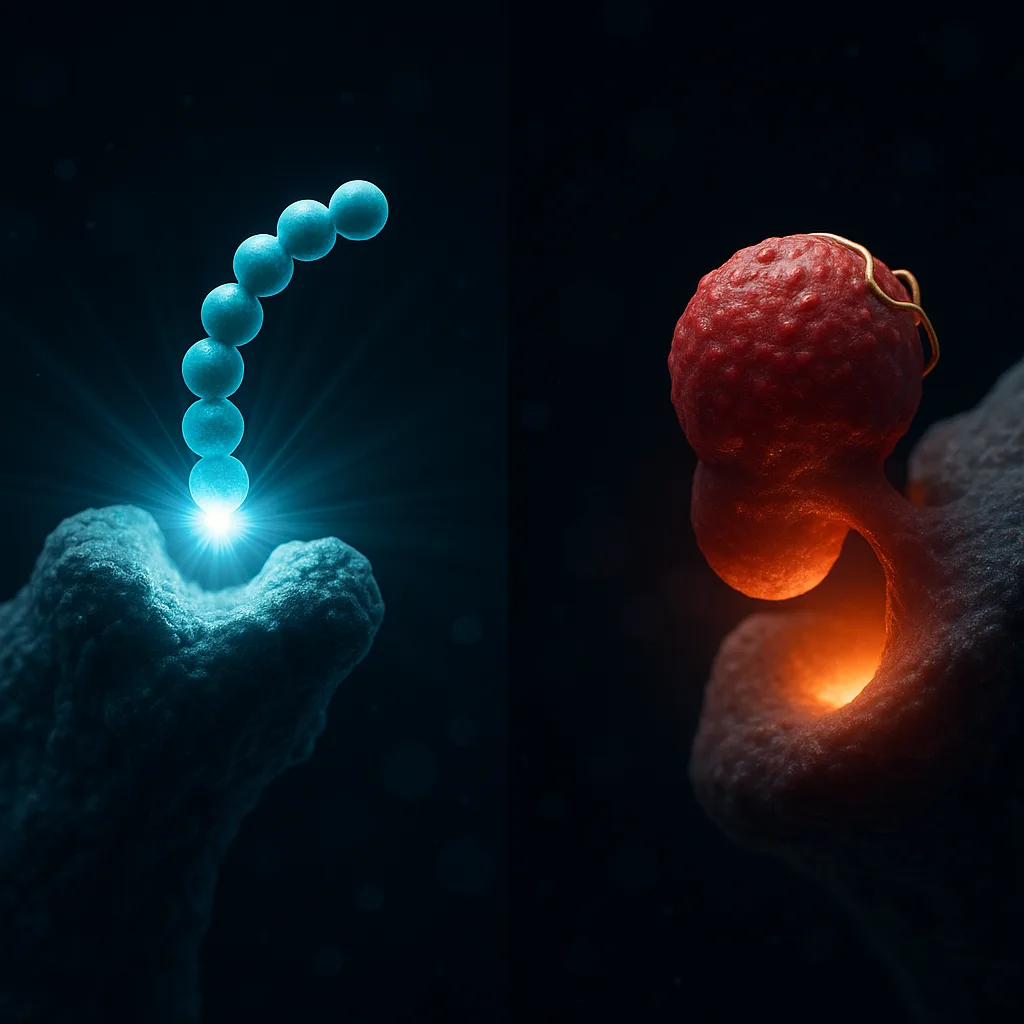
Gonadorelin: hypothalamic signal → pituitary gonadotroph → LH + FSH → Leydig and Sertoli cells → intratesticular testosterone and spermatogenesis
HCG: injected hormone → Leydig cell LH receptor → intratesticular testosterone
Gonadorelin's route passes through one extra organ. For that route to produce testicular stimulation, three things must all hold: the pituitary gonadotrophs must be present and responsive, the delivered signal must arrive in a pulse pattern the gonadotrophs will read as physiological, and the resulting LH must be released in quantities sufficient to reach the testes.
HCG's route requires none of that. It does not care whether the pituitary is suppressed, sluggish, or surgically absent — it lands on the Leydig cell and switches it on.
That distinction is not academic in this population. The entire reason someone on testosterone therapy is considering either compound is that exogenous testosterone has suppressed the pituitary's gonadotropin output through negative feedback. Gonadorelin is being asked to override a system that a continuous supraphysiological androgen signal is actively holding down. HCG operates downstream of that feedback loop entirely.
The Pulsatility Problem
This is the mechanistic risk that gets glossed over most often, and it is the single most important thing to understand about gonadorelin.
GnRH signaling is frequency-coded. Belchetz and colleagues established this in a 1978 Science experiment in rhesus monkeys with hypothalamic lesions: continuous infusion of GnRH failed to restore sustained gonadotropin secretion, while the same hormone delivered as one pulse per hour restored pituitary function normally. Switching animals from intermittent to continuous delivery caused desensitization. The delivery pattern, not the total dose, determined the response (PMID 100883).
Sustained GnRH-receptor occupancy therefore does the opposite of the intended effect — it downregulates the receptor and suppresses LH and FSH. This is not a theoretical concern dredged up to make a point; it is the documented pharmacology that GnRH-agonist androgen deprivation therapy is built on. Long-acting GnRH agonists are used clinically to shut the axis down, and they do it by removing pulsatility.
Gonadorelin's short terminal half-life means true continuous exposure is unlikely at the injection frequencies described in community and clinic protocols. But the Belchetz finding still frames the problem correctly: the pulse pattern is the active variable, and a subcutaneous injection twice a week is not a pulse pattern the pituitary evolved to read. The published protocols that produce results replicate the physiological rhythm with hardware.
What the Evidence Actually Measured
HCG: measured directly, in the exact population
Coviello and colleagues ran the study that matters most here. Twenty-nine men with normal reproductive physiology received 200 mg of testosterone enanthate weekly — enough to suppress gonadotropins — plus saline placebo or 125, 250, or 500 IU of HCG every other day for three weeks. Intratesticular testosterone was then measured directly by testicular aspiration. Post-treatment intratesticular testosterone was 25% below baseline in the 125 IU group, 7% below baseline at 250 IU, and 26% above baseline at 500 IU (PMID 15713727).
That is a dose-response curve, in men whose axis was deliberately suppressed by exogenous testosterone, measuring the actual endpoint of interest rather than a surrogate.
Hsieh and colleagues followed the clinical endpoint. In a 26-man series on testosterone replacement with concomitant low-dose HCG (mean follow-up 6.2 months), no patient became azoospermic, semen parameters remained stable, and nine of the 26 contributed to a pregnancy during follow-up (PMID 23260550).
Gonadorelin: strong evidence, for a delivery method almost nobody uses
The clinical evidence supporting GnRH therapy is real and genuinely impressive — but it is evidence for pump-delivered pulsatile GnRH in congenital hypogonadotropic hypogonadism, a different delivery method in a different population.
Hao and colleagues treated 28 men with congenital hypogonadotropic hypogonadism using a pulsatile GnRH pump and reported LH and FSH rising to 2.66 ± 1.74 and 5.05 ± 3.03 IU/L respectively over the treatment period (PMID 34277762). Zhang and colleagues compared a pulsatile gonadorelin pump against cyclical HCG/hMG therapy in 28 azoospermic men with the same condition: median time to spermatogenesis was 6 months on the pump versus 14 months on cyclical gonadotropins, with spermatogenesis occurring in 90% and 83.3% of each group (PMID 30569789).
Two things follow from that Zhang result, and both matter.
First, pulsatile gonadorelin genuinely outperformed HCG-based therapy on time-to-spermatogenesis in that population — this is the strongest pro-gonadorelin data that exists, and it should not be waved away.
Second, it was delivered by a pump, in men with an intact but unstimulated pituitary and no exogenous testosterone suppressing anything. Neither condition matches a man on testosterone therapy injecting gonadorelin subcutaneously twice a week. Transplanting the conclusion across that gap is the error at the center of most gonadorelin-versus-HCG content.
No published trial has measured intratesticular testosterone or semen parameters on non-pulsatile gonadorelin in men whose axis is suppressed by exogenous testosterone. The community and clinic figure most often quoted — that gonadorelin maintains roughly 50-60% of testicular function, with a meaningful minority of men not responding adequately — comes from practitioner and community sources, not from a published trial, and should be read as the signal it is: a self-reported estimate with wide variance.
Side-by-side evidence
Outcomes where both peptides have published data. Each cell carries two grades: clinical evidence (human-RCT depth for this specific outcome) and community evidence (real-world adoption). How we grade evidence.
| Outcome | Gonadorelin | HCG |
|---|---|---|
| Maintaining intratesticular testosterone on testosterone therapy | Clinical:Preliminary Community:Moderate No published trial has measured intratesticular testosterone on non-pulsatile gonadorelin in a suppressed axis. | Clinical:Strong Community:Strong Dose-response measured directly: 500 IU every other day held ITT 26% above baseline under weekly testosterone (Coviello 2005). |
| Preserving spermatogenesis alongside testosterone | Clinical:Weak Community:Moderate Clinic and community sources report partial, variable maintenance; no published semen-parameter data in this setting. | Clinical:Moderate Community:Strong No azoospermia in 26 men on testosterone plus low-dose HCG over a mean 6.2 months (Hsieh 2013). |
| Restoring spermatogenesis in congenital hypogonadotropic hypogonadism | Clinical:Moderate Community:Weak Pump-delivered pulsatile gonadorelin reached spermatogenesis at a median 6 months vs 14 on cyclical gonadotropins (Zhang 2019). | Clinical:Moderate Community:Moderate Cyclical HCG/hMG achieved spermatogenesis in 83.3% of the comparator arm, but more slowly (Zhang 2019). |
| Independence from pituitary responsiveness | Clinical:Weak Community:Moderate Requires responsive gonadotrophs and a physiological pulse pattern; continuous exposure downregulates the receptor (Belchetz 1978). | Clinical:Strong Community:Strong Binds the Leydig-cell LH/CG receptor directly, bypassing the pituitary and androgen negative feedback entirely. |
| Cost, supply stability, and assay interference | Clinical:Moderate Community:Strong Cheaper per vial, unaffected by the 2020 compounding transition, and does not cross-react with LH immunoassays. | Clinical:Weak Community:Moderate Only 5 of 75 surveyed outsourcing facilities still supplied HCG in 2023; cross-reacts with LH assays (Borgert 2023). |
Where the Evidence Lands
For maintaining testicular function and spermatogenesis during testosterone therapy, HCG is the better-supported and more predictable choice. It has direct intratesticular testosterone measurements in the exact suppressed population, a clean dose-response relationship, a clinical fertility endpoint, and a mechanism that does not depend on a pituitary that exogenous testosterone is actively suppressing.
Gonadorelin's supporting evidence is strong but load-bearing in the wrong place: it demonstrates what pulsatile GnRH does through a pump in men with congenital hypogonadotropic hypogonadism, not what twice-weekly subcutaneous gonadorelin does in a suppressed axis. Where response is reported, it is reported as partial and variable rather than reliable.