Almost every peptide vendor now publishes a Certificate of Analysis, and most of those certificates answer one question: what share of the material is the target peptide, measured by HPLC. That number matters, but it leaves most of the useful questions open. Is it the right molecule? How much of it is in the vial? Was it screened for endotoxin, microbes, heavy metals or fentanyl?
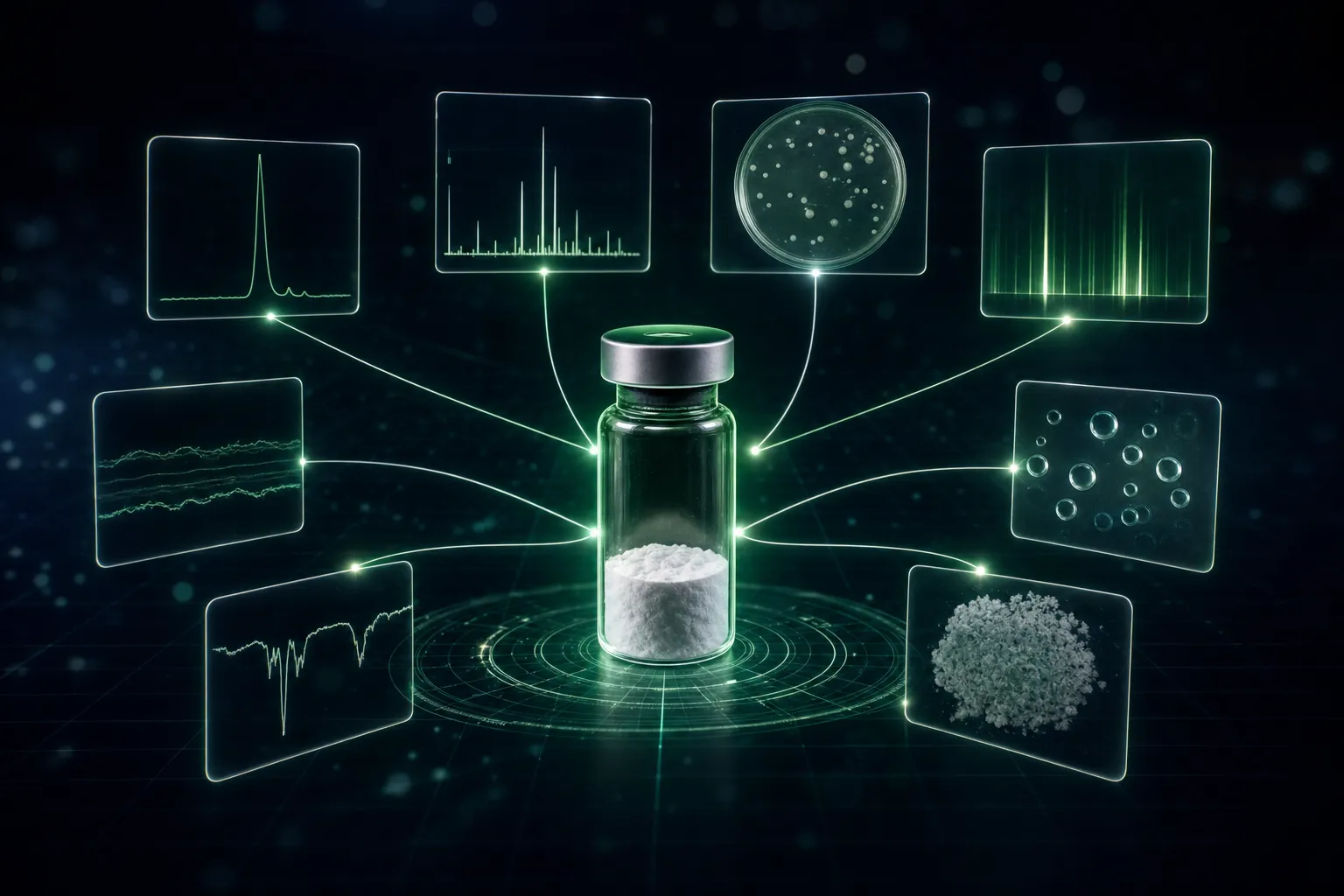
The Gold Panel COA is a standard that answers all of them. It names eight lab tests and a pass level for each, and a lot meets the standard only when every test on its report meets its level. This page sets out the eight tests, what each one measures, and why a report built this way tells far more than a purity figure on its own.
Research-context information only. This article describes laboratory testing of research peptides and reports what test documents show, not what should be done with any compound. A test result describes one lot and the tests listed on its report; it is not a statement that a compound is safe or effective.
The Gold Panel COA standard
| Test | How the lab measures it | Pass level |
|---|---|---|
| Identity | LC-MS (mass spectrometry) | Identity confirmed by mass spectrometry |
| Purity | HPLC-UV, two samples | 99.0% or higher |
| Net content | Measured by the lab, in mg | At least 90% of the labelled amount |
| Appearance | Visual inspection | Conforms: lyophilized powder or capsules as labelled |
| Endotoxin | LAL assay, two replicates | Both replicates pass |
| Microbial | PCR | No detectable microbial DNA |
| Heavy metals | ICP-MS: arsenic, cadmium, lead, mercury | All four below the lab's reporting limits |
| Fentanyl | Targeted screen | No fentanyl detected |
Three rules make it a standard rather than a list:
- Every test, every level. A lot that misses any level, or whose report leaves a test out, does not meet the standard.
- One lot, one report. The report has to be for the lot being sold, carrying the same lot number as the vial.
- Capsules are judged on seven. Capsule reports carry no HPLC purity, so a capsule lot is judged on the other seven tests.
In our view, a Gold Panel COA, tied to the lot and published before purchase, is the gold standard for research-peptide testing.
The Gold Panel COA badge

Wherever this badge appears on The Peptide Catalog, next to a vendor in our lists or on its deals page, it marks a vendor whose published lot reports, as we have reviewed them, meet the Gold Panel COA standard: all eight tests, each at its pass level, on reports tied to the lot being sold. It describes the vendor's documents, not the quality of any product.
It matters because it compresses the whole standard into one signal. A purity figure answers one question out of eight; the badge says the other seven were answered too, on paper, for each lot. It is not a statement about how any compound performs, and the lot report behind it remains the document of record.
Vendors register for the Gold Panel COA at goldpanelcoa.com, where a company and its lot reports are matched against the standard.
Basic COA vs Gold Panel COA
| Basic COA | Gold Panel COA | |
|---|---|---|
| What it reports | HPLC purity, sometimes a mass-spec identity line | All eight tests, each against a stated pass level |
| Question it answers | How much of the peptide material is the target sequence | Whether the lot is the right molecule, how pure it is, how much is there, and what it was screened for |
| What it leaves open | Identity (often), content, endotoxin, microbes, metals, adulterants, appearance | Only what no lab test covers (see below) |
A basic certificate is not a fake certificate. It is a narrow one.
The eight tests, explained
1. Identity: mass spectrometry
Mass spectrometry (LC-MS on a Gold Panel report) weighs the molecule. If the measured mass matches the theoretical mass of the sequence on the label, the lot is the compound it claims to be. This is the test that catches a mislabeled or substituted vial, and it answers a different question from purity: a lot can be 99% pure and still be 99% of the wrong peptide. Identity is checked first because every other number on the report depends on it.
2. Purity: HPLC, 99.0% or higher
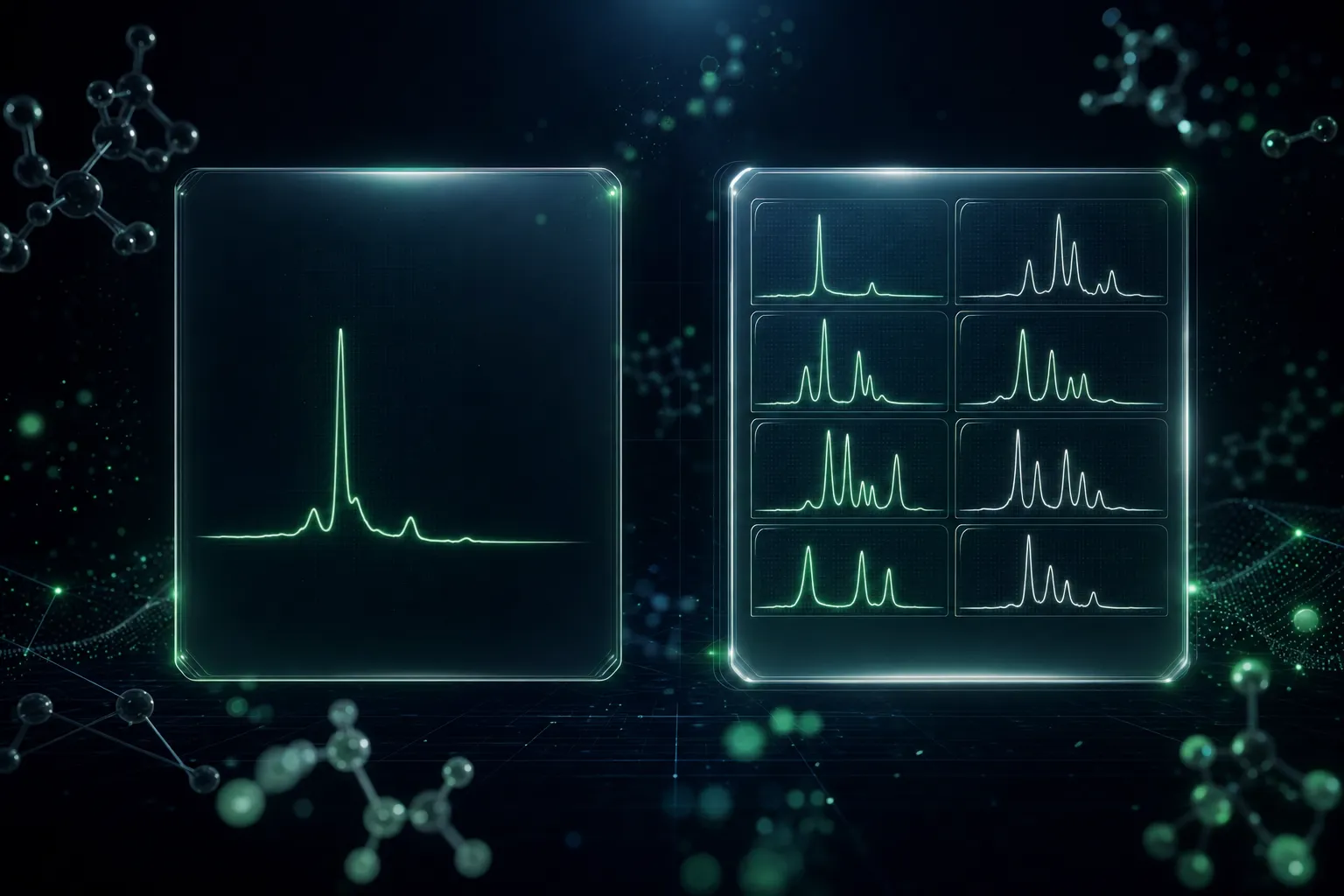
High-performance liquid chromatography separates the components of a sample and reports the target peptide as a share of everything detected. A Gold Panel report runs two samples, gives the percentage for each, and shows the chromatogram. The pass level is 99.0%.
What the leftover percentage is. On a 99% result, most of the remaining 1% is synthesis fragments: truncated or deletion sequences missing one or more amino acids, and by-products of the protecting-group chemistry used to build the chain. FDA's 2021 guidance on synthetic peptides treats these peptide-related impurities as something to identify and limit, not ignore. A visible chromatogram, the actual trace with its peaks and baseline, shows that fraction in a way a single typed figure cannot, and is far harder to fabricate.
Purity is not peptide content. HPLC purity is a ratio within the peptide material. It does not say how much of the powder by weight is peptide at all. Lyophilized peptides also carry counter-ions (acetate or TFA) and residual water, so a vial that is 99% pure by HPLC can be well under 99% peptide by weight. That is what the next test is for.
3. Net content: at least 90% of the label
Net content is the amount of material actually measured in the vial, in milligrams, against the amount on the label (for a blend, each component is measured). Purity says what share of the peptide material is the right sequence; net content says how much of it is there. A vial can pass purity and still be under-filled, which is why the Gold Panel sets a floor of 90% of the labelled amount.
4. Appearance
A visual description of the lot, for example white lyophilized powder, checked against its form. It is the simplest test on the panel, and it catches handling problems such as discoloration or a collapsed or wet cake before any instrument is involved.
5. Endotoxin: both replicates pass
Bacterial endotoxins are fragments of bacterial cell walls. They are invisible to HPLC and survive filtration and heat that kill the bacteria themselves, which is why they are tested for directly. The Gold Panel uses the LAL assay (the method described in USP chapter 85) on two replicates, and both have to pass.
6. Microbial: no detectable microbial DNA
A microbial test looks for bacterial and fungal contamination, which a purity trace cannot see. The Gold Panel uses a PCR screen that looks for microbial DNA directly, and the pass level is none detected. Other labs use culture-based counts of aerobic bacteria, yeast and mold (the USP 61/62 methods) or a sterility test (USP 71); whichever method is used, a report should name it, because "microbial: pass" with no method is a weaker statement.
7. Heavy metals: below the lab's reporting limits
Inductively coupled plasma mass spectrometry (ICP-MS) measures trace elements that can come from reagents or equipment and do not show up on HPLC. The Gold Panel tests arsenic, cadmium, lead and mercury, the four elements the ICH Q3D guideline places in its highest-concern class (the same elemental-impurity framework as USP chapters 232/233). All four have to come in below the lab's reporting limits.
8. Fentanyl screen: none detected
A targeted screen for fentanyl on each lot. Cross-contamination is a supply-chain risk for any powder handled alongside other materials, and this is a contamination screen, not a purity measure: it says whether fentanyl was detected at the limit the lab states.
Reading a certificate against the standard
Working from the certificate actually in hand, the questions are short:
- Are all eight tests printed, with results? A test mentioned on a product page but not printed on the report does not count.
- Does each result meet its level? 99.0% purity, at least 90% of the labelled content, identity confirmed, and pass or none detected on the four screens.
- Is identity confirmed by mass spectrometry, not just purity? Look for a measured molecular weight, not only an HPLC percentage.
- Is the method named, not just the number? "99.4% by HPLC-UV" is a measurement; "99% pure" is a claim.
- Is a named lab on the report, with a way to look the report up? An independent lab with a report number can, in principle, confirm the result.
- Does the lot number match the vial? A certificate that cannot be tied to the material in hand documents someone else's batch.
The forgery side of this, and how to confirm a certificate is genuine at all, is covered in our companion guide on how to verify a peptide COA.
What a Gold Panel COA still does not tell anyone
A complete report documents what one lot was tested for and what the results were, at the limits the lab states. It does not:
- cover tests that are not on the report;
- describe a different lot from the one tested;
- say anything about how a compound behaves in the body, or whether it is safe or effective for any use.
Why it matters
Each test answers a question the others cannot. HPLC purity cannot tell whether the molecule is the right one; mass spec can. Neither says whether endotoxin, microbes, metals or fentanyl are present, or whether the vial holds the milligrams on the label. A basic certificate leaves every one of those questions open; a Gold Panel report, tied to the lot, answers them on paper for the material actually being sold.
It is also the version that is hardest to fake quietly. A lot-matched report from a named lab, with stated pass levels and published before purchase, can be checked against the vial, the listing and the lab itself.