Two women ended up in critical condition after peptide injections at RAADFest in Las Vegas. A third-party testing lab reports that 40% of vendors fail basic purity checks. And the mainstream media — NBC, The New Yorker, STAT News — is running wall-to-wall coverage declaring peptides unsafe.
Here is the reality: peptides are not inherently dangerous. Bad peptides are dangerous. The difference between a safe injection and a hospital visit comes down to whether you verified what is actually in the vial before using it.
The Purity Crisis: What the Data Actually Shows
Finnrick, the largest independent peptide testing organization, has analyzed over 6,100 samples from 185 vendors across 15 popular peptides. Their findings are sobering:
- Nearly 40% of vendors fail to meet their stated purity levels
- Some products test as low as 75% actual peptide content
- Quantity diverges up to 46% from advertised amounts — meaning your 10mg vial might contain 5.4mg
- Even among vendors with acceptable purity (98%+), quantity accuracy varies wildly
For specific peptides, Finnrick's data shows:
| Peptide | Samples Tested | Vendors | Purity Range (5th-95th) | Quantity Variance |
|---|---|---|---|---|
| Retatrutide | 2,234 | 145 | 98.74% – 99.95% | Up to +/-46% |
| Tirzepatide | 1,604 | 124 | 98.75% – 99.95% | Up to +/-45% |
| BPC-157 | 469 | 69 | 96.25% – 99.95% | Varies by vendor |
The purity numbers look reasonable for the top quartile. The quantity variance is the real problem — you cannot dose accurately if your vial contains half the advertised amount.
This is not theoretical. The RAADFest incident in Las Vegas put two women (ages 38 and 51) in the hospital with swollen tongues, breathing difficulty, and elevated heart rates after peptide injections at a conference booth. Nevada regulators fined the providers $10,000 each, but investigators could not determine whether the cause was contamination or a reaction to the peptides themselves — because no one had tested the serums beforehand.
How to Read a Certificate of Analysis (COA)
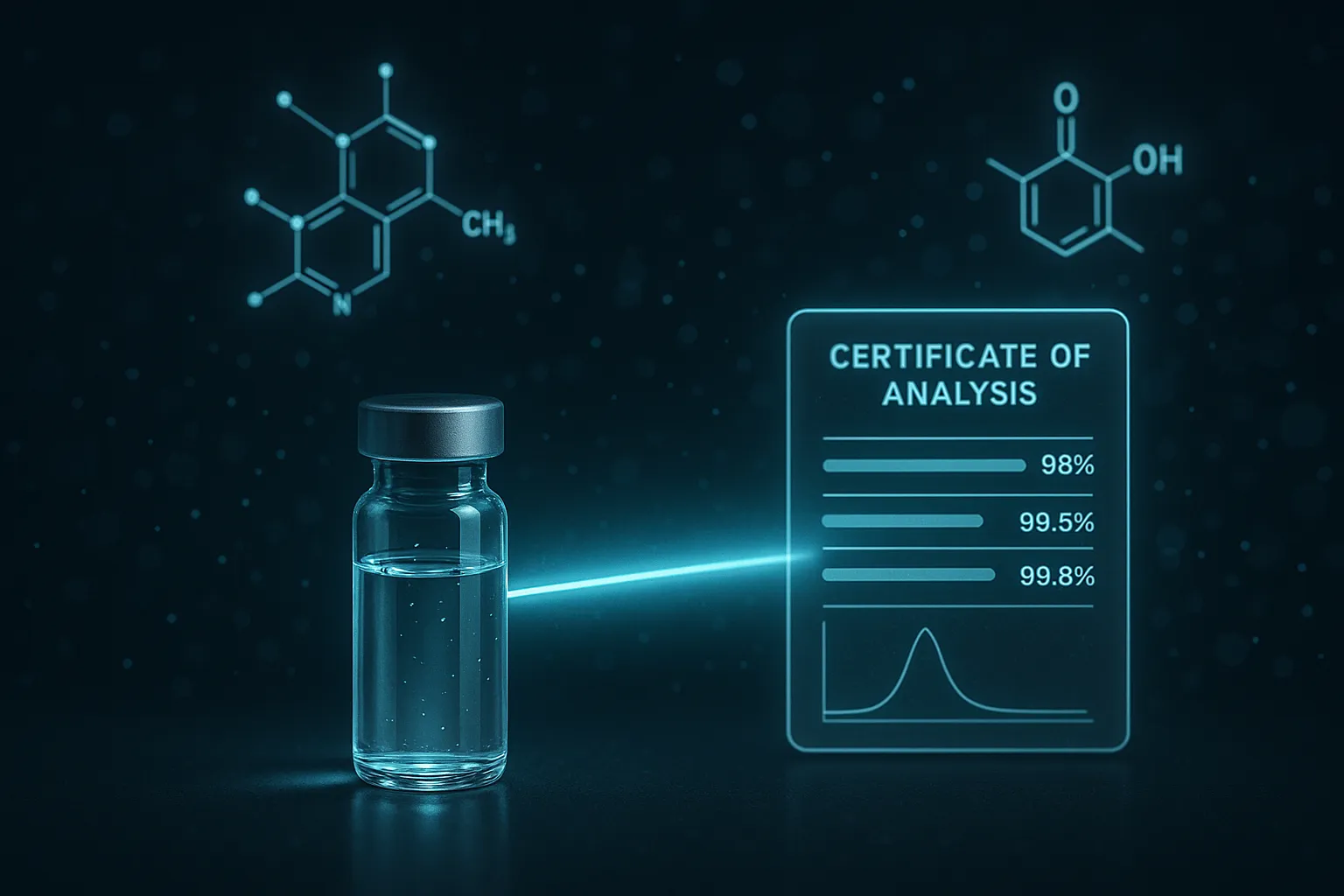
A COA is the single most important document between you and a safe injection. Here is exactly what to look for:
The 5 Non-Negotiable COA Elements
1. HPLC Purity (≥98%)
High-Performance Liquid Chromatography separates a peptide into its components and measures the proportion that is the target molecule. Anything below 98% means significant impurities are present — truncated peptide fragments, synthesis byproducts, or degradation products that may have unpredictable biological effects (PMID: 34110145).
2. Mass Spectrometry (Identity Confirmation)
HPLC tells you how pure the sample is. Mass spec tells you what it actually is. Without mass spectrometry, a 99% pure sample could be 99% pure wrong peptide. The observed molecular weight must match the expected molecular weight of your target peptide within 0.1% tolerance.
3. Endotoxin Testing (LAL Assay)
This is the one most vendors skip, and it is the most dangerous omission. Endotoxins are bacterial cell wall fragments that standard HPLC testing cannot detect at all. A peptide can show 99.9% HPLC purity while harboring endotoxin levels far exceeding pharmaceutical safety limits (PMID: 557238).
The LAL (Limulus Amebocyte Lysate) assay is the gold standard. Results should show less than 5 EU/kg for injectable products. If a vendor does not test for endotoxins, they are not testing for the most dangerous form of contamination.
4. Lot/Batch Number (Must Match Your Vial)
The COA should reference a specific lot number that matches the label on your vial. A generic COA without a lot number — or one that does not match — is worthless. Some vendors publish a single COA and apply it to every batch. This tells you nothing about what is in your specific vial.
5. Third-Party Lab Name
The COA should be issued by an independent laboratory, not the vendor's in-house facility. In-house testing is a conflict of interest. Look for named labs with verifiable accreditation (ISO 17025 or equivalent).
Red Flags That Should Stop You From Injecting
- COA available "upon request" only (legitimate vendors publish them proactively)
- No lot number, or lot number does not match your product
- HPLC only, no mass spec or endotoxin data
- In-house testing with no third-party verification
- COA date more than 6 months old (peptides degrade)
- Purity listed as a round number like "99%" with no decimal precision
What This Means for Buyers
The 40% failure rate does not mean 40% of peptides are dangerous. It means 40% of vendors are not delivering what they promise. The difference matters — underdosed peptides waste your money; contaminated peptides can put you in the hospital.
Here is how to protect yourself:
Check Finnrick ratings before ordering. Their vendor ratings page grades vendors A through F based on independent testing. An A-rated vendor has consistently delivered verified purity and quantity across multiple samples.
Only buy from vendors that publish full COAs. Our top-rated vendors all provide HPLC, mass spec, and endotoxin testing data for every batch. If you are shopping for a specific peptide, check our vendor comparison pages:
- Best BPC-157 vendors — verified COAs, live pricing
- Best retatrutide vendors — tested sources with quantity verification
- Best tirzepatide vendors — third-party tested options
- Best TB-500 vendors — COA-verified sources
Vendors that publish COAs + exclusive discount codes. These vendors meet the quality bar in this article — third-party HPLC, mass spec, and endotoxin testing — and offer reader-exclusive savings:
Use vendor discount codes to offset costs. Higher-quality vendors sometimes cost more, but verified peptides at the right dose are cheaper than underdosed ones. See the full peptide coupon codes page for all active discounts.