resultsJuly 21, 2026·4 min read

HCG Results: Week-by-Week Timeline

Testicular fullness returns within weeks; fertility effects take months. What HCG does at each stage on TRT, in PCT, and for fertility induction.

HCG Results Timeline

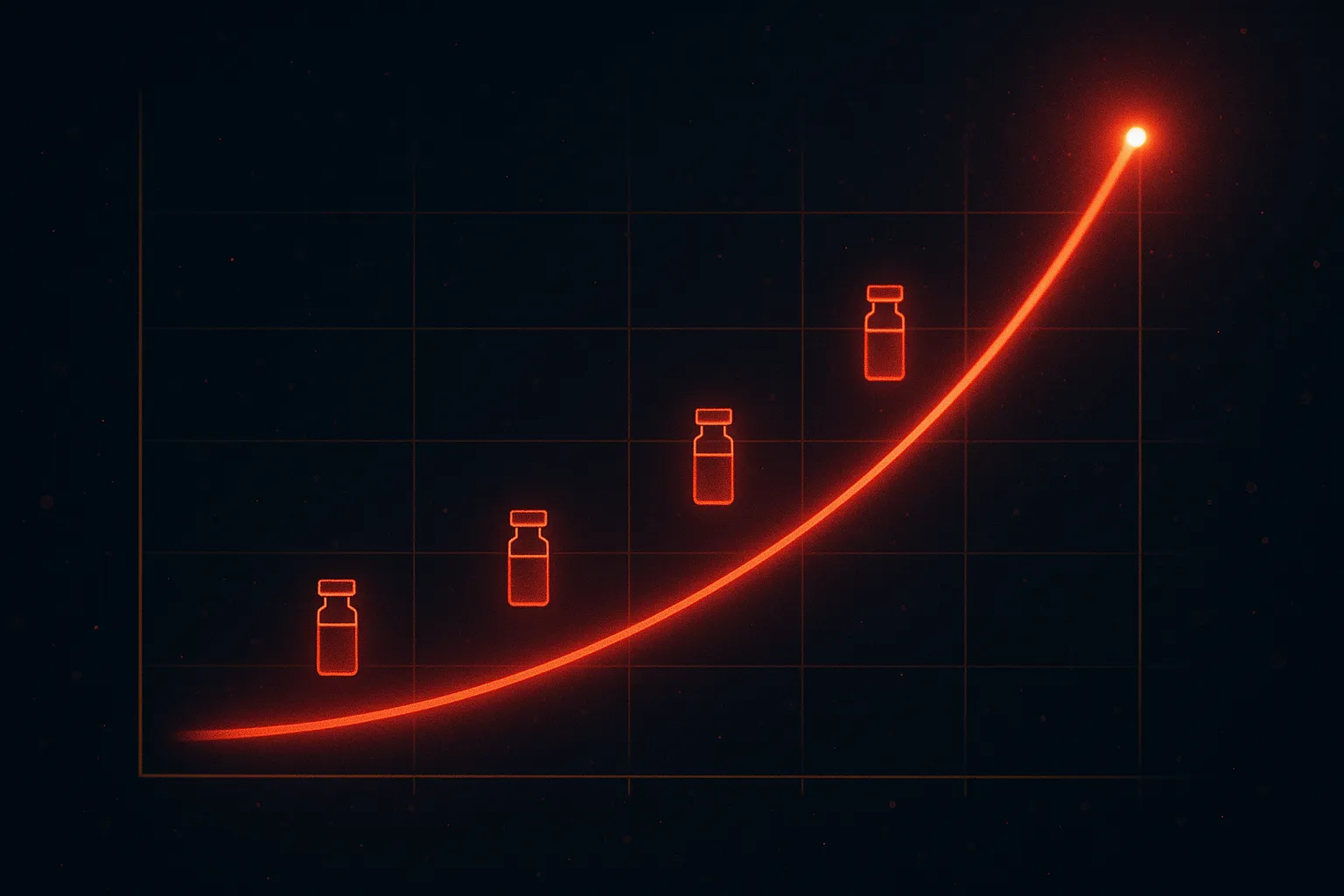
HCG results split into two tracks that move at very different speeds: testicular size and fullness tend to respond within a few weeks, while fertility effects unfold over months. The timeline below reflects what clinical studies documented and what community sources consistently report, separated so the trial data and the anecdotal reports never blur together.

Research-context information only. HCG (Human Chorionic Gonadotropin) is the active ingredient in FDA-approved products for hypogonadotropic hypogonadism and infertility; research-peptide and compounded forms are not FDA-approved and are sold for research purposes only. Protocols, doses, and reactions reported below come from clinical trials and community sources. This article reports what has been documented, not what should be done. Consult a licensed physician for personal medical decisions.

How fast results appear depends on the goal — testicular maintenance on testosterone therapy, axis restart in a post-cycle protocol, or fertility induction — plus baseline testicular volume, which studies identify as a predictor of response. For the protocols behind these timelines, see the HCG dosing guide.

Week 1

Little is visible in the first week, but the mechanism is already engaging. HCG binds Leydig-cell LH receptors and begins driving intratesticular testosterone; a 2005 controlled study (Coviello) showed low-dose HCG maintaining intratesticular testosterone within the dosing window even under gonadotropin suppression. Trial data (Coviello 2005) show serum testosterone can begin shifting within days. Community sources commonly report no outward change yet at this stage.

Weeks 2-4

This is where the most commonly reported subjective change appears. Community reports cluster around testicular fullness and size returning within two to four weeks, reflecting renewed Leydig-cell activity in tissue that had gone quiet on testosterone therapy. Serum testosterone and estradiol responses are typically measurable on bloodwork by this point, which is why protocols often schedule labs here to confirm the axis is responding and to check that estradiol has not climbed.
HCG week-by-week response

Months 1-2

For testicular maintenance on testosterone therapy, this stage is about stability rather than dramatic change — the testes stay active and full while testosterone continues. In the 2013 Hsieh study, men on testosterone plus low-dose HCG maintained semen parameters over follow-up, which is the "result" in the maintenance context: sperm production preserved rather than lost. In post-cycle use, community protocols expect the axis to show early signs of restart across these weeks.

Months 3-6+

Fertility outcomes belong to this longer window. In gonadotropin-therapy studies of hypogonadotropic men (Boeri 2021), HCG-based regimens — often combined with FSH — induced spermatogenesis in roughly 80% of patients and pregnancy in about half over a 12-24 month course. For men who added HCG to a testosterone protocol to protect fertility, this is the period over which preserved semen parameters translate into real-world fertility. Testicular support itself persists only as long as HCG is continued.

Ready to buy? Compare the three recommended HCG vendors and per-vial pricing in our HCG buying guide, or browse all coupon codes for up to 50% off.
Top HCG (Human Chorionic Gonadotropin) Vendors

Ranked by price, COA availability, and reputation

1
Ascension PeptidesCOA
10/10
5000 IU
2
Swiss ChemsCOA
9/10
5000 IU

Factors That Affect Results

  • Baseline testicular volume — studies report larger pretreatment volume predicts faster spermatogenesis response (Boeri 2021).
  • Dose and frequency — low, frequent IU dosing is described as steadier; large, infrequent doses can spike estradiol via aromatization.
  • Use case — maintenance, PCT, and fertility induction have fundamentally different timelines and endpoints.
  • Concurrent testosterone — on testosterone therapy, HCG maintains function but the natural axis stays suppressed until testosterone stops.
  • Estradiol management — unmanaged estradiol is the most-cited reason community users report feeling worse rather than better.

By Use Case

  • Testicular maintenance (on TRT): fullness back in ~2-4 weeks (community-reported); semen parameters preserved over months (Hsieh 2013).
  • Fertility induction (hypogonadotropic hypogonadism): spermatogenesis over 12-24 months in ~80% of men (Boeri 2021).
  • Post-cycle / axis restart: early restart signs over weeks; community-reported schedules, not trial-validated.

When Protocols Adjust

Documented protocols adjust on bloodwork, not feel. Testosterone and estradiol levels a few weeks in tell whether the dose is doing what it should; rising estradiol symptoms or a flat testosterone response are what clinical protocols flag for medical review. Community sources consistently frame HCG as a compound to titrate carefully with labs rather than escalate by intuition.

30ml bacteriostatic water vial — 0.9% benzyl alcohol multi-dose
Bac Water Made for Peptides
Don't risk a $300 peptide on generic bac water.
Most cloudy reconstitutions trace back to one thing — and it isn't the peptide. Sterile, non-pyrogenic, 0.9% benzyl alcohol — formulated for peptide reconstitution, not repackaged from generic stock.
0.9% benzyl alcohol Made for peptides 30 mL multi-dose
See why our bac water doesn't ruin peptides
30ml from $18.75 · Ships fast · Code thepeptidecatalog

Frequently Asked Questions

How quickly does HCG restore testicular size?
Community reports commonly describe testicular fullness returning within two to four weeks of adding HCG, reflecting renewed Leydig-cell stimulation. The underlying rise in intratesticular testosterone begins earlier — a 2005 controlled study (Coviello) showed low-dose HCG maintaining it dose-dependently within the dosing window.
How long until HCG affects fertility?
Fertility effects unfold over months, not weeks. In gonadotropin-therapy studies of hypogonadotropic men (Boeri 2021), HCG-based regimens induced spermatogenesis over a 12-24 month course. For men on testosterone therapy, the 2013 Hsieh study reported preserved semen parameters with concurrent low-dose HCG rather than a rapid change.
When are testosterone changes measurable on bloodwork?
Serum testosterone responses to HCG are measurable within days to a couple of weeks. Because HCG stimulates the testes directly, protocols often check bloodwork a few weeks in to confirm the axis is responding, then adjust based on testosterone and estradiol levels.
What if nothing seems to change?
Testicular-support effects are partly internal (intratesticular testosterone) and won't always be obvious day to day. Community sources note that baseline testicular volume predicts response — larger volume tends to respond faster (Boeri 2021). Persistent non-response, or rising estradiol symptoms, is what protocols flag for medical review rather than self-escalation.
Do HCG results last after stopping?
It depends on the use case. On testosterone therapy, testicular support lasts only while HCG is continued, because testosterone keeps suppressing the natural LH signal. In fertility-induction or post-cycle use, the goal is to restart the axis so it can eventually sustain itself, which is why those protocols are time-limited.

References

  1. Hsieh TC, Pastuszak AW, Hwang K, Lipshultz LI. Concomitant intramuscular human chorionic gonadotropin preserves spermatogenesis in men undergoing testosterone replacement therapy. J Urol. 2013;189(2):647-650. PMID: 23260550
  2. Coviello AD, Matsumoto AM, Bremner WJ, et al. Low-dose human chorionic gonadotropin maintains intratesticular testosterone in normal men with testosterone-induced gonadotropin suppression. J Clin Endocrinol Metab. 2005;90(5):2595-2602. PMID: 15713727
  3. Boeri L, Capogrosso P, Salonia A. Gonadotropin treatment for the male hypogonadotropic hypogonadism. Curr Pharm Des. 2021;27(24):2775-2783. PMID: 32445446