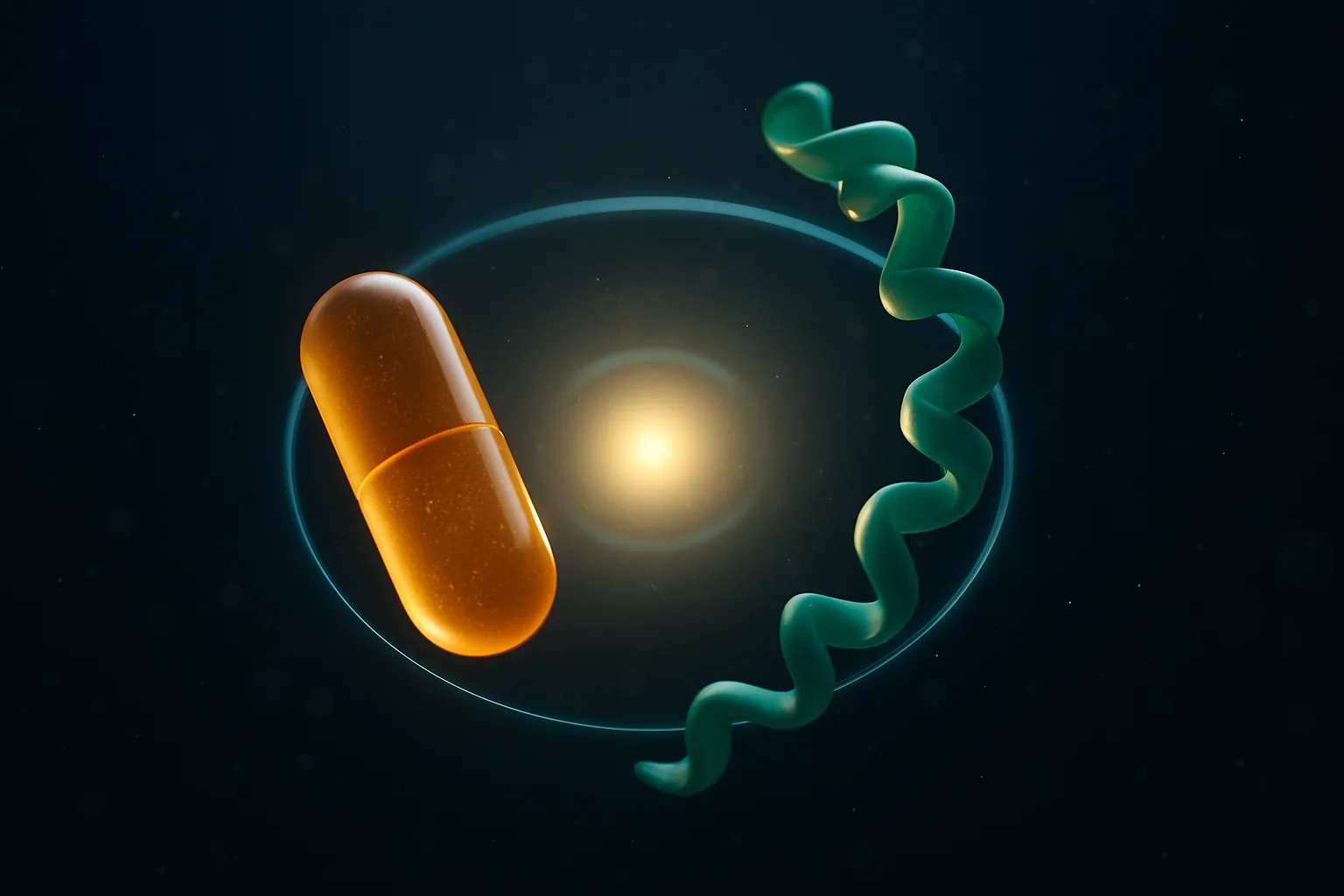
Orforglipron and retatrutide sit at opposite ends of the next-generation weight-loss field, and the honest version of this comparison starts by admitting they are not really competing for the same job. Orforglipron is a once-daily pill you swallow; retatrutide is a compound you inject. One is FDA-approved and manufactured at pharmaceutical scale; the other is still in trials.
The efficacy numbers also point in one clear direction. Across their separate trials, retatrutide reported roughly twice the peak weight loss of orforglipron. So the interesting question is not "which loses more weight" — retatrutide's trial figure is markedly higher — but whether orforglipron's oral convenience and manufacturing scale outweigh a lower ceiling. This article lays out what each has actually shown.
Research-context information only. Orforglipron is FDA-approved under the brand name Foundayo for chronic weight management; any discussion here of research-chemical or grey-market forms refers to material that is not FDA-approved and is sold for research purposes only. Retatrutide is an investigational drug not approved by the FDA. Protocols, doses, and reactions reported below come from published clinical trials and self-reported community sources. Possession or use of investigational drugs outside an authorized clinical trial may be illegal in your jurisdiction. This article reports what has been documented, not what should be done. Consult a licensed physician for personal medical decisions.
Side-by-side evidence
Outcomes where both peptides have published data. Each cell carries two grades: clinical evidence (human-RCT depth for this specific outcome) and community evidence (real-world adoption). How we grade evidence.
| Outcome | Orforglipron | Retatrutide |
|---|---|---|
| Body weight reduction | Clinical:Strong Community:Moderate ~12.4% weight loss at 72 weeks (ATTAIN-1, 36 mg oral). | Clinical:Moderate Community:Strong ~24.2% weight loss at 48 weeks (Phase 2 obesity, 12 mg injectable). |
| Glycemic control (HbA1c) | Clinical:Strong Community:Moderate HbA1c −1.5 to −1.8% in Phase 3 T2D trials (ACHIEVE-1, ATTAIN-2). | Clinical:Moderate Community:Strong Strong HbA1c reductions in Phase 2 T2D; full Phase 3 glycemic data pending. |
| Mechanism breadth | Clinical:Strong Community:Moderate Single GLP-1 receptor agonist (small molecule). | Clinical:Moderate Community:Strong Triple agonist (GLP-1 + GIP + glucagon) — broadest mechanism. |
| Route & convenience | Clinical:Strong Community:Moderate Once-daily oral pill — no injection, no reconstitution, no food/water timing. | Clinical:Moderate Community:Strong Subcutaneous injection requiring reconstitution. |
| Regulatory status | Clinical:Strong Community:Moderate FDA-approved for chronic weight management (2026); T2D filing pending. | Clinical:Preliminary Community:Strong Investigational — Phase 3 ongoing, not yet FDA-approved. |
Quick Verdict
For maximum weight loss: Retatrutide's Phase 2 trial reported up to 24.2% mean weight loss at 12 mg over 48 weeks. Orforglipron's ATTAIN-1 trial reported up to 12.4% at 36 mg over 72 weeks. Those come from separate trials, but the gap is large enough that retatrutide is clearly the stronger compound on documented weight loss.
For convenience and access: Orforglipron is a once-daily oral tablet with no injection, no reconstitution, and no cold-chain storage — and it is FDA-approved and manufactured at scale. Retatrutide is an injectable still confined to trials and the research-chemical market.
For mechanism: Orforglipron activates a single receptor (GLP-1). Retatrutide activates three (GLP-1, GIP, and glucagon). The efficacy gap tracks the mechanism gap.
Quick Comparison Table
| Orforglipron | Retatrutide | |
|---|---|---|
| Format | Oral tablet, once daily | Subcutaneous injection |
| Mechanism | Single GLP-1 agonist (small molecule) | Triple GLP-1 / GIP / glucagon agonist |
| Peak trial weight loss | 12.4% (36 mg, 72 wk, ATTAIN-1) | 24.2% (12 mg, 48 wk, Phase 2) |
| Regulatory status | FDA-approved 2026 (Foundayo) | Investigational, in Phase 3 |
| Reconstitution / injection | None | Required |
| Manufacturing | Chemically synthesized, scalable | Peptide, injectable-fill limited |
Every figure in that table comes from the trials cited below, and the two weight-loss numbers are drawn from different studies — see the efficacy section for why that matters.
Mechanism of Action

Orforglipron — oral single GLP-1 agonist
Orforglipron is a non-peptide small molecule that activates the GLP-1 receptor, the same receptor targeted by first-generation incretin drugs. Because it is a small molecule rather than a peptide, it is chemically synthesized, survives oral absorption, and does not require the cold-chain handling or injectable fill that peptide drugs do.
Reported oral bioavailability is around 30-40%, with a half-life long enough (roughly 24-38 hours) to support once-daily dosing. It carries no food or water timing restrictions. Being non-peptide, it is expected not to provoke the immune response peptides sometimes can. The practical translation: a pill taken any time of day, no reconstitution, no needles.
Retatrutide — injectable triple agonist
Retatrutide activates three receptors at once: GLP-1 and GIP (the same two tirzepatide targets) plus glucagon. The glucagon arm is the addition that distinguishes it, engaging energy expenditure and fat oxidation pathways that GLP-1 activity alone does not directly drive.
That third pathway is the mechanistic explanation most often offered for retatrutide's larger weight-loss figures. It is a peptide delivered by subcutaneous injection, which is why it carries reconstitution and cold-chain requirements orforglipron does not.
The core difference: one receptor versus three, and a pill versus an injection. The efficacy data below lines up with that split.
Efficacy Comparison
Direct head-to-head trials of these two compounds have not been conducted, so everything here is an indirect cross-trial comparison — different trials, different populations, different durations. The figures should be read as what each compound reported in its own study, not as a measured margin between them.
Orforglipron — ATTAIN-1 (NEJM 2025)
ATTAIN-1 studied orforglipron over 72 weeks in 3,127 adults with obesity (no diabetes required):
- Weight loss by dose: 6 mg reported 7.8%, 12 mg reported 9.3%, and 36 mg reported 12.4% (about 27.3 lb), versus 0.9% on placebo.
- Responder rates at 36 mg: 59.6% of subjects reached at least 10% weight loss, and 39.6% reached at least 15%.
Retatrutide — Phase 2 (NEJM 2023)
Retatrutide's Phase 2 obesity trial studied it over 48 weeks in adults with obesity:
- Peak weight loss: the trial reported up to 24.2% mean weight loss at the 12 mg dose at 48 weeks.
Cross-trial snapshot
| Metric | Orforglipron (36 mg) | Retatrutide (12 mg) |
|---|---|---|
| Peak reported weight loss | 12.4% | 24.2% |
| Trial duration | 72 weeks | 48 weeks |
| Delivery | Oral tablet | Injection |
| Regulatory status | FDA-approved | Investigational |
For context on where these land against the dual agonist between them, tirzepatide's SURMOUNT-1 trial reported roughly 20.9-22.5% weight loss at 15 mg over 72 weeks. Lined up, the three compounds fall in mechanism order — single, dual, then triple agonism — which is the clearest way to read the efficacy spread. Orforglipron's differentiator is not peak weight loss; it is being an approved, scalable oral option.
Side Effects
Both compounds share the gastrointestinal profile characteristic of GLP-1 receptor activation — nausea, vomiting, diarrhea, and constipation, generally dose-dependent and most pronounced during titration.
Orforglipron's ATTAIN-1 trial quantified this at the 36 mg dose versus placebo: nausea 33.7% vs 10.4%, vomiting 24.0% vs 3.5%, diarrhea 23.1% vs 9.6%, constipation 25.4% vs 9.3%, and dyspepsia 14.1% vs 5.0%. Adverse-event discontinuation ran to about 10.3% at the top dose versus 2.6% on placebo. Through Phase 1-2, no clinically meaningful liver-enzyme signal was reported, and no pancreatitis or retinal signal has emerged to date, with post-approval monitoring ongoing.
Retatrutide's trials likewise reported GI-dominant adverse events consistent with its GLP-1 component. Because the two compounds were studied in different trials, their side-effect rates are not directly comparable. For the full per-compound picture, see Retatrutide Side Effects.