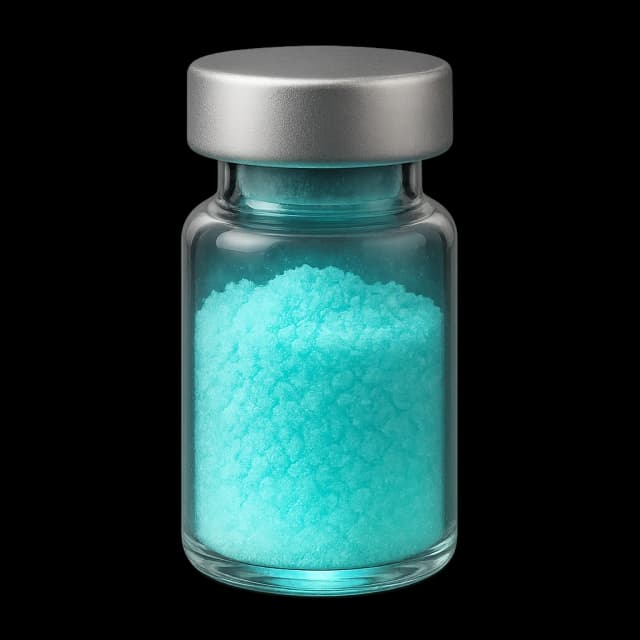
P-21 has no clinically established human dose. It has never been studied in a human clinical trial, so the figures that circulate come from vendor listings and community discussion rather than pharmacokinetic data. The number referenced most often is roughly 500 mcg to 1 mg once daily, with a broader cited range of about 100 mcg to 2 mg per day, typically reconstituted from a lyophilized vial and dosed subcutaneously or intranasally.
That figure is real and widely circulated, but it is anecdotal and vendor-derived, not trial-validated. P-21's entire evidence base is preclinical rodent work — much of it from the lab that created the compound — and there is a notable mismatch between how those studies dosed it (oral and peripheral) and how community sources describe taking it (subcutaneous and intranasal).
Research-context information only. P-21 is a research peptide. Protocols, doses, and reactions reported below come from published research and self-reported community sources. This article reports what has been documented, not what should be done. Consult a licensed physician for personal medical decisions.
P-21 (P021) is a synthetic adamantane-modified tetrapeptide (Ac-DGGLAG-NH2) derived from the active region of ciliary neurotrophic factor (CNTF). This guide reports the dose figures community sources reference, the route mismatch, and the all-preclinical evidence behind both — not a recommended protocol.
Quick Reference: Protocol
There is no standard protocol to publish here, because no human trial has defined one. The table below reports the figures that appear in vendor listings and community discussion. Every value is anecdotal and vendor-derived, not a recommendation.
| Parameter | Community/vendor-reported figure | Source class |
|---|---|---|
| Typical daily figure | ~500 mcg-1 mg, once daily | Vendor copy + community reports |
| Broader cited range | ~100 mcg-2 mg/day | Vendor copy + community reports |
| New-user references | ~250-500 mcg (lower end) | Community reports |
| Timing | Morning (to avoid sleep disruption) | Community convention |
| Cycle length | 4-8 weeks, with time off | Community convention |
These are microgram-to-low-milligram figures — far below the milligram ranges seen with some other nootropic peptides. The "dose in the morning" advice is itself community convention: a subset of users report overstimulation or sleep disruption with higher doses or later-day dosing. None of these numbers derives from human pharmacokinetic data, and no human safety data backs any cycle duration.
Routes of Administration
Community discussion and the preclinical literature diverge on route, with no human pharmacokinetic data to reconcile them.
- Subcutaneous injection: The route community sources most often describe. Because P-21 ships as a lyophilized vial, this involves reconstituting with bacteriostatic water like a standard injectable peptide. Injection-site reactions are the generic risk for any reconstituted subcutaneous peptide.
- Intranasal: Also mentioned in community sources. Users describe local irritation as a non-specific anecdotal complaint.
- Oral / peripheral (preclinical): The rodent studies demonstrated efficacy with oral and peripheral administration. Community human use skews subcutaneous and intranasal instead — a route mismatch worth flagging, since the demonstrated animal data does not map onto the route people report using.
Frequency is usually described as once daily, in the morning.
Ready to buy? The single research-grade, COA-checked P-21 source we track: