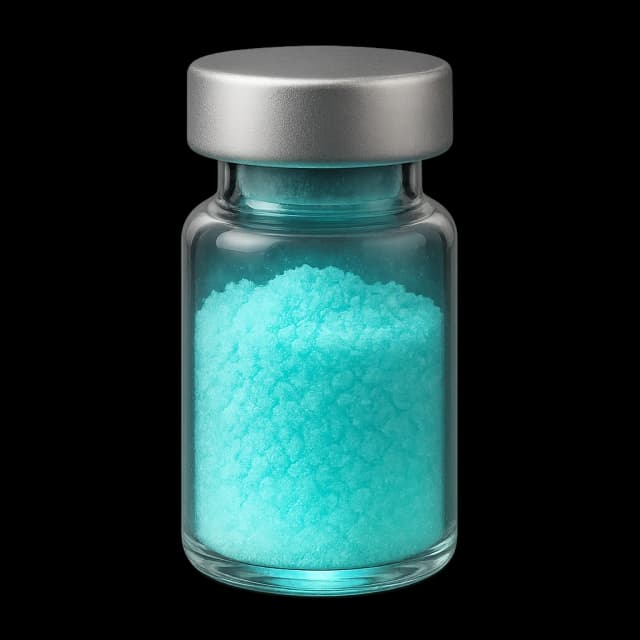
P-21 ships as a 5 mg lyophilized (freeze-dried) vial, so anyone following the subcutaneous route community sources describe has to reconstitute it with bacteriostatic water first — the same mechanical step as any injectable peptide. The math itself is simple: the volume of water you add sets the concentration, and the concentration sets how many units you draw for a given microgram target. What is not simple is the dose, because P-21 has no human trial and therefore no validated figure to aim for.
The number community and vendor sources reference most is roughly 500 mcg to 1 mg once daily, with a broader cited range of about 100 mcg to 2 mg per day. This guide reports how a 5 mg vial maps onto that range so the syringe math is clear — it is not a recommended protocol, and the underlying dose is anecdotal, not trial-validated.
Research-context information only. P-21 is a research peptide. Protocols, doses, and reactions reported below come from published research and self-reported community sources. This article reports what has been documented, not what should be done. Consult a licensed physician for personal medical decisions.
P-21 (P021) is a synthetic adamantane-modified tetrapeptide (Ac-DGGLAG-NH2) derived from the active region of ciliary neurotrophic factor (CNTF). Its entire evidence base is preclinical rodent work — much of it from the lab that created the compound — and there is a notable mismatch between how those studies dosed it (oral and peripheral) and how community sources describe taking it (subcutaneous and intranasal).
New to bacteriostatic water? Start with what it is, how much to use per vial, and how long it lasts — or see the full Bacteriostatic Water Guide.
What You Need
The materials are the standard injectable-peptide handling kit. Nothing here is P-21-specific:
- The 5 mg lyophilized P-21 vial
- Bacteriostatic water (0.9% benzyl alcohol) — not sterile water, not tap water. The benzyl alcohol is what allows multi-week refrigerated storage of the reconstituted vial.
- A 3 mL reconstitution syringe for adding the water
- U-100 insulin syringes for drawing doses
- Alcohol swabs and a sharps container

Step-by-Step Reconstitution
The sequence community sources describe for P-21 matches standard injectable-peptide handling:
- Both vials are brought to room temperature; stoppers are wiped with an alcohol swab.
- The chosen water volume is drawn into the reconstitution syringe (see the chart below for what each volume does to concentration).
- Water is injected slowly down the inside wall of the vial — aimed at the glass rather than the powder cake to reduce mechanical shearing.
- The vial is left to sit; the cake dissolves within a minute or two. Gentle swirling is used if needed. Shaking is avoided — agitation foams the solution.
- Once the solution runs clear, community sources describe refrigerating the vial immediately.
Dilution Chart
The table below shows how a 5 mg vial maps onto the community-referenced ~500 mcg and ~1 mg figures at three common water volumes. The 2 mL example row is the volume that keeps draw amounts in an easy-to-measure range — it is not a recommendation, since no human dose has been established.
Syringe Math
On a U-100 insulin syringe, 100 units equal 1 mL, so each unit is 0.01 mL. After reconstituting with 2 mL of bacteriostatic water, the 5 mg vial holds 2,500 mcg per mL:
- A ~500 mcg target is 0.2 mL — 20 units.
- A ~1 mg target is 0.4 mL — 40 units.
Add more water and each microgram target spreads across more units, which makes a small dose easier to draw accurately; add less and the draws shrink toward the bottom of the syringe where precision drops. The total amount of compound in the vial never changes with water volume — only the concentration does.
Ready to buy? The single research-grade, COA-checked P-21 source we track: