Glutathione is the most abundant intracellular antioxidant in the human body -- a tripeptide (glutamate-cysteine-glycine) produced in every cell. Published research documents age-related glutathione decline of 17-50% depending on tissue type (Lang et al., 1992), which has made exogenous supplementation one of the fastest-growing segments of the research-peptide and supplement markets. The problem is that most buyers get the purchase decision wrong before they even look at vendors.
The single biggest factor in glutathione supplementation is not which vendor you choose -- it is which delivery form you buy. Standard oral glutathione capsules are largely destroyed by gut enzymes before reaching systemic circulation. Published pharmacokinetic data show IV glutathione raises plasma levels roughly 47-fold above baseline (Aebi et al., 1991), while standard oral capsules produce minimal measurable change. This guide covers how to choose the right form for your goals, what a real COA proves, what you should pay per milligram, and the red flags that signal a product to avoid.
Research-context information only. Glutathione is a research peptide. Protocols, doses, and reactions reported below come from published research and self-reported community sources. This article reports what has been documented, not what should be done. Consult a licensed physician for personal medical decisions.
This is not a ranked vendor list -- for that, see our Best Glutathione Vendors comparison. This guide teaches you how to evaluate any glutathione product yourself.
Quick Reference: What to Look For
| Factor | What to Check | Why It Matters |
|---|---|---|
| Form | Injectable, buccal, liposomal, or standard oral | Bioavailability differs by 10-50x between forms |
| Active form | Reduced glutathione (GSH), not oxidized (GSSG) | GSSG is the spent form; GSH is biologically active |
| Purity | 97%+ by HPLC on third-party COA | Lower purity means degradation products or contaminants |
| Molecular weight | 307.32 Da confirmed by mass spectrometry | Confirms the product is glutathione, not a precursor |
| Endotoxin testing | Required for injectable product | Endotoxins cause fever and inflammation if injected |
| Storage | Lyophilized (shelf-stable); reconstituted requires refrigeration | Glutathione degrades rapidly in solution at room temperature |
| Third-party COA | Janoshik, MZ Biolabs, or Colmaric Analyticals | In-house testing alone is insufficient for injectable product |
Choosing the Right Form: The Decision That Matters Most
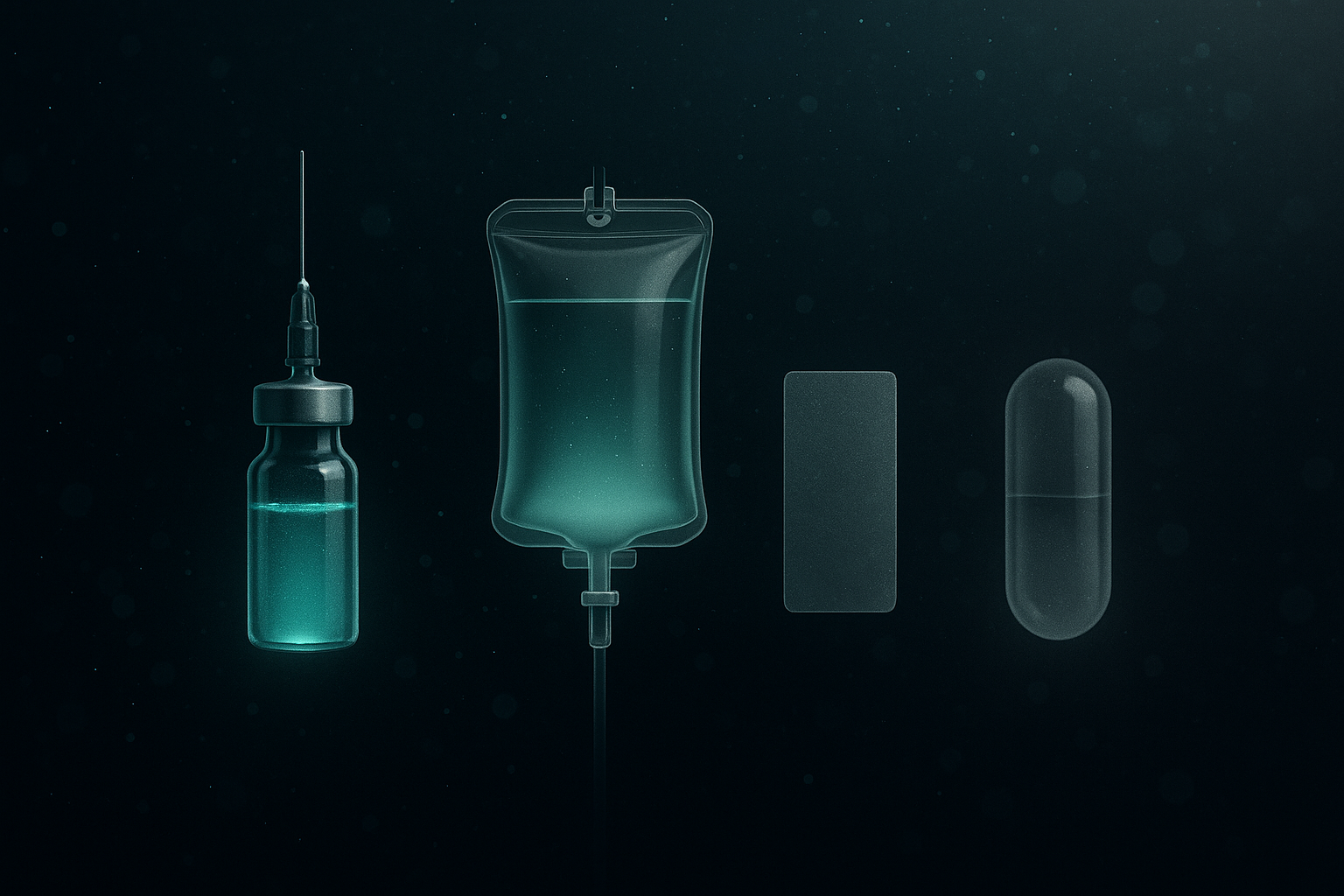
This is where most buyers either get it right or waste their money. Each delivery form has a distinct bioavailability profile, cost structure, and practical trade-off. Published research directly compares several of these routes (Schmitt et al., 2015).
Injectable (IM/SubQ) -- Highest Non-IV Bioavailability
Lyophilized glutathione powder reconstituted with bacteriostatic water and injected intramuscularly or subcutaneously. This is the standard research-peptide form.
Strengths:
- High bioavailability -- bypasses gut degradation entirely
- Community-reported dose range of 200-600 mg per injection, 2-3 times per week
- Cost-effective at scale ($0.03-0.15/mg from research vendors)
- Self-administered at home once reconstituted
Limitations:
- Requires reconstitution and injection supplies (syringes, bacteriostatic water, alcohol swabs)
- Reconstituted solution must be refrigerated and used within 28 days
- Not suitable for needle-averse individuals
Best for: Users who want the highest-bioavailability home-use option and are comfortable with injection protocols. This is the dominant form in the research-peptide market.
Buccal/Sublingual Strips -- Best Non-Injectable Option
Orobuccal formulations dissolve on the inner cheek or under the tongue, absorbing through the oral mucosa directly into the bloodstream. Published research documented measurable blood glutathione elevation within 30-60 minutes of buccal administration (Buonocore et al., 2015).
Strengths:
- No injection required -- dissolves in the mouth in 15-30 minutes
- Bypasses intestinal GGT degradation (the enzyme that destroys oral glutathione)
- Published crossover trial showed sublingual GSH produced higher plasma GSH levels and GSH/GSSG ratio than standard oral GSH or NAC (Schmitt et al., 2015)
- Convenient for daily maintenance protocols
Limitations:
- Lower peak plasma levels compared to injectable or IV routes
- Dose per strip typically limited to 100-250 mg
- Higher cost per mg than lyophilized injectable powder
- Fewer research vendors offer this form
Best for: Users who want meaningful bioavailability without needles, or as a daily maintenance complement to less-frequent injectable protocols.
Liposomal Oral -- Protected Oral Delivery
Liposomal encapsulation wraps glutathione in a phospholipid layer that protects it from GGT degradation in the gut. Published research documented that liposomal glutathione at 500-1000 mg daily elevated blood glutathione stores over 1-6 months in healthy adults (Sinha et al., 2018).
Strengths:
- No injection, no special administration -- swallow a capsule or liquid
- Meaningfully better absorption than standard oral glutathione
- Widely available from supplement vendors
- Published clinical data supporting efficacy
Limitations:
- Still lower bioavailability than injectable or buccal routes
- Liposomal quality varies dramatically between manufacturers -- the lipid encapsulation must actually survive stomach acid
- Higher doses required (500-1000 mg/day) compared to injectable (200-600 mg, 2-3x/week)
- More expensive per effective milligram than injectable when adjusted for bioavailability
Best for: Users who want the convenience of an oral supplement with better absorption than standard capsules. A reasonable entry point for those exploring glutathione supplementation before committing to injectable protocols.
Standard Oral Capsules -- Lowest Bioavailability
Standard reduced glutathione capsules taken orally. This is the cheapest and most widely available form, but also the least effective per milligram.
Strengths:
- Cheapest absolute cost per mg
- Available at any supplement retailer
- A randomized controlled trial documented that oral glutathione at 250-1000 mg/day for 6 months did increase blood GSH levels (Richie et al., 2015)
- No special handling or reconstitution
Limitations:
- Extensive first-pass metabolism -- GGT in the intestinal brush border cleaves the tripeptide before absorption
- Requires higher doses (500-1000 mg/day) sustained over months to produce measurable changes
- Plasma elevation is modest compared to injectable, IV, or even buccal routes
- Cost per effective milligram (adjusted for bioavailability) is actually higher than injectable
Best for: Users who want the simplest possible supplementation and are willing to accept lower bioavailability. More useful as a long-term baseline than an acute repletion strategy.
IV Infusion -- Highest Peak Levels, Clinic Setting
Intravenous glutathione administered by healthcare providers, typically 600-2000 mg per session.
Strengths:
- Highest possible bioavailability -- 47-fold plasma elevation documented (Aebi et al., 1991)
- No absorption or bioavailability concerns
- Often combined with IV vitamin C in functional medicine settings
Limitations:
- Requires clinical supervision -- cannot be self-administered
- Most expensive option ($150-500 per session)
- Short plasma half-life (~14 minutes) means peak levels are transient
- Weekly or biweekly visits required for sustained protocols
Best for: Users who prefer clinic-supervised protocols or need acute glutathione repletion. Not practical as a sole long-term strategy for most people due to cost and logistics.
Form Comparison Summary
| Form | Bioavailability | Typical Dose | Frequency | Monthly Cost | Convenience |
|---|---|---|---|---|---|
| IV infusion | Highest | 600-2000 mg/session | Weekly-biweekly | $600-2000+ | Clinic visits |
| Injectable (IM/SubQ) | High | 200-600 mg | 2-3x/week | $30-90 | Home use, requires injection |
| Buccal/sublingual | Moderate-high | 100-250 mg/strip | Daily | $60-150 | Dissolve in mouth |
| Liposomal oral | Moderate | 500-1000 mg | Daily | $40-120 | Swallow capsule/liquid |
| Standard oral | Low | 500-1000 mg | Daily | $15-50 | Swallow capsule |
Understanding Glutathione Pricing
Glutathione pricing varies dramatically by form, and comparing across forms requires adjusting for bioavailability. A $15/month oral capsule that delivers minimal systemic glutathione is not cheaper than a $60/month injectable that delivers substantially more.
Research-Grade Injectable Pricing (2026)
| Vial Size | Typical Price Range | Price Per mg | Approximate Supply |
|---|---|---|---|
| 200 mg | $8-25 | $0.04-0.13/mg | 1 injection at standard dose |
| 500 mg | $15-45 | $0.03-0.09/mg | 1-2 injections |
| 1000 mg (1g) | $25-75 | $0.01/mg | 2-5 injections |
| 2000 mg (2g) | $40-120 | $0.02-0.06/mg | Best value for sustained protocols |
Cost at common protocols:
| Protocol | Weekly Use | Monthly Cost (1g vials) |
|---|---|---|
| 200 mg, 2x/week | 400 mg | $12-32/month |
| 200 mg, 3x/week | 600 mg | $18-48/month |
| 400 mg, 3x/week | 1200 mg | $36-96/month |
For current vendor-specific pricing with exact $/mg breakdowns, see our Best Glutathione Vendors comparison or Compare Glutathione Prices.