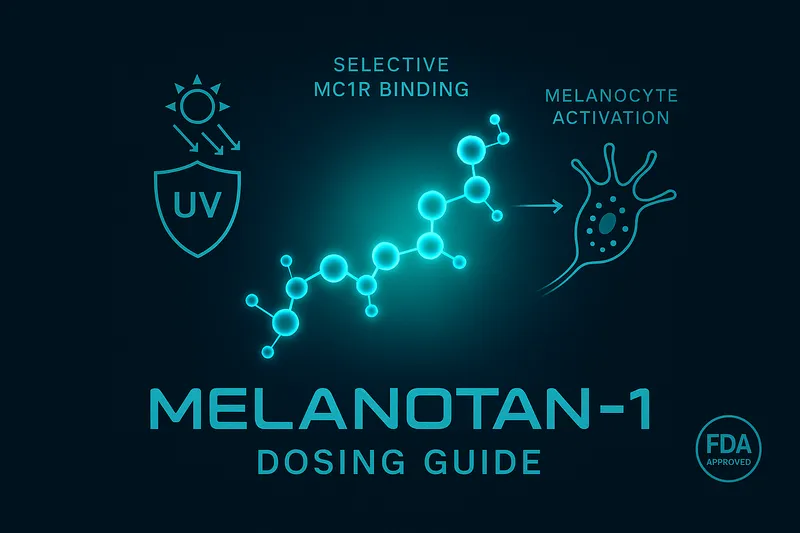
Melanotan-1 (afamelanotide) is a synthetic analog of alpha-MSH that stimulates melanin production for photoprotection. FDA-approved for erythropoietic protoporphyria (EPP) as a subcutaneous implant. Community protocols extrapolate from this clinical data. This is not medical advice.
Research-context information only. Melanotan-1 (afamelanotide) is the active ingredient in an FDA-approved product for erythropoietic protoporphyria (EPP); research-peptide and injectable forms are not FDA-approved and are sold for research purposes only. Protocols, doses, and reactions reported below come from clinical trials and community sources. This article reports what has been documented, not what should be done. Consult a licensed physician for personal medical decisions.
Melanotan-1 Dosing Table
Match your vial size below — reconstitution and dose math update automatically.
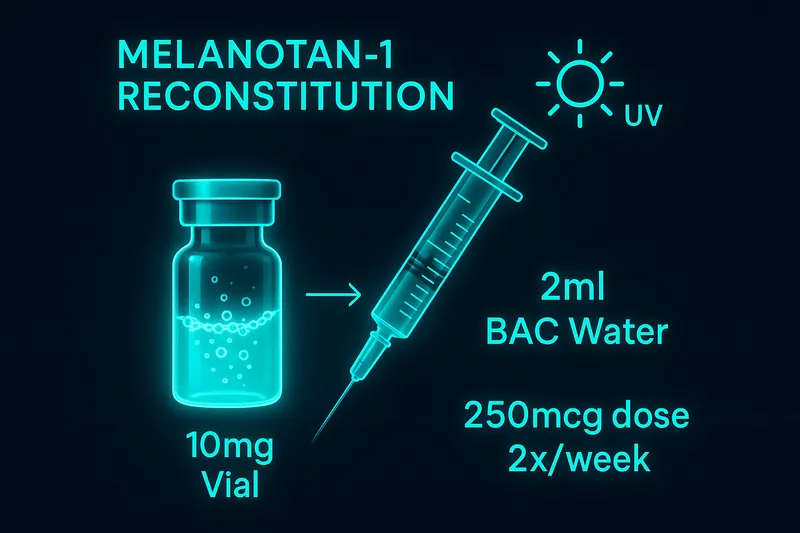
Reconstitute: add 2 mL of bacteriostatic water to the 10 mg vial. Resulting concentration: 5 mg/mL.
Dose
Syringe units
mL volume
Schedule
250 mcg
5 units
0.05 mL
2x/week SubQStandard tanning protocol
500 mcg
10 units
0.1 mL
2x/week SubQAdvanced loading
250 mcg5 units · 0.05 mL
2x/week SubQ
Standard tanning protocol
500 mcg10 units · 0.1 mL
2x/week SubQ
Advanced loading
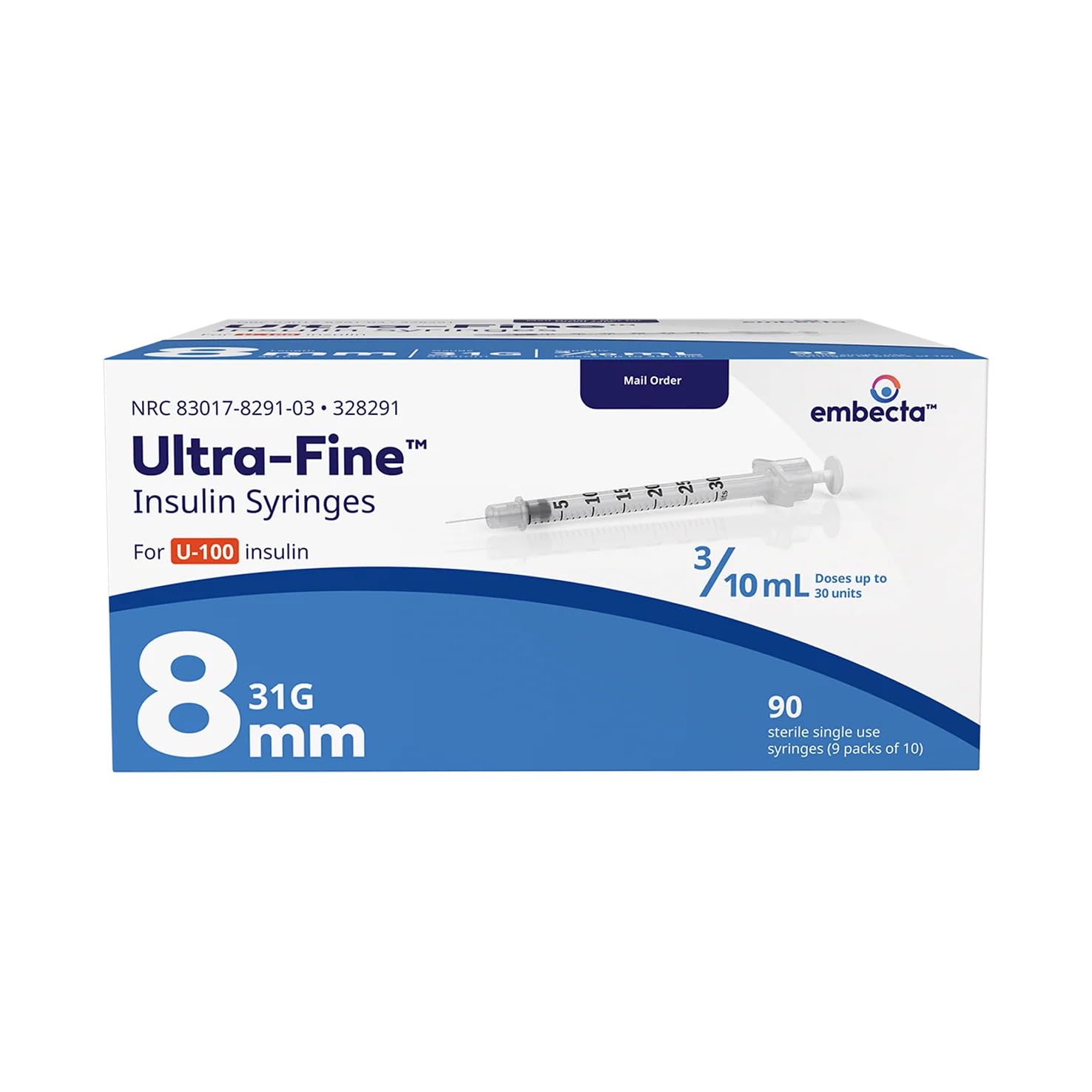
Math assumes U-100 insulin syringes (1 mL = 100 units). Verify your syringe matches before injecting. Round half-units to the nearest visible mark.
Quick Reference: Loading + Maintenance
Parameter
Loading (tolerance phase)
Maintenance
Dose
~50 mcg (1 unit)
250 mcg (5 units)
Frequency
Once daily, ~7 days or until color
2×/week, or 1×/week by sun exposure
Route / timing
Subcutaneous, AM
Subcutaneous, AM
Vial size
10 mg
10 mg
Reconstitution
2 mL BAC water (5,000 mcg/mL)
2 mL BAC water (5,000 mcg/mL)
Storage
Refrigerate, use within 28 days
Refrigerate, use within 28 days
These figures reflect community-reported protocols, not a recommended schedule. Units assume the standard 10 mg / 2 mL reconstitution (5,000 mcg/mL), where 1 unit on a U-100 insulin syringe = 50 mcg and 250 mcg = 5 units.
UV stimulation — Community protocols and clinical data describe 15–30 minutes of daily UV exposure during loading as necessary for melanin response. MT-1 amplifies UV response rather than independently darkening skin.
Cycling Details
Community protocols have shifted toward starting low and building up rather than front-loading a full dose. The pattern most often described now has two phases:
Loading / tolerance phase: roughly 50 mcg — 1 unit on a U-100 insulin syringe at the standard 10 mg / 2 mL reconstitution — subcutaneously once daily for about 7 days in a row, or until noticeable color begins to appear. Community sources describe this low daily dose as a way to assess tolerance first and build eumelanin gradually, paired with short, gradually increasing daily UV exposure (15-30 minutes).
Maintenance phase: once color develops, protocols describe dropping to 250 mcg (5 units) twice per week — or once per week depending on sun exposure, with more sun meaning less frequent dosing — while continuing regular UV to hold the tan.
This ramp mirrors the natural tanning curve, where melanin density builds over the first couple of weeks before plateauing (Langendonk et al., 2015). Users commonly self-report running it seasonally: several weeks before summer, or a few weeks pre-vacation.
Routes of Administration
Subcutaneous (standard): abdomen or love handle area. Community sources describe rotating sites and using a 29-31 gauge insulin syringe. Volume is typically 0.05 mL per injection, with morning injections most commonly reported.
Subcutaneous implant (clinical only): FDA-approved 16 mg biodegradable implant every 60 days for EPP patients. Not available for community use.
Not effective: Oral (degraded by stomach acid), nasal (no protocols), topical (molecule too large).
Bac Water Made for Peptides50% off
Don't risk a $300 peptide on generic bac water.
Most cloudy reconstitutions trace back to one thing — and it isn't the peptide. Sterile, non-pyrogenic, 0.9% benzyl alcohol — formulated for peptide reconstitution, not repackaged from generic stock.
✓ 0.9% benzyl alcohol✓ Made for peptides✓ 30 mL multi-dose
Affiliate disclosure: vendor links in this article are affiliate links — The Peptide Catalog may earn a commission if you buy through them, at no additional cost to you.
Where These Numbers Come From
Community dosing is extrapolated from FDA-approved clinical data and early trials.
Afamelanotide is FDA-approved for EPP at 16 mg subcutaneous implant every 60 days — roughly 2 mg/day of continuous release (Langendonk et al., 2015). Phase II trials in healthy volunteers used 0.16 mg/kg subcutaneous injections with dose-dependent skin darkening (Barnetson et al., 2006).
The community's 250 mcg twice weekly (0.5 mg/week, ~70 mcg/day equivalent) is conservative compared to clinical data (FDA implant ~14 mg/week), and the newer ~50 mcg/day loading dose is lower still. Community sources report that these lower doses still produce melanogenesis when combined with UV exposure, with fewer reported side effects than clinical-dose levels.
Stacking Protocols
Stack
MT-1 Dose
Partner
Partner Dose
Purpose
UV exposure
250 mcg 2x/wk
Gradual UV
10-30 min/day
Essential combination
Antioxidants
250 mcg 2x/wk
Astaxanthin + Vit C
4-8 mg + 1000 mg
Photoprotection support
Community sources describe MT-1 and MT-2 as a poor pairing — adding MT-2 increases side effects without proportional benefits, and MT-1's selectivity for MC1R is described as its advantage.
Side Effects & Safety
Injection site redness — lasting 30-60 minutes, mild
Mole/freckle darkening — gradual, may complicate skin cancer monitoring
Mild fatigue — uncommon, on injection days
Mild nausea — much less than MT-2
No nausea/vomiting at standard doses (MT-1 doesn't significantly activate MC4R)
No libido effects — limited CNS penetration unlike MT-2
No appetite suppression — doesn't affect feeding centers
Excessive UV caution — false confidence may lead to overexposure
mg to Units Conversion
On a standard 100-unit insulin syringe, each "unit" equals 0.01 mL (so 100 units = 1 mL). Once Melanotan-1 is reconstituted, the conversion from a target dose to syringe units depends on the chosen dilution.
The two reconstitution ratios most often described in community protocols are below.
Reconstitution A: 10 mg vial + 2 mL BAC water (5 mg/mL) — the standard dilution from the Quick Reference above.
Dose (mcg)
Volume (mL)
Units (insulin syringe)
100 mcg
0.02 mL
2 units
250 mcg
0.05 mL
5 units
400 mcg
0.08 mL
8 units
500 mcg
0.1 mL
10 units
Reconstitution B: 10 mg vial + 5 mL BAC water (2 mg/mL) — more BAC water for larger, easier-to-measure draws.
Dose (mcg)
Volume (mL)
Units (insulin syringe)
100 mcg
0.05 mL
5 units
250 mcg
0.125 mL
12.5 units
400 mcg
0.2 mL
20 units
500 mcg
0.25 mL
25 units
These conversions reflect the dilutions documented in community reconstitution protocols. They report how the math is described, not a recommended dosing schedule.
Core Supplies for This Protocol
The essentials for running any reconstituted injectable: cold storage, accurate syringes, alcohol prep pads, and metabolic tracking.
Community protocols now describe a low-dose ramp: roughly 50 mcg (1 unit) subcutaneously once daily for about 7 days, or until color begins to appear, to assess tolerance and build eumelanin gradually — then 250 mcg (5 units) twice per week, or once weekly depending on sun exposure. From a 10 mg vial reconstituted with 2 mL BAC water (5,000 mcg/mL), 1 unit is 50 mcg and 250 mcg is 5 units.
Do I need UV exposure with Melanotan-1?
Community protocols and clinical data consistently describe UV stimulation as necessary for meaningful melanin response — without UV exposure, MT-1 produces minimal darkening. Unlike Melanotan-2, MT-1's mechanism operates primarily through UV-amplified melanogenesis rather than direct receptor saturation.
How long should a Melanotan-1 cycle last?
The community standard is 8 weeks on, 8 weeks off, with loading over 2-4 weeks to build melanin, then maintenance. Cycling is a community convention (cost, side-effect and mole-monitoring caution, not wanting to stay dark off-season) rather than a documented requirement — the long-term clinical data on afamelanotide, dosed repeatedly over up to 8 years, reports sustained efficacy without documented receptor desensitization. For ongoing light sensitivity, continuous or seasonal maintenance dosing is the documented clinical photoprotection model.
What do community sources describe about year-round Melanotan-1 use?
Community protocols often cycle (8 weeks on/off), but this is convention rather than an evidence-based requirement — clinical use of afamelanotide over years shows sustained efficacy with no documented receptor desensitization. Many users self-report running it seasonally before summer or tropical trips; for ongoing photoprotection in light-sensitive individuals, continuous maintenance dosing mirrors the clinical model (repeated implants year after year).
How do I reconstitute Melanotan-1?
Protocols describe adding 2 mL of bacteriostatic water to a 10 mg vial for a concentration of 5,000 mcg/mL. At that dilution 1 unit on an insulin syringe is 50 mcg (the daily loading dose) and a 250 mcg maintenance dose is 5 units. Reconstituted vials are typically stored refrigerated and used within 28 days.