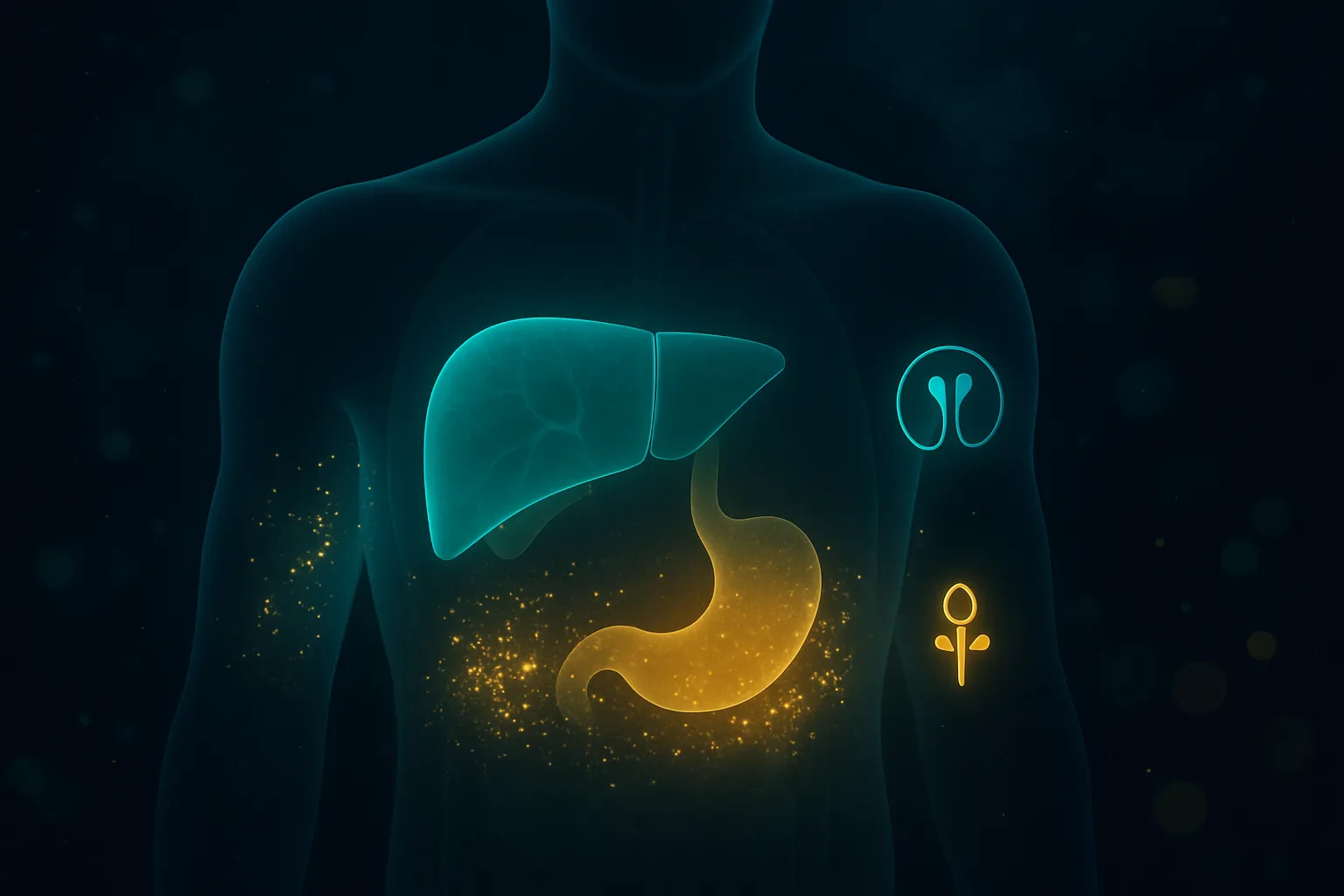
Survodutide is a dual glucagon/GLP-1 receptor agonist — and it's the glucagon component that makes the benefit profile distinct from semaglutide or tirzepatide. Here are six research-backed effects, ranked by the strength of clinical evidence.
Research-context information only. Survodutide is an investigational drug not approved by the FDA. Protocols, doses, and reactions reported below come from published clinical trials and self-reported community sources. This article reports what has been documented, not what should be done. Possession or use of investigational drugs outside an authorized clinical trial may be illegal in your jurisdiction. Consult a licensed physician for personal medical decisions.
Key Benefits at a Glance
Weight loss: Up to 18.7% body weight reduction in Phase 2 (46 weeks)
Liver fat clearance: 62% MASH improvement rate at the 4.8mg dose (Phase 2)
Glycemic control: Dose-dependent HbA1c reductions in T2D patients
Body composition: Dual mechanism targets fat loss from both intake and expenditure
Cardiovascular markers: Improvements in lipids, blood pressure, and inflammatory markers
Energy expenditure: Glucagon receptor activation increases metabolic rate
1. Weight Loss (Strongest Evidence)
Evidence level: Phase 2 randomized controlled trial in 387 participants
The Phase 2 obesity trial demonstrated dose-dependent weight loss over 46 weeks:
Over half of participants receiving 4.8mg achieved ≥15% body weight loss. The dual mechanism — appetite suppression via GLP-1 plus increased energy expenditure via glucagon — creates weight loss from both sides of the energy equation.
Practical significance: The 18.7% weight loss in completers approaches retatrutide's Phase 2 results and substantially exceeds semaglutide monotherapy.
This may be survodutide's most clinically significant benefit. In a dedicated Phase 2 trial for metabolic dysfunction-associated steatohepatitis (MASH, formerly NASH):
62% of participants on the 4.8mg dose achieved histologic improvement in MASH with no worsening of fibrosis (47% / 62% / 43% across the 2.4 / 4.8 / 6.0mg doses vs 14% placebo)
36% achieved improvement in fibrosis by at least one stage at 4.8mg (34% / 36% / 34% across doses vs 22% placebo)
Liver fat content decreased by ≥30% in the majority of treated participants
The glucagon receptor component is the key driver — glucagon directly stimulates hepatic lipid oxidation and reduces hepatic lipogenesis. Based on that 62% histologic-improvement rate reported in the Phase 2 MASH trial, survodutide ranks — alongside retatrutide — among the most effective pharmacological interventions studied for MASH to date.
3. Glycemic Control (Strong Evidence)
Evidence level: Phase 2 randomized trial in people with type 2 diabetes
In the T2D trial, survodutide produced dose-dependent HbA1c reductions:
Survodutide at the highest doses reduced HbA1c significantly more than placebo
Body weight decreased dose-dependently up to -8.7% (highest dose group)
Survodutide at doses ≥1.8mg weekly produced greater body weight reductions than open-label semaglutide 1mg
The dual mechanism provides glycemic control through complementary pathways: GLP-1 enhances glucose-dependent insulin secretion while glucagon paradoxically improves hepatic glucose metabolism by reducing liver fat.
10mg · sold research-use-only · we may earn a commission
4. Increased Energy Expenditure (Moderate Evidence)
Evidence level: Mechanistic data from preclinical studies + indirect human evidence
Unlike GLP-1-only drugs that primarily reduce caloric intake, survodutide's glucagon receptor activation increases the calories your body burns at rest. Glucagon signaling promotes:
Thermogenesis — direct heat production from fat oxidation
Hepatic energy expenditure — the liver burns more fat for fuel
Reduced metabolic adaptation — metabolism doesn't slow down as aggressively during weight loss
This is reflected in the clinical data: the weight loss exceeds what would be expected from appetite suppression alone, suggesting meaningful contributions from the energy expenditure side.
Evidence level: Secondary endpoints from Phase 2 trials
Across survodutide trials, improvements were observed in:
Blood pressure: Reductions in systolic and diastolic BP
Lipid profiles: Improvements in triglycerides and cholesterol markers
Inflammatory markers: Reductions consistent with decreased visceral fat
Body composition: Preferential visceral fat loss, which directly reduces cardiovascular risk
Dedicated cardiovascular outcomes trials have not been conducted yet. However, the surrogate markers are encouraging, and a recent review highlighted survodutide's potential to reshape cardiometabolic care.
6. Body Composition Optimization (Emerging Evidence)
Evidence level: Indirect evidence from weight loss composition data
The glucagon receptor component may contribute to a more favorable fat-to-lean mass loss ratio:
Glucagon promotes fat oxidation as the primary fuel source
Energy expenditure increases may spare lean tissue compared to pure caloric restriction
Visceral fat appears preferentially targeted
However, formal body composition substudies (DEXA) for survodutide have not been published yet. This benefit is inferred from the dual mechanism and indirect clinical observations. Resistance training during any weight loss protocol remains essential for muscle preservation.
Evidence Summary
Benefit
Evidence Level
Trial Phase
Key Metric
Weight loss
Strong
Phase 2 RCT
-18.7% at 4.8mg
Liver fat / MASH
Strong
Phase 2 RCT
62% MASH improvement (4.8mg)
Glycemic control
Strong
Phase 2 RCT
Significant HbA1c reduction
Energy expenditure
Moderate
Preclinical + indirect
Mechanism-based inference
Cardiovascular markers
Moderate
Phase 2 secondary
BP, lipids improved
Body composition
Emerging
Indirect
Mechanism-based inference
Who Should Consider Survodutide
Obesity (BMI ≥30)
Survodutide's potent weight loss profile makes it suited for individuals needing substantial weight reduction, particularly those who haven't responded adequately to GLP-1-only options.
MASH / Fatty Liver Disease
Given the remarkable liver fat clearance data, individuals with diagnosed MASH may see outsized benefits from survodutide's glucagon-driven hepatic effects.
Type 2 Diabetes with Obesity
The dual improvements in glycemic control and body weight make survodutide relevant for people with both conditions — addressing root causes rather than treating each separately.
Prior GLP-1 Non-Responders
The additional glucagon receptor pathway may provide benefit where GLP-1 alone was insufficient for weight loss or metabolic improvement.
Bac Water Made for Peptides50% off
Don't risk a $300 peptide on generic bac water.
Most cloudy reconstitutions trace back to one thing — and it isn't the peptide. Sterile, non-pyrogenic, 0.9% benzyl alcohol — formulated for peptide reconstitution, not repackaged from generic stock.
✓ 0.9% benzyl alcohol✓ Made for peptides✓ 30 mL multi-dose
Weight loss has the strongest Phase 2 data, with up to 18.7% body weight reduction at 4.8mg/week over 46 weeks. However, the MASH/liver fat data is arguably the most clinically significant — 62% of participants on the 4.8mg dose achieved histologic improvement in MASH without worsening fibrosis.
Does survodutide help with fatty liver disease?
Yes. In a dedicated Phase 2 MASH trial (Sanyal et al., NEJM 2024), MASH improvement without worsening fibrosis occurred in 47%, 62%, and 43% of participants on the 2.4, 4.8, and 6.0mg doses respectively, versus 14% on placebo; fibrosis improved by at least one stage in 34-36% of treated participants. This is driven by glucagon receptor activation promoting hepatic fat oxidation.
How does survodutide compare to semaglutide for benefits?
Survodutide adds glucagon receptor activation to GLP-1 effects, providing additional benefits for energy expenditure, liver fat clearance, and potentially body composition. In the Phase 2 T2D trial, survodutide at ≥1.8mg produced greater weight loss than semaglutide 1mg.
What did trials report about survodutide's safety profile?
Phase 2 data showed a manageable safety profile. The most common side effects are gastrointestinal (nausea, vomiting, diarrhea) in about 75% of participants. No unexpected safety signals were identified. Phase 3 trials will provide more comprehensive safety data.
Research Supplies for Survodutide
Hand-picked storage, injection, and recovery supplies paired with Survodutide protocols.
Blüher M, et al. (2024). Glucagon and GLP-1 receptor dual agonist survodutide for obesity — a phase 2 trial. Lancet Diabetes Endocrinol. PMID:38330987
Sanyal AJ, et al. (2024). A Phase 2 randomized trial of survodutide in MASH and fibrosis. N Engl J Med. PMID:38847460
Blüher M, et al. (2024). Dose-response effects on HbA1c and bodyweight reduction of survodutide in T2D. Diabetes Obes Metab. PMID:38095657
Saxena AR, et al. (2023). Phase I studies of BI 456906 safety and tolerability. Diabetes Obes Metab. PMID:36527386
Survodutide: A dual GLP-1/glucagon agonist reshaping cardiometabolic care. (2025). PMID:40963161
This article is for educational and informational purposes only. It is not medical advice. Survodutide is an investigational compound not approved by the FDA. All benefits described are based on published clinical trial data. Consult a licensed healthcare provider before using any peptide.