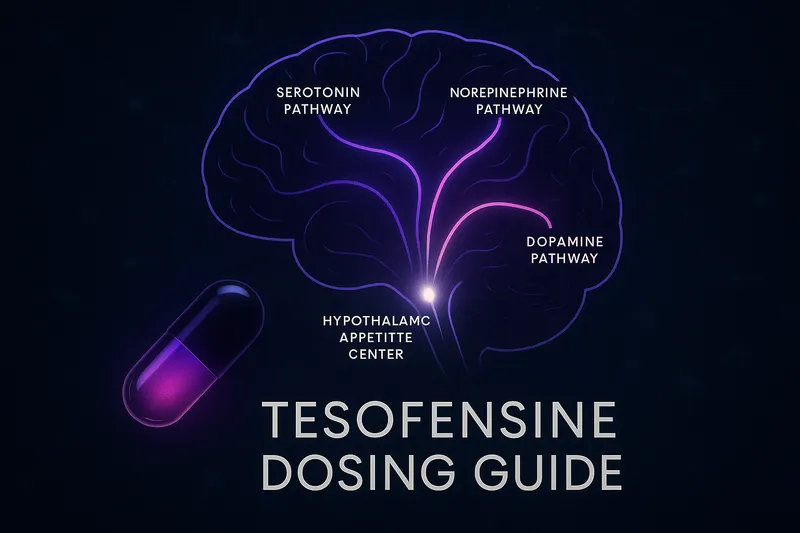
Tesofensine Dosing Guide: Cycles & Stacks (2026)
Tesofensine dosing guide with 0.25-0.5mg protocols, 8-12 week cycling, tolerance management, and GLP-1 stacking.
Tesofensine is an oral small-molecule weight loss compound — not a peptide — that acts as a triple monoamine reuptake inhibitor. If you're looking for the full research breakdown, mechanism of action, and clinical trial data, see our comprehensive tesofensine weight loss guide. This guide focuses on how people actually use tesofensine: practical dosing, cycling, and stacking protocols drawn from community experience.

Table of Contents
- Quick Reference
- Community Dosing Protocols
- Cycling and Tolerance Management
- Stacking Considerations
- What Clinical Trials Used
- Side Effects by Dose
- Important Safety Notes
- Frequently Asked Questions
- References
Quick Reference
| Parameter | Details |
|---|---|
| Compound Type | Small molecule (not a peptide) |
| Route | Oral (capsule/tablet) |
| Common Doses | 0.25mg, 0.5mg, 1.0mg |
| Community Standard | 0.5mg once daily |
| Timing | Morning, fasted or with light meal |
| Frequency | Once daily |
| Cycle Length | 8–12 weeks |
| Common Forms | Capsules (most common), tablets |
| Half-Life | ~220 hours (parent compound) |
| Time to Steady State | ~2 weeks |
Community Dosing Protocols
Starting Dose: 0.25mg
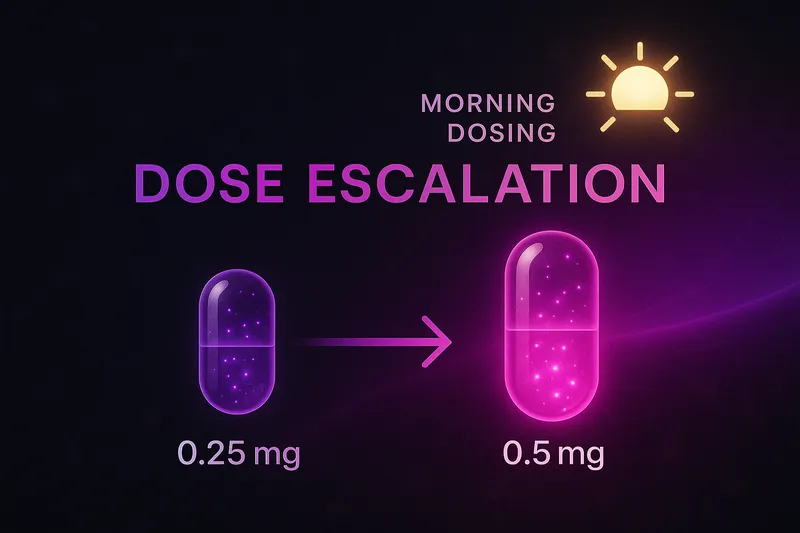
Most experienced users recommend beginning at 0.25mg per day for the first 1–2 weeks. This allows you to assess tolerance to the stimulant-like effects before increasing. At this dose, you'll typically notice:
- Mild appetite suppression
- Slight increase in energy and focus
- Minimal side effects for most people
Standard Dose: 0.5mg
The 0.5mg dose is where the community has settled as the sweet spot. It provides significant appetite suppression and metabolic effects while keeping side effects manageable. Clinical trials confirmed this — 0.5mg produced nearly as much weight loss as 1.0mg with far fewer adverse events [1].
Why Not 1.0mg?
While 1.0mg showed the highest weight loss in clinical trials (12.8% body weight in 24 weeks), it also came with substantially more side effects — particularly elevated heart rate, insomnia, and dry mouth [1]. The community consensus is that the marginal benefit over 0.5mg isn't worth the increased side effect burden.
Timing and Administration
- Take it in the morning — tesofensine increases norepinephrine and dopamine, which can interfere with sleep if taken later in the day
- Fasted or with a light meal — absorption is not significantly affected by food, but some users report slightly faster onset on an empty stomach
- Same time each day — consistency helps maintain steady blood levels given the long half-life
- Swallow whole — don't crush or chew capsules unless you're intentionally splitting doses with a milligram scale
Building Up Slowly
A common titration schedule:
| Week | Dose | Notes |
|---|---|---|
| 1–2 | 0.25mg | Assess tolerance |
| 3+ | 0.5mg | Standard maintenance dose |
| Only if needed | 1.0mg | Rarely recommended by community |

Ready to Buy? Compare Prices
Best current prices from verified vendors with COA testing.
EZ Peptides · 10mg · $4.80/mgCOA ✓
EZ Peptides · 60mg · $2.38/mgCOA ✓
EZ Peptides · 48mg · $4.33/mgCOA ✓
The Peptide Brief
Weekly price drops, new research, and vendor deals — straight to your inbox.
No spam. Unsubscribe anytime.
Cycling and Tolerance Management
Unlike peptides that can often be run continuously, tesofensine's monoamine mechanism means tolerance is a real consideration. The compound affects the same neurotransmitter systems as stimulants, and receptor sensitivity decreases over time.
Cycle Length
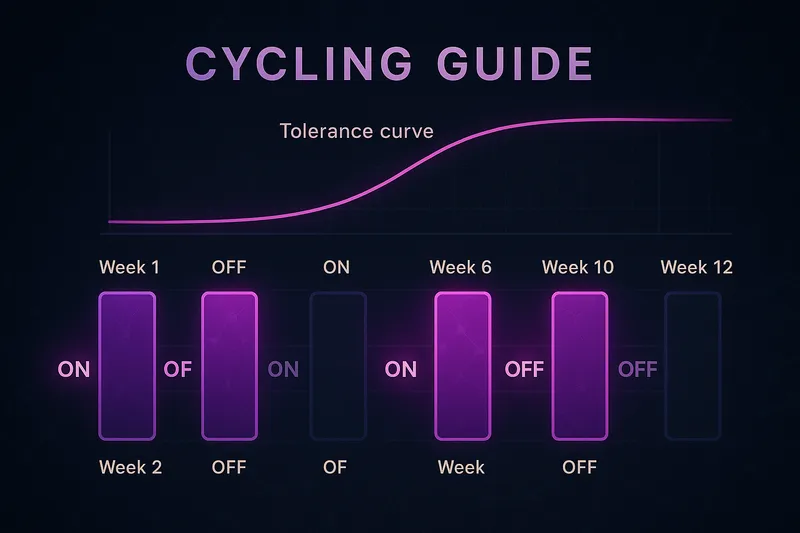
The standard approach is 8–12 weeks on, followed by a break:
- 8 weeks — conservative, minimizes tolerance buildup
- 12 weeks — matches the clinical trial duration, maximum recommended
Signs Tolerance Is Developing
Watch for these indicators, typically appearing around weeks 4–6:
- Appetite suppression weakening noticeably
- Energy/focus boost diminishing
- Needing to increase dose to feel the same effects (don't do this — cycle off instead)
- Return of cravings that were previously controlled
Cycling Strategies
Two popular approaches in the community:
Standard Cycle (8 on / 4 off)
- 8 weeks at your working dose
- 4 weeks completely off
- Repeat
Modified Cycle (5 on / 2 off, weekly)
- 5 days on (Monday–Friday)
- 2 days off (weekends)
- Continue for 10–12 weeks, then take 4 weeks fully off
The 5/2 approach is popular among users who want to maintain some appetite control during the work week while giving receptors periodic rest. However, given tesofensine's long half-life (~220 hours for the parent compound), the 2-day break may not provide full receptor recovery — the standard 8/4 cycle is generally considered more effective for managing tolerance.
Stacking Considerations
Tesofensine + GLP-1 Agonists
The most discussed stack in the weight loss community combines tesofensine with a GLP-1 receptor agonist like semaglutide or tirzepatide. The rationale:
- Tesofensine reduces appetite via dopamine/norepinephrine/serotonin pathways and increases energy expenditure
- GLP-1 agonists reduce appetite through satiety signaling and slow gastric emptying
- Together they target completely different mechanisms — some users report more effective appetite control than either alone
When stacking, most users run tesofensine at the standard 0.5mg and keep the GLP-1 agonist at a moderate dose, since the combined appetite suppression can be quite strong.
For a detailed comparison of GLP-1 options, see our semaglutide vs tirzepatide comparison.
Tesofensine + Cardarine (GW501516)
Some users pursuing body recomposition combine tesofensine with cardarine:
- Tesofensine handles appetite suppression and metabolic boost
- Cardarine enhances fat oxidation and endurance
- The stack is popular among those trying to preserve muscle while cutting
What NOT to Stack With
This is critical — see the Safety Notes section below. Tesofensine should never be combined with MAOIs, SSRIs/SNRIs, or other stimulants.
What Clinical Trials Used
The landmark Phase 2 trial (TIPO-1) tested three doses against placebo over 24 weeks with a controlled diet [1]:
| Dose | Weight Loss | vs Placebo |
|---|---|---|
| 0.25mg | 6.7% | Significant |
| 0.5mg | 11.3% | Highly significant |
| 1.0mg | 12.8% | Highly significant |
The jump from 0.25mg to 0.5mg was substantial (nearly double the weight loss), while the jump from 0.5mg to 1.0mg was marginal — only 1.5 percentage points more. This dose-response curve is exactly why the community settled on 0.5mg as the standard: you get ~88% of the maximum effect with significantly fewer side effects.
For the complete clinical trial analysis, including the Phase 3 program and comparison with GLP-1 agonists, see our tesofensine weight loss guide.
Side Effects by Dose
At 0.25mg (Starting Dose)
Generally well-tolerated. Most common reports:
- Mild dry mouth
- Slight difficulty falling asleep (if taken too late)
- Occasional headache in the first few days
- Mild increase in heart rate (2–5 bpm)
At 0.5mg (Standard Dose)
The side effect profile increases but remains manageable for most:
- Dry mouth — the most common complaint. Keep water nearby; sugar-free gum helps
- Insomnia — take the dose early in the morning (before 9am). Some users add magnesium glycinate at bedtime
- Elevated heart rate — typically 5–10 bpm increase. Monitor with a fitness tracker
- Constipation — increased fiber and water intake usually resolves this
- Mild mood elevation — generally positive, but be aware of it
At 1.0mg (High Dose)
Side effects become more pronounced and are the primary reason this dose isn't widely recommended:
- Significant heart rate increase — 8–15+ bpm above baseline [2]
- Insomnia — more frequent and harder to manage
- Anxiety or jitteriness — particularly in stimulant-sensitive individuals
- Nausea — more common than at lower doses
- Mood swings — the dopaminergic effects become more pronounced
When to Lower Your Dose
Drop back to a lower dose or discontinue if you experience:
- Resting heart rate consistently above 100 bpm
- Persistent insomnia lasting more than a week despite morning dosing
- Significant anxiety or agitation
- Heart palpitations
- Blood pressure increase beyond your normal range
Important Safety Notes
Absolute Contraindications
Do NOT use tesofensine if you are taking:
- MAOIs (monoamine oxidase inhibitors) — risk of serotonin syndrome and hypertensive crisis
- SSRIs or SNRIs (antidepressants like sertraline, fluoxetine, venlafaxine) — overlapping serotonergic mechanisms increase the risk of serotonin syndrome [3]
- Stimulants (amphetamines, methylphenidate, modafinil) — compounding effects on norepinephrine and dopamine can cause dangerous cardiovascular strain
- Other monoamine reuptake inhibitors (sibutramine, bupropion) — same mechanism overlap
Medical Conditions
Tesofensine should be avoided by individuals with:
- Cardiovascular disease or history of cardiac events
- Uncontrolled hypertension
- History of stroke or TIA
- Arrhythmias
- Glaucoma (increased intraocular pressure risk)
- Hyperthyroidism
- History of seizures
Monitoring Recommendations
- Heart rate: Check resting heart rate daily for the first 2 weeks, then weekly. Use a reliable monitor, not just wrist-based estimates
- Blood pressure: Measure weekly, especially during the first month
- Sleep quality: Track subjectively. Persistent insomnia warrants dose reduction
- Mood: Note any unusual irritability, anxiety, or mood changes
Not Approved for Clinical Use
Tesofensine has not been approved by the FDA or any major regulatory agency for weight loss. It is available only as a research compound. All protocols described in this guide are based on community experience and clinical trial data — not medical advice. Consult a healthcare provider before use.
Frequently Asked Questions
Can I open tesofensine capsules and split the dose?
Some users open capsules and weigh partial doses with a milligram scale to start at lower amounts. This works but requires an accurate scale (0.001g precision). Most people find it easier to start with pre-made 0.25mg capsules.
How long does it take for tesofensine to start working?
Most users report noticeable appetite suppression within the first 2–3 days. The stimulant-like effects (increased energy, focus) are typically felt on day one. Full weight loss effects become apparent over 2–4 weeks as the compound reaches steady state.
Can I take tesofensine with coffee?
Yes, but be cautious. Tesofensine increases norepinephrine and dopamine levels, which can amplify the stimulant effects of caffeine. Many users reduce their caffeine intake by 50% when starting tesofensine to avoid jitteriness, elevated heart rate, or insomnia.
What happens if I miss a dose?
Take it as soon as you remember, provided it's still morning. If it's afternoon or evening, skip the missed dose and resume the next morning. Taking tesofensine late in the day significantly increases the risk of insomnia due to its long half-life.
Is tesofensine better than semaglutide for weight loss?
They work through completely different mechanisms and are difficult to compare directly. Tesofensine acts on dopamine, serotonin, and norepinephrine (appetite + energy), while semaglutide targets GLP-1 receptors (satiety + gastric emptying). Some users stack both for complementary effects. See our tesofensine weight loss guide for a detailed comparison.
References
-
Astrup, A., et al. "Effect of tesofensine on bodyweight loss, body composition, and quality of life in obese patients: a randomised, double-blind, placebo-controlled trial." The Lancet, 372(9653), 1906-1913 (2008). PubMed
-
Sjödin, A., et al. "The effect of the triple monoamine reuptake inhibitor tesofensine on energy metabolism and appetite in overweight and moderately obese men." International Journal of Obesity, 34(11), 1634-1643 (2010). PubMed
-
Hauser, R.A., et al. "Tesofensine (NS 2330), a monoamine reuptake inhibitor, in patients with advanced Parkinson disease and motor fluctuations." Neurology, 68(14), 1077-1085 (2007). PubMed
-
Appel, L., et al. "The tesofensine� story: from Alzheimer's and Parkinson's disease to weight loss drug development." Drugs of Today, 50(6), 415-433 (2014). PubMed
-
Gilbert, J.A., et al. "The effect of tesofensine on appetite sensations." Obesity, 20(3), 553-561 (2012). PubMed