CJC-1295 comes in two versions that share the same base peptide but behave completely differently in the body. The DAC (Drug Affinity Complex) version binds to albumin and lasts over a week. The no-DAC version (also called mod GRF 1-29 or modified GRF 1-29) is cleared in about 30 minutes. That single pharmacokinetic difference changes the dosing protocol, the GH release pattern, the stacking strategy, and potentially the results.
This comparison breaks down every meaningful difference to help you choose the right version for your goals.
Side-by-side evidence
Outcomes where both peptides have published data. Each cell carries two grades: clinical evidence (human-RCT depth for this specific outcome) and community evidence (real-world adoption). How we grade evidence.
| Outcome | CJC-1295 | CJC-1295 with DAC |
|---|---|---|
| GH pulse pattern | Clinical:Moderate Community:Strong Sharp pulses lasting ~30 minutes; preserves natural pulsatile GH release. | Clinical:Moderate Community:Moderate Sustained GH elevation across multiple days from a single dose; flattens pulse pattern. |
| IGF-1 elevation | Clinical:Moderate Community:Strong Modest IGF-1 rise when paired with a GHRP; effect is dose-by-dose. | Clinical:Moderate Community:Moderate Sustained IGF-1 increases reported in early human studies due to continuous receptor activation. |
| Dose convenience | Clinical:Moderate Community:Strong Multiple weekly injections needed (commonly 5x/week with a GHRP). | Clinical:Moderate Community:Moderate Once or twice weekly dosing thanks to ~8-day half-life from albumin binding. |
| Side effect burden | Clinical:Weak Community:Strong Lower risk of sustained desensitization; sides limited to injection-site reactions. | Clinical:Weak Community:Moderate Higher risk of GH receptor desensitization, water retention, and tingling at higher doses. |
Quick Comparison Table
| Factor | CJC-1295 DAC | CJC-1295 No DAC (Mod GRF 1-29) |
|---|---|---|
| Half-life | 5.8-8.1 days | ~30 minutes |
| Injection frequency | 1-2x/week | 2-3x/day |
| Injections per month | 4-8 | 60-90 |
| GH release pattern | Sustained elevation ("GH bleed") | Sharp pulsatile spikes |
| Fasting required | No | Yes (every injection) |
| GHRP synergy | Limited | Strong (5-10x amplification) |
| Typical dose | 2 mg/week | 100-200 mcg per injection |
| Cycle length | 8-12 weeks | 12-16 weeks |
| Human clinical data | Yes (multiple trials) | No (based on DAC clinical data) |
| Community preference | Convenience users | Performance-focused users |
Mechanism of Action: Same Receptor, Different Kinetics
Both versions activate the GHRH receptor (GHRHR) on pituitary somatotropes. The amino acid sequence of the active peptide is identical — both are modified GHRH (1-29) analogs with four amino acid substitutions (Ala2, Gln8, Ala15, Leu27) that improve enzymatic stability.
The difference is what happens after injection:
CJC-1295 DAC: A reactive chemical group (the DAC moiety) covalently bonds to serum albumin within minutes of injection. Since albumin has a half-life of ~20 days, this essentially turns the peptide into a slow-release depot. The result: continuous GHRH receptor stimulation for 6-14 days (Teichman et al., 2006).
CJC-1295 No DAC: Without the albumin-binding modification, the peptide circulates freely and is degraded by peptidases within ~30 minutes. Each injection produces a brief but potent GHRH pulse, stimulating a discrete GH spike that resolves within 2-3 hours.
GH Release Pattern: Pulses vs Bleed
This is the most important functional difference and the core of the DAC/no-DAC debate.
No DAC: Pulsatile GH (More Physiological)
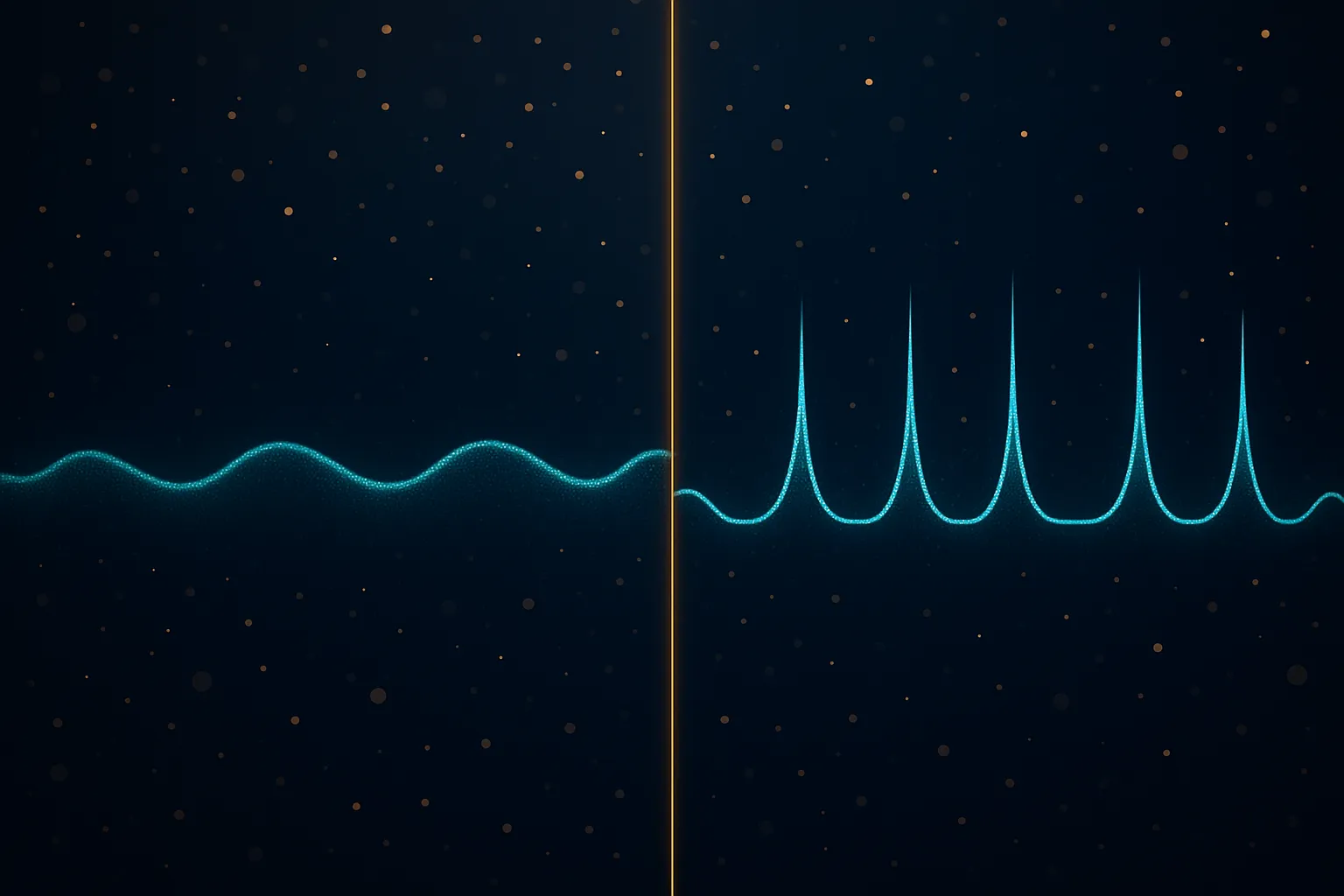
The body naturally secretes GH in pulses — sharp spikes followed by return to baseline. The largest pulse occurs during the first phase of slow-wave sleep. CJC-1295 no DAC mimics this pattern: each injection triggers a discrete GH pulse, and between injections, GH returns to baseline.
When paired with a GHRP (ipamorelin, GHRP-2), the combined GHRH + GHRP receptor activation produces a synergistic GH pulse 5-10x greater than either alone. This is why the no-DAC + ipamorelin stack is considered the gold standard for GH secretagogue use.
DAC: Sustained GH Elevation (GH Bleed)
CJC-1295 DAC raises baseline GH levels continuously. Ionescu & Frohman (2006) showed that basal (trough) GH levels increased 7.5-fold while pulse frequency and magnitude were preserved (PMID: 17018654). So you still get GH pulses — they just ride on top of a much higher baseline.
This "GH bleed" means 24/7 GH stimulation. It is more convenient but less physiological. The elevated baseline may increase risk of insulin resistance compared to pulsatile release, though this has not been directly compared in clinical trials.
Efficacy Comparison
IGF-1 Elevation
Both versions effectively raise IGF-1, the downstream mediator of most GH benefits:
- DAC: 1.5-3 fold increase sustained for 9-11 days after a single injection (PMID: 16352683)
- No DAC: IGF-1 elevation depends on cumulative daily pulse effect. With 2-3 daily injections + GHRP, comparable IGF-1 increases are achieved
No head-to-head trial has compared steady-state IGF-1 levels between the two versions at equivalent community doses.
Body Composition
Community reports suggest similar body composition outcomes from both versions over 8-12 week cycles. The theoretical advantage of pulsatile GH (no-DAC) for fat loss is based on the observation that GH's lipolytic effect may be more potent in a pulsatile pattern. However, the sustained IGF-1 from DAC also promotes fat oxidation and lean mass preservation.
Bottom line: Both work. The difference in body composition outcomes is likely small compared to the impact of training, nutrition, and total IGF-1 exposure.
Sleep Quality
Both versions improve sleep quality, but through slightly different mechanisms:
- DAC: Continuous GHRH stimulation enhances the nocturnal GH surge from an elevated baseline
- No DAC: Pre-bed injection directly amplifies the natural sleep-onset GH pulse
Community reports of sleep improvement are consistent for both versions.
Side Effects Comparison
| Side Effect | DAC | No DAC |
|---|---|---|
| Water retention | More common (continuous GH) | Less common (transient pulses) |
| Flushing at injection | Less frequent (weekly dosing) | More frequent (daily) |
| Insulin resistance risk | Higher (sustained GH bleed) | Lower (pulsatile, with baseline recovery) |
| Appetite increase | Moderate | Mild (or strong if paired with GHRP-6) |
| Injection site reactions | Fewer (less frequent injections) | More frequent (more injection events) |