Follistatin-344 occupies a unique position in the research peptide landscape. While most peptides nudge hormone levels up or down, follistatin removes a biological brake — it neutralizes myostatin, the protein that actively limits how much muscle your body can build. Every animal model tested has shown dramatic muscle mass increases, and the mechanism is well-characterized across species from mice to primates to pigs.
Research-context information only. Follistatin-344 is a research peptide. Protocols, doses, and reactions reported below come from published research and self-reported community sources. This article reports what has been documented, not what should be done. Consult a licensed physician for personal medical decisions.
But myostatin inhibition is not the whole story. Follistatin interacts with multiple TGF-beta family members, giving it a broader biological footprint than a simple "muscle builder." Here are five benefits ranked by evidence quality — and the strongest data may not be where you expect.
How Follistatin Works
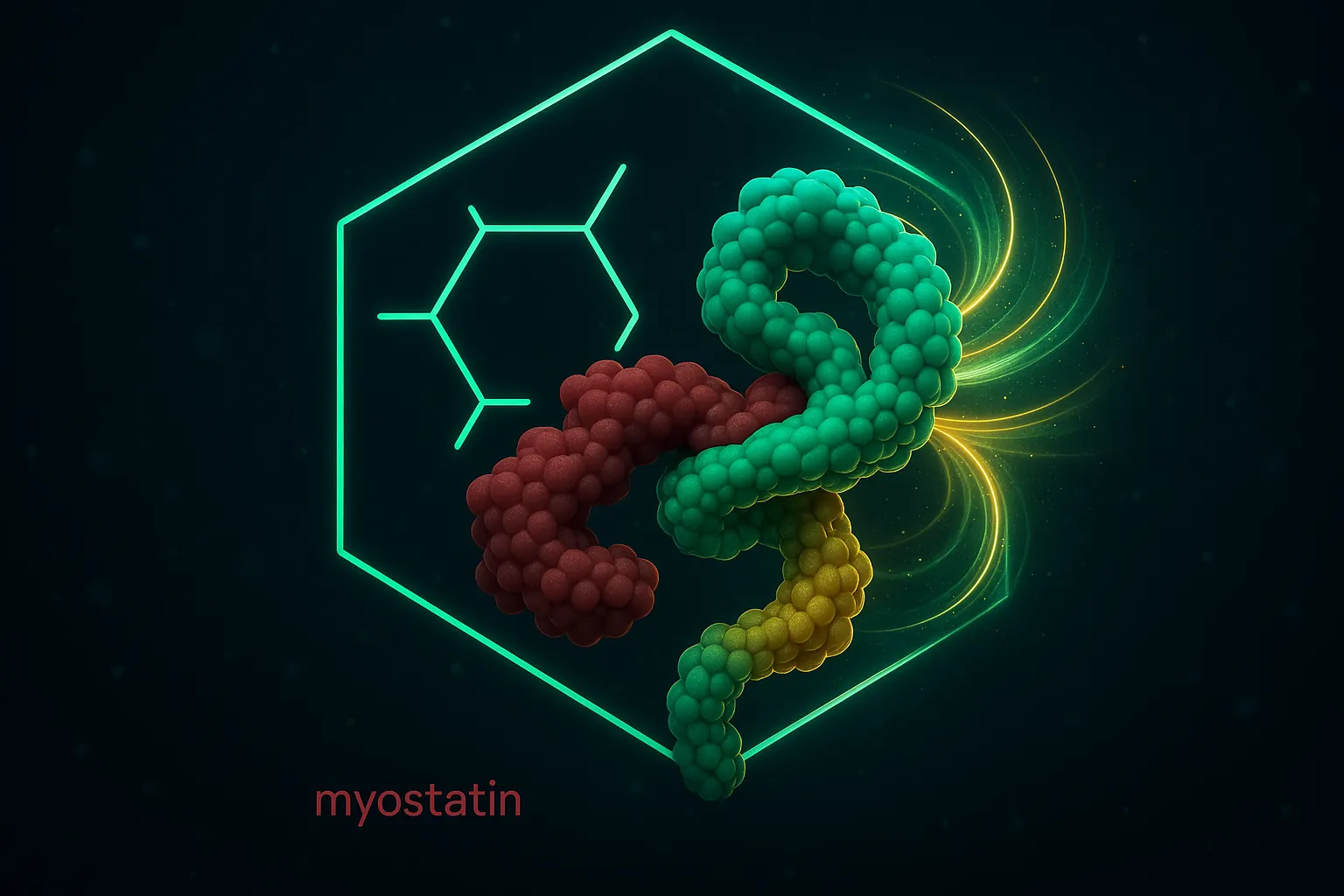
Follistatin is an endogenous glycoprotein that binds and neutralizes members of the TGF-beta superfamily, particularly myostatin (GDF-8) and activin A. The FS344 isoform produces the mature FS315 protein after post-translational processing, which was specifically selected for clinical research due to its selectivity for myostatin over FSH-related targets.
The mechanism: follistatin physically wraps around myostatin in a high-affinity (Kd ~5.84 x 10^-10 M) interaction, preventing myostatin from reaching its receptor (ActRIIB) and triggering the Smad2/3 signaling cascade that suppresses muscle growth (Amthor et al., 2004).
For detailed dosing protocols, see the Follistatin-344 Dosing Guide.
1. Muscle Mass Increase (Strongest Evidence)
Evidence level: Animal models (mice, primates, pigs) + one human gene therapy trial
This is follistatin's headline benefit, and the preclinical data is exceptionally strong across species:
Mice: Haidet et al. (2008) demonstrated that a single AAV-delivered dose of follistatin-344 produced sustained muscle mass increases exceeding 20% in both normal and dystrophic mice, with effects lasting over 2 years. Follistatin outperformed all other myostatin inhibitors tested (PMID: 18334646).
Primates: Kota et al. (2009) showed that AAV1-delivered FS344 increased muscle size and strength in cynomolgus macaques, with no adverse immune response and no effect on reproductive hormones (PMID: 20368179).
Pigs: Transgenic pigs expressing human follistatin-344 showed significantly increased skeletal muscle mass (72.95% vs 69.18% lean meat percentage) due to myofiber hypertrophy (PMID: 27787698).
Humans: The only human data comes from a Phase 1/2a gene therapy trial in Becker muscular dystrophy patients. Direct intramuscular injection of AAV1.CMV.FS344 improved 6-minute walk test distance by 58 and 125 meters in the first two patients, with no serious adverse events (Mendell et al., 2015).
Important caveat: All animal and human studies used gene therapy delivery (viral vectors producing sustained local expression), not subcutaneous peptide injection. The pharmacokinetics are fundamentally different — gene therapy produces weeks to months of continuous follistatin expression, while subcutaneous injection has a half-life measured in hours.
Practical takeaway: The muscle growth mechanism is well-validated across species. However, community peptide protocols (100 mcg/day subcutaneous) are extrapolated from gene therapy data, and the degree of myostatin inhibition achieved through brief subcutaneous exposure is unknown.
2. Myostatin Pathway Suppression (Strong Evidence)
Evidence level: In-vitro + animal models
Beyond direct muscle effects, myostatin suppression has systemic implications. Lee & McPherron (2001) demonstrated that follistatin, the myostatin propeptide, and a dominant-negative ActRIIB receptor all produced dramatic muscle mass increases comparable to myostatin knockout mice when overexpressed transgenically (PMID: 11459935).
Follistatin also binds activin A, another TGF-beta family member that limits muscle growth. Lee et al. (2010) provided genetic evidence that follistatin inhibits both myostatin and activin A to regulate muscle size, suggesting its muscle-building effect is broader than myostatin inhibition alone (PMID: 20810712).
This dual inhibition (myostatin + activin A) may explain why follistatin overexpression produces larger muscle gains than myostatin knockout alone in some models.
Practical takeaway: Follistatin does not just block myostatin — it blocks multiple growth-limiting signals simultaneously, which may produce a more robust anabolic effect than targeting myostatin alone.
3. Body Composition Improvement (Moderate Evidence)
Evidence level: Animal models, community reports
Animals with elevated follistatin consistently show reduced body fat alongside increased muscle mass. The transgenic pig model showed both increased lean percentage and reduced fat proportion (PMID: 27787698). The mechanisms likely include:
- Increased basal metabolic rate from greater muscle mass (muscle is metabolically expensive tissue)
- Direct adipose effects — myostatin and activin signaling influence adipocyte differentiation and lipid metabolism
- Nutrient partitioning — blocking myostatin may redirect caloric resources toward muscle synthesis rather than fat storage
Community reports with subcutaneous follistatin-344 describe gradual improvements in body composition over 30-day cycles, typically manifesting as improved muscle definition and reduced waist measurements. These reports are inherently subjective and confounded by concurrent training and nutrition changes.
Practical takeaway: Fat loss is likely a secondary effect driven primarily by increased muscle mass. Do not expect rapid fat loss — follistatin is a muscle-building compound first.
4. Connective Tissue Considerations (Emerging Evidence)
Evidence level: Theoretical concern + community reports
This is a critical consideration rather than a benefit. Rapid muscle growth without proportional connective tissue adaptation creates an injury risk. Tendons and ligaments strengthen more slowly than muscle, and follistatin-driven muscle growth may outpace their adaptation.
Community protocols frequently pair follistatin-344 with BPC-157 and TB-500 specifically to support connective tissue during cycles. While no clinical data validates this approach, the rationale is sound — BPC-157's tendon repair properties and TB-500's systemic tissue repair may help close the adaptation gap.
Practical takeaway: If using follistatin-344, consider adding connective tissue support peptides and avoiding maximal strength training in the first 2-3 weeks to allow tendons to begin adapting.
5. Hair Growth Potential (Early Research)
Evidence level: In-vitro + preclinical
Follistatin's interaction with TGF-beta signaling has implications beyond muscle. TGF-beta plays a role in hair follicle cycling, and early research suggests that follistatin may promote hair growth by counteracting TGF-beta-mediated follicle regression (catagen induction).
This is the least mature area of follistatin research. No clinical trials have tested follistatin for hair loss, and the in-vitro data does not translate directly to subcutaneous peptide injection outcomes. Community anecdotal reports of improved hair quality exist but are sparse and difficult to attribute specifically to follistatin versus concurrent protocols.
Practical takeaway: Do not choose follistatin primarily for hair growth — the evidence is too preliminary. If you are using it for muscle building and notice hair improvements, that is a potential bonus, not a reliable expectation.
Ready to buy? Compare verified vendors on our best follistatin 344 sources page, or browse all coupon codes for up to 50% off.