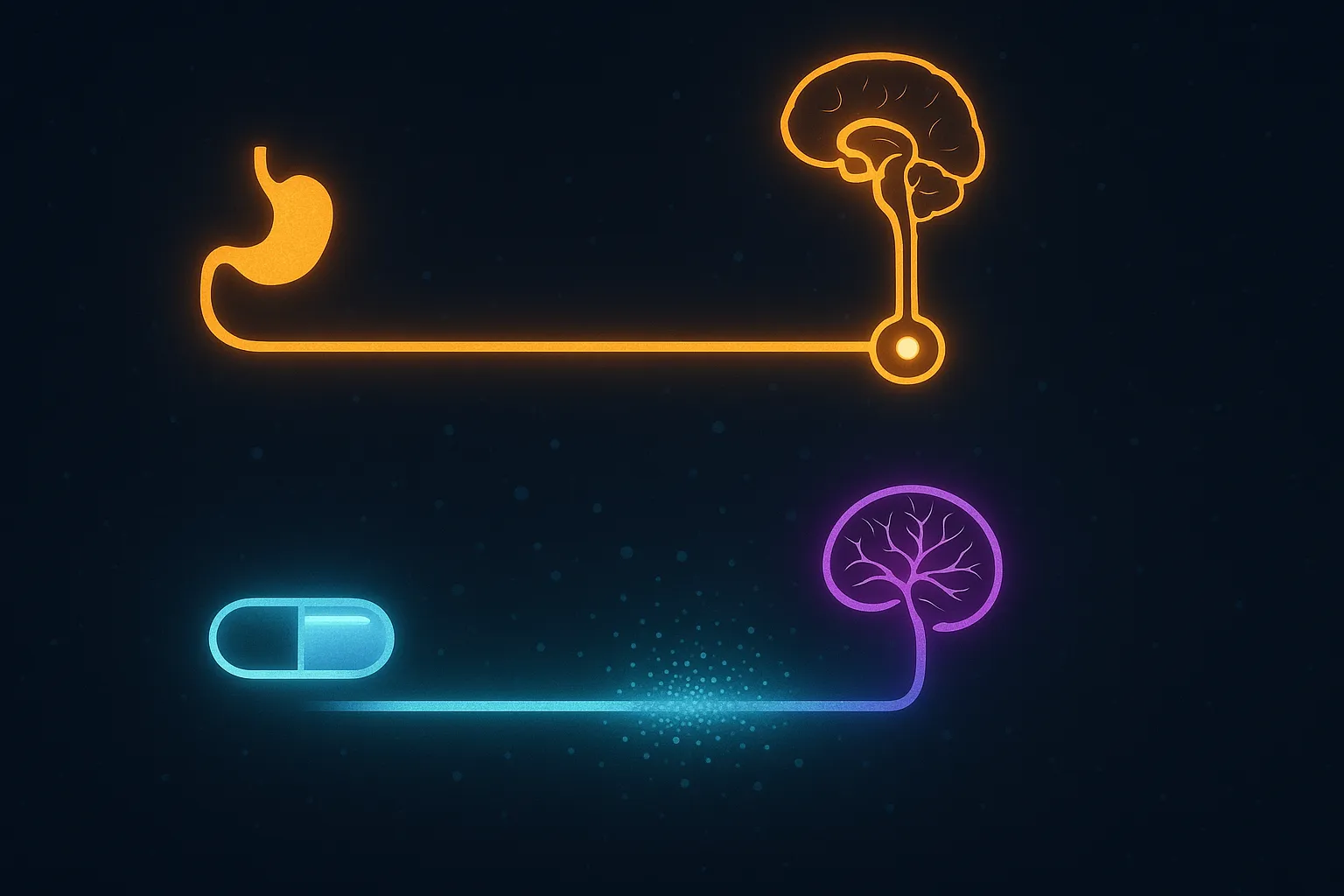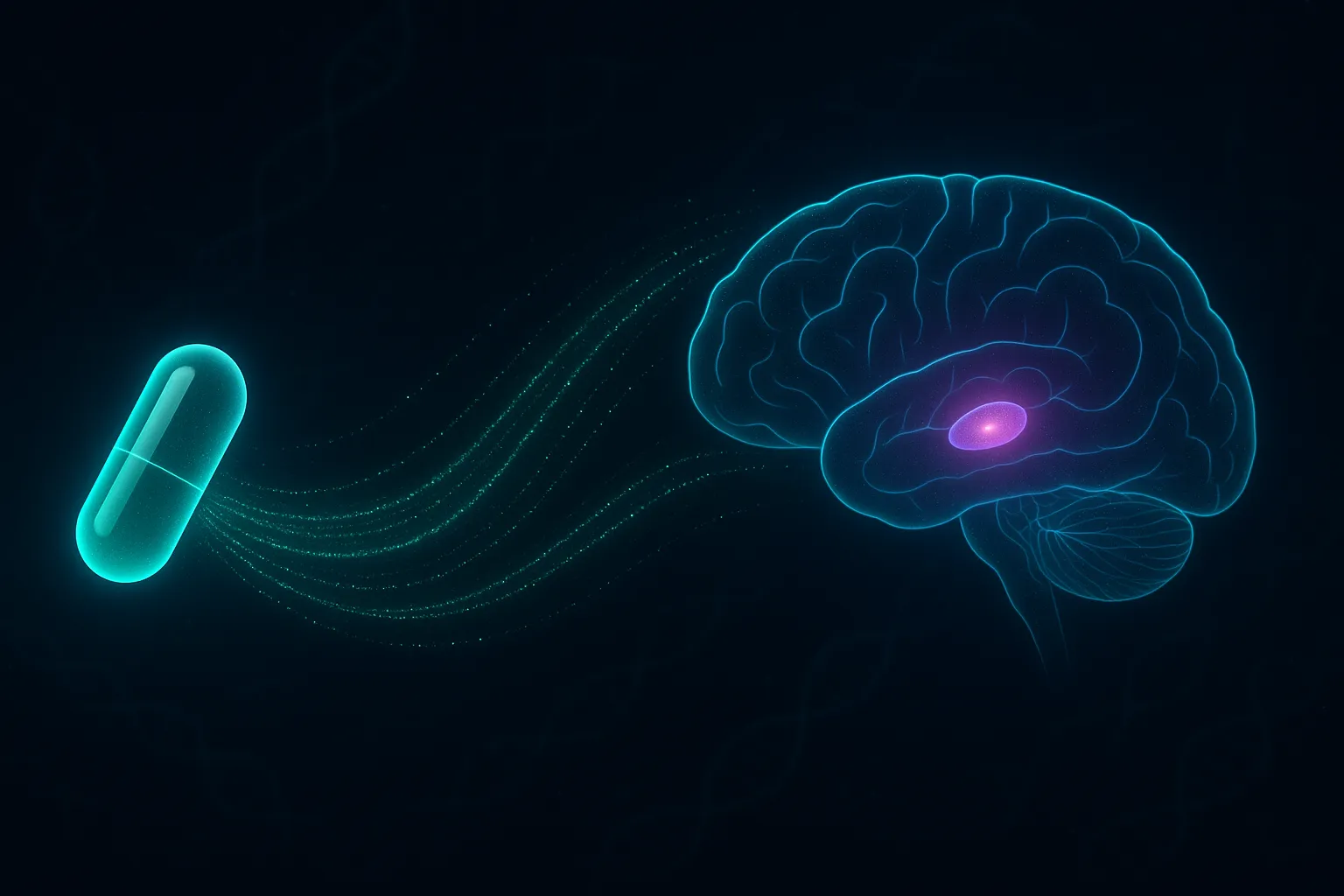
A study published May 6, 2026 in Nature found that oral small-molecule GLP-1 drugs reach a deep brain region — the central amygdala — that injectable peptide GLP-1s like semaglutide and tirzepatide appear unable to access. The pills shut down dopamine release in the brain's reward circuit during pleasure eating, a mechanism distinct from simple appetite suppression.
Research-context information only. Peptides discussed below are research compounds. Protocols, doses, and reactions reported come from published research and self-reported community sources. This article reports what has been documented, not what should be done. Consult a licensed physician for personal medical decisions.
For anyone choosing between an oral pill and a compounded peptide injection right now, this changes the trade-off conversation — but not in the direction the headlines imply.
What the Study Actually Found
The paper, A brain reward circuit inhibited by next-generation weight-loss drugs in mice (DOI 10.1038/s41586-026-10444-4), came out of Ali Guler's lab at the University of Virginia with NIH funding. Lead author Elizabeth Godschall and colleagues used mice engineered with humanized GLP-1 receptors to track where two oral small-molecule drugs — Lilly's orforglipron (FDA approved April 1, 2026 as Foundayo) and Pfizer's danuglipron — actually go in the brain.
The headline finding: both drugs activated GLP-1 receptor neurons in the central amygdala, a deep limbic region tied to motivation and desire. Once activated, that population of neurons reduced dopamine release into the nucleus accumbens — the brain's primary reward hub — specifically during hedonic feeding (eating for pleasure rather than hunger).
A few key details from the NIH press release and the published paper:
- The central amygdala is deeper than most researchers thought GLP-1 drugs could reach. Peptide GLP-1s are large and hydrophilic — published data shows they act mostly through circumventricular organs (regions outside the blood-brain barrier) and the brainstem.
- Small-molecule pills are roughly 1/40th the size of peptide GLP-1s and cross the blood-brain barrier far more easily.
- The newly identified circuit runs in parallel to, not instead of, the homeostatic appetite-suppression pathway. So oral GLP-1s appear to dial back both hunger and wanting, while peptide injections may primarily dial back hunger.
- The authors flag the central amygdala pathway as potentially relevant for substance use disorder. NIH co-author Lorenzo Leggio (NIDA) has separately published on GLP-1s in alcohol use disorder.
This is a mechanism study in mice. It does not mean orforglipron produces more weight loss than peptide injectables in humans — Phase 3 data still shows the opposite (orforglipron ~12% at 72 weeks vs. tirzepatide ~20-22%). What it does suggest is that the pattern of weight loss may differ.
What This Means for Peptide Buyers
If you're currently choosing between an oral GLP-1 pill and a compounded peptide injection, the practical takeaway is more nuanced than "pills now reach the brain better."
If your problem is food cravings and emotional eating
Small-molecule oral GLP-1s (orforglipron / Foundayo) may have a real mechanistic advantage on the wanting dimension. People who report binge episodes, snack-driven weight regain, or food noise that survives normal satiation could see disproportionate benefit from the oral class once it scales. The catch: orforglipron costs $149-299/mo self-pay and produces less total weight loss than injectable peptides on average.
If your problem is volume of food and total weight loss
Compounded semaglutide and tirzepatide still win on absolute scale. The injectables work primarily through homeostatic satiety and gut motility — they crush appetite hard, and at $129-299/mo for compounded semaglutide and $150-350/mo for compounded tirzepatide, they're often cheaper than the oral pill.
If you're stalling out on a peptide and food noise is the reason
This is where the new research is most actionable. A subset of people respond well to the injectable on appetite but still report intrusive food thoughts. Adding or switching to a small-molecule oral GLP-1 — once available beyond Lilly's direct channel — could target that residual reward-circuit driver. We don't yet have head-to-head trial data on this combination, so it remains a hypothesis.
| Option | Mechanism Profile | Avg. Weight Loss | Self-Pay Cost |
|---|---|---|---|
| Orforglipron (oral) | Homeostatic + reward circuit | ~12% at 72 wks | $149-299/mo |
| Compounded semaglutide | Primarily homeostatic | ~15% at 68 wks | $129-299/mo |
| Compounded tirzepatide | Homeostatic + GIP | ~20-22% at 72 wks | $150-350/mo |
| Compounded retatrutide | Homeostatic + GIP + glucagon | ~24% at 48 wks | $200-400/mo |
For pricing across all five recommended vendors, see the GLP-1 cost comparison on the deals hub and individual /best/semaglutide and /best/tirzepatide pages.