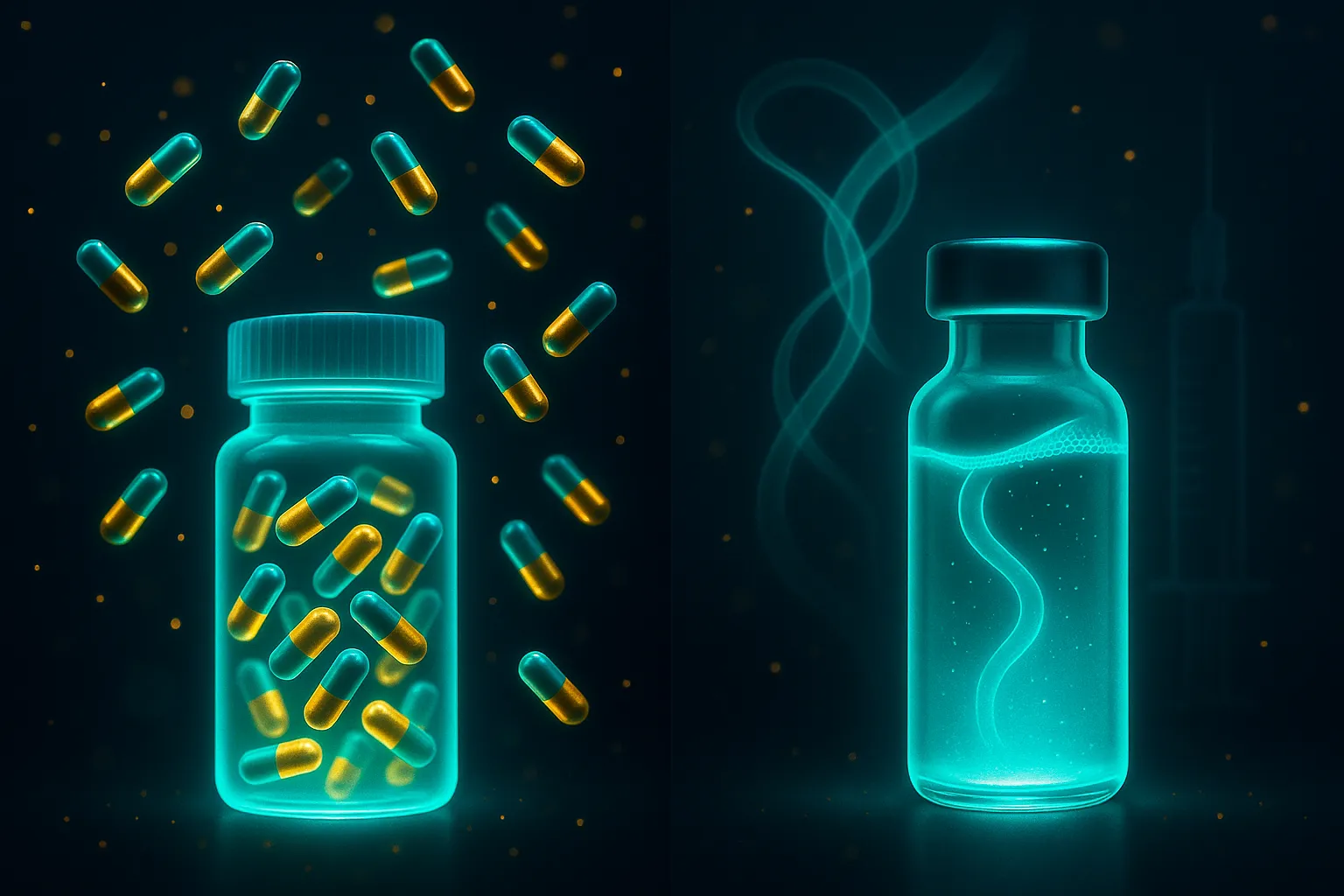
The 2026 GLP-1 Landscape Has Two Tracks
Through 2024 the GLP-1 conversation was almost entirely about which weekly injection — semaglutide or tirzepatide. By April 2026 there are now two parallel tracks:
Track 1 — Oral pills. Orforglipron (Foundayo) became the first non-peptide oral GLP-1 receptor agonist approved by the FDA on April 1, 2026. Oral semaglutide has been approved since 2019 in branded form and entered broader compounding channels in late 2025. Several other oral candidates are in phase 2 and phase 3.
Track 2 — Injectables, getting longer-acting. Weekly injectable semaglutide and tirzepatide remain the established commercial standard. Investigational retatrutide is in phase 3 with the highest reported weight-loss numbers in any GLP-1 trial. Pfizer's PF-3944 is moving toward once-monthly dosing in ten phase 3 studies launching in 2026.
Research-context information only. GLP-1 receptor agonists discussed below include FDA-approved finished products (semaglutide, tirzepatide, liraglutide, orforglipron) whose research-peptide and compounded forms are not FDA-approved and are sold for research purposes only, plus investigational compounds (retatrutide, PF-3944) not approved by the FDA in any form. Protocols, doses, and reactions reported below come from published clinical trials and self-reported community sources. This article reports what has been documented, not what should be done. Possession or use of investigational drugs outside an authorized clinical trial may be illegal in your jurisdiction. Consult a licensed physician for personal medical decisions.
The buyer question — pill or shot — used to be theoretical. Now it is a real decision with real cost and efficacy data on both sides. This article covers what the trials show, where each format wins, and where the gap is closing.
The Current Oral GLP-1 Cohort (2026 Status)
Four oral candidates matter for buyers right now. The fifth — Pfizer's PF-3944 — is technically injectable and is covered in the injectable section, but it shares the "convenience-first" pitch that drives the oral category.
Orforglipron (Eli Lilly, Foundayo)
The headline approval. Orforglipron is a small-molecule, non-peptide oral GLP-1 receptor agonist — the first of its kind. Because it is not a peptide, it survives stomach acid and absorbs without food or water timing restrictions, the limitation that hobbled oral semaglutide.
ATTAIN-1 phase 3 trial reported (PMID 40960239):
- Mean body-weight reduction at 72 weeks: -7.5% (6 mg), -8.4% (12 mg), -11.2% (36 mg)
- Placebo arm: -2.1%
- 36 mg responder rates: 54.6% lost ≥10%, 36.0% lost ≥15%, 18.4% lost ≥20%
- Adverse-event discontinuation: 5.3-10.3% on orforglipron vs 2.7% on placebo
Pricing (Lilly Self-Pay Journey program): $149-$299/month self-pay. Insurance copay can drop to $25/month. Medicare Part D access at $50/month is scheduled for July 2026.
Buyer takeaway: Best-in-class oral efficacy, but the 11.2% peak weight loss is below every injectable in the comparison set.
Oral Semaglutide
The original oral GLP-1, approved in 2019 for type 2 diabetes and now widely used off-label and via compounding for weight loss. The molecule is identical to injectable semaglutide; the formulation co-administers an absorption enhancer (SNAC) to push roughly 1% of the oral dose into systemic circulation.
PIONEER 1 trial reported (Diabetes Care 2019): -0.6% to -1.4% placebo-adjusted HbA1c reduction at 26 weeks across 3 mg, 7 mg, and 14 mg dose arms.
The weight-loss limitation: Because of the ~1% bioavailability, the daily oral dose (3-14 mg) is multiples higher than the weekly injectable dose (0.25-2.4 mg) but produces meaningfully less weight reduction in head-to-head data. Lilly's ACHIEVE-3 trial reported orforglipron outperformed oral semaglutide on both weight loss and glycemic control.
Pricing: Branded oral semaglutide retail prices rose to $199-299/month range in April 2026. See the oral semaglutide pill price hike coverage for the latest.
Pipeline Oral Candidates
Several next-generation oral GLP-1 candidates are in phase 2 and phase 3 trials, including additional small-molecule agonists from competing sponsors. None have approval timelines firm enough for buyer planning in 2026. Watch for ADA scientific sessions in June 2026 for the next round of phase 2 readouts.
What "Oral" Actually Buys You
Across the oral cohort, the consistent advantages are:
- No injection, no syringes, no needle disposal
- No cold-chain storage requirements (room temperature pills)
- Simple travel logistics
- Lower commitment threshold for a treatment trial
- Generally faster onboarding for needle-averse patients
The consistent trade-offs are:
- Lower peak weight loss in every published head-to-head
- Daily dosing burden vs weekly injection
- Higher per-month branded cost than compounded injectable peers
- For peptide-based orals (semaglutide), strict food/water timing requirements (orforglipron solves this)

The Current Injectable GLP-1 Cohort (Established Players)
Injectables remain the efficacy leaders in 2026. Four molecules dominate.
Semaglutide (Weekly Injectable)
The original commercial GLP-1 weight-loss drug. Administered once-weekly subcutaneously.
STEP 1 trial reported (PMID 33567185): ~14.9% mean placebo-adjusted body-weight reduction at 68 weeks on 2.4 mg/week.
Pricing channels:
- Branded weight-loss formulation: $1,000-$1,400/month US retail without insurance
- Compounded semaglutide via telehealth: $80-$300/month
- Research-grade peptide vials (research use only): $20-$60/month equivalent dose
For sourcing across vetted vendors, see best semaglutide vendors for current prices and COA verification.
Tirzepatide (Weekly Injectable, Dual GIP/GLP-1)
The dual-receptor agonist that overtook semaglutide on raw efficacy.
SURMOUNT-1 trial reported (PMID 35658024): Mean weight reduction of 16.0% (5 mg), 21.4% (10 mg), 22.5% (15 mg) at 72 weeks.
SURMOUNT-2 trial reported (PMID 37385275): In adults with obesity plus type 2 diabetes, mean weight reduction of 13.4% (10 mg) and 15.7% (15 mg) at 72 weeks.
Pricing channels:
- Branded weight-loss formulation: $1,000-$1,400/month US retail without insurance
- Compounded tirzepatide via telehealth: $150-$350/month
- Research-grade peptide vials: $30-$80/month equivalent dose
Best tirzepatide vendors carries the current vendor-by-vendor pricing.
Retatrutide (Weekly Injectable, Triple GLP-1/GIP/Glucagon — Investigational)
The triple agonist still in phase 3 but already producing the highest reported weight-loss numbers in any GLP-1 trial.
Phase 2 trial reported (PMID 37366315): Up to 24.2% mean weight reduction at 48 weeks on 12 mg/week, with dose-response from 7.2% (1 mg) to 24.2% (12 mg).
Retatrutide is investigational — no FDA approval anywhere. The TRIUMPH phase 3 program is reading out through 2026. See retatrutide phase 3 results for the latest data and best retatrutide vendors for research-grade sourcing.
Liraglutide (Daily Injectable — Largely Displaced)
The first commercially successful GLP-1 for weight management. Daily injection produced lower weight loss (~6-8% in trials) and has been mostly displaced by weekly semaglutide and tirzepatide. Still relevant for patients who prefer daily over weekly dosing or who tolerate it better.
PF-3944 (Pfizer, Monthly Injectable — Investigational)
Technically injectable but pitched as "almost as convenient as an oral pill." Phase 2b reported up to 12.3% placebo-adjusted weight loss at 28 weeks on 4.8 mg, with a modeled 9.6 mg high-dose cohort projected at ~16% in phase 3. Ten phase 3 studies launching in 2026. Earliest realistic US availability: 2028. Full breakdown in Pfizer's monthly GLP-1 injection PF-3944.
Head-to-Head: Oral vs Injectable Decision Factors
| Decision factor | Oral cohort | Injectable cohort |
|---|---|---|
| Peak weight loss (best-in-class trial data) | ~11.2% (orforglipron 36 mg, ATTAIN-1, 72 wks) | ~24.2% (retatrutide 12 mg, phase 2, 48 wks); ~22.5% (tirzepatide 15 mg, SURMOUNT-1, 72 wks) |
| Dosing frequency | Daily (orforglipron, oral semaglutide) | Weekly (sema, tirz, reta); daily (lira); monthly in pipeline (PF-3944) |
| Branded retail cost | $149-$299/mo (orforglipron self-pay); $199-$299/mo (oral sema) | $1,000-$1,400/mo (branded sema/tirz without insurance) |
| Compounded/research-grade cost | Limited oral compounded supply | $80-$350/mo (compounded); $20-$80/mo (research-grade vials) |
| FDA status | Orforglipron approved Apr 2026; oral sema approved 2019 | Sema, tirz, lira approved; reta and PF-3944 investigational |
| Convenience advantage | No needles, no cold chain, room-temp storage | None — requires syringes, cold-chain shipping for compounded, weekly injection |
| Side-effect profile | Similar GI events to injectables (nausea, diarrhea), 5-10% AE-driven discontinuation in ATTAIN-1 | Similar GI events; tirz typically reports ~31% nausea, ~23% diarrhea; reta similar |
| Research-grade availability | Limited (oral sema only; no orforglipron) | Broad (sema, tirz, reta, lira all available from research vendors) |
| Travel-friendliness | High | Lower (cold-chain, syringes, supply on the road) |
| Best for buyer who... | Hates needles, wants short-term trial, has insurance copay access | Wants maximum weight loss per dollar, already comfortable with self-injection |
When Oral Makes Sense
Oral GLP-1s win on five concrete buyer profiles:
Needle-averse patients. A meaningful share of GLP-1 candidates never start treatment because of injection friction. For those patients, an oral pill at moderately lower efficacy is materially better than no treatment.
Travel-heavy lifestyles. Compounded injectables ship cold-chain and require refrigeration in many cases. Pills travel anywhere — TSA, international flights, hotel rooms without minibars. For consultants, sales reps, or anyone living out of suitcases, the oral format eliminates a real logistics problem.
Lower body-weight goals (5-10%). If the target is a 5-10% reduction — a meaningful health threshold per multiple cardiovascular outcome studies — orforglipron's ~11% mean weight loss easily covers it. The marginal extra weight loss from tirzepatide or retatrutide may not be needed.
Future-state buyers waiting for cheaper pricing. Oral GLP-1 pricing is trending downward as more candidates clear phase 3 and competitive pressure builds. For patients whose situation can wait, the 2027-2028 oral landscape will likely be more competitive than today's.
Short-term trial of a GLP-1 mechanism. Lower commitment threshold. Easier to start, easier to stop. Fewer "wasted" supplies if the patient discontinues at week 4 due to side effects.
When Injectables Still Win
Injectables remain the better choice on five other profiles:
Aggressive weight-loss goals (>15% body weight). If the target is meaningful body-composition change — 30+ pounds of lost weight, or remission of obesity-related comorbidities — every published trial points to injectable tirzepatide or retatrutide. Oral candidates simply do not produce that magnitude of weight reduction.
Trial-data preference. Injectable GLP-1s have substantially deeper RCT depth. STEP, SURMOUNT, SUSTAIN, PIONEER (oral), and the retatrutide phase 2/TRIUMPH program represent thousands of patient-years of data. The oral cohort is newer and the long-term safety record is shorter.
Cost per percentage-of-body-weight lost. Research-grade injectable peptide vials, sold for research purposes only at $20-$80/month equivalent dosing, beat every oral channel on cost per percentage-of-body-weight lost. Compounded telehealth injectables come in second. Branded oral pricing trails on a cost-per-result basis even with insurance copays.
Tirzepatide and retatrutide superiority. The dual and triple-receptor mechanisms deliver weight-loss numbers oral mono-agonists do not match. If the buyer specifically wants the GIP-receptor benefit (tirz) or the glucagon-receptor benefit (reta), the answer is injectable by definition.
Existing protocol optimization. Patients already on a weekly injectable protocol who are tolerating it well have weak reason to switch. The orforglipron ATTAIN-2 switching trial reported maintenance of weight loss in switchers, but introducing a new variable when the current protocol works is rarely worth the trouble.
Cost Comparison
The real cost picture has four channels with very different math.
| Channel | Format | Monthly cost (approx) | Notes |
|---|---|---|---|
| Branded oral (orforglipron) | Daily pill | $149-$299 self-pay; $25 insured | Lilly Self-Pay Journey caps at $299 |
| Branded oral (oral semaglutide) | Daily pill | $199-$299 retail | Recent price hike per April 2026 update |
| Branded injectable (semaglutide, tirzepatide) | Weekly injection | $1,000-$1,400 retail without insurance | Coverage varies; weight-loss indication often not covered |
| Compounded injectable (telehealth) | Weekly injection | $80-$350 | Sema lower end; tirz upper end; reta $200-$400 |
| Research-grade injectable peptide vials | Weekly injection | $20-$80 equivalent dose | Sold for research purposes only; not for human use |
Why research-grade still beats oral on pure dollars: A $30/month research-grade tirzepatide vial sourced through a vetted vendor at the equivalent of 10-15 mg/week dosing produces the trial-reported ~21-22% weight loss. Even orforglipron's lowest-tier $149/month self-pay produces ~11% weight loss. Per percentage-of-body-weight lost, the research-grade injectable channel is roughly 5-10x cheaper than branded oral options.
That gap exists because branded products carry the full pharmaceutical-distribution stack (clinical trials, FDA review, sales force, insurance contracts). Research-grade vendors carry none of that. The trade-off is the lack of FDA finished-product oversight on the research-grade channel — buyers self-source COA verification through independent third-party testing, which the vendor scoring rubric addresses for the recommended-vendor list.
For a side-by-side coupon and discount snapshot across recommended vendors, see /deals/?from=oral-glp1-vs-injectable-2026.