NAD+ for subcutaneous injection comes as a lyophilized (freeze-dried) white powder in a sealed vial. It is reconstituted with bacteriostatic water before injection. The process is identical to other peptides with one key difference: NAD+ is dosed in milligrams (not micrograms), so the math works a little differently.
This guide covers mixing, measuring doses, and storing NAD+ so nothing goes to waste.
Research-context information only. NAD+ is a research peptide. Protocols, doses, and reactions reported below come from published research and self-reported community sources. This article reports what has been documented, not what should be done. Consult a licensed physician for personal medical decisions.
NAD+ lyophilized vial (typically 100mg, 250mg, or 500mg)
Bacteriostatic water (BAC water) — not sterile water, not saline
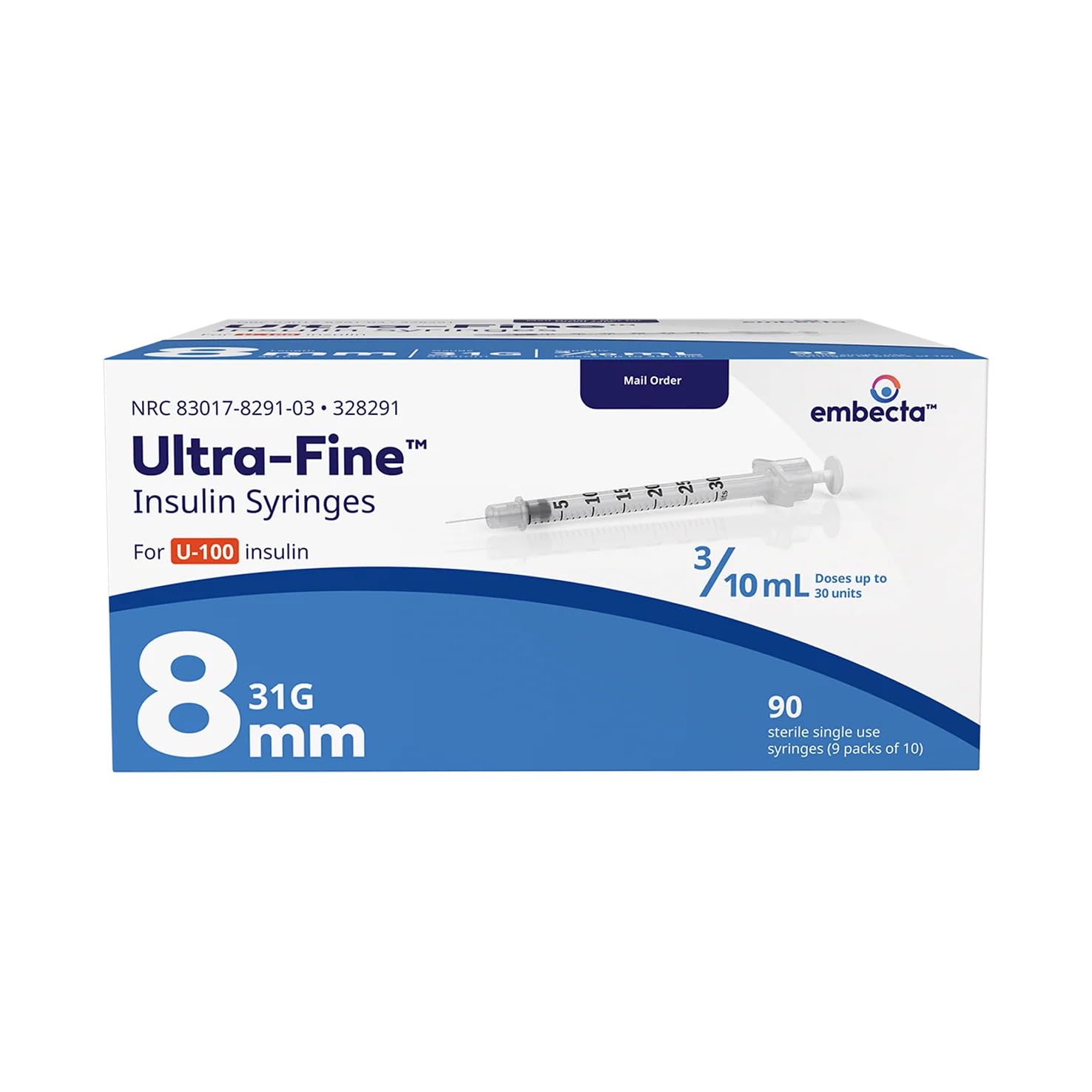
Insulin syringes — 1mL (100 unit), 29-31 gauge
Alcohol swabs — for cleaning vial tops
A clean, flat workspace
Why bacteriostatic water? It contains 0.9% benzyl alcohol that prevents bacteria from growing in the solution. Regular sterile water has no preservative, so the vial must be used within 24 hours. BAC water allows up to 28 days refrigerated.
Note on NAD+ stability: NAD+ is less stable in solution than many peptides. Prompt refrigeration after reconstitution is especially important. Some users reconstitute smaller vials (100-250mg) to use the solution within 2-3 weeks rather than pushing the full 28-day window.
Bac Water Made for Peptides50% off
Don't risk a $300 peptide on generic bac water.
Most cloudy reconstitutions trace back to one thing — and it isn't the peptide. Sterile, non-pyrogenic, 0.9% benzyl alcohol — formulated for peptide reconstitution, not repackaged from generic stock.
✓ 0.9% benzyl alcohol✓ Made for peptides✓ 30 mL multi-dose
Protocols describe wiping the tops of both vials (NAD+ and BAC water) with alcohol swabs, then letting them air dry for 10 seconds. This prevents contamination — a step community resources flag as essential.
Step 2: Draw Your Bacteriostatic Water
Protocols describe using a fresh insulin syringe to draw the desired amount of BAC water. The amount added determines the concentration (see the dilution charts below).
Community resources commonly document 2.5mL into a 250mg vial as the sweet spot. It gives 100mg/mL — clean, round numbers for standard doses.
Larger vial? A bigger draw needle helps. NAD+ reconstitutes into a larger volume than microgram-dosed peptides, so community protocols describe pulling the dose with a larger-gauge draw needle, then switching to a thin 30G needle to inject — see Drawing a larger vial.
Step 3: Add Water to the NAD+ Vial
Protocols describe inserting the needle into the NAD+ vial at an angle, aiming at the glass wall — not directly at the powder — and letting the water trickle down the side of the vial gently.
Water is not squirted directly onto the powder. While NAD+ is more robust than many peptides, gentle technique preserves molecular integrity.
Step 4: Let It Dissolve
Protocols describe swirling the vial gently with a slow rotating motion rather than shaking it. NAD+ typically dissolves quickly — within 1-2 minutes into a perfectly clear, colorless solution.
If particles remain after 5 minutes of gentle swirling, the NAD+ may be degraded. A properly manufactured NAD+ dissolves easily.
Step 5: Store Correctly
Reconstituted vials are refrigerated immediately at 36-46°F (2-8°C). The reconstituted solution is stable for up to 28 days with bacteriostatic water, though using it within 21 days is ideal given NAD+'s relative instability in solution.
Dilution Charts
Why these water amounts? They all produce a 100mg/mL concentration, making dose calculation simple: 1 unit on the syringe = 1mg of NAD+. A 50mg dose = 50 units. A 100mg dose = 100 units (full 1mL syringe).
The Math (So You Can Do It Yourself)
Here's the formula for any vial size and any amount of water:
Concentration = Vial Size (mg) ÷ Water Added (mL)
Then to find the injection volume:
Units to inject = Desired Dose (mg) ÷ Concentration (mg/mL) × 100
Example: 250mg vial + 2.5mL water = 100mg/mL. For a 50mg dose: 50 ÷ 100 × 100 = 50 units.
For variable vial sizes or doses, the Reconstitution Calculator applies this formula automatically. Vendors selling NAD+ as a research compound are compared on the best NAD+ sources page, including current coupon codes.
Affiliate disclosure: vendor links in this article are affiliate links — The Peptide Catalog may earn a commission if you buy through them, at no additional cost to you.
Common Mistakes
Shaking the Vial
While NAD+ is more structurally robust than large peptide chains, shaking creates foam that makes accurate volume measurement difficult and can introduce air bubbles that interfere with injection. Protocols describe swirling gently rather than shaking.
Using Too Little Water
Adding 0.5mL to a 250mg vial gives 500mg/mL. That means a 50mg dose is only 10 units — harder to measure accurately on an insulin syringe. Protocols describe using enough water to keep doses above 25 units for accurate measurement.
Leaving It at Room Temperature
NAD+ degrades faster in solution than most peptides. Every hour at room temperature reduces potency. Protocols describe pulling the vial out, drawing the dose, and returning it to the refrigerator rather than leaving it on the counter.
Reusing Needles
Each puncture through the rubber stopper dulls the needle and increases contamination risk. Protocols describe a fresh syringe every time — they cost pennies.
Freezing Reconstituted NAD+
Freezing a liquid solution creates ice crystals that can damage the molecular structure. Protocols describe freezing only lyophilized (powder) NAD+. Once reconstituted, the solution is refrigerated — never frozen.
Not Accounting for Larger Volumes
NAD+ doses (50-200mg) require larger injection volumes than typical peptides. A 200mg dose at 100mg/mL = 2mL, which exceeds a standard 1mL insulin syringe. Protocols describe either using a 3mL syringe with a fine gauge needle or splitting into two 1mL injections at different sites.
Buffered vs Unbuffered NAD+: What pH Means for Your Vial
NAD+ is sold in two forms that reconstitute differently. Plain (unbuffered) NAD+ — the free-acid form in particular — dissolves into an acidic solution, while the disodium salt sits closer to neutral. "Buffered" NAD+ has been pH-adjusted toward physiological ~7.4 with a buffering agent before it reaches the vial.
The distinction is comfort, not strength. The reconstituted concentration, the dose math, and the biological effect are the same whichever form is in the vial — only the injection feel changes. Community reconstitution protocols attribute most of the subcutaneous sting to acidity rather than technique, which is why a buffered vial can feel very different from an unbuffered one prepared identically. Vendors don't always state which form they ship: the NAD+ buying guide covers how to confirm it, and the side-effects guide details the sting itself.
How Many Doses Per Vial?
This depends on the dose and vial size:
100mg vial at 50mg/dose = 2 doses100mg vial at 100mg/dose = 1 dose250mg vial at 50mg/dose = 5 doses250mg vial at 100mg/dose = 2.5 doses500mg vial at 50mg/dose = 10 doses500mg vial at 100mg/dose = 5 doses500mg vial at 200mg/dose = 2.5 doses
Community protocols commonly documenting 100mg three times weekly would exhaust a 250mg vial in under a week. A 500mg vial lasts about 1.5 weeks. NAD+ protocols consume vials faster than most peptide protocols.
Storage Quick Reference
State
Temperature
Shelf Life
Lyophilized (powder)
Room temp
3-6 months
Lyophilized (powder)
Refrigerated
12+ months
Lyophilized (powder)
Frozen (-20°C)
2+ years
Reconstituted (BAC water)
Refrigerated
Up to 28 days (use within 21 ideal)
Reconstituted (sterile water)
Refrigerated
Use within 24 hours
Pro tip: With multiple vials, unopened ones are kept frozen and only what will be used within 2-3 weeks is reconstituted. NAD+ lyophilized powder is much more stable than the reconstituted solution.
Frequently Asked Questions
How much bacteriostatic water is added to NAD+?
For a 250mg vial, adding 2.5mL gives a 100mg/mL concentration — the ratio community protocols most commonly describe. At that concentration, a 50mg dose corresponds to 50 units (0.5mL) on an insulin syringe.
Can sterile water be used instead of bacteriostatic water for NAD+?
It can, but bacteriostatic water contains 0.9% benzyl alcohol which prevents bacterial growth. With sterile water, community storage resources describe using the entire vial within 24 hours. Bacteriostatic water extends shelf life to 28 days refrigerated.
How can reconstituted NAD+ be identified as gone bad?
Cloudiness, floating particles, yellowing, or an unusual smell are signs of degradation. Properly reconstituted NAD+ is completely clear and colorless. NAD+ is less stable in solution than many peptides — if anything looks off, protocols describe discarding the vial.
What size syringe is used for NAD+ injections?
For doses up to 100mg (1mL at standard concentration), protocols describe a 1mL (100 unit) insulin syringe with a 29-31 gauge needle. For doses above 100mg, a 3mL syringe with a fine gauge needle may be needed.
Research Supplies for NAD+
Hand-picked storage, injection, and recovery supplies paired with NAD+ protocols.
Martens, C.R., et al. (2018). Chronic nicotinamide riboside supplementation is well-tolerated and elevates NAD+ in healthy middle-aged and older adults. Nature Communications, 9(1), 1286. PubMed
Grant, R., et al. (2019). A pilot study investigating changes in the human plasma and urine NAD+ metabolome during a 6 hour intravenous infusion of NAD+. Front Aging Neurosci, 11, 257. PubMed
USP General Chapter 797: Pharmaceutical Compounding — Sterile Preparations. Storage and beyond-use dating guidelines for reconstituted compounds.
This guide is for educational and informational purposes only. It is not medical advice. NAD+ is sold as a research compound and is not FDA-approved for human use as an anti-aging therapy. Reconstituting and self-administering injectable compounds carries inherent risks including infection, contamination, and dosing errors. Always use proper sterile technique. Consult a qualified healthcare provider before starting any NAD+ protocol. The Peptide Catalog is not responsible for any adverse effects resulting from the use or misuse of information presented here.