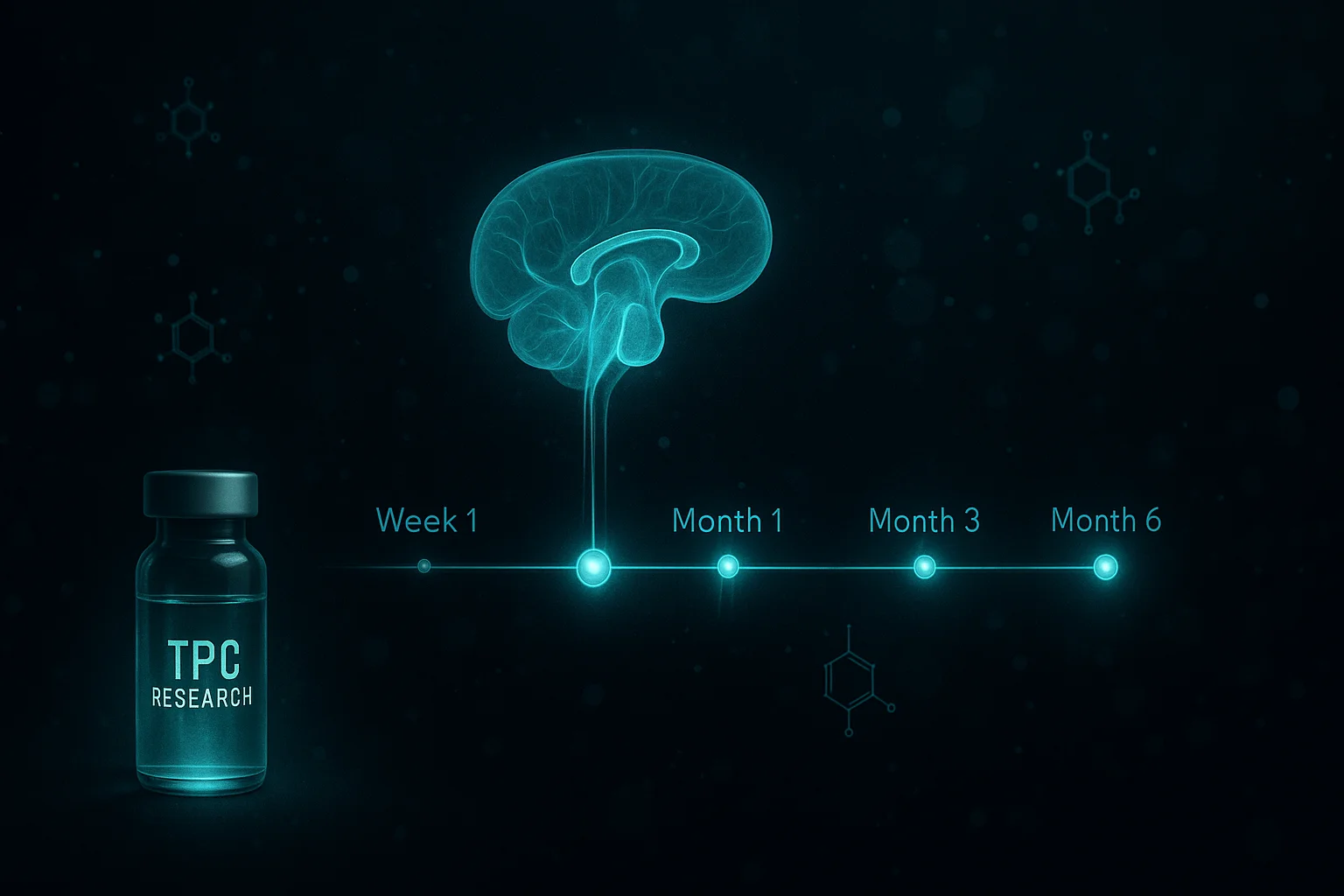
Sermorelin results follow a predictable pattern — but it is slower than most people expect. The compound works by restoring the pituitary's natural GH output, not by injecting growth hormone directly. That means results build gradually as the GH-IGF-1 axis reactivates.
Research-context information only. Sermorelin is previously FDA-approved (now withdrawn); current research-peptide forms are not FDA-approved. Protocols, doses, and reactions reported below come from published clinical trials and self-reported community sources. This article reports what has been documented, not what should be done. Possession or use of investigational drugs outside an authorized clinical trial may be illegal in your jurisdiction. Consult a licensed physician for personal medical decisions.
The good news: sermorelin has genuine clinical trial data backing its timeline. The Khorram et al. 5-month RCT in adults aged 55-71 provides specific time points for measurable changes (Khorram et al., 1997). This article maps those findings onto a practical week-by-week framework.
The single biggest factor in results: consistency. Sermorelin's short half-life (8-12 minutes) means each injection produces one GH pulse. Missed doses break the cumulative signaling. The 5-on/2-off schedule is the common community pattern, described in terms of cost and IGF-1 normalization rather than a desensitization requirement.
What happens biologically: Sermorelin begins binding GHRH receptors on the pituitary somatotrophs within minutes of each injection. Each dose triggers a GH pulse lasting 1-2 hours. The body is responding, but cumulative effects have not yet built.
What users report: Likely nothing yet. Some users report mild injection site reactions (redness, warmth) or brief facial flushing — both are normal and typically resolve within minutes. A few report subtle sleep changes even in the first week, but this is not consistent.
Protocol notes: Documented protocols emphasize compliance — injecting at the same time each night, on an empty stomach (2-3 hours after eating), 30 minutes before bed. This is the foundation everything else builds on.
Bloodwork: A baseline IGF-1 and GH panel before starting provides a reference point to measure progress objectively.
Weeks 2-4: First Measurable Changes
What happens biologically: This is when the clinical data shows the first objective shift. In the Khorram et al. trial, serum IGF-1 and IGFBP-3 levels rose significantly within 2 weeks of starting nightly GHRH analog injections (Khorram et al., 1997). A separate study confirmed that 14 days of GHRH administration reversed age-related decreases in GH and IGF-1 in older men (Corpas et al., 1992).
What users report:
Sleep: This is typically the first subjective change. GHRH directly promotes slow-wave (deep) sleep, and bedtime dosing amplifies the natural nocturnal GH pulse. Many users report falling asleep faster, sleeping deeper, and waking more refreshed (Kerkhofs et al., 1993).
Recovery: Some users notice mildly improved exercise recovery, though this is subtle at this stage.
Energy: Slight improvements in daytime alertness, likely secondary to better sleep quality.
What not to expect yet: Visible body composition changes, significant strength gains, or skin improvements. These require more time.
What happens biologically: With 4-8 weeks of consistent nightly dosing, the GH-IGF-1 axis operates at sustainably higher output. Nocturnal GH secretion is significantly elevated compared to baseline. The cumulative effect of restored GH pulsatility is now driving downstream metabolic changes — increased protein synthesis, enhanced lipolysis, and collagen production.
What users report:
Sleep: Continues to improve and stabilize. Deep sleep phases are more consistent.
Recovery: Noticeably faster recovery from workouts. Reduced muscle soreness duration.
Body composition: The earliest hints of change — slightly improved muscle tone, potentially reduced abdominal softness. These are subtle and easier to measure than to see in the mirror.
Skin and hair: Some users report improved skin texture and hydration. Nail growth may accelerate.
Bloodwork at 4-6 weeks: This is the critical checkpoint. A retest of IGF-1 typically shows a meaningful increase from baseline. If IGF-1 has not risen, something is wrong — product quality, dosing consistency, or timing are worth reassessing.
In the Khorram et al. trial, IGF-1 remained elevated throughout the treatment period after rising in the first 2 weeks, confirming sustained pituitary response without desensitization on nightly dosing (Khorram et al., 1997).
Months 3-4: Where the Real Changes Happen
What happens biologically: This is the phase where accumulated GH restoration translates into measurable physical changes. The Khorram et al. trial measured outcomes at 4 months and found significant results across multiple endpoints.
Insulin sensitivity: Significant improvement in men
Skin thickness: Increased in both men and women — one of the few benefits that was not sex-dependent
Well-being and libido: Significant improvement in men on quality-of-life assessments
What users report:
Body composition: Visible changes now. Clothes fit differently. Reduced body fat, particularly abdominal. Improved muscle definition, especially with consistent training.
Skin: Noticeably improved texture, thickness, and hydration. Some users report reduced fine lines.
Energy and mood: Sustained improvement in daytime energy, motivation, and general well-being.
Libido: Increased in men (clinical data supports this). Less consistent in women.
Exercise performance: Better endurance, faster recovery, improved ability to add training volume.
A separate study of prolonged high-dose GHRH in middle-aged and older men found that 3 months of treatment increased fat-free mass, reduced total abdominal adiposity, and improved certain functional performance measures including walking speed and stair-climbing time (Veldhuis et al., 2004).
Prefer the prescribed route?Sermorelin is one of the few peptides legitimately compounded under 503A — clinician oversight, intake labs, and shipping in all 50 states.
Months 5-6: Full Effect and Plateau
What happens biologically: By 5-6 months of consistent use, most sermorelin benefits have reached or are approaching their plateau. The GH-IGF-1 axis is operating at its restored level. Further improvements become incremental rather than dramatic.
What users report:
Body composition: Stabilized at improved levels. The rate of change slows, but gains are maintained.
Sleep: Consistently improved. This tends to be the most durable benefit.
Skin and connective tissue: Continued gradual improvement. Collagen remodeling is a slow process.
Cognitive function: A 20-week trial of GHRH analog in adults aged 55-87 found favorable effects on executive function and verbal memory trends, with IGF-1 increasing 117% and body fat decreasing 7.4% (Baker et al., 2012).
Important note on cycling: The standard documented protocol is 8 weeks on, 8 weeks off. Continuous use over 5-6 months would typically include at least one off-cycle period. Some clinicians extend to 12-16 weeks before cycling off. Community sources frame the off-cycle around cost and IGF-1 normalization; the 16-week Khorram trial documented sustained response without desensitization on continuous nightly dosing. See Do GH Peptides Desensitize the Pituitary? for how this compares across GH secretagogues.
Results Summary Table
Timeframe
Effect
Evidence Level
Week 1
GH pulses begin, no subjective changes
Pharmacokinetic data
Weeks 2-4
IGF-1 rises, sleep improves
Strong (human RCT)
Months 1-2
Recovery improves, early body composition hints
Moderate (human data + user reports)
Months 3-4
Lean mass up, fat down, skin thicker, libido improved
Strong (human RCT, 4-month endpoint)
Months 5-6
Full effects plateau, cognitive benefits emerge
Moderate (human RCT, 20-week endpoint)
Bac Water Made for Peptides
Don't risk a $300 peptide on generic bac water.
Most cloudy reconstitutions trace back to one thing — and it isn't the peptide. Sterile, non-pyrogenic, 0.9% benzyl alcohol — formulated for peptide reconstitution, not repackaged from generic stock.
✓ 0.9% benzyl alcohol✓ Made for peptides✓ 30 mL multi-dose
Dose and schedule compliance. Sermorelin's 8-12 minute half-life means each injection is one GH pulse. Missing doses breaks the cumulative signaling chain. The 5-on/2-off schedule with bedtime timing is not optional — it is the protocol that clinical data supports.
Empty stomach requirement. Food, especially carbohydrates, blunts GH release. Inject at least 2-3 hours after eating. This is one of the most common reasons for suboptimal results.
Age. Older adults (55+) tend to see more dramatic improvements because their baseline GH output is lower. A 35-year-old with reasonable GH levels will see less relative improvement than a 65-year-old with significant somatopause.
Sex. The Khorram et al. data showed body composition and well-being improvements were stronger in men than women. Skin thickness improved in both sexes. The sex-dependent differences may relate to testosterone's synergistic effects with GH.
Body composition at baseline. Higher body fat is associated with lower GH secretion. Obesity can blunt the pituitary's response to GHRH. Concurrent exercise and dietary improvement amplify sermorelin's effects.
Product quality. Sermorelin is a fragile peptide — it degrades faster than many others. Third-party COA testing is worth verifying. Reconstituted solution is stored refrigerated and used within 14-28 days. When IGF-1 does not rise after 4-6 weeks of consistent use, product quality is the first thing to investigate.
Stacking. Combining sermorelin with a GHRP like ipamorelin produces synergistic GH release via different receptor pathways. This can accelerate timeline by amplifying each GH pulse. See our Sermorelin Dosing Guide for stack protocols.
When to Adjust the Protocol
Signs it is working:
IGF-1 rising on bloodwork (check at 4-6 weeks)
Deeper, more consistent sleep (weeks 2-4)
Faster workout recovery (weeks 4-8)
Gradual body composition shift (months 2-4)
Signs it is not working:
No IGF-1 increase after 4-6 weeks — reassess product quality, storage, and dosing compliance
No sleep improvement after 4 weeks — confirm bedtime timing and empty stomach
No body composition changes after 12 weeks with consistent training — consider stacking with ipamorelin or switching to CJC-1295 for sustained GHRH signaling
When to stop: Trials reported discontinuation when subjects experienced persistent headaches, significant joint pain, or signs of fluid retention. These are rare with sermorelin (more common with direct GH) but warrant medical evaluation.
Men vs. Women: What the Data Shows
The Khorram et al. trial is one of the few studies that included both men and women, making the sex-specific findings particularly valuable:
Outcome
Men
Women
IGF-1 increase
Yes
Yes
Lean body mass
Significant increase
No significant change
Insulin sensitivity
Significant improvement
No significant change
Skin thickness
Significant increase
Significant increase
Well-being/libido
Significant improvement
No significant change
Current evidence does not support the same body composition or libido results in women as in men. However, GH restoration (IGF-1) and skin benefits appear equivalent. The sex disparity may relate to hormonal interactions rather than sermorelin itself being less effective in women.
Frequently Asked Questions
How long does sermorelin take to work?
IGF-1 levels rise within 2 weeks of starting sermorelin. Sleep improvements typically appear by weeks 2-4. Body composition changes (fat loss, lean mass gains) require 8-12 weeks. Full benefits including skin thickness and well-being improvements develop over 3-6 months.
What is the first thing users notice on sermorelin?
Most users report improved sleep quality as the earliest noticeable effect, typically within 1-3 weeks. This aligns with GHRH's direct role in promoting slow-wave (deep) sleep. Bloodwork shows rising IGF-1 before subjective changes appear.
How is sermorelin response confirmed?
Baseline IGF-1 bloodwork before starting and a retest at 4-6 weeks provide a reference point. A meaningful rise in IGF-1 confirms the compound is active. Subjective signs reported include deeper sleep, improved recovery after exercise, and gradual changes in body composition over 8-12 weeks.
Why do some users not see results from sermorelin?
Common reasons: inconsistent dosing, not taking on an empty stomach, poor timing (bedtime is the documented protocol), low-quality product without third-party COA, or unrealistic expectations. Body composition changes require 8-12 weeks minimum. If IGF-1 hasn't risen after 4-6 weeks, protocol or product quality is worth reassessing.
Is sermorelin better than HGH for long-term results?
Sermorelin produces more gradual, physiological results because it works through the pituitary's natural feedback loops. Direct GH replacement produces faster, more dramatic changes but carries higher risk of side effects (joint pain, edema, insulin resistance). Sermorelin's results build over months but with a significantly better safety profile.
Research Supplies for Sermorelin
Hand-picked storage, injection, and recovery supplies paired with Sermorelin protocols.
For educational and research purposes only. This is not medical advice. Sermorelin is not currently FDA-approved for adult use and is available only as a research chemical.