
articlesAugust 27, 2026·12 min read

GLP-1 Bone Loss: What the 5-Year Data Actually Shows

Five-year records on 73,483 GLP-1 users show higher osteoporosis rates — but only in some groups. The numbers, the mechanism, what people track.

Cross-section of trabecular bone as a luminous silver-blue lattice, dense on the left and progressively thinning to the right where struts break apart into drifting particles

The lean-mass problem on GLP-1s has been covered to death. The bone problem has not, and it is the one with five-year data behind it. A retrospective cohort of 73,483 matched patients presented at the 2026 Annual Meeting of the American Academy of Orthopaedic Surgeons reported osteoporosis in 4.1% of GLP-1 receptor agonist users versus 3.2% of matched controls at five years — a relative risk of 1.29. Osteomalacia showed the largest relative gap in the dataset: 2.0% versus 0.1%.

The reason this has not turned into a headline cycle is that the evidence points in two directions at once. A real-world cohort in type 2 diabetes reported a hazard ratio of 0.69 — a lower osteoporosis risk on GLP-1s. A separate 2-million-patient analysis found both results in the same dataset, split by whether the patient had diabetes. The signal is real, but it is conditional, and almost every summary circulating online picks one half of it.

Research-context information only. Compounds discussed below are research peptides and supplements; some are investigational drugs not approved by the FDA. Semaglutide and tirzepatide are active ingredients in FDA-approved prescription products; the research-peptide and compounded forms discussed and linked below are not FDA-approved and are sold for research purposes only. Protocols, doses, and reactions reported come from published research and self-reported community sources. Possession or use of investigational drugs outside an authorized clinical trial may be illegal in your jurisdiction. This article reports what has been documented, not what should be done. Consult a licensed physician for personal medical decisions.

What the five-year records show

The AAOS 2026 dataset is a matched retrospective cohort drawn from patients carrying both a type 2 diabetes and an obesity diagnosis, followed for five years, with GLP-1 users matched one-to-one against non-users. The musculoskeletal outcomes reported:

Outcome at 5 years GLP-1 users Matched controls Risk ratio
Osteoporosis 4.1% 3.2% 1.29
Gout 7.4% 6.6% 1.12
Osteomalacia 2.0% 0.1% 2.55

All three differences were reported as statistically significant. The same AAOS session paired this with a separate retrospective analysis of ten common orthopaedic procedures, which reported better short-term surgical outcomes for GLP-1 users — lower odds of postoperative emergency department visits, reduced surgical site infection rates in total knee and hip arthroplasty, and lower knee revision rates. The authors' framing was that short-term perioperative benefit and long-term skeletal risk are not mutually exclusive, and that bone health surveillance is the gap.

The osteomalacia figure deserves a caveat that the coverage generally drops. A jump from 0.1% to 2.0% is a 25-fold absolute increase in a condition that is diagnosed largely on the basis of vitamin D status and bone biochemistry. In a population undergoing rapid weight loss with substantially reduced caloric intake — and often reduced fat-soluble vitamin absorption — a diagnostic-detection effect is difficult to rule out in a retrospective claims-style dataset.

The split almost nobody reports: diabetes status changes the sign

The most informative dataset on this question is an Epic Research analysis published in March 2026 that ran the same question across two separate populations: roughly 2 million patients with type 2 diabetes and 380,438 without. Stratifying by amount of weight lost, the direction of the effect reversed depending on diabetes status.

Among patients with type 2 diabetes who maintained stable weight, GLP-1 use was associated with an 8.7% lower osteoporosis risk than non-users, and the protective gap persisted as weight loss increased. Among patients without diabetes who maintained stable weight, GLP-1 use was associated with a 22% higher osteoporosis risk than other weight-loss medications.

That mirrors a real-world retrospective cohort out of Tangdu Hospital covering 2012 to 2023, which reported a fully adjusted hazard ratio of 0.69 (95% CI 0.45–0.84) for incident osteoporosis among GLP-1 receptor agonist users with type 2 diabetes (PMID 40469447). Type 2 diabetes is itself associated with impaired bone quality, so a treatment that improves glycaemic control has a plausible route to net skeletal benefit in that group that simply does not exist in a metabolically healthy person using the same drug purely to lose weight.

The practical read: the population most of the current research-peptide market resembles — people without diabetes, using a GLP-1 for body composition — sits on the side of the split where the reported risk is higher, not lower.
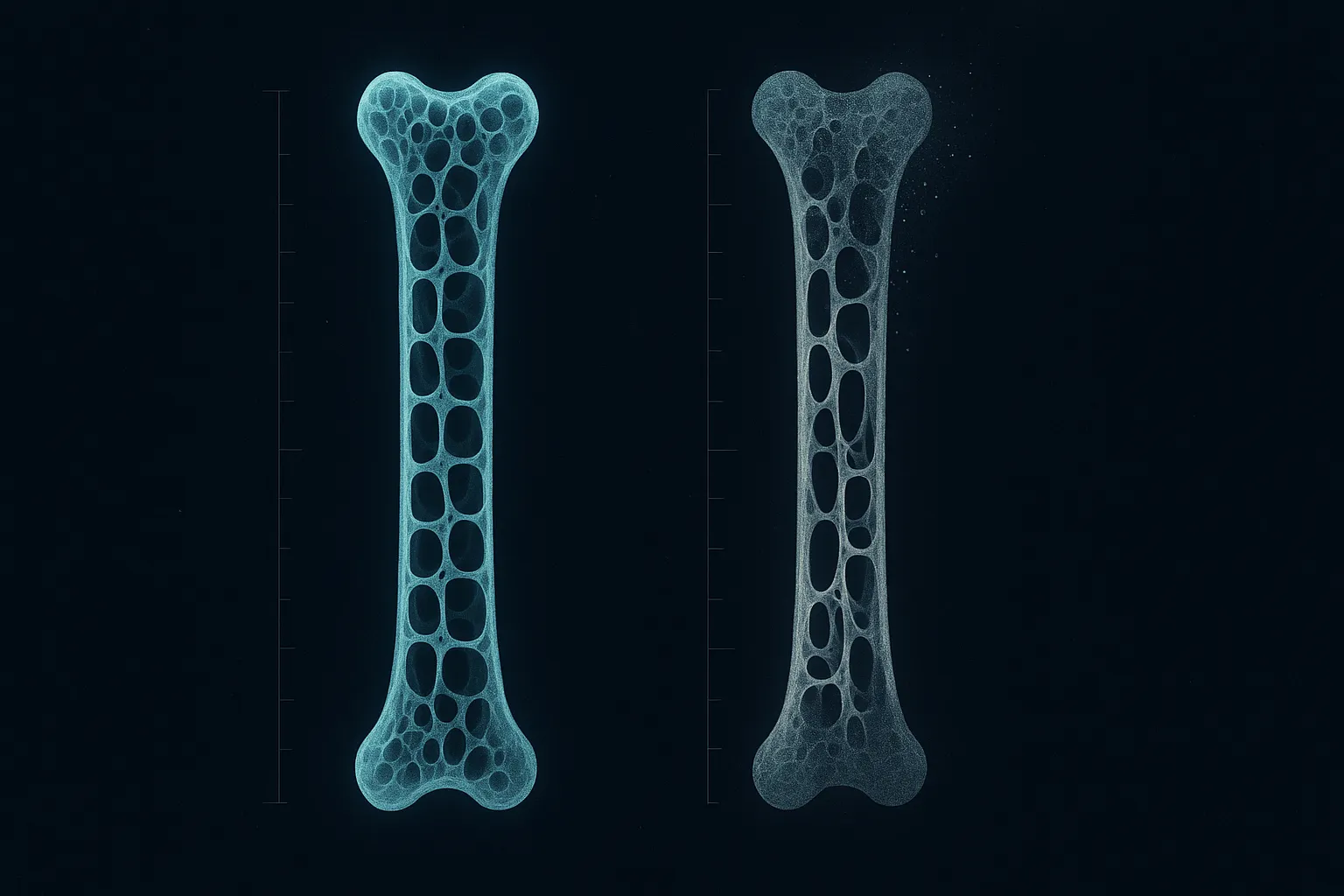
Two luminous bone-lattice columns side by side, the left dense and teal, the right pale silver-blue and visibly thinner and more porous in its upper two thirds

Why density falls: loading, lean mass, and turnover

The cleanest interventional evidence is a randomised, double-blinded, placebo-controlled phase 2 trial run across two Danish hospitals in 64 adults selected for increased fracture risk — a T-score below −1.0 at the total hip or lumbar spine, or a low-energy fracture within three years. Participants received once-weekly semaglutide 1.0 mg or placebo for 52 weeks (PMID 38737002).

At 52 weeks the semaglutide group had lower areal bone mineral density at both measured sites: an estimated treatment difference of −0.018 g/cm² at the lumbar spine (95% CI −0.031 to −0.005, p = 0.007) and −0.020 g/cm² at the total hip (95% CI −0.032 to −0.008, p = 0.001) — approximately 2.1% and 2.6% respectively. The turnover markers point at the mechanism: P1NP, a bone formation marker, showed no between-group difference, while CTX, a bone resorption marker, was higher on semaglutide. Formation held steady; breakdown accelerated.

Three mechanistic threads run through the literature, and none of them requires the drug to be directly toxic to bone:

  • Mechanical unloading. Bone remodels to the load placed on it. Removing 15–25% of body mass removes a proportional share of the daily compressive load, and the skeleton adapts downward.
  • Lean mass goes with it. A network meta-analysis of 22 randomised trials and 2,258 participants reported GLP-1 receptor agonists reducing total body weight by 3.55 kg, fat mass by 2.95 kg and lean mass by 0.86 kg — with lean mass accounting for roughly 25% of the total loss (PMID 39719170). A 2026 meta-analysis in the International Journal of Obesity covering 7 studies and 821 patients reported absolute lean mass down 1.74 kg even as lean mass as a proportion of body weight rose 1.81%. Muscle pulling on bone is a primary osteogenic stimulus; less muscle means less of it.
  • Intake falls with appetite. Substantially reduced food intake reduces calcium, vitamin D and protein intake at exactly the point the skeleton is remodelling fastest. This is the thread that also makes the osteomalacia number plausible rather than anomalous.

Every one of those mechanisms is shared with any rapid weight loss — bariatric surgery cohorts show the same directional pattern. What is specific to the current moment is the number of people losing that much mass that fast, without a surgical team monitoring their bone biochemistry on the way down.

What it changes for anyone running a GLP-1 protocol

Nothing here changes availability, legality or pricing for any compound. What it changes is what belongs on the monitoring list next to the usual metabolic panel.

The interventions with the most documentation behind them in this literature are unglamorous and non-pharmacological: progressive resistance training, adequate protein, and repletion of vitamin D and calcium. A clinical trial currently recruiting (NCT07554417) is testing precisely that — whether a 12-week structured exercise and individualised nutrition programme reduces muscle and bone loss in adults with obesity on a GLP-1. That trial has not reported.

For the compound side, our ranked breakdown of what is actually documented for protecting lean mass on a GLP-1 is in Preserve Muscle on Semaglutide & Tirzepatide, and the growth-axis evidence specific to bone turnover is below. Current per-vendor $/mg and COA coverage for the compounds named here are on Best Semaglutide Vendors, Best Tirzepatide Vendors and Best MK-677 Vendors, with active codes on the deals page.

What the growth-axis compounds show for bone specifically

The GH/IGF-1 axis is the one place in the research-peptide catalogue where bone endpoints — not muscle endpoints borrowed and extrapolated — have actually been measured. The results are more modest than the marketing around these compounds suggests.

MK-677 (ibutamoren) has the most direct data. Murphy and the MK-677 Study Group pooled 187 adults aged 65 and over across three randomised, double-blind, placebo-controlled studies lasting 2–9 weeks. Serum IGF-1 rose 55–94%. At 9 weeks, mean serum osteocalcin rose 29.4% and bone-specific alkaline phosphatase 10.4% versus placebo (both p < 0.001), with urinary NTX excretion up 22.6% (p < 0.05) — formation and resorption markers both up, i.e. accelerated remodelling rather than one-directional gain (PMID 10404019). The two-year trial in healthy older adults by Nass and colleagues reported an increase in fat-free mass but did not establish a bone mineral density benefit (PMID 18981485). The honest summary is that MK-677 measurably activates bone turnover; it has not been shown to raise bone mineral density on its own.

Recombinant growth hormone in adults with documented growth hormone deficiency does have a BMD meta-analysis behind it — Barake and colleagues reported increases in bone mineral density and bone mineral content with rhGH replacement (PMID 24423364) — with the structural caveat that significant density gains in this literature generally did not appear until 12–24 months of treatment. That is a replacement-in-deficiency finding in a diagnosed population, not a read-across to a GH secretagogue used by someone with normal GH output.

The GHRH and GHRP analogs people commonly stack — tesamorelin, ipamorelin, sermorelin — raise IGF-1 through the same axis, but their published endpoints are visceral fat, body composition and IGF-1 concentration. Bone mineral density has not been a primary endpoint in the trials that exist for them. Anyone describing them as bone-density agents is extrapolating, and the extrapolation runs through a mechanism that MK-677's own bone data shows is bidirectional.

What people track

The markers that recur across both the clinical literature and community protocol threads are narrow and cheap. DEXA at the total hip and lumbar spine is the density measurement the trials above used, typically at 12-month intervals since the reported changes are in the low single-digit percentages and sit close to scanner precision error over shorter windows.

Between scans, the biochemistry is what moves. P1NP tracks bone formation and CTX tracks resorption — the pair that separated in the semaglutide trial. 25-hydroxyvitamin D, serum calcium and PTH cover the nutritional and regulatory side that the osteomalacia signal implicates. IGF-1 is the axis marker for anyone also running a growth-axis compound; our per-compound panels are in Semaglutide Bloodwork & Biomarkers and Tirzepatide Bloodwork & Biomarkers.

A luminous bone-lattice beam running horizontally, reinforced from beneath by glowing warm-gold support struts, holding firm under soft blue light falling from above

What the data does not show

Four limits, because the headline number travels further than the evidence under it.

  • Density is not fracture. The interventional trials measured areal bone mineral density and bone turnover markers. None were powered for clinical fractures. Several large cohort and network meta-analytic datasets have reported neutral or lower fracture rates among GLP-1 users versus other diabetes treatments, which is the endpoint that actually matters and currently disagrees with the density trend.
  • The interventional trial is small and enriched. Sixty-four participants, two centres, and deliberately selected for existing fracture risk. That design maximises the chance of detecting a signal; it does not tell you the magnitude in a healthy 35-year-old.
  • Retrospective cohorts inherit their confounders. The AAOS five-year dataset is matched, not randomised. Diagnostic intensity, baseline nutrition, activity level and the reason for the prescription are not fully controlled by matching on diagnosis codes.
  • Almost none of it studied the doses people actually run. The semaglutide trial used 1.0 mg weekly. Community protocols on grey-market material frequently run considerably higher, on compounds like retatrutide that have no bone endpoint data of any kind. The extrapolation from a 1.0 mg diabetes-range dose to a high-dose triple agonist is not supported by anything published.

Supplies still work the same way

None of this changes bench procedure. Reconstitution protocols for lyophilized research peptides call for bacteriostatic water as the diluent across every compound named above — the step research sources note is routinely the first thing done wrong.

30ml bacteriostatic water vial — 0.9% benzyl alcohol multi-dose
Bac Water Made for Peptides50% off
Don't risk a $300 peptide on generic bac water.
Most cloudy reconstitutions trace back to one thing — and it isn't the peptide. Sterile, non-pyrogenic, 0.9% benzyl alcohol — formulated for peptide reconstitution, not repackaged from generic stock.
0.9% benzyl alcohol Made for peptides 30 mL multi-dose
See why our bac water doesn't ruin peptides
Ships fast · 50% off with code thepeptidecatalog

Frequently Asked Questions

Do GLP-1 drugs cause bone loss?
The published data is split rather than uniform. A 52-week randomised trial in 64 adults at increased fracture risk reported lower lumbar spine and total hip bone mineral density on semaglutide 1.0 mg versus placebo — roughly 2.1% and 2.6% respectively (PMID 38737002). A five-year retrospective cohort of 73,483 matched patients presented at the 2026 AAOS Annual Meeting reported osteoporosis in 4.1% of GLP-1 users versus 3.2% of controls. But a real-world cohort in type 2 diabetes reported the opposite direction, a hazard ratio of 0.69 for osteoporosis in GLP-1 users (PMID 40469447). Which way the number points appears to depend heavily on the population studied.
Is the bone loss caused by the drug or by the weight loss?
The mechanism most consistently proposed in the literature is weight loss itself rather than a direct toxic effect on bone. Rapid loss of body mass reduces mechanical loading on the skeleton, and roughly a quarter of the weight lost on GLP-1 receptor agonists is lean rather than fat tissue according to a network meta-analysis of 22 randomised trials (PMID 39719170). Analyses that separate patients by diabetes status and by amount of weight lost tend to find the bone signal tracks the weight change, not the prescription.
Who appears to be most affected?
Reported risk concentrates in adults without type 2 diabetes, in peri- and postmenopausal women, in adults over 50, and in anyone with a prior low-trauma fracture. An Epic Research analysis of roughly 2 million patients with type 2 diabetes and 380,438 without reported an 8.7% lower osteoporosis risk among stable-weight GLP-1 users with diabetes and a 22% higher risk among stable-weight users without diabetes.
Do fracture rates actually go up?
Not consistently in the published record. The bone mineral density trials were not powered for fracture outcomes, and several large cohort and meta-analytic datasets have reported neutral or lower fracture rates among GLP-1 users compared with other diabetes treatments. Falling density and rising fractures are separate endpoints and the data on them currently disagrees.
What do people on GLP-1 protocols track for this?
Community and clinical sources most often describe DEXA scans for areal bone mineral density at the hip and lumbar spine, plus serum markers of bone turnover — P1NP for formation and CTX for resorption — alongside 25-hydroxyvitamin D, calcium and PTH. DEXA is typically repeated at 12-month intervals in the trials that measured it, since the reported changes are in the low single-digit percentages.

References

  • Studies explore: GLP-1 receptor agonist use and its impact on long-term musculoskeletal health. AAOS 2026 Annual Meeting Press Kit, American Academy of Orthopaedic Surgeons. Link — 73,483 matched patients, five-year osteoporosis 4.1% vs 3.2% (RR 1.29), gout 7.4% vs 6.6% (RR 1.12), osteomalacia 2.0% vs 0.1% (RR 2.55); companion arthroplasty outcomes analysis
  • GLP-1 Use Associated with Lower Osteoporosis Risk in Adults with Type 2 Diabetes but Higher Risk in Adults Without Diabetes. Epic Research, March 3, 2026. Link — 2 million patients with type 2 diabetes and 380,438 without; 8.7% lower risk with diabetes at stable weight, 22% higher risk without diabetes at stable weight
  • Once-weekly semaglutide versus placebo in adults with increased fracture risk: a randomised, double-blinded, two-centre, phase 2 trial. eClinicalMedicine, 2024. PMID 38737002 — 64 participants, 52 weeks; lumbar spine ETD −0.018 g/cm², total hip ETD −0.020 g/cm²; CTX higher, P1NP unchanged
  • Chen M, Lyu Y, Zhao J, et al. Use of GLP-1 receptor agonist and risk of osteoporosis among patients with type 2 diabetes: a real-world study. Frontiers in Endocrinology, 2025. PMID 40469447 — retrospective EMR cohort 2012–2023; fully adjusted HR 0.69 (95% CI 0.45–0.84)
  • Effect of glucagon-like peptide-1 receptor agonists and co-agonists on body composition: systematic review and network meta-analysis. Metabolism, 2025. PMID 39719170 — 22 RCTs, 2,258 participants; −3.55 kg total weight, −2.95 kg fat mass, −0.86 kg lean mass
  • Effect of GLP-1 receptor agonists at doses for obesity management on muscle health: systematic review and meta-analysis of randomized controlled trials. International Journal of Obesity, 2026. Link — 7 studies, 821 patients; lean mass proportion +1.81%, absolute lean mass −1.74 kg
  • Murphy MG, Bach MA, Plotkin D, et al. Oral administration of the growth hormone secretagogue MK-677 increases markers of bone turnover in healthy and functionally impaired elderly adults. Journal of Bone and Mineral Research, 1999;14(7):1182–1188. PMID 10404019 — 187 adults 65+; osteocalcin +29.4%, BSAP +10.4%, urinary NTX +22.6%, IGF-1 +55–94%
  • Nass R, Pezzoli SS, Oliveri MC, et al. Effects of an oral ghrelin mimetic on body composition and clinical outcomes in healthy older adults: a randomized trial. Annals of Internal Medicine, 2008;149(9):601–611. PMID 18981485 — two-year MK-677 trial; fat-free mass increase without established BMD benefit
  • Barake M, Klibanski A, Tritos NA. Effects of recombinant human growth hormone therapy on bone mineral density in adults with growth hormone deficiency: a meta-analysis. Journal of Clinical Endocrinology & Metabolism, 2014;99(3):852–860. PMID 24423364 — rhGH replacement associated with increased bone mineral density and bone mineral content in GH-deficient adults
  • Combatting Muscle Loss in Obese Adult Patients on GLP-1 Medications Through Dietary Counseling and Exercise During Treatment. ClinicalTrials.gov NCT07554417. Link — 12-week exercise and individualised nutrition programme testing reduction of muscle and bone loss on GLP-1