articlesMay 13, 2026·7 min read

GLP-1s Cause Sarcopenia in Seniors: 2026 Trial Data

A 24-month semaglutide cohort in adults 65+ shows accelerated muscle loss + falling gait speed. What it means for older GLP-1 buyers.

Glowing emerald GLP-1 injection vial with faded older human silhouette and muscle-mass trajectory curves on dark navy background

A 24-month retrospective cohort published in Drug Design, Development and Therapy (PMID 40631351) followed 220 older adults with type 2 diabetes on semaglutide and a matched control group. The headline: semaglutide cut weight, but grip strength declined and gait speed fell significantly in both sexes. A second study published in early 2026, SEMALEAN, told a more optimistic story in younger obesity patients. The contrast matters for anyone over 60 currently on a GLP-1 or considering one.

Research-context information only. Peptides and pharmaceuticals discussed below are research compounds or prescription drugs. Protocols, doses, and reactions reported come from published research and self-reported community sources. This article reports what has been documented, not what should be done. Consult a licensed physician for personal medical decisions.

This is the most concrete read yet on a question that has been hanging over the GLP-1 boom for two years: are these drugs safe for the older patients who, demographically, need them most?

What the New Data Actually Says

Two trials, two populations, two different stories.

The 24-month sarcopenia cohort (Drug Design Development and Therapy, 2025; PMID 40631351) was a retrospective design. 220 adults with type 2 diabetes treated with semaglutide, 212 matched controls, followed 24 months. Mean age skewed older. Sarcopenia prevalence at baseline was 27.7% — already at the high end of population norms before the drug.

Headline findings:

  • BMI and muscle mass both fell significantly on semaglutide vs controls
  • Grip strength initially improved in men, then declined
  • Grip strength fell continuously in women across the full 24 months
  • Gait speed dropped significantly in both sexes
  • Independent predictors of muscle loss: semaglutide dose, baseline ASMI, baseline gait speed
  • Effect was most severe in patients already meeting sarcopenia criteria at baseline

SEMALEAN (Diabetes, Obesity and Metabolism, 2026; PMID 41068996) was prospective, longitudinal, single-center. 115 obesity patients on semaglutide 2.4 mg for 12 months. DXA, handgrip, and resting energy expenditure measured at baseline, month 7, month 12.

Headline findings:

  • 13% weight loss at month 12
  • 18% fat-mass loss
  • Lean mass dropped 3 kg at month 7, then stabilized
  • Grip strength rose +4.5 kg at month 12
  • Sarcopenic-obesity prevalence fell from 49% at baseline to 33% at month 12

The two studies are not contradictory. They enrolled different patients. SEMALEAN's population was younger, broader-BMI, and not selected for diabetes. The sarcopenia cohort was older, diabetic, and started closer to the functional cliff.

The clinical translation: GLP-1 weight loss in younger adults with abundant reserve is mostly fat. In older adults with limited reserve, especially diabetics, it is meaningfully lean mass — and the functional consequences (gait speed, grip strength) show up faster than people expect.

Comparison of weekly versus monthly GLP-1 dosing vials with divergent fat-loss and grip-strength trajectory lines on dark navy

Why Older Adults Are Different

The standard "30 to 40 percent of weight loss is lean mass" stat from STEP and SURMOUNT body-composition substudies was generated in mostly middle-aged patients. The math is the same in older adults — but the starting point is not.

Natural aging strips 12 to 16% of skeletal muscle by 65. Roughly half of adults over 80 already meet sarcopenia criteria. The grip-strength and gait-speed thresholds for sarcopenia (less than 27 kg grip in men, less than 16 kg in women; gait speed below 1.0 m/s) are real clinical predictors of falls, fractures, hospitalizations, and mortality.

A 72-year-old with sarcopenic obesity at baseline, on semaglutide 2.4 mg, can lose 3 kg of lean mass on the way to a 15 kg total weight loss and cross from "compensated" to "sarcopenic with functional decline" inside 12 months. That is what the 24-month cohort captured.

The mechanism is not mysterious. GLP-1s drive caloric restriction; protein turnover requires both adequate intake and a mechanical stimulus. Older adults eat less, train less, and recover slower. Drop their calories by 500 a day and remove the resistance-training stimulus, and lean mass goes.

What Buyers Over 50 Should Do Now

The practical implications, in order of leverage:

1. Get a baseline if you're over 50 and starting a GLP-1. DXA scan if affordable. Grip strength and gait speed if not. Both are cheap and reproducible. You need to know where you are before you can monitor decline.

2. Resistance training 2 to 3 days per week, non-negotiable. This is the highest-leverage intervention. The protein-synthesis stimulus from resistance training partially blocks the lean-mass loss GLP-1s cause via caloric restriction. Walking is not enough.

3. Protein target: 1.2 to 1.6 g per kg body weight per day. For a 75 kg adult that is 90 to 120 g per day. GLP-1s suppress appetite, which makes hitting protein targets hard. Whey, casein, or protein-fortified meals are easier than chicken breast when you're not hungry.

4. Consider a muscle-preserving peptide stack. The most-used categories in community protocols are:

  • Tesamorelin + Ipamorelin — restores GH/IGF-1 axis that declines with age. Most-discussed pairing for "GLP-1 plus muscle preservation."
  • Cagrilintide — amylin analogue that suppresses appetite via a non-GLP-1 mechanism. Used in CagriSema (with semaglutide) and shows better lean-mass preservation in head-to-head body-composition data than GLP-1 monotherapy.
  • MK-677 (ibutamoren) — oral GH secretagogue. Cheap, easy, but elevates IGF-1 long-term and may worsen insulin resistance. Less appropriate for diabetic patients.

5. Monitor function quarterly. If gait speed falls below 1.0 m/s or grip strength drops more than 5 kg from baseline, that warrants a prescriber conversation. Options at that point include dose reduction, adding a muscle-preserving peptide stack, or switching to a GLP-1 with a lower lean-mass-loss signal (cagrilintide-containing combos like CagriSema appear better than monotherapy).

For vendors with the relevant compounds:

How This Compares to Tirzepatide and Cagrilintide

Most of the muscle-loss data is on semaglutide because that's what's been on the market longest. The relevant question for new buyers is whether other GLP-1-class drugs have a better lean-mass signal.

Tirzepatide (GLP-1/GIP dual agonist): SURMOUNT body-composition substudies suggest tirzepatide produces slightly better lean-mass preservation than semaglutide at matched weight loss, but the absolute lean-mass loss is still substantial. The GIP arm appears mildly protective. No dedicated older-adult sarcopenia cohort has been published.

Cagrilintide (amylin): Cagrilintide monotherapy and the cagrilintide-semaglutide combo CagriSema both show lower lean-mass loss per kilogram of weight loss than pure GLP-1 drugs. Amylin acts via different brain circuits and does not produce the same protein-catabolic profile. REDEFINE-1 body-composition data is the strongest case for amylin-containing regimens in older or sarcopenic patients.

Retatrutide (GLP-1/GIP/glucagon triple agonist): Higher weight-loss efficacy (28.7% in TRIUMPH-4 at 12 mg) means more absolute weight to come off — and probably proportionally more lean mass. No older-adult sarcopenia data exists yet. The glucagon arm has metabolic effects that may partially counter muscle loss but the evidence is preclinical.

For most older adults already on a GLP-1, switching drugs is a bigger conversation than adding resistance training and protein. The lowest-friction intervention is mechanical and dietary, not pharmacological.

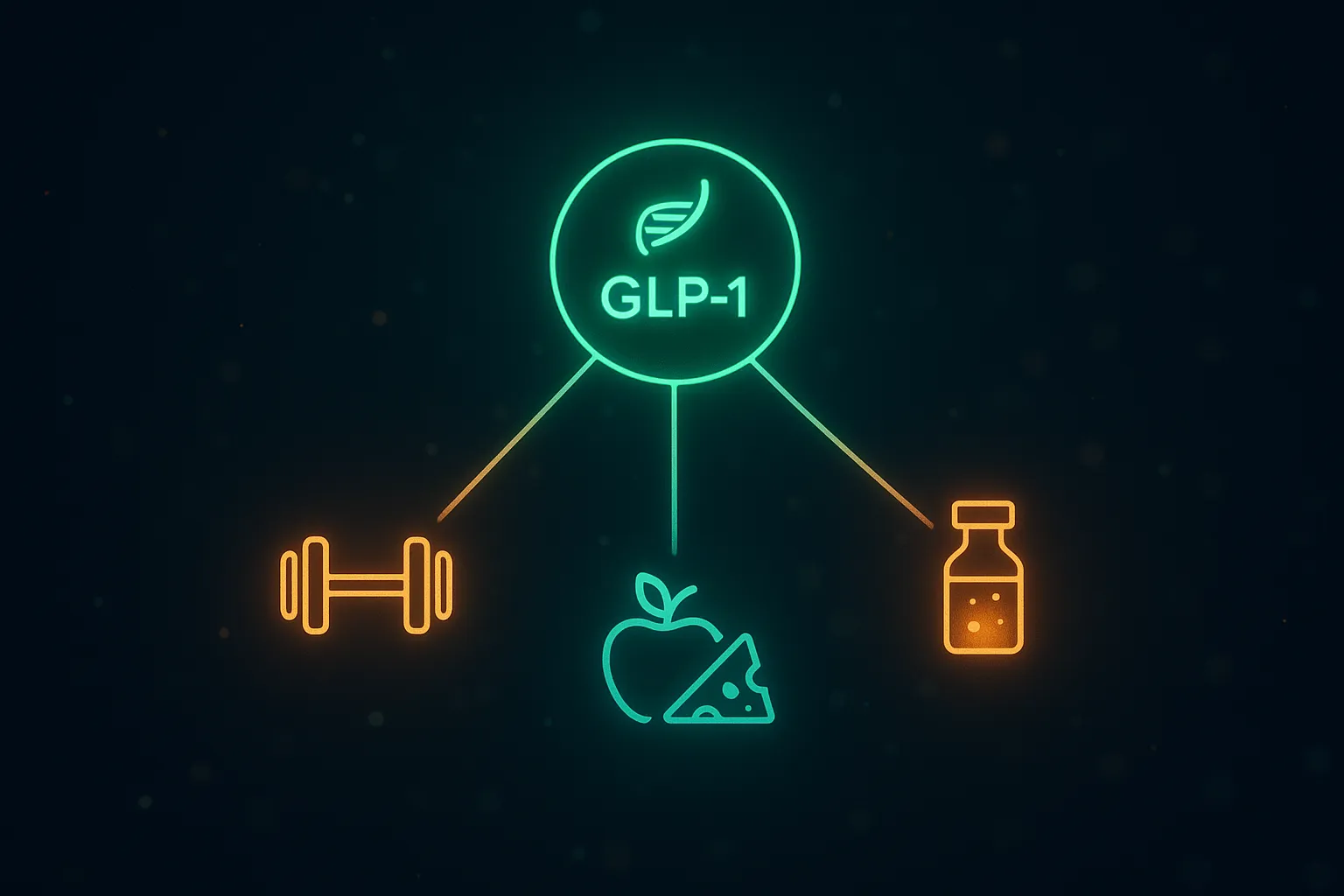
Branching peptide-stack pathways from a central GLP-1 node leading to dumbbell, protein, and adjunct peptide nodes on dark navy

What the Data Doesn't Cover

This cohort study is retrospective and limited to diabetics. The lean-mass-loss signal is real but the magnitude is harder to nail down because:

  • No randomized comparison to caloric restriction without GLP-1 in the same older population
  • 24 months is short for a sarcopenia-trajectory question; falls and fractures take 5+ years to accumulate as endpoints
  • Resistance-training and protein-intake confounders were not controlled in the cohort
  • No body-composition (DXA) substudy in the original cohort — muscle mass was inferred from bioimpedance, which is noisier in older adults with shifting fluid balance
  • The control group was matched on BMI and HbA1c but not on baseline ASMI

The SEMALEAN data is also limited: single center, no diabetic stratification, 12 months, no randomization. Both studies point at the same shape — GLP-1s preserve function in younger, healthier patients and erode it in older, frailer ones — but neither is a definitive Phase 3 endpoint.

The data we actually need is a prospective RCT in adults 65+ comparing semaglutide, semaglutide plus resistance training, semaglutide plus cagrilintide, and placebo, with DXA and functional endpoints at 36 months. That trial is not running.

Frequently Asked Questions

What did the 24-month sarcopenia cohort study actually show?
Published in Drug Design, Development and Therapy in July 2025 (PMID 40631351), the retrospective cohort followed 220 older adults with type 2 diabetes on semaglutide and 212 matched controls for 24 months. Sarcopenia prevalence at baseline was 27.7%. Semaglutide significantly reduced both BMI and muscle mass versus controls. Grip strength initially improved in men, then declined; in women it fell throughout. Gait speed dropped significantly in both sexes. Semaglutide dose, baseline appendicular skeletal muscle index (ASMI), and gait speed independently predicted muscle loss.
Doesn't the SEMALEAN study show GLP-1s preserve muscle?
SEMALEAN (Diabetes Obesity and Metabolism, 2026) followed 115 obesity patients on semaglutide 2.4 mg for 12 months. It reported 13% weight loss, 18% fat-mass loss, an initial 3 kg lean-mass drop that stabilized, +4.5 kg grip strength at month 12, and sarcopenic-obesity prevalence falling from 49% to 33%. The discrepancy is age and indication. SEMALEAN enrolled a broader-age obesity population. The 24-month sarcopenia study enrolled type 2 diabetics with a mean age in the 70s. Older adults start with less reserve, and the data shows function falls even when grip strength briefly rises early on.
Why are older adults specifically at higher risk?
Natural aging strips 12 to 16% of skeletal muscle by age 65, and up to half of adults over 80 already meet sarcopenia criteria. Up to 40% of weight lost on high-dose GLP-1s is lean mass. For a 30-year-old with abundant reserve, losing 3 kg of lean mass on the way to a 20 kg fat-mass loss is cosmetic. For a 72-year-old with sarcopenic obesity at baseline, the same 3 kg can drop them below the gait-speed and grip-strength thresholds linked to falls, fractures, and disability.
Which peptides actually preserve muscle on GLP-1s?
Three currently available peptide categories are most often used to protect lean mass during GLP-1 weight loss. Tesamorelin plus ipamorelin restores GH and IGF-1 signaling that declines with age. Cagrilintide, an amylin analogue, slows gastric emptying and lowers appetite without GLP-1's muscle-catabolic profile and is the most-studied combination partner. MK-677 (ibutamoren) elevates GH/IGF-1 orally. None of these are FDA approved for muscle preservation on GLP-1s; all are used off-label or through research-peptide channels. See our preserve-muscle-on-GLP-1s guide for the full ranking.
Should an older adult on semaglutide stop the drug?
Not based on this one study. The 24-month cohort is observational, retrospective, and limited to diabetics. But the signal is clinically meaningful enough that an older adult on semaglutide or tirzepatide should add resistance training 2 to 3 days per week, target 1.2 to 1.6 g protein per kg body weight per day, and consider baseline DXA plus grip-strength and gait-speed testing. If gait speed drops below 1.0 m/s or grip strength falls more than 5 kg from baseline, that warrants a prescriber conversation about dose reduction or an adjunctive muscle-preserving stack.
30ml bacteriostatic water vial — 0.9% benzyl alcohol multi-dose
Bac Water Made for Peptides
Don't risk a $300 peptide on generic bac water.
Most cloudy reconstitutions trace back to one thing — and it isn't the peptide. Sterile, non-pyrogenic, 0.9% benzyl alcohol — formulated for peptide reconstitution, not repackaged from generic stock.
0.9% benzyl alcohol Made for peptides 30 mL multi-dose
See why our bac water doesn't ruin peptides
30ml from $18.75 · Ships fast · Code thepeptidecatalog

References

  1. Semaglutide Therapy and Accelerated Sarcopenia in Older Adults with Type 2 Diabetes: A 24-Month Retrospective Cohort Study. Drug Design, Development and Therapy. 2025. PMID 40631351
  2. Impact of Semaglutide on fat mass, lean mass and muscle function in patients with obesity: The SEMALEAN study. Diabetes, Obesity and Metabolism. 2026. PMID 41068996
  3. Sarcopenia considerations when prescribing glucagon-like peptide-1 agonists to older adults. PMC: PMC13033422
  4. Treating Sarcopenic Obesity in the Era of Incretin Therapies: Perspectives and Challenges. Diabetes (ADA). 2025; 74(12): 2179
  5. Antiobesity Medications for Older Adults — the New, the Good, the Bad, and the Unknown. PMC: PMC12592770